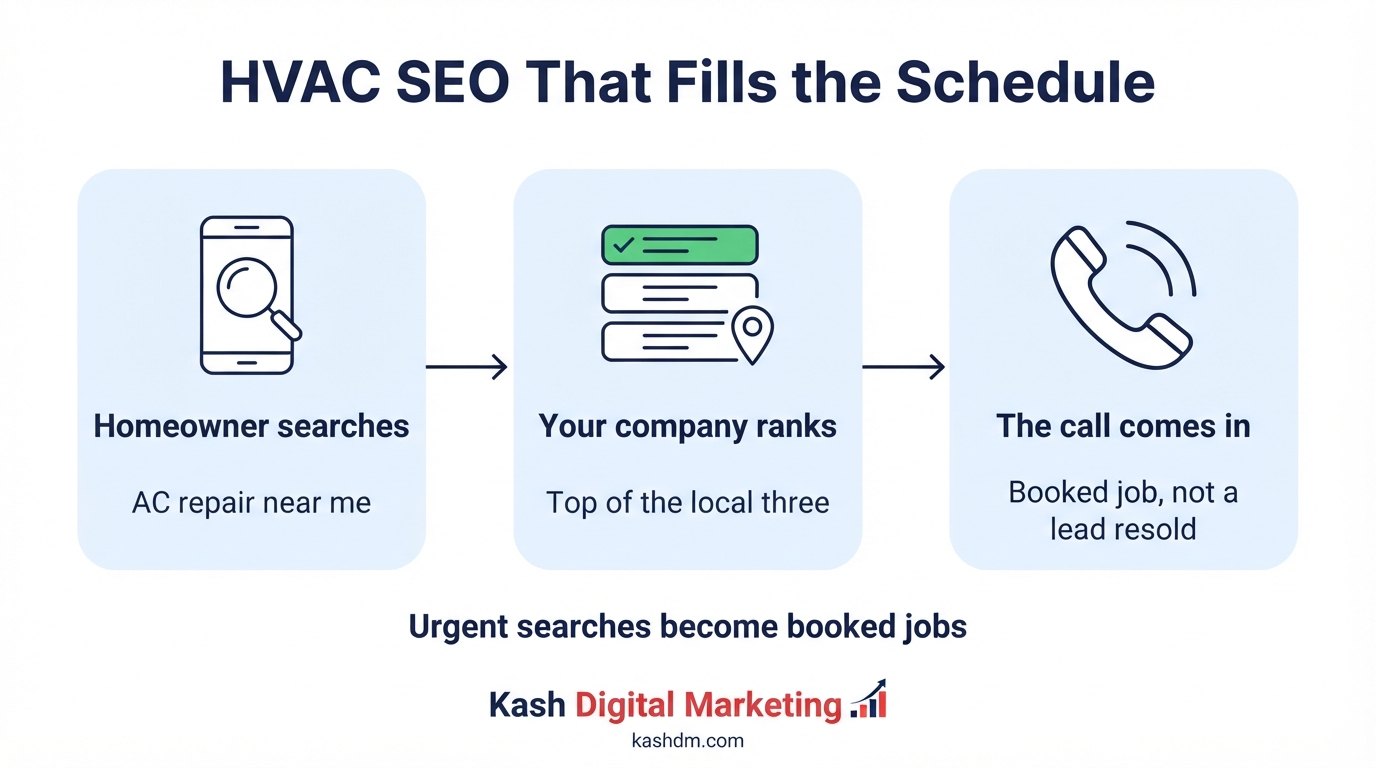
HVAC SEO is the practice of ranking a heating and cooling company at the top of Google search and the local map pack so homeowners with a dead furnace or a failed AC unit call you first instead of a competitor. At Kash Digital Marketing, our HVAC SEO services combine Google Business Profile optimization, local landing pages for every city you cover, service-level content for repair, replacement and maintenance, review generation and technical site work into one system built to turn urgent searches into booked jobs.
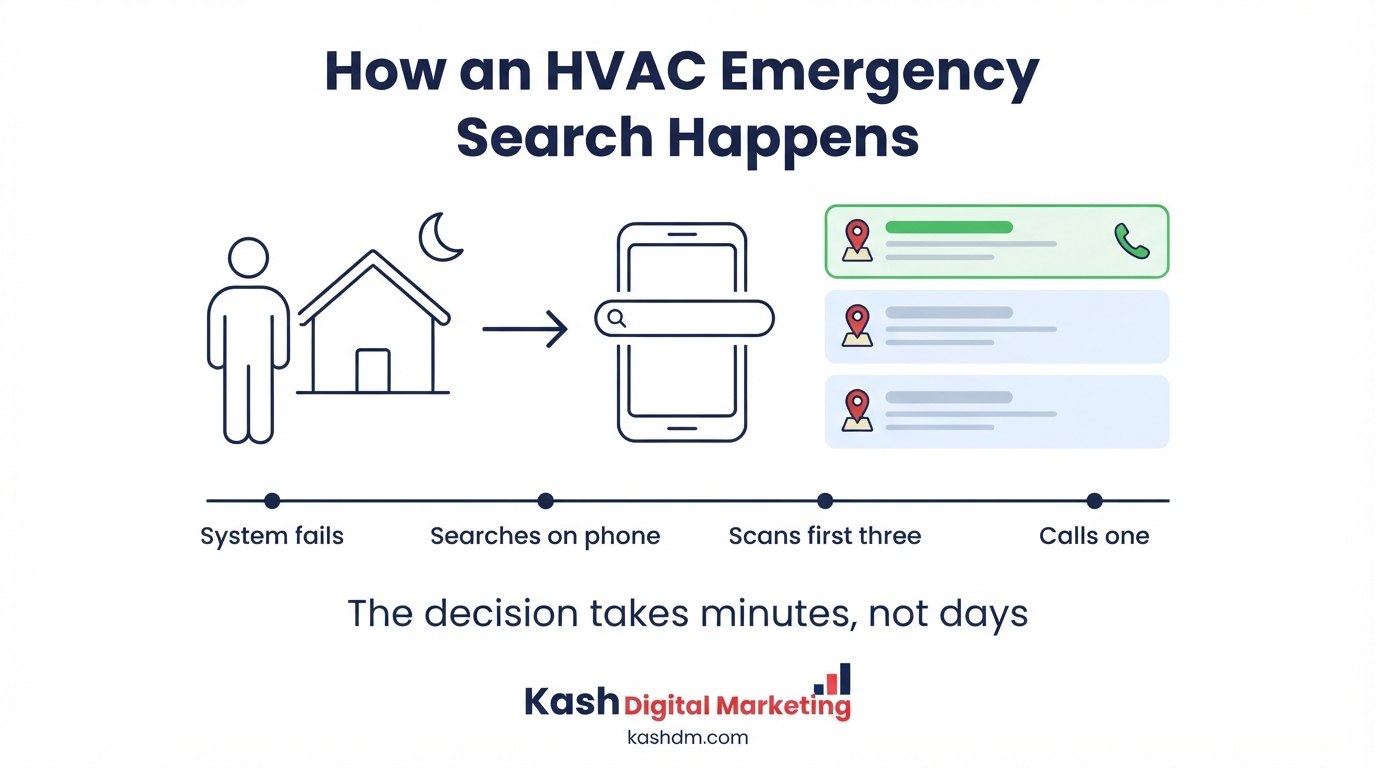
No trade lives or dies by local search quite like HVAC. When a furnace quits at 11pm in January, or an air conditioner fails during the first 95-degree week of July, nobody asks a neighbor for a referral. They pull out a phone, search "AC repair near me," and call one of the first two or three businesses that look credible. If your company is not in that shortlist, the job goes to whoever is, and you never even learn the call happened.
This page is a complete guide to HVAC SEO across the United States, written so you can evaluate any provider, including us, against a real standard. It covers what HVAC SEO actually involves, how local SEO for HVAC contractors differs from general SEO, what the work costs, how long it takes, and the specific mistakes that keep heating and cooling companies stuck on page two while a competitor with a worse truck fleet takes the calls.
What HVAC SEO Is and How It Actually Works
HVAC SEO is the process of optimizing a heating and cooling company's website, Google Business Profile and local signals so the business appears at the top of search results when nearby homeowners look for AC repair, furnace replacement or maintenance. It differs from generic SEO because almost every valuable HVAC search carries local intent and urgency at the same time.
Most people searching for HVAC help are not browsing. They have a problem right now, they are uncomfortable in their own home, and they are going to call somebody within the next few minutes. That compressed decision window is what makes HVAC SEO both harder and more valuable than SEO in most other industries.
What is HVAC SEO in plain terms
HVAC SEO means earning visibility in three places at once: the map pack that appears at the top of local searches, the organic blue links beneath it, and increasingly the AI-generated answer that sits above both. Each of those placements is won differently, and a provider who only works on one of them is leaving most of the opportunity on the table.
How HVAC SEO differs from general small business SEO
General SEO often chases national keywords and informational traffic. HVAC SEO chases a homeowner within a fifteen-mile radius who needs a technician today. The keyword volumes are smaller, the competition is denser, and the conversion rate on a correctly targeted term is dramatically higher. Ranking third for "HVAC repair" in your own metro is worth more than ranking first for a national term no buyer ever searches.
The three placements HVAC SEO has to win
The map pack drives the phone calls, organic results drive the research and comparison traffic, and AI Overviews increasingly decide which companies get mentioned at all when someone asks an assistant who to call. A complete HVAC SEO program treats all three as separate targets with overlapping requirements.
Why HVAC search intent is unusually valuable
An HVAC customer acquired through search is rarely a one-time transaction. A repair customer becomes a maintenance-plan customer, then a replacement customer when the system finally fails. That lifetime value is why competitors bid aggressively on the same terms, and why organic visibility compounds into an advantage paid advertising cannot match.
| Search type | Example query | Intent | What wins it |
|---|---|---|---|
| Emergency | ac repair near me | Call within minutes | Map pack, reviews, proximity |
| Replacement | furnace replacement cost | Research, then quote | Organic content, trust signals |
| Maintenance | hvac tune up service | Scheduled, price-aware | Service page, offers, reviews |
| Commercial | commercial hvac contractor | Long sales cycle | Authority content, case studies |
Why HVAC Contractors Need SEO More Than Almost Any Other Trade
HVAC contractors need SEO because heating and cooling emergencies generate high-intent local searches around the clock, and the businesses that appear first capture the overwhelming majority of those calls. Paid lead platforms resell the same homeowner to several competitors; organic visibility gives you the call exclusively.
Why should HVAC dealers invest in local SEO
Because the map pack is where the calls are. A homeowner searching on a phone sees three local businesses before anything else, and those three absorb most of the clicks and nearly all of the calls. Local SEO for HVAC is the only reliable way into that block of three without paying for every single click.
What happens when your competitor ranks and you do not
Nothing visible happens, and that is the problem. There is no notification when a homeowner three streets away calls another company. Losing on search is silent, which is why so many HVAC owners assume their marketing is fine while a competitor quietly compounds an advantage that gets harder to reverse every quarter.
Seasonality makes HVAC visibility urgent, not optional
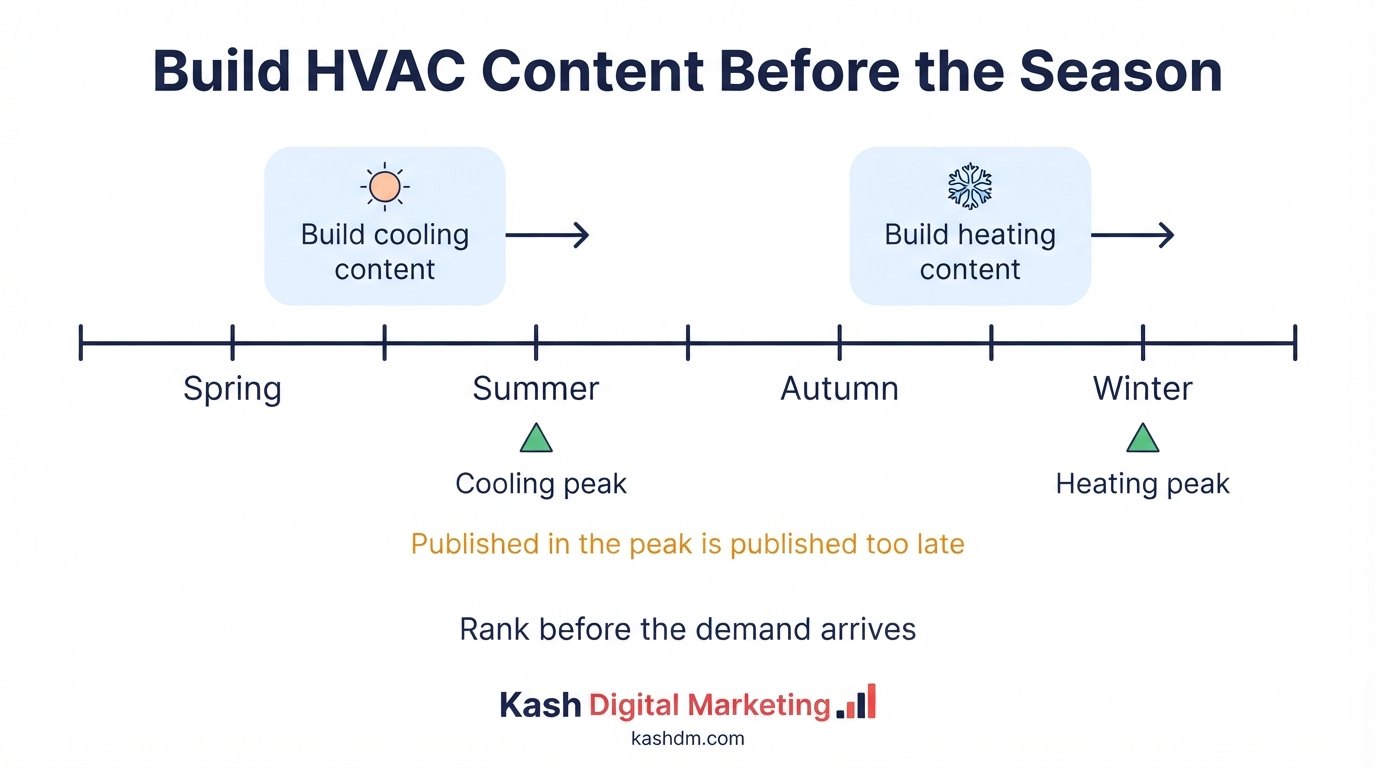
Demand spikes twice a year, and the businesses that rank in June and December are the ones that built visibility in March and September. SEO takes months to mature, so the work has to be done ahead of the season it is meant to serve. Starting during a heat wave is starting too late.
Why buying HVAC leads is not a substitute
Lead platforms sell the same homeowner to three, four or five contractors at once, which means you are paying to enter a price race you did not choose. Organic search delivers a caller who chose you specifically, before anyone quoted a number.
Local SEO for HVAC Contractors and the Map Pack
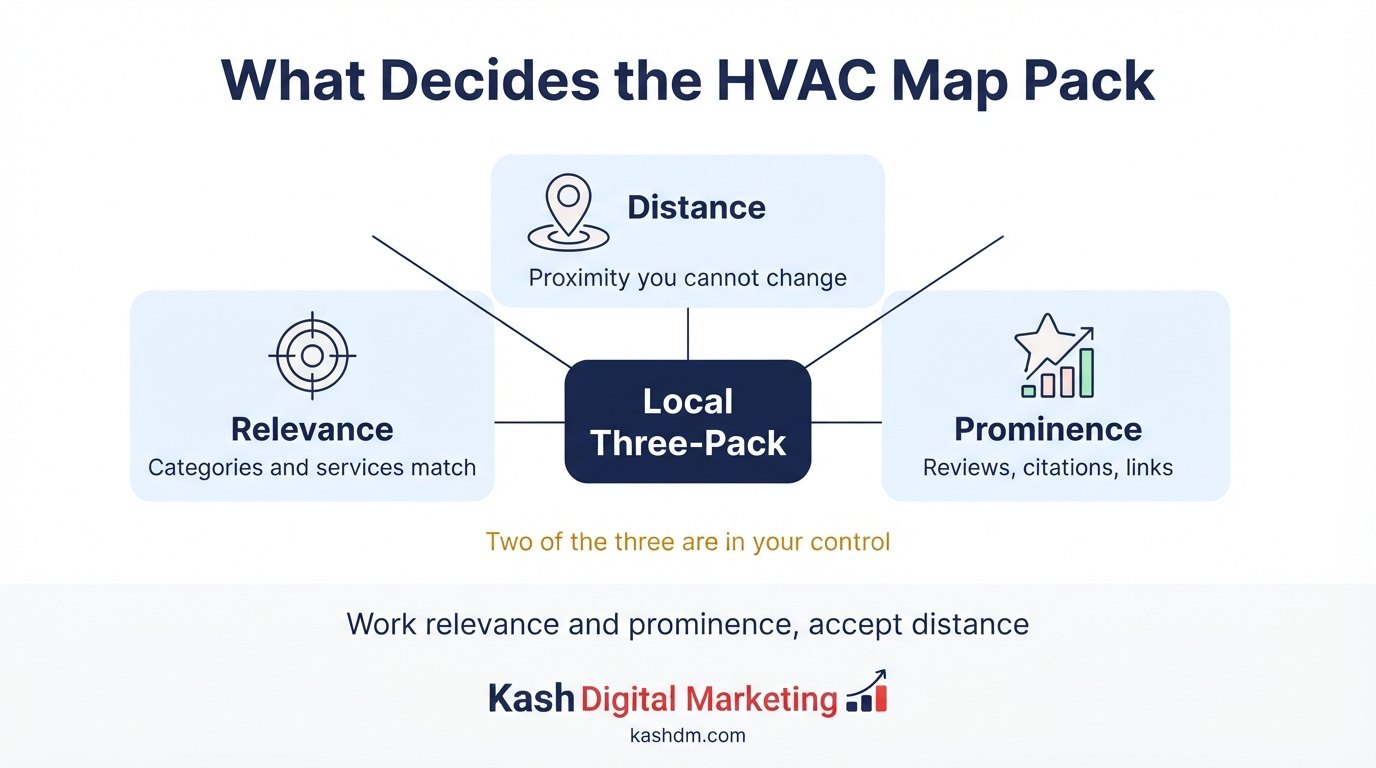
Local SEO for HVAC contractors is the work of ranking your business in the three-result map pack for every city and neighborhood you serve, which is where the majority of HVAC phone calls originate. Google decides those three slots on relevance, distance and prominence, and all three can be influenced.
How local SEO for HVAC companies actually works
Google matches a searcher to nearby businesses whose profiles, websites and citations most clearly say they do this work in this place. Local SEO is the discipline of making those signals unambiguous: consistent business information everywhere, service categories that match what people search, and content proving you genuinely operate in each area you claim.
The three factors that decide map pack rankings
Relevance is how well your profile matches the query. Distance is how close you are to the searcher. Prominence is how well known and well reviewed your business is. Distance is the one you cannot change, which makes relevance and prominence the entire battleground.
Why proximity limits how far HVAC local SEO can reach
A single location will not rank in the map pack forty miles away, no matter how good the SEO is. Expanding real coverage means either physical locations, or ranking organically with genuine city pages for the outer ring while the map pack carries the core service area.
Local SEO for HVAC contractors near me searches
"Near me" is not a keyword you optimize for literally. Google interprets it as the searcher's location, so the work is making your business the obvious nearby answer through profile completeness, category accuracy, review volume and local relevance signals.
HVAC local SEO service for multi-location companies
Multi-location HVAC businesses need a separate, fully built Google Business Profile per location, each with its own landing page, its own reviews and its own local citations. Pointing several profiles at one generic contact page is the single most common way multi-location HVAC companies suppress their own rankings.
| Ranking factor | Can you influence it | How |
|---|---|---|
| Relevance | Yes, heavily | Categories, services, profile content, on-page match |
| Prominence | Yes, over time | Reviews, citations, links, brand searches |
| Distance | No | Additional real locations only |
Google Business Profile Optimization for HVAC Companies
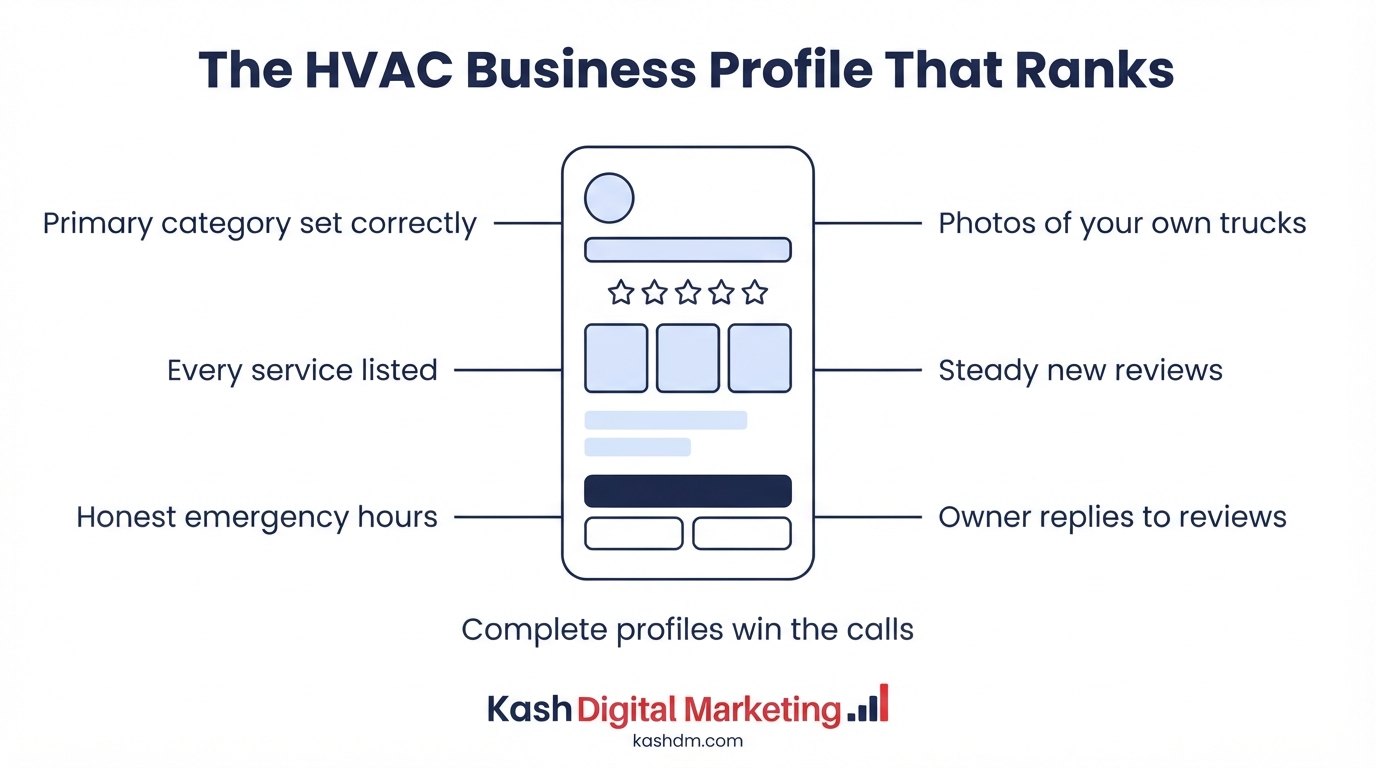
A fully optimized Google Business Profile is the single highest-return asset in HVAC SEO, because it is what appears in the map pack, in Google Maps searches and in the knowledge panel when someone searches your brand. Most HVAC profiles are half-finished, which is exactly why the opportunity is still open.
Choosing the right primary and secondary categories
Primary category carries the most weight. An HVAC contractor should generally use "HVAC contractor" as primary, then add relevant secondaries such as air conditioning repair service, heating contractor and furnace repair service. Categories you do not genuinely serve dilute relevance rather than expanding it.
Google Maps SEO for HVAC businesses
Maps visibility responds to profile completeness, category accuracy, review velocity, photo freshness and the consistency of your name, address and phone number across the web. It also responds to real-world signals: how many people search your brand, request directions and tap to call.
Service areas, service lists and business hours
List every service explicitly, repair, installation, replacement, maintenance, ductwork, indoor air quality, rather than assuming Google infers them. If you offer emergency service, hours should reflect it honestly, because 24-hour listings that do not answer at 2am generate the reviews that undo the ranking.
Photos, posts and profile freshness
Profiles that are updated consistently outperform profiles that are set up once and abandoned. Real photographs of your trucks, technicians and completed installations perform better than stock imagery, and they double as proof for the homeowner deciding between you and the next listing.
The profile mistakes that suppress HVAC rankings
Keyword-stuffed business names, a residential address used without proper service-area configuration, duplicate listings from previous owners, and category choices copied from a competitor in a different specialty are the four errors we find most often on HVAC audits.
HVAC Keyword Research: The Terms That Actually Book Jobs
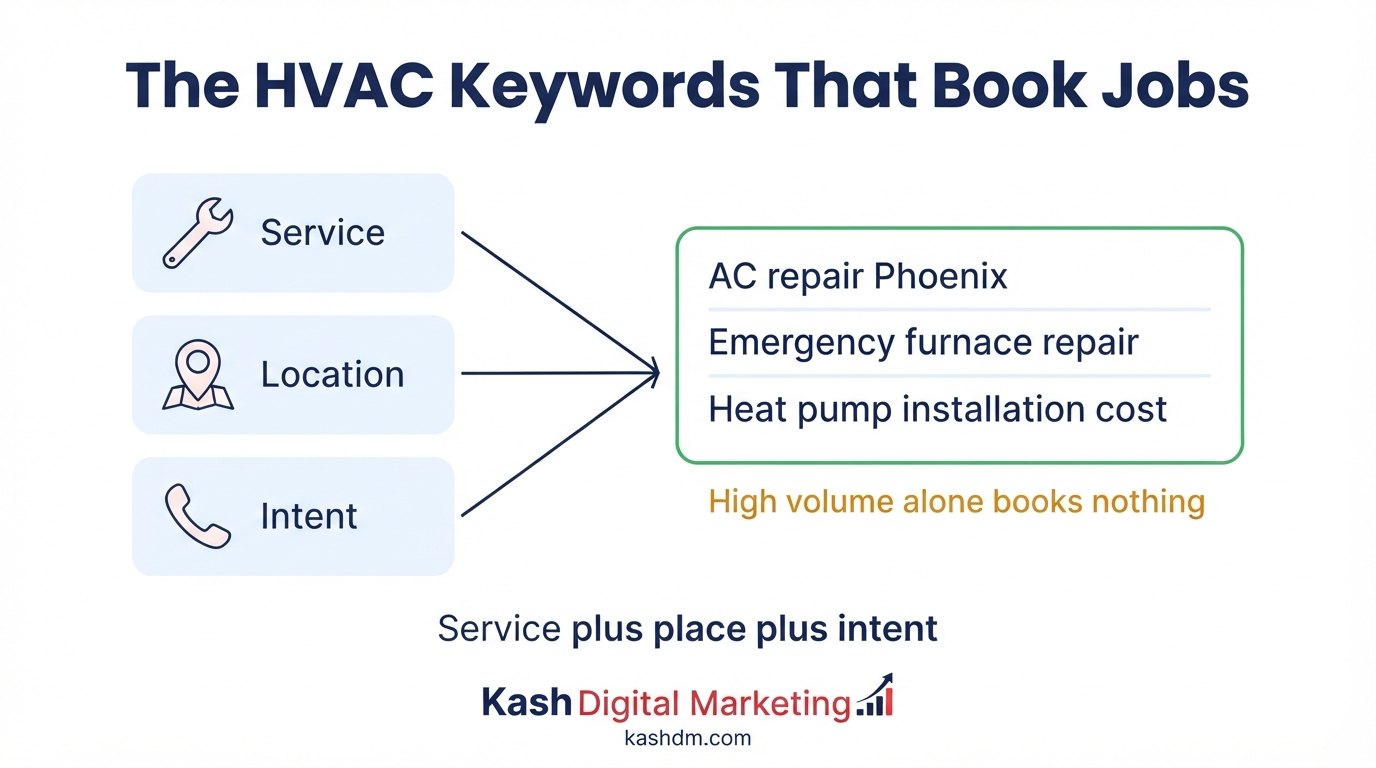
The best SEO keywords for an HVAC company are the ones that combine a service, a location and an intent to hire, not the high-volume generic terms that attract researchers and job seekers. Volume is the least useful number in HVAC keyword research.
Best SEO keywords for HVAC companies
The highest-value HVAC keywords are service-plus-city and service-plus-urgency terms: "AC repair Phoenix," "emergency furnace repair," "heat pump installation cost," "HVAC maintenance plan near me." These have modest search volume and extraordinary conversion rates.
Mapping HVAC keywords to the right page
Each service gets its own page, each city gets its own page, and the two intersect on city-plus-service pages only where you genuinely have coverage and something specific to say. Trying to rank one page for every service in every city is the fastest route to ranking for none of them.
Seasonal HVAC keyword patterns
Cooling terms climb from April, peak in July and collapse by October. Heating terms invert. Maintenance and indoor air quality run flatter year-round. A keyword plan built only on annual averages will always be preparing for the wrong season.
Commercial versus residential HVAC keywords
Commercial HVAC searches are lower volume, longer sales cycle and dramatically higher value. They also require separate pages: a homeowner searching "AC repair" and a facilities manager searching "commercial rooftop unit service" are not the same buyer and should not land on the same page.
Long-tail HVAC keywords worth targeting deliberately
Terms like "why is my AC blowing warm air," "how much does a new furnace cost," and "how often should HVAC be serviced" bring in homeowners earlier in the cycle. They convert less immediately but they build the topical depth that helps the money pages rank.
| Keyword type | Example | Volume | Value per visitor |
|---|---|---|---|
| Emergency service | emergency ac repair near me | Low | Very high |
| Service + city | furnace repair Denver | Low | Very high |
| Cost research | furnace replacement cost | Medium | Medium |
| Informational | why is my ac not cooling | High | Low, but builds authority |
On-Page SEO for HVAC Websites
On-page SEO for HVAC means giving every service and every city its own properly structured page, with titles, headings and content that state plainly what you do and where you do it. Most HVAC sites fail here not through bad writing but through missing pages.
Service pages that rank and convert
Repair, installation, replacement, maintenance, ductwork, heat pumps and indoor air quality each deserve a dedicated page. A single "Our Services" page listing all of them ranks for none of them, because it has no chance to be the most specific answer to any individual query.
Title tags and headings for HVAC pages
Titles should lead with the service and the place, kept under about sixty characters so Google does not truncate them. Headings should mirror the questions a homeowner actually asks, not internal department names.
Writing HVAC content homeowners trust
Specifics build trust: brands you service, typical response times, whether you charge a diagnostic fee, what a maintenance visit includes. Vague reassurance builds nothing. The page that answers the awkward questions is the page that gets the call.
Internal linking across HVAC service and city pages
Service pages should link to the city pages where that service is offered, and city pages back to the services available there. This is what turns a pile of pages into a structure Google can read as genuine coverage of a service area.
Technical SEO for HVAC Sites
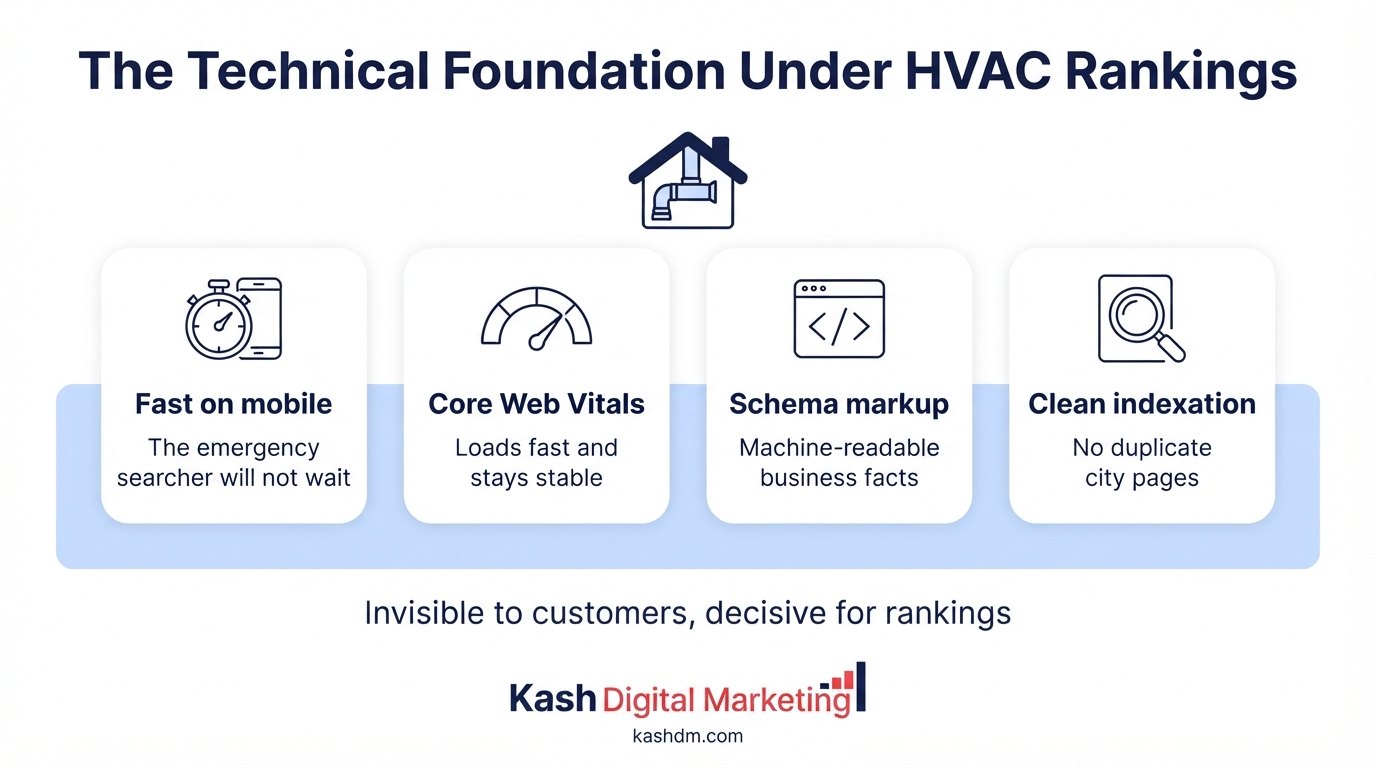
Technical SEO for HVAC is the work of making sure the site loads fast on a phone, can be crawled and indexed cleanly, and carries the structured data that helps Google understand a local service business. It is invisible to customers and decisive for rankings.
Mobile speed decides HVAC conversions
The homeowner searching for emergency AC repair is on a phone, often on mobile data, often frustrated already. A site that takes six seconds to load loses that call to a competitor whose site takes two. Speed is not a technical nicety here; it is the difference between a booked job and a bounce.
Core Web Vitals for contractor websites
Largest Contentful Paint, Interaction to Next Paint and Cumulative Layout Shift measure whether the page feels fast and stable. Oversized hero images and layout that jumps while loading are the two problems we find most often on HVAC sites built from generic contractor templates.
Schema markup for HVAC businesses
LocalBusiness and HVACBusiness schema, service markup, review markup where genuinely earned, and FAQ markup give Google explicit, machine-readable facts about the business. This matters more every year as AI systems assemble answers from structured data rather than reading page copy.
Crawlability, indexation and duplicate city pages
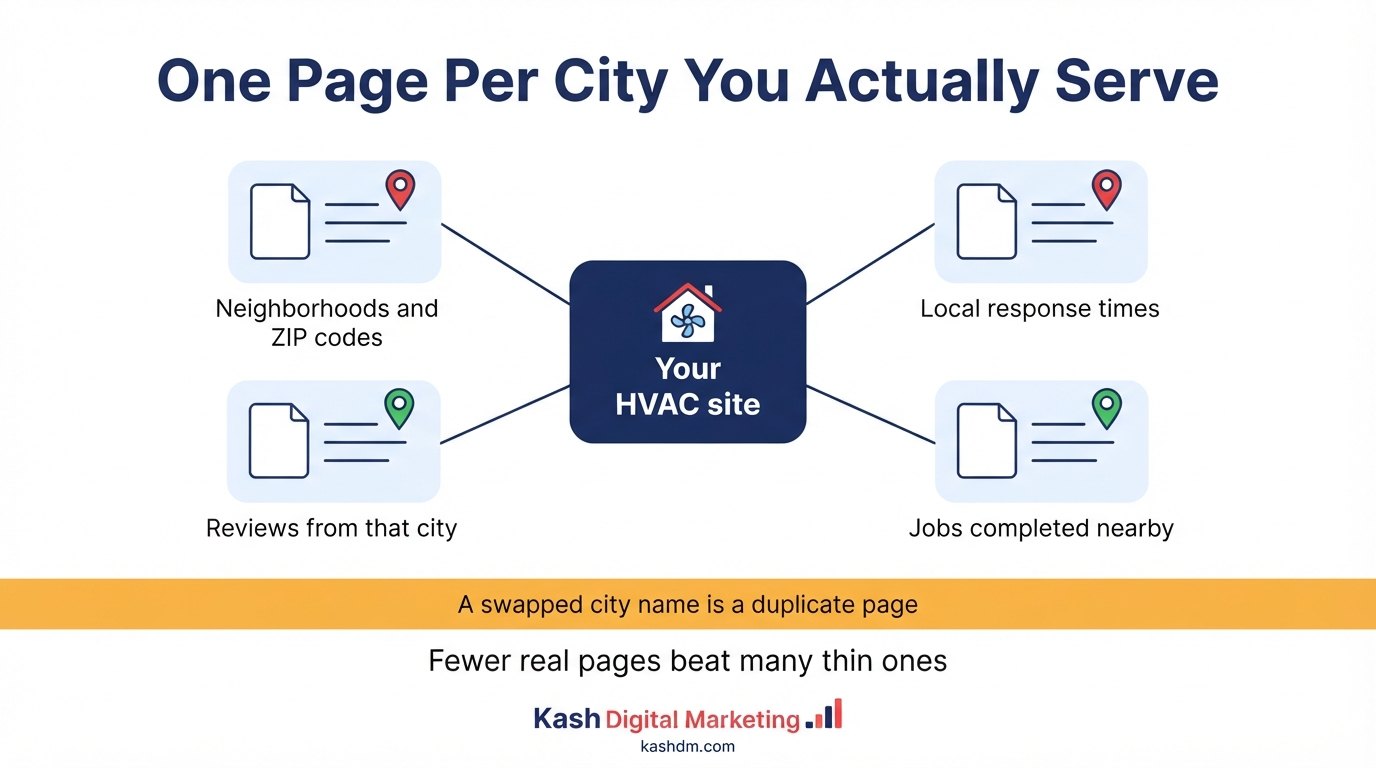
Thin city pages that differ only by a swapped place name get treated as duplicates and quietly dropped. Each location page needs genuinely distinct content, or it drags down the pages around it.
Technical SEO consultant work versus ongoing SEO
A technical audit is a one-time diagnostic. Ongoing SEO is the content, links and profile work that follows. Buying only the audit and never acting on it is the most common way HVAC companies spend money on SEO and see nothing change.
HVAC Website Design That Converts Searchers Into Calls
An HVAC website earns its keep by turning visitors into phone calls, which means the phone number, the service area and the reason to trust you must be visible without scrolling. Ranking a site that does not convert simply buys traffic for a competitor to inherit.
What an HVAC website has to do in five seconds
Show what you do, where you do it, that you are reachable now, and that other people in the area have used you. Everything else is secondary. Most contractor templates lead with a stock photo of a smiling family and bury the phone number.
Click-to-call, forms and emergency contact
A tap-to-call button fixed within reach on mobile outperforms every other conversion element on an HVAC site. Forms matter for quotes and scheduled work; for emergencies they are friction the homeowner will not accept.
Trust signals HVAC homeowners look for
Licensing and insurance, years in business, brands serviced, financing options, warranty terms and real reviews with names attached. Every one of these answers a question the homeowner is already asking silently.
Why HVAC website design and SEO cannot be separated
A redesign that ignores SEO routinely erases years of rankings by changing URLs, dropping content and removing the pages that were doing the work. Design and search have to be planned together or the launch becomes a setback.
Location Pages: Ranking Across Every City You Serve
Location pages let an HVAC company rank organically in cities beyond the reach of its map pack radius, provided each page carries genuinely local content rather than a find-and-replace city name. This is how single-location contractors expand visibility without opening new offices.
What a real HVAC city page contains
The neighborhoods and ZIP codes covered, response times for that area, jobs completed there, local landmarks or housing stock that affect the work, reviews from customers in that city, and the services most requested locally. Anything less is a duplicate page waiting to be ignored.
How many location pages an HVAC company should build
Start with the cities that already produce revenue, prove the format works, then expand. Twenty thin pages built in a weekend perform worse than four substantial ones, and they take longer to recover from.
City plus service pages for competitive metros
In dense markets, "AC repair Houston" and "furnace repair Houston" deserve separate pages. In smaller markets a single city page covering all services is usually enough. Building depth you cannot support just spreads authority thin.
Serving suburbs and outlying areas honestly
Claiming coverage of a city you will not actually drive to produces the worst possible outcome: a ranking, a call, and a customer told no. Coverage claims should match dispatch reality.
Link Building and Citations for HVAC Companies
HVAC link building and citation work is the process of earning mentions, listings and links that tell Google your business is established and locally prominent. For local search, consistency across directories matters as much as the raw number of links.
HVAC citations and NAP consistency
Your name, address and phone number must match exactly across Google, Yelp, Angi, the Better Business Bureau, manufacturer dealer locators and every trade directory you appear in. Mismatches, especially old addresses and tracking phone numbers, actively suppress local rankings.
HVAC SEO backlinks worth pursuing
Manufacturer dealer pages, local chambers of commerce, trade associations, supplier partner listings, local news coverage, sponsorships of youth sports and community events. These are unglamorous, defensible and largely unavailable to a competitor who will not do the work.
Link schemes that put HVAC sites at risk
Bulk directory submissions, paid link networks, private blog networks and mass guest posting on irrelevant sites are the tactics that produce a temporary lift and a lasting penalty. Any provider selling a fixed number of links per month is describing a risk, not a strategy.
Why local relevance beats domain authority for HVAC
A link from the local chamber of commerce with modest authority outperforms a high-authority link from an unrelated national site, because local relevance is exactly the signal a map pack ranking is built on.
Reviews and Reputation for HVAC Contractors
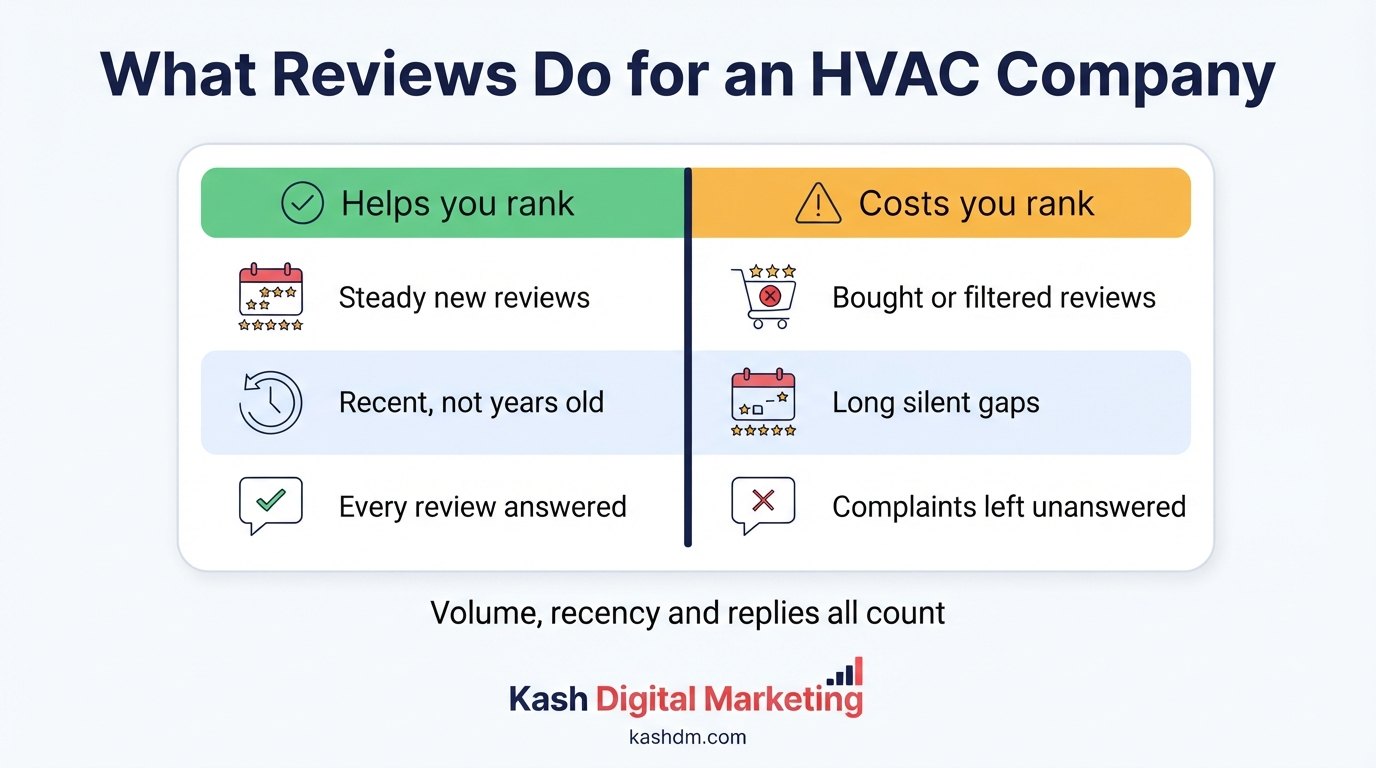
Reviews influence both where an HVAC company ranks in the map pack and whether the homeowner who sees it actually calls, which makes review generation one of the highest-leverage activities in HVAC SEO. Volume, recency, rating and response all count.
How reviews affect HVAC map pack rankings
Review count and velocity feed prominence, one of the three local ranking factors. A steady stream of new reviews outperforms a large number collected years ago and left to age.
Asking for reviews without breaking the rules
Ask every satisfied customer, at the moment the job is finished and the house is comfortable again. Never incentivize, never filter for positive reviewers only, and never buy reviews. Technicians asking in person convert far better than automated follow-up alone.
Responding to negative HVAC reviews
Respond quickly, factually and without defensiveness. Prospective customers read the response more carefully than the complaint. A professional reply to a bad review frequently converts better than an unbroken run of five stars, which many homeowners now distrust.
Reviews on platforms beyond Google
Yelp, Angi, Facebook and manufacturer dealer pages all surface in branded searches. They matter less for ranking and considerably for the homeowner who searches your company name before calling.
Seasonal HVAC SEO: Cooling Season, Heating Season and the Gaps Between
HVAC demand swings twice a year, so HVAC SEO has to be worked counter-seasonally: cooling content built in late winter, heating content built in late summer. Content published during the peak arrives months too late to rank for it.
Building cooling season visibility before the first heat wave
Air conditioning repair, AC replacement and refrigerant content should be published and indexed by early spring. Pages take weeks to months to mature; a page published in July competes for a season that is already ending.
Heating season and furnace search behavior
Furnace repair, heat pump performance in cold weather and no-heat emergency searches climb from October. The work supporting them belongs in August and September.
Using shoulder seasons for maintenance and IAQ
Spring and autumn are when maintenance plans, duct cleaning, indoor air quality and system tune-up searches carry the most weight. These fill the calendar between the emergency peaks and produce the recurring revenue that stabilizes a contracting business.
Keeping rankings through the off season
Rankings decay when content stops. Off-season is when city pages get expanded, technical debt gets cleared and reviews get gathered, so that the next peak arrives with the site already in position.
Emergency and Near Me Searches: Winning the Late Night Call
Emergency HVAC searches convert faster than any other category in the trade, and they are won on map pack presence, review credibility and whether the phone is genuinely answered. SEO can produce the call; only operations can capture it.
HVAC SEO near me and how proximity really works
"Near me" is resolved by the searcher's device location, so there is nothing literal to optimize. What moves the result is category accuracy, profile completeness, review strength and genuine proximity to demand.
24-hour and after-hours HVAC searches
If you advertise 24-hour service, the phone must be answered at 3am by a person. Listings that promise round-the-clock service and route to voicemail collect the one-star reviews that cost far more ranking value than the listing ever gained.
Answer rate as an SEO factor in practice
Missed calls do not directly change rankings, but they change reviews, repeat business and brand searches, all of which do. The fastest measurable improvement most HVAC companies can make is answering the phone during peak hours.
Emergency landing pages that convert under pressure
Short, direct, phone number first, service area stated, no long form. A homeowner with water pooling under a furnace will not fill in six fields to request a callback.
HVAC SEO Versus PPC, LSAs and Buying Leads
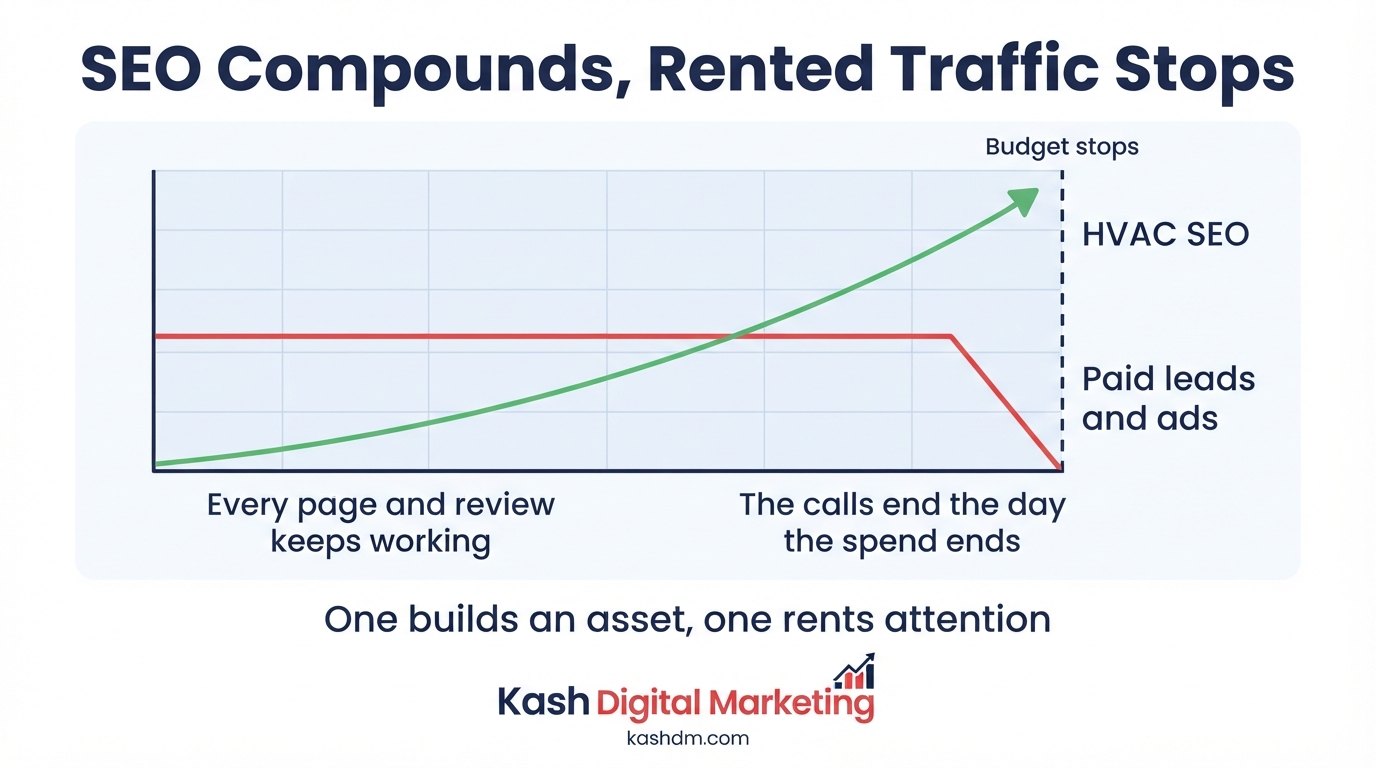
SEO, Google Ads, Local Services Ads and purchased leads solve different problems, and most successful HVAC companies use a combination rather than choosing one. The difference is what happens when you stop paying.
What SEO does that paid channels cannot
SEO compounds. Every page, review and link keeps working after it is paid for. Ads stop the moment the budget stops, and lead platforms never build an asset you own.
Where Google Ads and LSAs genuinely help
Ads and Local Services Ads buy immediate visibility, which is valuable while SEO matures, during a demand spike, or when entering a new city. LSAs in particular put a verified badge in front of emergency searchers.
The economics of buying HVAC leads
Shared leads are resold to several contractors, so you pay to compete on price with companies that also paid. Cost per acquired job climbs as competitors bid up the same pool. It works as a supplement and fails as a foundation.
How the channels should work together
Ads while SEO builds, SEO to reduce dependence on ads, LSAs for emergency coverage, and lead purchases only to fill genuine capacity gaps. The goal is a declining share of revenue from rented channels every year.
| Channel | Speed | Cost over time | Asset you own |
|---|---|---|---|
| HVAC SEO | Slow to start | Falls per job | Yes |
| Google Ads | Immediate | Constant, rising | No |
| Local Services Ads | Immediate | Per lead | No |
| Purchased leads | Immediate | Highest per job | No |
Commercial HVAC SEO Versus Residential
Commercial and residential HVAC buyers search differently, decide differently and require separate pages, keywords and proof. Serving both from one set of pages usually means winning neither.
How commercial HVAC search behavior differs
A facilities manager researches during business hours, compares vendors, checks credentials and often requests a formal proposal. The cycle runs weeks, not minutes, and the content has to support scrutiny rather than urgency.
Commercial HVAC keywords and page structure
Rooftop units, chillers, preventive maintenance contracts, building automation and emergency commercial service each warrant their own page. These terms carry low volume and very high value.
Proof that matters to commercial buyers
Named projects, building types served, certifications, insurance limits, response-time guarantees and references. Residential trust signals do not transfer to a buyer signing an annual maintenance contract.
Keeping the two audiences separate on one site
Distinct navigation paths, distinct service pages and distinct calls to action. A homeowner and a property manager should be able to tell within one screen which part of the site is meant for them.
Measuring HVAC SEO: The Numbers That Mean Something
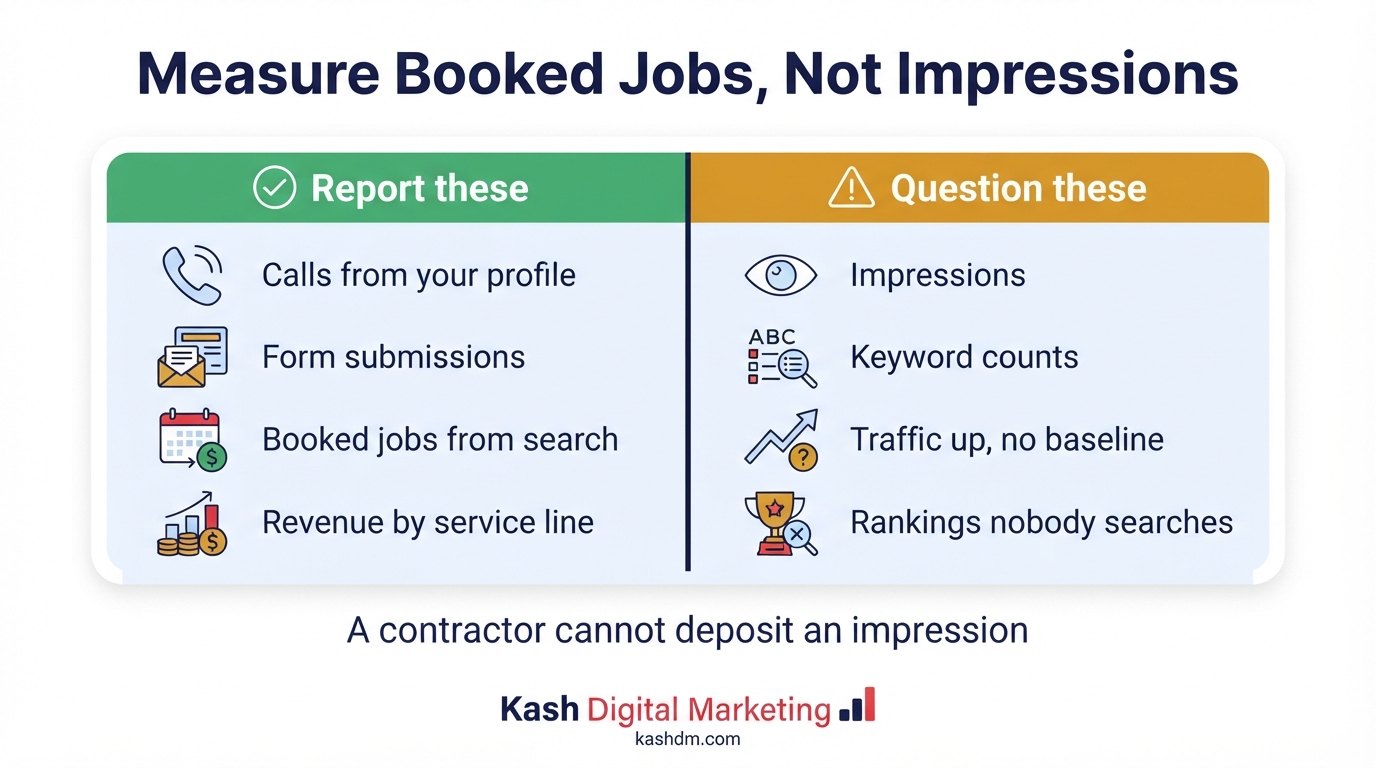
HVAC SEO should be measured in booked jobs and revenue, not in rankings or raw traffic, because a contractor cannot deposit an impression. Any report that stops at position and sessions is hiding the part that matters.
Metrics worth reporting for HVAC SEO
Calls from Google Business Profile, form submissions, booked jobs attributed to organic search, revenue by service line, map pack visibility for core service-plus-city terms, and review growth. Everything else is context.
Vanity metrics that hide poor performance
Impressions, keyword counts, "traffic up 40%" with no baseline, and rankings for terms nobody searches. A traffic graph without a starting number is a rhetorical device, not a report.
Tracking calls without breaking NAP consistency
Call tracking is compatible with local SEO if implemented correctly using dynamic number insertion, with the real number preserved in the profile and structured data. Replacing the listed number outright breaks the consistency local rankings depend on.
What a realistic HVAC SEO timeline looks like
Google Business Profile improvements and long-tail city terms often move within four to eight weeks. Competitive head terms in a major metro typically take three to six months, with compounding gains after that. Anyone promising page one in thirty days is describing a sales pitch.
| Month | What typically moves |
|---|---|
| 1–2 | Profile fixes, technical cleanup, review flow starts |
| 3–4 | Long-tail and city terms enter the top ten |
| 5–6 | Map pack movement on core service terms |
| 7–12 | Competitive head terms, compounding call volume |
How Much HVAC SEO Costs and What Affects the Price
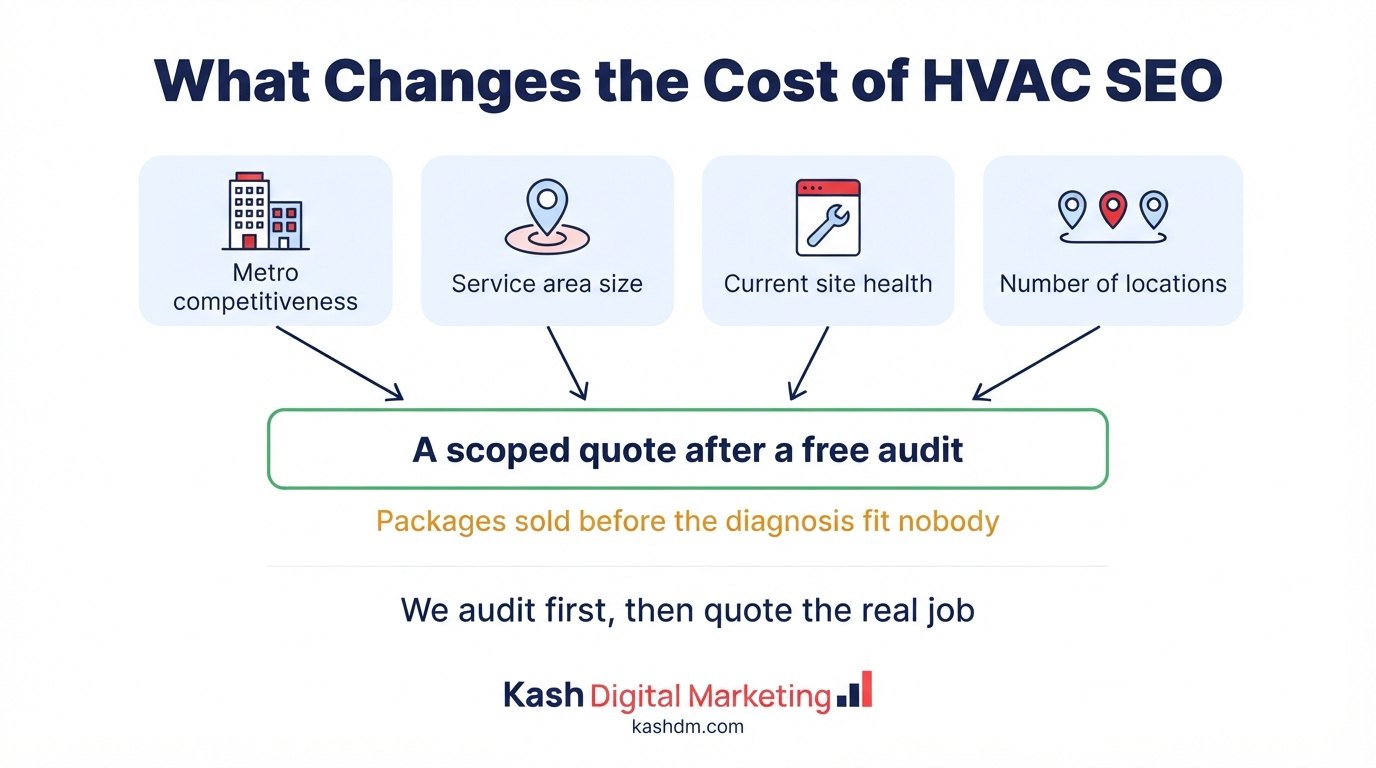
HVAC SEO cost depends on market competitiveness, the number of cities targeted and the state of the existing site, which is why an honest provider quotes after an audit rather than from a price list. Anyone quoting before seeing the site is guessing.
What drives the cost of SEO for an HVAC company
Metro competitiveness, service area size, current site quality, number of locations, whether commercial work is included, and how much technical repair is needed before growth work can begin. A single-city contractor with a healthy site and a five-city operation with a broken one are different projects.
Affordable SEO for HVAC contractors without cutting corners
Affordable means sequenced, not thin. Fix the profile, fix the technical foundation, build the highest-value city and service pages first, then expand. Spreading a small budget evenly across twenty cities produces twenty pages that rank nowhere.
Why SEO packages for HVAC companies can be misleading
Fixed packages sell inputs, a set number of blog posts and links per month, regardless of whether those inputs address the actual constraint. If your problem is a duplicate Google listing and a four-second load time, four blog posts a month will not fix it.
What cheap HVAC SEO usually costs later
Recycled content, low-quality links, keyword-stuffed pages and abandoned profiles. The cleanup routinely costs more than doing it properly the first time, and rankings lost to a penalty take months to rebuild.
How we quote HVAC SEO
We audit first, at no cost, then scope the work against what the audit finds and what the market requires. The quote reflects the actual job. There are no long contracts and no packages sold before the diagnosis. See our SEO pricing page for how we structure this.
Choosing the Best HVAC SEO Company
The best HVAC SEO company for your business is the one that can show contractor results, explain its methods plainly and quote after an audit rather than from a package sheet. Trade specialization matters less than transparency, but it does matter.
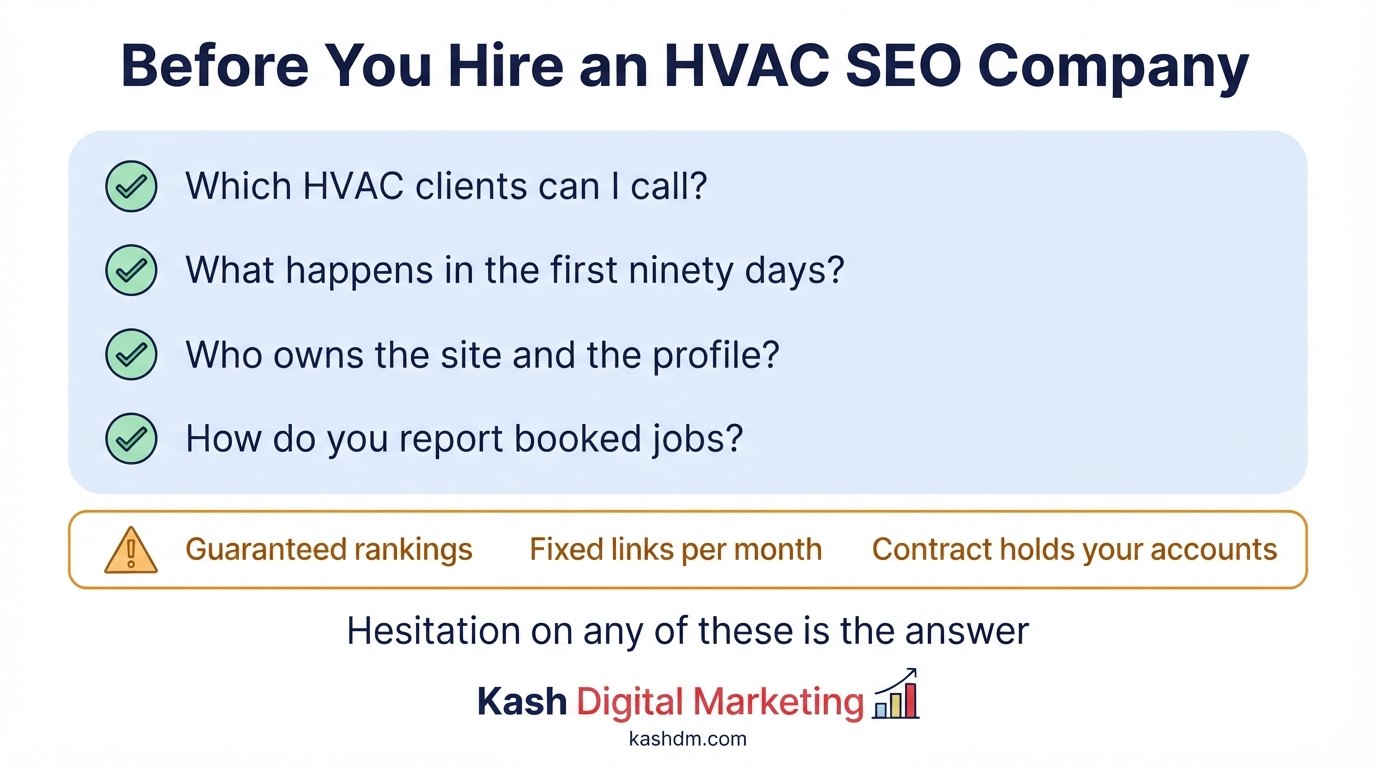
Questions to ask any HVAC SEO agency
Which HVAC clients can I speak to? What exactly will you do in the first ninety days? Who owns the website and the Google profile if we part ways? How do you report booked jobs? What happens to the work if I cancel? Hesitation on any of these is the answer.
Why HVAC industry experience helps
A provider who has worked with contractors already understands seasonality, emergency intent, the difference between commercial and residential buyers, and why answering the phone is part of the strategy. It shortens the learning curve considerably.
Red flags in HVAC SEO proposals
Guaranteed rankings, a fixed number of links per month, contracts that hold your website or Google profile hostage, reporting built entirely on impressions, and refusal to name the specific work being performed. See our full guide to choosing an SEO agency for the complete list.
Working with a specialist versus a generalist
Specialists know the trade. Generalists with strong local SEO fundamentals often perform just as well, provided they take the time to learn how HVAC buyers behave. The deciding factor is whether they will show you their reasoning.
HVAC SEO Mistakes That Keep Contractors on Page Two
Most HVAC companies are not losing rankings to sophisticated competitors, they are losing to fixable mistakes on their own site and profile. These are the errors that appear on almost every audit we run.
One page trying to rank for every service and city
The most common and most costly error. Google needs a specific page to answer a specific query. A single services page covering everything gives it nothing to rank.
Duplicate city pages with the name swapped out
Templated location pages differing only by a place name get filtered as duplicates and can drag down the rest of the site. Fewer, genuinely local pages always outperform many generic ones.
Ignoring the Google Business Profile after setup
The profile is not a one-time task. Categories drift out of date, services go unlisted, photos stale, reviews go unanswered and competitors quietly pull ahead on the one asset that drives the most calls.
Slow, image-heavy sites on mobile
Contractor templates loaded with oversized hero images routinely take five seconds or more on mobile data. The emergency searcher is gone before the page paints.
No tracking, so nobody knows what works
Without call tracking and conversion measurement, budget follows opinion instead of evidence. Contractors then cut the channel that was working because it was the one they could not see.
Stopping during the busy season
Rankings decay when work stops. Pausing SEO through a busy summer is exactly how contractors arrive at the following spring behind competitors who never stopped.
What Our HVAC SEO Services Include
Our HVAC SEO services cover the four things that decide whether a heating and cooling company ranks: the Google Business Profile, the website's technical health, service and city page coverage, and local prominence. Every engagement includes all four, because fixing three of them and ignoring the fourth is how contractors end up paying for SEO that never moves.
Google Business Profile management, not just setup
We audit and correct categories, services, service areas, hours and attributes, remove duplicate listings, and keep the profile active with photos and posts. Profile work continues every month, because this is the asset that produces the map pack calls.
Technical repair before growth work
Site speed on mobile, Core Web Vitals, crawl and index errors, schema markup, redirect chains and broken internal structure. We do this first, because publishing content onto a broken foundation is the most common way HVAC SEO budgets get wasted.
Service pages for every job you want to sell
Dedicated pages for AC repair, AC installation, furnace repair, furnace replacement, heat pumps, ductwork, indoor air quality and maintenance plans, each written to answer the questions a homeowner actually asks before calling.
City pages for every market you actually serve
Real local pages carrying the neighborhoods you cover, your response times, reviews from that city and jobs completed there, internally linked to the services available in each market. Never a template with the city name swapped.
Reviews, citations and local links
Review generation your technicians will actually use, citation cleanup across the directories that matter, and local link building through chambers of commerce, suppliers, manufacturer dealer pages and community sponsorships.
Reporting that names booked jobs
Monthly reporting on calls, form submissions, booked jobs and revenue by service line, with next month's priorities set by what the numbers show. If a month underperforms, the report says so and explains what changes.
| Included every month | What it produces |
|---|---|
| Google Business Profile management | Map pack visibility and direct calls |
| Technical monitoring and fixes | Pages that load fast and stay indexed |
| Service and city page build-out | Rankings for the jobs you want to sell |
| Review and citation work | Prominence, the third ranking factor |
| Local link building | Authority a competitor cannot copy quickly |
| Reporting on calls and booked jobs | Evidence instead of impressions |
Your First 90 Days of HVAC SEO With Us
We tell you exactly what happens in the first ninety days before you sign anything, because that is the question we tell contractors to ask every agency they consider. It would be a poor guide that refused to answer its own test.
Days 1 to 15, audit and diagnosis
We audit your Google Business Profile, technical health, current rankings, competitor positions and the gap between the cities you serve and the cities you rank in. You get the findings in plain language, and they are yours whether or not you continue with us.
Days 15 to 45, foundation repair
Duplicate listings removed, categories and services corrected, name, address and phone inconsistencies cleaned across directories, mobile speed fixed and indexation errors resolved. This phase often produces the first visible movement, because most HVAC sites are held back by something broken rather than something missing.
Days 45 to 75, coverage build
The highest-value service pages and priority city pages get written and published, internally linked so the structure reads as genuine service-area coverage rather than a scatter of unrelated pages.
Days 75 to 90, prominence and first reporting
Review generation starts with your technicians, citations get built out, and you receive the first full report showing calls, form submissions and booked jobs attributed to organic search, with the next quarter's priorities set from it.
What we need from you
Access to the website and Google profile, a list of the cities that actually produce revenue, and technicians willing to ask satisfied customers for a review. That is genuinely all. We do not need weekly meetings or a marketing coordinator on your side.
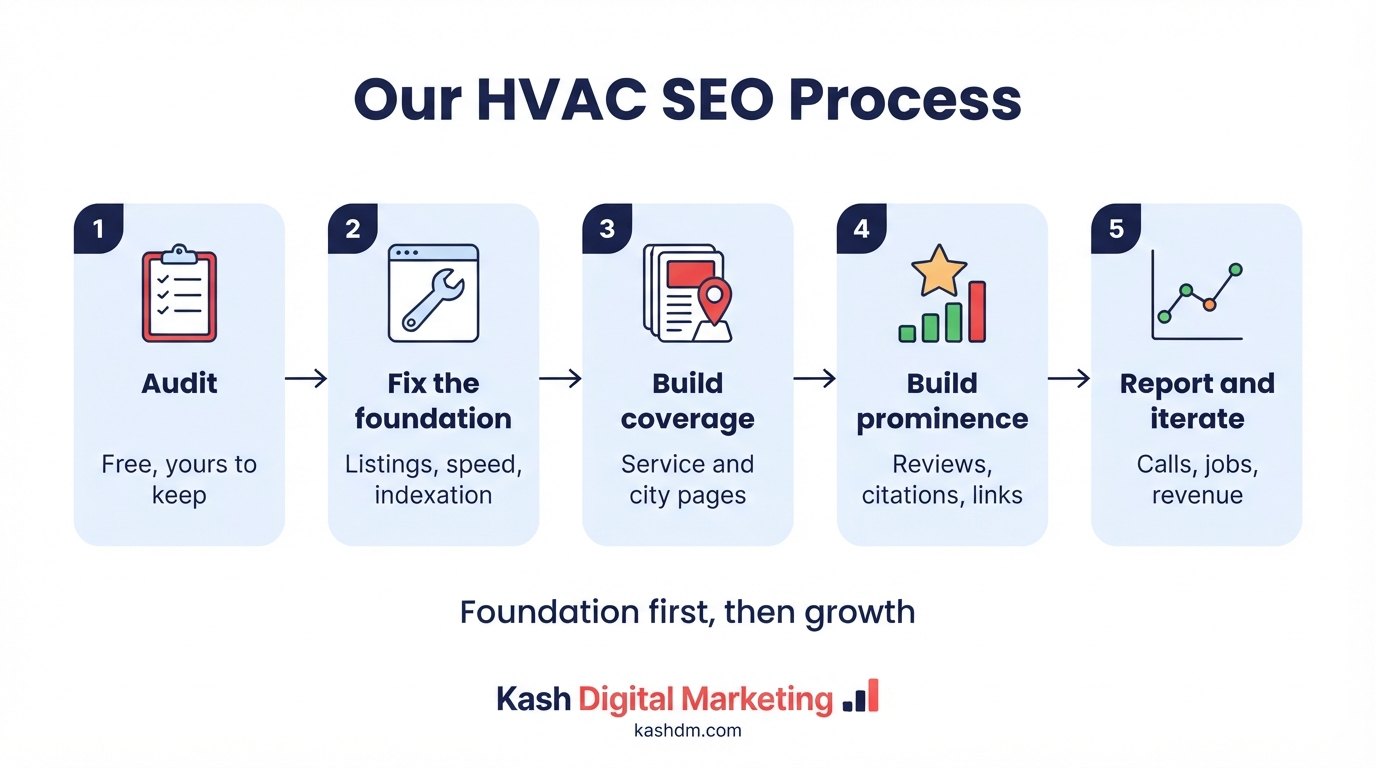
Our HVAC SEO Process at Kash Digital Marketing
We run HVAC SEO as a sequence: audit, fix the foundation, build local coverage, then expand and compound. Skipping ahead to content and links before the foundation is sound wastes both.
Step one, the free HVAC SEO audit
We review your Google Business Profile, technical health, existing rankings, competitor positions and the gap between the cities you serve and the cities you rank in. You receive the findings whether or not you hire us.
Step two, foundation repair
Duplicate listings, category corrections, NAP inconsistencies, site speed, indexation problems and broken internal structure. This is unglamorous work that frequently produces the fastest movement.
Step three, service and location coverage
Dedicated pages for each service and each priority city, written to answer real homeowner questions, internally linked so the structure reads as genuine service-area coverage.
Step four, prominence
Reviews, citations, local links and the ongoing profile activity that lifts the prominence factor behind map pack rankings.
Step five, reporting and iteration
Monthly reporting on calls, booked jobs and revenue by service line, with the next month's priorities set by what the numbers show rather than by a fixed content quota.
HVAC SEO Across the United States
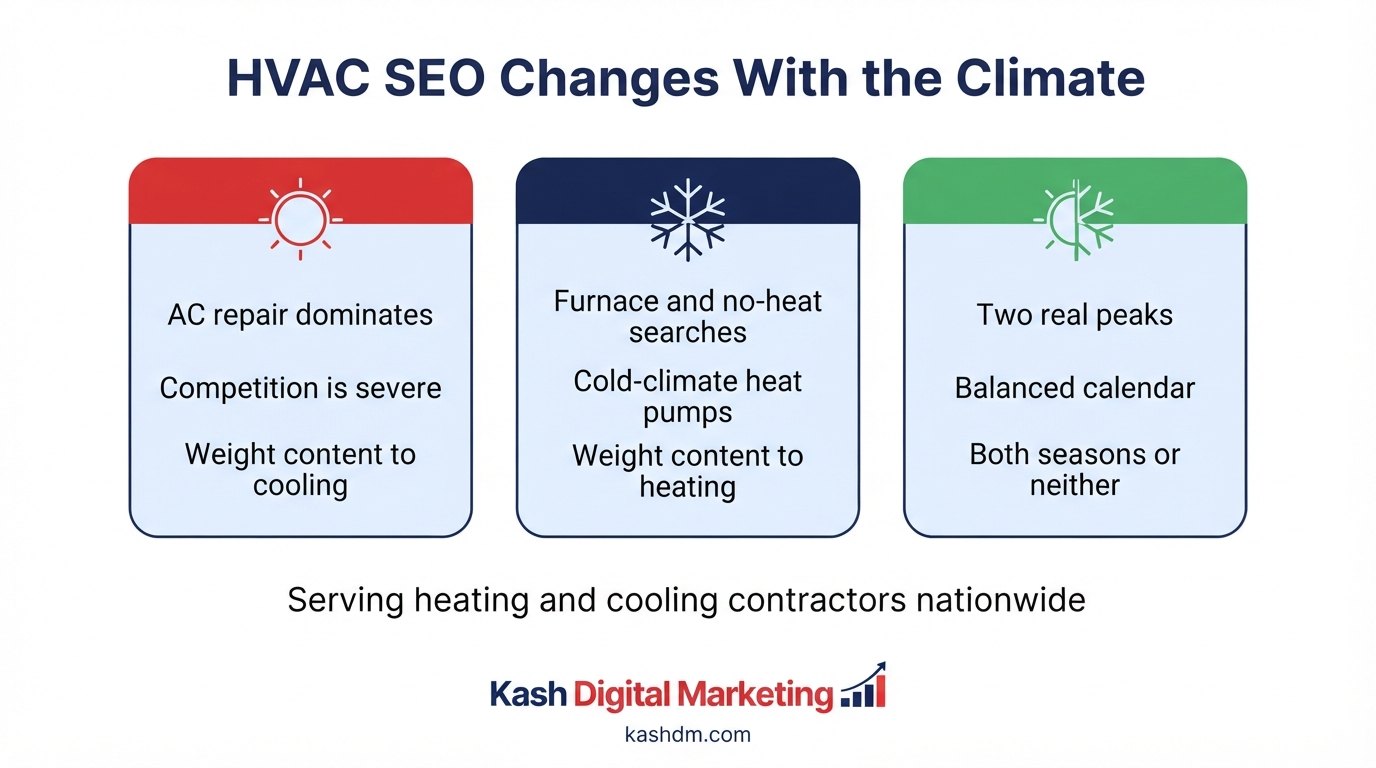
We provide HVAC SEO services to heating and cooling contractors in every US state and metro, remotely, with strategy adapted to local climate, competition and housing stock. What ranks in Phoenix is not what ranks in Minneapolis.
Hot-climate metros and cooling-dominant SEO
In Phoenix, Houston, Las Vegas, Miami and much of the Southwest and Gulf Coast, air conditioning terms dominate almost year-round and competition on emergency AC repair is severe. Content weighting shifts heavily toward cooling, heat pumps and system efficiency.
Cold-climate metros and heating-dominant SEO
In Minneapolis, Chicago, Denver, Cleveland and the Northeast, furnace and no-heat searches carry the year. Cold-climate heat pump performance is a growing and under-served content opportunity in these markets.
Mixed-climate markets with two full seasons
Atlanta, Dallas, Nashville, Kansas City and much of the mid-Atlantic run genuine cooling and heating peaks. These markets reward a balanced content calendar and punish contractors who build for only one season.
Competition levels by metro size
Large metros demand deeper city-plus-service structures and stronger review velocity. Smaller markets are often winnable with a well-built profile, a fast site and consistent citations, which makes them some of the best returns in HVAC SEO.
Remote HVAC SEO service without a local office
SEO work is remote by nature. We serve contractors nationwide, using local data, local competitor analysis and your own service-area knowledge. See our locations page for coverage detail.
Plumbing and HVAC SEO for Combined Trade Companies
Companies offering both plumbing and HVAC need parallel page structures for each trade rather than a blended one, because the two are searched separately and rank separately. Combining them on one page halves the relevance of both.
Why plumbing and HVAC need separate page trees
A homeowner with a burst pipe and a homeowner with a dead furnace share nothing except your phone number. Each trade needs its own service pages, its own city pages and its own keyword targeting.
Google Business Profile categories for combined companies
The primary category should reflect your dominant revenue line, with the second trade added as a secondary category. Splitting into separate listings is only appropriate with genuinely separate locations, staff and phone numbers.
Sharing authority between the two trades
Both trades benefit from the same reviews, citations and brand strength. Structured properly, a combined company can compete in two verticals at once, which is a genuine advantage over single-trade competitors.
Where combined companies usually go wrong
A single "Plumbing and HVAC Services" page targeting everything, a profile category that names neither trade clearly, and city pages that mention both trades in passing without ranking for either.
Related reading: our home services SEO page covers the wider trade landscape, and local SEO services covers the map pack fundamentals that apply to every trade.
Why HVAC Contractors Choose Kash Digital Marketing
We work the way we would want an agency to work for us: diagnose before quoting, no long contracts, plain reporting on booked jobs, and no promises about rankings nobody can guarantee. That is the whole pitch, and it is deliberately easy to verify.
We audit before we quote, not after
Most HVAC marketing proposals arrive before anyone has looked at the Google profile or run a speed test. Ours arrives after. A five-city contractor with duplicate listings and a four-second load time is a different job from a single-city contractor with a healthy site, and the quote should say so.
No long contracts
We keep clients by producing results, not by holding them to a twelve-month term. If we stop earning the work, you should be free to leave that month. Contracts that lock a contractor in for a year exist to protect the agency.
You own everything, during and after
Your website, your domain, your Google Business Profile, your content, and every citation and link we build. Some agencies build on their own platform, so leaving means starting from zero. If we part ways, you keep the entire asset.
White-hat only, because a penalty costs more than a ranking
No purchased links, no manufactured reviews, no keyword stuffing, no private blog networks. Every technique we use is one we would explain to Google directly. A contractor with a twenty-year reputation has too much at stake to gamble it on shortcuts that work until they suddenly do not.
Reporting that names booked jobs
You get calls, form fills, booked jobs and revenue by service line. Impressions and keyword counts appear nowhere in our reporting, because a contractor cannot deposit an impression.
We reply within one hour
Contractors work on urgency and so do we. Audit requests get a response within the hour during business hours, which is also a fair preview of what working together looks like.
We will tell you when SEO is not the answer
If your Google profile is suspended, your phone goes unanswered during peak hours, or your service area is too small to support the investment, we will say so rather than sell you a retainer. Sometimes the honest recommendation is to fix operations first and start SEO next quarter.
| How HVAC marketing is often sold | How we work |
|---|---|
| Quoted from a package sheet | Free audit first, then a scoped quote |
| Twelve-month contract | No long contracts |
| Agency owns the site or the profile | You own every asset |
| Rankings guaranteed | No guarantees, documented method instead |
| Reporting on impressions and rankings | Reporting on calls and booked jobs |
| Fixed number of links per month | Work chosen by what the audit found |
HVAC Companies We Work With
We work with residential and commercial heating and cooling contractors across the United States, from single-truck operations to multi-location companies covering several metros. The strategy changes considerably between them.
Single-location residential contractors
The most common case, and often the fastest to move. One profile, a strong service-area structure, a handful of genuine city pages and consistent reviews will outrank larger competitors who never did the basics properly.
Multi-location and multi-metro HVAC companies
Each location needs its own profile, its own landing page and its own review stream. Coordinating that across markets is a process problem before it is a marketing problem, and it is where an outside team usually earns its cost several times over.
Commercial HVAC and mechanical contractors
Separate pages, separate keywords and proof aimed at facilities managers rather than homeowners: project types served, certifications, response-time commitments and maintenance contract terms.
Combined plumbing and HVAC companies
Parallel page structures for each trade, a profile whose primary category reflects your dominant revenue line, and shared review and citation strength working for both verticals at once.
Newer HVAC companies building from zero
No rankings, few reviews and no citation history is a real disadvantage, and also the cleanest starting point, because nothing has to be undone first. Long-tail city terms are usually winnable within the first few months.
Get Your Free HVAC SEO Audit
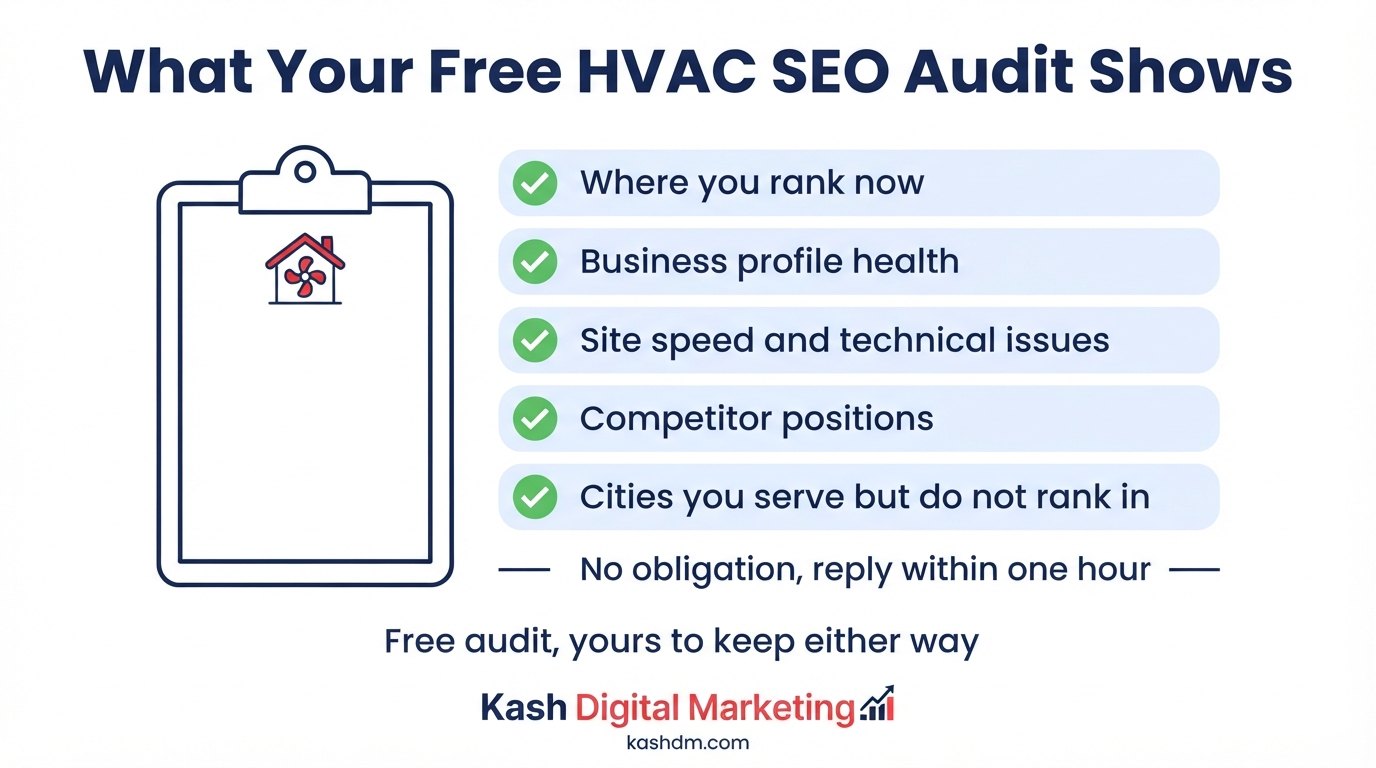
Send us your website and your service area, and we will send back a free HVAC SEO audit showing where you rank, what is holding you back and the fastest available wins. No obligation, no long contract, and a reply within one hour.
What the free HVAC SEO audit covers
Your current rankings for core service-plus-city terms, Google Business Profile completeness and category accuracy, technical health and mobile speed, competitor positions in your metro, and the gap between where you work and where you rank.
What happens after the audit
We walk you through the findings, you decide whether to act on them yourself or with us, and either way the audit is yours to keep. There is no pressure and no obligation attached to it.
How to get started
Use the audit form on this site, or message us on WhatsApp if you would rather talk it through. Tell us the cities you serve and the services that matter most, and we will scope the audit around them.
HVAC Marketing Services Beyond SEO
HVAC marketing services cover everything that brings a homeowner to your door, and SEO is the part that compounds while the rest is rented. A complete HVAC digital marketing program uses each channel for what it is genuinely good at.
What HVAC digital marketing services usually include
HVAC digital marketing services typically bundle search visibility, paid advertising, website work, email and reputation management. The bundle only makes sense when each element is measured separately, otherwise a strong channel subsidises a weak one indefinitely and nobody notices.
Where HVAC web marketing overlaps with SEO
Web marketing decisions such as page structure, load speed, calls to action and offer clarity all change search performance directly. This is why HVAC contractor SEO marketing cannot be treated as a bolt-on service delivered separately from the website itself.
HVAC company SEO marketing versus general advertising
General advertising interrupts someone who was not looking. HVAC company SEO marketing reaches someone at the exact moment their system failed. The cost per booked job between those two approaches is rarely close.
Should you buy HVAC leads alongside SEO
Buying HVAC leads makes sense only to fill genuine capacity gaps, not as a foundation. Shared leads are resold to several contractors at once, so the same homeowner is quoted by three companies within the hour and price becomes the only differentiator.
HVAC website design company work as part of the mix
An HVAC website design company that ignores search will build something attractive that nobody finds, and a redesign that changes URLs without redirects will erase rankings overnight. Design and search have to be scoped together.
Working With an HVAC SEO Agency, Expert or In-House Team
An HVAC SEO agency brings process and pattern recognition across many contractors, an in-house hire brings availability and product knowledge, and the right answer depends on how many cities you are trying to win. Both fail for the same reason: no consistent execution.
What an HVAC SEO agency should actually deliver
A credible HVAC SEO agency delivers a diagnosed plan, visible monthly execution, reporting tied to booked jobs, and full ownership of every asset for you. Anything sold as a fixed monthly quota of blog posts and links is selling inputs, not outcomes.
HVAC SEO experts versus generalist marketers
HVAC SEO experts already understand seasonality, emergency intent and the split between commercial and residential buyers. A capable generalist can learn all of it, but you pay for the learning curve in months you cannot get back during a peak season.
When a local SEO agency for HVAC contractors makes sense
Multi-city and multi-location contractors benefit most, because coordinating profiles, citations, reviews and city pages across several markets is a process problem before it is a marketing problem. Single-location contractors in small markets can often carry more of it in-house.
Building HVAC SEO capability in-house
In-house works when someone owns it as a real responsibility rather than an extra duty. The profile, the reviews and the city pages need consistent weekly attention; assigning that to an office manager already handling dispatch usually means it stops within a quarter.
Choosing the best HVAC SEO marketing agency for your market
Ask for contractor references in markets of comparable size, request the first ninety days in writing, confirm asset ownership, and check that reporting names booked jobs. The best HVAC SEO marketing companies answer all four without hesitating.
What Realistic HVAC SEO Results Look Like
Realistic HVAC SEO results follow a predictable shape: profile and long-tail movement within the first two months, city and service terms from month three, and competitive head terms from month six onward. Anyone showing you a faster curve is showing you a smaller starting point than yours.
What moves first, and why
Google Business Profile corrections move fastest because the profile is re-crawled constantly and most contractors have obvious errors sitting in it. Duplicate listings, a wrong primary category or missing services can suppress a profile for years and take days to fix.
What a normal ranking curve looks like
Long-tail city and service terms enter the top ten first, because competition on them is thin. Head terms follow much later. The curve is slow, then compounding, which is the opposite shape of paid advertising and the reason SEO is judged over quarters rather than weeks.
Why call volume lags ranking movement
Ranking third instead of eleventh changes visibility immediately, but the seasonal demand cycle decides when those rankings convert into calls. A furnace page that reaches position four in May proves nothing until October.
Results depend on your starting point, not just the work
A contractor with a suspended profile, a four-second website and no reviews has more available upside than one already ranking fifth, and will show larger percentage gains for the same work. This is exactly why percentage improvements quoted without a baseline are meaningless.
How to verify any HVAC SEO provider's results claims
Ask what the starting position was, over what timeframe, in which metro, and what else changed during the period. Ask to speak to the contractor named in the case study. A provider confident in genuine results will answer all four without hedging; one relying on a flattering graph will hesitate on at least one.
| Claim you might be shown | What to ask before believing it |
|---|---|
| Traffic up 400% | Up from what number, over how long? |
| Ranked #1 in 30 days | For which term, in which city, at what volume? |
| 200 new leads | Leads or booked jobs, and from which channel? |
| Case study with no name | Can I speak to that contractor directly? |
Our Position on Case Studies and Client Privacy
Kash Digital Marketing is a growing agency, and we publish no HVAC case studies yet because we will not invent them. This page argues that contractors should demand verifiable proof, and it would be worthless if we broke that rule ourselves on our own page.
Why there are no HVAC case studies on this page
We would rather tell you plainly that our HVAC portfolio is still being built than publish a stock graph and an unnamed client. Every claim on this page is a claim about method, not about results we cannot evidence. When we have HVAC results worth publishing, they will appear here with the starting baseline, the timeframe and the work performed.
Client privacy when we do publish
Client work is published only with written permission. Many contractors would rather competitors in their own metro not know who handles their search visibility, and that preference is entirely reasonable in a market where three companies are fighting for the same map pack slots. Where a client prefers anonymity, we publish the metro size, the timeframe and the mechanism, and omit the name.
What you can verify about us today
Our method is documented in full on this page, including the ninety-day plan, what is included every month and what we report. You own every asset we build, there is no long contract, and the audit that starts the relationship is free and yours to keep. Those are commitments you can test cheaply before committing anything meaningful.
How to judge a newer agency fairly
Judge the diagnosis. Request the free audit, see whether the findings are specific to your business or generic boilerplate, and check whether the recommended work matches the problems found. An agency that correctly diagnoses your site before being paid is demonstrating the exact skill you are hiring for.
HVAC SEO by Metro: How Competition Changes City to City
HVAC SEO difficulty varies enormously by metro, and the strategy that wins in Phoenix is not the one that wins in Cleveland. We work with contractors remotely nationwide, adapting to each market rather than applying one template.
HVAC SEO in Phoenix and the wider Valley
Phoenix, Scottsdale, Glendale, Gilbert, Tucson and Surprise form one of the most competitive cooling markets in the country. Air conditioning terms carry demand almost year-round, review counts among established contractors run high, and winning usually requires suburb-level city pages rather than a single Phoenix page.
HVAC SEO in Los Angeles and Southern California
Los Angeles is fragmented across dozens of distinct submarkets, so a single citywide page rarely ranks. Neighborhood and suburb targeting, combined with strong review velocity, tends to outperform attempts to rank for the metro name alone.
Houston SEO for HVAC contractors
Houston combines extreme cooling demand with humidity-driven indoor air quality searches, giving contractors a content angle many competitors ignore. The metro is large enough that service-plus-city pages are essential rather than optional.
Local SEO for HVAC contractors in Cleveland and the Midwest
Cleveland, Columbus, Detroit and similar Midwest markets are heating-dominant with older housing stock, which raises demand for furnace repair, replacement and ductwork content. Competition is generally lighter than in Sun Belt metros, making these strong markets for contractors starting SEO now.
Cold-climate metros: Minneapolis, Chicago and Denver
No-heat emergencies dominate, and cold-climate heat pump performance is an under-served content topic that established competitors have largely skipped. That gap is one of the clearest openings in HVAC SEO today.
Two-season metros: Dallas, Atlanta and Nashville
These markets run genuine cooling and heating peaks, which rewards a balanced content calendar and punishes contractors who build only for summer. The shoulder seasons carry unusually strong maintenance-plan demand.
Smaller metros and rural service areas
Smaller markets are frequently winnable with a complete Google Business Profile, a fast website and consistent citations alone. They deliver some of the best returns in HVAC SEO because so few local competitors have done the basic work.
Frequently Asked Questions About HVAC SEO
What is HVAC SEO?
HVAC SEO is the practice of optimizing a heating and cooling company's website, Google Business Profile and local signals so the business ranks at the top of Google search and the map pack when nearby homeowners search for AC repair, furnace replacement, or HVAC maintenance. It combines local SEO, technical site work, service and city pages, reviews and content built around the urgency of HVAC searches.
How much does SEO cost for HVAC companies?
It depends on how competitive your metro is, how many cities you target, and the condition of your current website and Google profile. That is why we audit first and quote after, rather than selling a fixed package. A single-city contractor with a healthy site needs far less work than a five-city operation with duplicate listings and a slow website.
How long does HVAC SEO take to work?
Google Business Profile improvements and long-tail city keywords often move within four to eight weeks. Competitive head terms like "AC repair" in a major metro typically take three to six months to reach full potential, with results compounding after that. Any provider promising page one in thirty days is selling something other than SEO.
Is local SEO for HVAC different from regular SEO?
Yes. Local SEO for HVAC focuses on the map pack, Google Business Profile, service-area coverage and proximity signals, because nearly every valuable HVAC search carries local intent. Regular SEO techniques still apply to the website itself, but on their own they will not win the three-result map pack where most HVAC calls originate.
What are the best SEO keywords for an HVAC company?
The highest-value keywords combine a service, a location and hiring intent: "AC repair Phoenix," "emergency furnace repair near me," "heat pump installation cost," "HVAC maintenance plan." These have lower search volume than generic terms like "HVAC" but convert dramatically better because the searcher is ready to call.
Do I need a separate page for every city I serve?
For the cities that genuinely produce revenue, yes. Each needs real local content: neighborhoods covered, response times, local reviews and jobs completed there. Templated pages that only swap the city name get treated as duplicates and can hold back the rest of the site, so build fewer strong pages rather than many thin ones.
Can HVAC SEO help with commercial work, not just residential?
Yes, but commercial requires its own pages and keywords. Facilities managers search terms like "commercial rooftop unit service" and "preventive maintenance contract," research during business hours, and need proof such as named projects, certifications and response-time guarantees. Serving them from residential pages usually wins neither audience.
Should HVAC companies do SEO or Google Ads?
Most successful contractors run both. Ads and Local Services Ads buy immediate visibility while SEO matures, and SEO reduces dependence on paid channels over time. The key difference is that SEO builds an asset you own, while ads stop producing the moment the budget stops.
Are purchased HVAC leads worth it?
They work as a supplement and fail as a foundation. Shared lead platforms resell the same homeowner to several contractors, so you pay to compete on price with companies that also paid. Organic search delivers a caller who chose your company specifically, before anyone quoted a number.
What is the best time of year to start HVAC SEO?
The off season, because SEO takes months to mature and content published during a peak arrives too late for it. Building cooling content in late winter and heating content in late summer means the pages are ranked and working when demand actually arrives.
Do you work with plumbing and HVAC companies together?
Yes. Combined trade companies need parallel page structures, separate service and city pages for each trade, and a Google Business Profile whose primary category reflects the dominant revenue line. Structured properly, a combined company can compete in two verticals at once.
Who owns the website and Google profile if we stop working together?
You do, always. You own your website, your Google Business Profile and every asset we build. We keep clients by producing results, not by holding accounts hostage, and there are no long-term contracts.
What makes Kash Digital Marketing different from other HVAC marketing agencies?
Three things you can verify before paying us anything. We audit before we quote instead of selling from a package sheet, we do not use long contracts, and you own your website, domain, Google Business Profile and every asset we build. Our reporting names calls and booked jobs rather than impressions, and if we think SEO is not your bottleneck we will say so.
Do you work with HVAC contractors in my city?
Yes. We work remotely with heating and cooling contractors in every US state and metro, from single-truck operations to multi-location companies. SEO does not require a local office, and what matters far more is understanding your market's climate, competition and housing stock, which we research per client.
What do I get in the free HVAC SEO audit, and is there a catch?
You get your current rankings for core service and city terms, an assessment of your Google Business Profile, technical and mobile speed issues, competitor positions in your metro, and the gap between the cities you serve and the cities you rank in. There is no catch and no obligation. The findings are yours to act on yourself or with another provider.
How do I know an HVAC SEO company is not just taking my money?
Ask for contractor references you can actually call, ask what specifically happens in the first ninety days, confirm in writing who owns the website and Google profile, and require reporting that names booked jobs. Any provider that hesitates on those four has answered the question. We publish our own ninety-day plan on this page for exactly that reason.