What Is AI SEO and How Does It Work in 2026?
AI SEO is the practice of optimizing your website, content, and brand so you appear inside AI-generated answers, not just the classic list of blue links. That includes Google AI Overviews, Google AI Mode, and answer engines like ChatGPT, Perplexity, Gemini, and Copilot. When someone asks one of these tools a question, AI SEO is what makes your business the source it pulls from, names, and links to.
Traditional SEO asks a narrow question: "how do I rank a page on Google?" AI SEO asks a broader one: "how does my brand get retrieved, quoted, and recommended by every AI system my customers now use to make decisions?" The goal has not changed, more qualified customers, but the surface where you win has. This page explains, in plain language, what AI SEO is, what it is called, how AI Overviews and AI Mode work, how to show up in them, how to use AI tools for SEO, and how to choose an AI SEO agency.
A simple definition of AI SEO you can act on
AI SEO is making your content easy for large language models and AI search engines to find, understand, trust, and cite. In practice that means clear structure, genuine expertise, strong technical foundations, and a brand that is mentioned in enough trusted places that the AI treats you as a credible answer. If a person can quickly find and trust your answer, so can an AI, and the reverse is just as true.
Think of AI SEO as earning a seat at the table when an AI assembles its answer. The model reads the web, decides which sources are worth trusting, and synthesizes a response. Your job is to be one of those sources, clearly relevant, obviously credible, and easy to quote.
How AI SEO actually works behind the scenes
AI search systems retrieve candidate sources for a query, rank them by relevance and trust, and generate an answer that cites a few of them. To influence that, you optimize three things: retrievability, so the system can find and parse your content; credibility, so it trusts you enough to cite you; and clarity, so your passage is easy to lift into the answer.
None of that is magic, and none of it replaces the fundamentals. It builds on top of strong, white-hat SEO, the same honest foundation we have always used for clients. The businesses that win at AI SEO are almost always the ones that were already serious about quality and trust.
What AI SEO is not
AI SEO is not spinning out thousands of AI-written articles and hoping for the best. That approach usually hurts you. It is not a magic trigger word, a hidden setting, or a way to game your way into an answer you have not earned. And it is not a replacement for content quality, technical health, or real expertise. It is those things, aimed at a new set of surfaces.

What Is AI SEO Called? GEO, AEO, AIO and LLM SEO Explained
The field is new, so people use several names for closely related ideas. They overlap heavily, and you do not need to memorize them, but here is what each term means so you can follow any conversation, brief, or sales pitch with confidence and spot when someone is dressing up the same idea in a new acronym.
What is GEO (Generative Engine Optimization)?
GEO means optimizing to appear inside generative answers, the paragraphs an AI writes rather than a ranked list of links. When people ask "what is GEO in SEO" or "what does GEO stand for in AI SEO," this is it. GEO focuses on being included and described accurately when a model generates a response, which depends on clear, quotable content and a trustworthy brand footprint.
In day-to-day work, GEO and AI SEO are used almost interchangeably. If a tool or agency talks about generative engine optimization, they are describing the same mission this page covers: earn a place inside AI-generated answers.
What is AEO (Answer Engine Optimization)?
AEO means optimizing to be the answer an engine gives, whether that engine is an AI Overview, a voice assistant, or a chatbot. It leans heavily on framing content as clear questions with clean, self-contained answers. AEO and GEO overlap so much that many practitioners treat them as two labels for one discipline, with AEO emphasizing direct question-and-answer formats.
If your customers ask questions out loud or in a chat box, AEO thinking helps you win those moments by making your answer the one that gets read back.
What are AIO and LLM SEO?
AIO stands for AI Optimization or AI Search Optimization, and LLM SEO means optimizing specifically for large language models like GPT and Gemini. You will also see "AI search optimization" and "search everywhere optimization." All of these, GEO, AEO, AIO, and LLM SEO, describe the same core mission from slightly different angles: be retrieved, trusted, and cited inside AI answers.
The takeaway is not to chase acronyms. It is to build the underlying strengths, clarity, trust, and technical soundness, that every one of these labels rewards.
| Term | Stands for | Core focus |
|---|---|---|
| AI SEO | AI Search Optimization | The whole discipline of ranking in AI-driven search |
| GEO | Generative Engine Optimization | Appearing inside generated answers |
| AEO | Answer Engine Optimization | Being the direct answer to a question |
| LLM SEO | Large Language Model SEO | Being retrieved and cited by models like GPT and Gemini |
| AIO | AI Optimization | Broad optimization for AI search surfaces |

Why AI SEO Matters for Brand Awareness and Visibility
Search behavior is shifting fast. A growing share of questions now get answered directly by AI, and many of those answers never send a click unless your brand is the one being named. If you are invisible inside AI answers, you are invisible to a rapidly growing slice of your market, at the exact moment they are choosing who to trust.
What is the best AI SEO for brand awareness?
The best AI SEO for brand awareness is not a single trick, it is being mentioned consistently and accurately across trusted sources so AI systems repeat your name as a recommended option. Every time an AI names your business as an answer, that is high-trust exposure at the moment of decision, and it compounds. The more places describe you credibly, the more confident the model becomes in recommending you.
Brand awareness through AI SEO is a flywheel. Mentions build trust, trust earns citations, citations drive awareness, and awareness earns more mentions. The work is to start that flywheel with genuine authority rather than trying to fake it.
How to make your brand visible in AI answers
To make your brand visible in AI answers, you combine three moves: publish complete, quotable content on the questions your buyers ask, earn mentions and links from respected sites, and keep your brand information consistent everywhere it appears. AI systems assemble a picture of you from the whole web, so consistency and credibility across that web is what makes you show up.
You also want to monitor how AI tools describe your brand, because an inaccurate or outdated description can quietly cost you recommendations. Correcting the record across the sources AI reads is part of modern brand management.
How to increase brand mentions for AI SEO
Increasing brand mentions is a mix of digital PR, genuinely useful content that others cite, partnerships, reviews, and being active where your industry talks. Our off-page SEO and link building work is built for exactly this, earning the credible mentions and links that make AI systems, and classic search, treat you as an authority.
The aim is not volume for its own sake. It is being mentioned in the right, trusted contexts so that when an AI weighs who to name, your brand keeps coming up.

How Google AI Overviews Work and How They Affect SEO
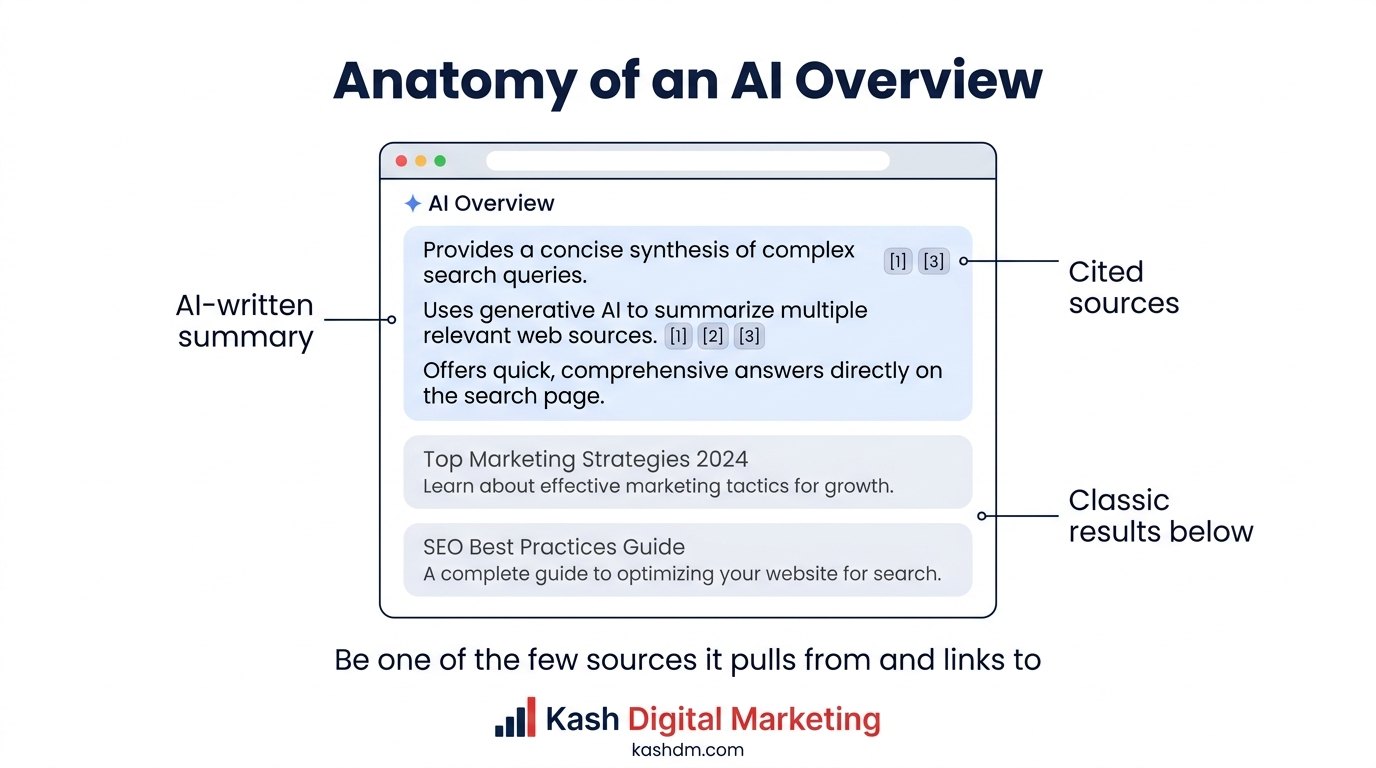
Google AI Overviews are the AI-written summaries that appear at the top of many search results, pulling from and linking to a handful of sources. They change how your customers find you, and understanding how they choose sources tells you exactly where to focus your AI SEO effort.
What is an AI Overview and how does it choose sources?
An AI Overview synthesizes an answer from multiple pages and links to the sources it relied on. It favors content that clearly answers the question, comes from a source it considers trustworthy, and is structured so the relevant passage is easy to lift. Strong topical authority and a healthy link and mention profile make you a more likely pick, the same signals that have always driven search, applied to a new format.
Being chosen is less about a single page and more about your overall credibility on a topic. If you are the recognized authority on a subject, you are far more likely to be cited across the many related questions people ask.
How do AI Overviews affect SEO and organic traffic?
For some informational queries, an AI Overview answers the question on the page, which can reduce clicks to any single result. That is real, and pretending otherwise helps no one. The response is twofold: get cited inside the Overview so you still earn visibility and referral clicks, and focus your commercial pages on the high-intent queries where people still click through to buy, book, or call.
Overviews affect informational searches most and high-intent transactional searches least. That means your money pages, the ones that drive leads, are the least disrupted, while your top-of-funnel content adapts to a new way of earning attention.
How are AI Overviews affecting SEO for blogging?
For blogging, thin, generic posts lose ground while genuinely useful, well-structured content gains a new way to earn visibility, as a cited source inside Overviews. The winners are pages that answer a real question completely, credibly, and clearly enough to quote. The losers are pages that added little in the first place.
This is good news for anyone committed to quality. AI Overviews reward depth, accuracy, and structure, exactly the things a serious content program already produces.
What triggers an AI Overview?
AI Overviews tend to appear for questions where a synthesized answer is genuinely helpful: how-to queries, comparisons, definitions, and multi-part research questions. They appear less on simple navigational or transactional searches, and on topics where accuracy is sensitive the system is more cautious. Knowing which of your keywords trigger an Overview tells you where AI SEO effort pays off and where classic ranking still rules.
Mapping your keyword set by whether it triggers an Overview is one of the first things we do, because it decides whether the goal for a given page is to be cited, to rank, or both.
How Google AI Mode Is Changing the Search and SEO Ecosystem
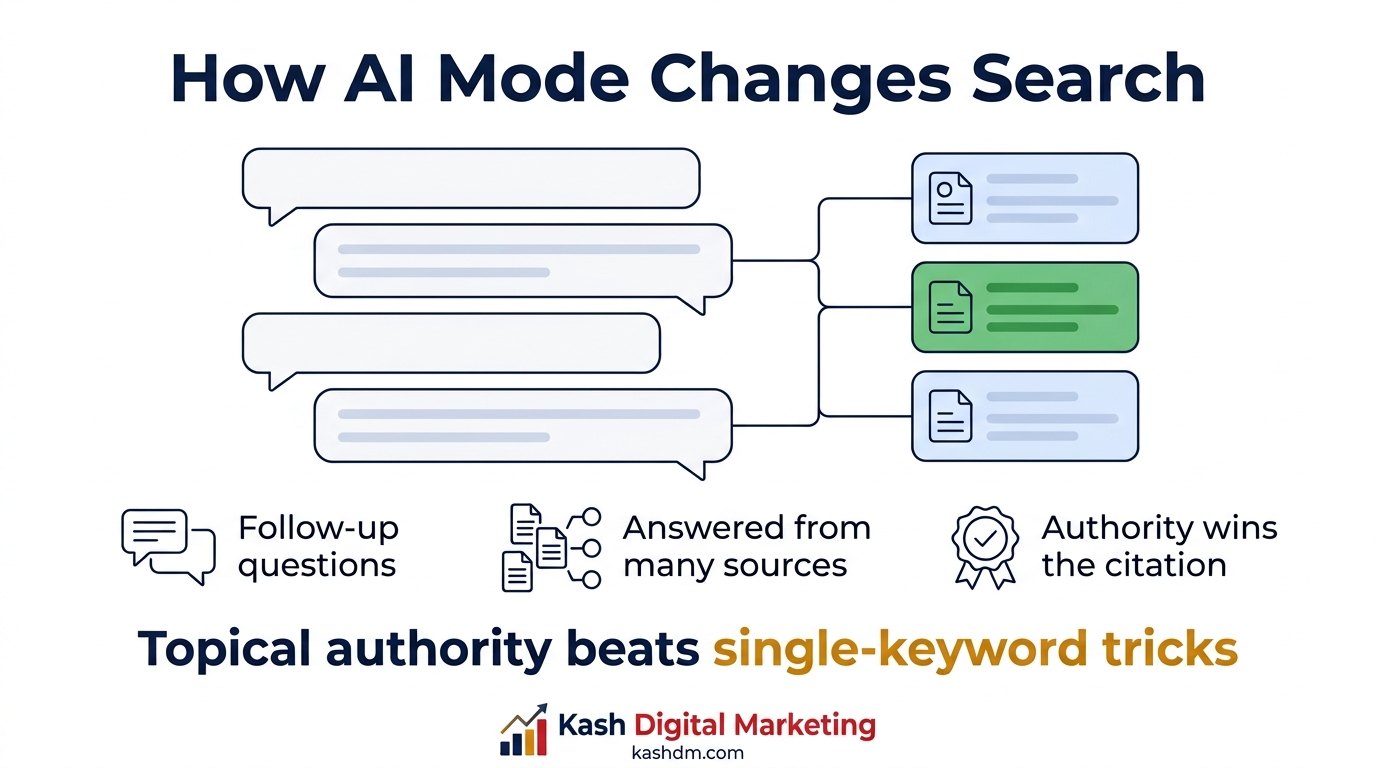
AI Mode is a fuller, conversational search experience where users ask follow-up questions and the system reasons across many sources to answer. It pushes search further from a list of links and closer to a dialogue, and it changes how visibility works for your brand.
How does SEO work in AI Mode?
In AI Mode, a single question can fan out into many sub-questions the system answers from different sources. To be present, you need coverage across the whole topic, not just one keyword, and content clear enough to be pulled into any part of that reasoning. Depth and completeness beat narrow, isolated pages.
This rewards a topic-cluster approach: a strong pillar page supported by focused pages that answer every related question. The more of that territory you own credibly, the more often you appear across an AI Mode conversation.
How will AI Mode change the Google SEO ecosystem?
AI Mode shifts value toward brands that are trusted authorities on a subject and away from pages that ranked on keyword tricks alone. It rewards clarity, structure, and genuine expertise, and it raises the bar on trust because the system is synthesizing rather than just listing. The ecosystem moves toward quality, which favors businesses willing to invest in being genuinely useful.
It also broadens where you can appear. Instead of one blue-link slot per query, you can be referenced across a multi-step answer, so the ceiling on visibility for a strong brand goes up, not down.
How to measure your visibility in Google AI Mode
Measuring AI Mode visibility means tracking which prompts and follow-ups surface your brand, whether you are cited or merely described, and how that changes over time against competitors. It is less about a single ranking number and more about share of voice across the conversations your customers actually have.
We set up this kind of AI-visibility tracking as part of an engagement so you can see, in plain terms, whether AI systems are naming you more often and more favorably over time.
How to Show Up and Get Cited in AI Overviews
Getting into an AI Overview is not a lever you pull, it is the result of being the clearest, most trustworthy answer. Here is the practical, repeatable playbook we use for clients to earn citations.
Answer the question directly and early
Lead each page with a crisp, quotable answer to the exact question, then expand with detail, nuance, and evidence. AI systems lift passages that stand on their own, so make your key sentences self-contained and unambiguous. A reader, or a model, should get the core answer in the first few lines.
This does not mean dumbing content down. It means front-loading the answer and then earning the reader's trust with the depth beneath it.
Structure content for easy retrieval
Use clear headings framed as real questions, short definitional sentences, tidy lists, and tables for comparisons. Add relevant structured data so machines understand what your page is about and can map your answers to questions. This is where classic technical SEO and AI SEO meet, clean markup and clear structure make you easier to parse and quote.
The easier your content is to break into clean, labeled pieces, the easier it is for an AI to lift the right piece into its answer with your brand attached.
Build the trust signals AI relies on
Demonstrate real experience and expertise, cite credible sources, keep information accurate and current, and earn mentions and links from respected sites through off-page SEO. AI systems lean on the same authority signals that classic search does, only more so, because they are staking an answer on your credibility rather than just listing you.
Trust is the hardest signal to fake and the most durable to build. It is also the one that decides, more than any formatting trick, whether you get cited.
Cover the topic completely to earn repeat citations
Answer the follow-up questions a reader would ask next, and the ones after that. Complete, well-organized topic coverage makes you a reliable source the model can return to across many related queries, not just one. That is how a single strong pillar becomes a citation magnet across an entire subject.
Completeness is a competitive moat. When you have credibly answered everything around a topic, competitors with partial coverage simply have fewer chances to be chosen.

How to Optimize Your SEO for Google's AI Overviews Step by Step
Beyond the principles, clients want a concrete sequence. Here is how we optimize a site for AI Overviews in practice, and how you can start.
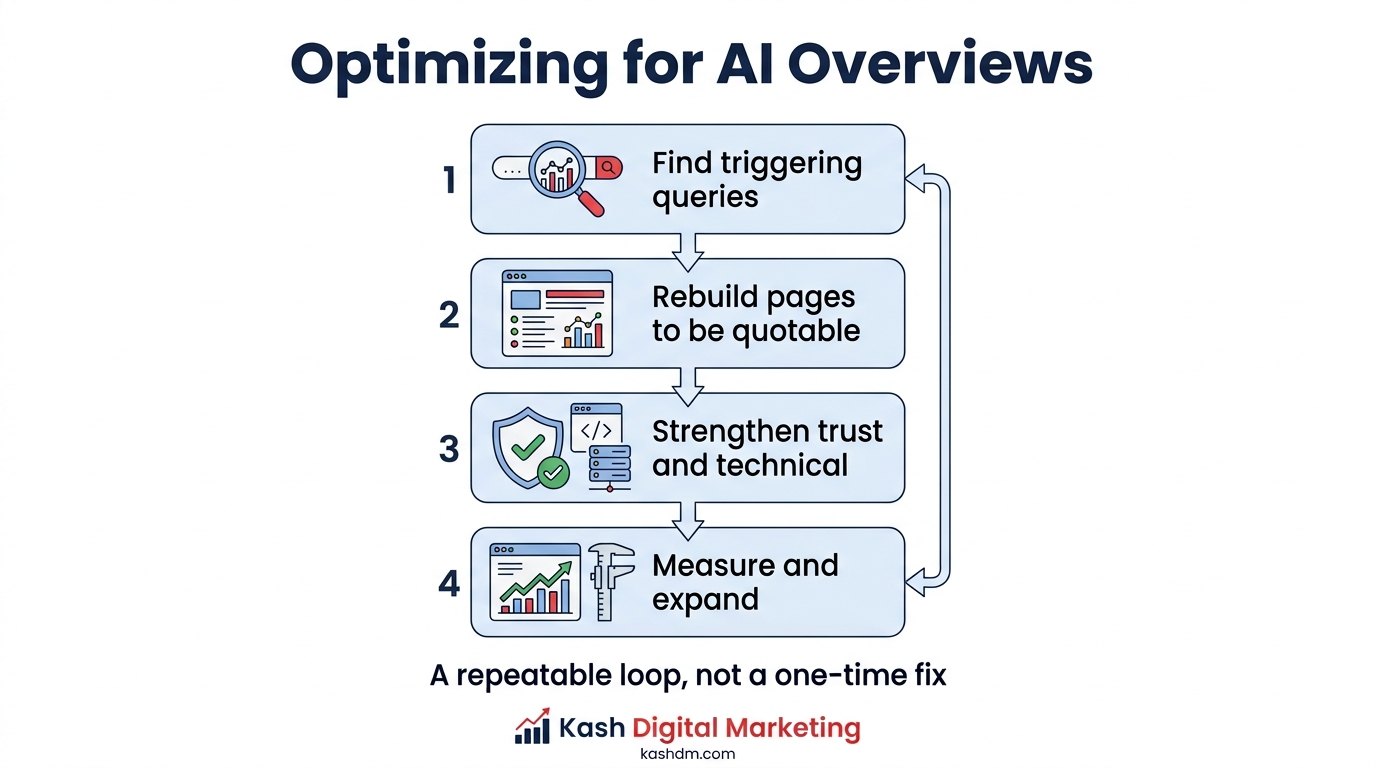
Find the queries that trigger AI Overviews in your market
Start by identifying which of your target questions actually produce an AI Overview, and who is being cited in them. That tells you where the opportunity is, who you are competing with for a citation, and what kind of answer the system currently prefers.
This audit turns a vague goal, "show up in AI," into a specific list of winnable queries and named competitors to displace.
Rebuild pages around the questions being asked
For each priority query, shape the page so a clear answer appears up top, the structure mirrors how people ask, and the supporting detail proves your expertise. Add the comparisons, definitions, and specifics that AI Overviews love to summarize.
Often this is less about writing brand-new pages and more about restructuring good ones so their best answers are surfaced and quotable rather than buried.
Strengthen trust and technical foundations
Make sure the page is fast, crawlable, and marked up with the right structured data, and that the site around it demonstrates real authority on the topic. A brilliant answer on a weak, untrustworthy site is far less likely to be chosen than a strong answer on a credible one.
We treat this as connected work: AI Overview optimization, technical SEO, and authority building are one system, not three separate projects.
Measure, learn, and expand
Track which pages start earning citations and mentions, learn what the winners have in common, and expand that pattern across your topic. AI SEO rewards iteration, the sites that keep refining their best answers keep gaining ground.
AI SEO vs Traditional SEO: What Changes and What Stays the Same
AI SEO does not throw out traditional SEO, it extends it. The foundations that made you rank in classic search are exactly what make AI systems trust you. What changes is where you appear and how you measure success.
What stays the same between AI SEO and traditional SEO
Quality content, sound site architecture, fast and crawlable pages, genuine expertise, and a strong link and mention profile still matter. Skipping the fundamentals to chase AI shortcuts fails in both worlds. If anything, AI raises the stakes on quality, because a synthesizing system is even less forgiving of thin or untrustworthy content.
Anyone who tells you AI SEO means abandoning traditional SEO is selling a shortcut that does not exist. The base is the same, and it is non-negotiable.
What is new and different in AI SEO
You now optimize for being retrieved and quoted, not only ranked. You track your visibility inside AI answers, not just your keyword positions. And you pay closer attention to how your brand is described across the wider web, because that shapes what AI repeats about you. Content also skews toward being clearly quotable, not just comprehensive.
The mental shift is from "rank my page" to "be the trusted source AI assembles its answer from." Same foundation, wider goal.
Which is better, AI SEO or traditional SEO?
This is a false choice. You do not pick one, you do both, because they share a foundation and reinforce each other. Traditional SEO wins the clicks that still happen in classic results, AI SEO wins visibility inside AI answers, and together they cover how customers actually search today. An honest provider integrates them rather than selling AI SEO as a separate, premium replacement.
| Dimension | Traditional SEO | AI SEO |
|---|---|---|
| Goal | Rank a page in the results list | Get cited and recommended inside AI answers |
| Main surface | Blue links | AI Overviews, AI Mode, chat answers |
| Key measure | Keyword rankings and clicks | AI visibility, mentions, and citations |
| Content style | Comprehensive pages | Comprehensive plus clearly quotable |
| Foundation | Quality, trust, technical health | The same, raised even higher |

What Is AEO (Answer Engine Optimization) and How to Do It
Because so many searches now expect a direct answer, Answer Engine Optimization has become a discipline of its own inside AI SEO. Here is what it means and how to apply it.
What is AEO in the context of AI and SEO?
AEO is optimizing your content to be the answer an engine returns, whether that engine is an AI Overview, a chatbot, or a voice assistant. It emphasizes clear question-and-answer structure, factual accuracy, and concise, self-contained responses that an engine can deliver with confidence.
Where classic SEO aims to rank a page, AEO aims to win the answer. In an AI-driven world those goals increasingly point at the same work, done with a sharper focus on directness.
How to merge SEO and AEO for AI visibility
Merging SEO and AEO means keeping your comprehensive, authority-building pages while ensuring each one leads with a clean, quotable answer and is structured for machines to parse. You get the depth that builds trust and the directness that wins answers, in the same asset. That combination is what modern AI visibility rewards.
Practically, that looks like a strong page that opens with a direct answer, backs it with evidence and detail, and is marked up so an engine can map your answers to the questions being asked.
AEO and voice search
Voice assistants are answer engines too, and they read back a single response. AEO thinking, direct answers to natural-language questions, is what earns those spoken results. For local businesses especially, being the answer to "who is the best near me" style questions is valuable ground.

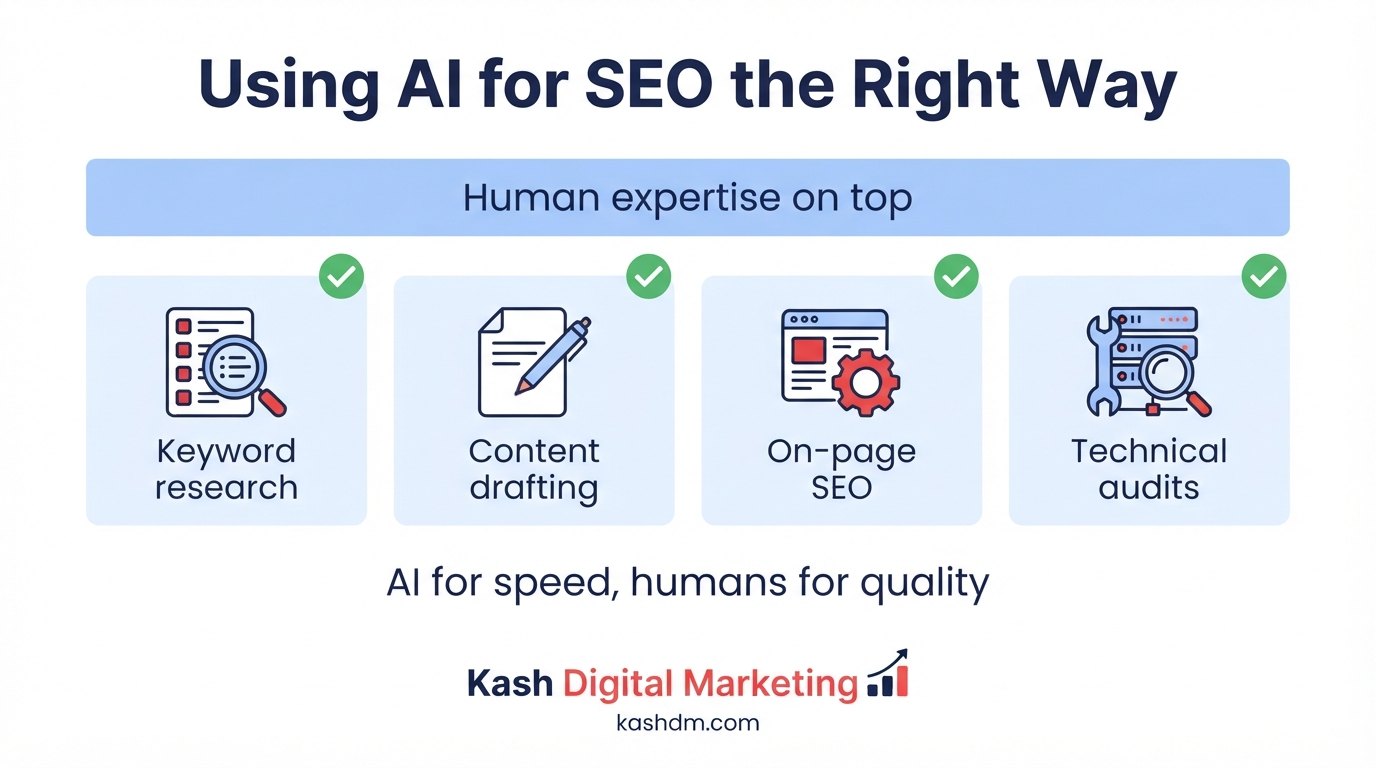
How to Use AI for SEO: Keyword Research, Content, On-Page and Technical
There are two sides to AI SEO: optimizing so AI finds you, and using AI to do SEO work faster and better. Used well, AI tools make your SEO stronger. Used carelessly, they flood your site with generic content that hurts you. This section is the practical guide to the second side.
How to use AI for keyword research and content gap analysis
AI is excellent for expanding a seed topic into the real questions people ask, clustering them into themes, and spotting gaps your competitors have missed. We use it to turn a raw keyword list into a prioritized content map, then verify demand and difficulty with proper search data before committing resources. It is a powerful brainstorming and organizing partner, not a source of truth on its own.
For content gap analysis, AI can compare your coverage against competitors and surface the questions you have not answered yet, which become your next content targets. Turning keywords into AI prompts, then into a structured plan, is one of the highest-leverage uses of AI in SEO.
How to use AI for content drafting and optimization
AI can accelerate outlines, first drafts, and revisions, but every piece needs human expertise, fact-checking, and a genuine point of view before it earns a place on your site. The goal is faster production of content that is still original, accurate, and trustworthy, not mass-produced filler. We treat AI as a drafting assistant and keep experienced humans as editors and owners of the final work.
Used this way, AI raises output without lowering standards. Used the other way, publishing whatever it generates, it quietly erodes the trust your rankings depend on.
How to use AI for on-page SEO
AI speeds up on-page work like drafting title tags, meta descriptions, headings, image alt text, and structured data, and it can suggest internal links and content improvements. A human still reviews and approves the output, because on-page details carry real weight and small errors compound across a site. The pattern is AI drafts, human decides.
Done carefully, this lets a small team keep a large site well-optimized, which used to require far more manual hours.
How to use AI for technical SEO audits
AI helps triage technical SEO issues at scale, spotting patterns across crawl data, flagging likely problems, and drafting fixes. It is a force multiplier for audits, surfacing what to investigate faster than manual review alone. The judgment about what to fix, and how, still belongs to an experienced SEO who understands the tradeoffs.
We use AI to accelerate the diagnosis and keep human expertise on the decisions, which is the balance that produces reliable results rather than confident-sounding mistakes.
How to Write SEO Content With AI Without Getting Penalized
Writing SEO content with AI is one of the most searched topics in this space, and one of the easiest to get wrong. Here is how to do it so it helps rather than harms.
Is AI-generated content good or bad for SEO?
AI-generated content is not automatically good or bad. What matters is whether the final content is helpful, accurate, and trustworthy. Reviewed, fact-checked content shaped by real expertise performs well. Unedited, mass-produced AI text published at scale performs badly and can damage the whole site's credibility. The technology is neutral, the process around it decides the outcome.
Search and AI systems are increasingly good at rewarding genuine helpfulness and demoting low-effort content regardless of how it was made. So the safe strategy is simple: make it genuinely good.
How to write high-quality SEO content with AI
Start with a clear brief and real expertise, use AI to accelerate research and drafting, then have a knowledgeable human add original insight, verify every fact, and shape the piece around a genuine point of view. Ensure it fully answers the question, includes specifics only an expert would know, and reads naturally. The AI handles speed, the human guarantees quality.
The best results come from treating AI as a capable junior writer whose work always gets edited by a senior, never as a publish-ready author.
How to humanize AI content for SEO
Humanizing AI content means more than swapping a few words. It means adding real examples, specific data, a consistent voice, and the judgment and nuance a machine cannot supply, then cutting the generic filler AI tends to produce. Good humanized content is indistinguishable from strong human writing because a human genuinely shaped it.
Avoid the trap of "humanizer" tools that just reshuffle text. The goal is content a real expert would be proud to sign, not text engineered to dodge detection while staying hollow.
How to verify AI content quality before publishing
Before anything goes live, verify the facts against primary sources, check that the advice is actually correct and current, confirm it adds something beyond what already ranks, and read it aloud to catch anything that sounds generic or off. This quality gate is what separates AI-assisted content that ranks from AI content that sinks.

The Best AI SEO Tools and How to Choose the Right Ones
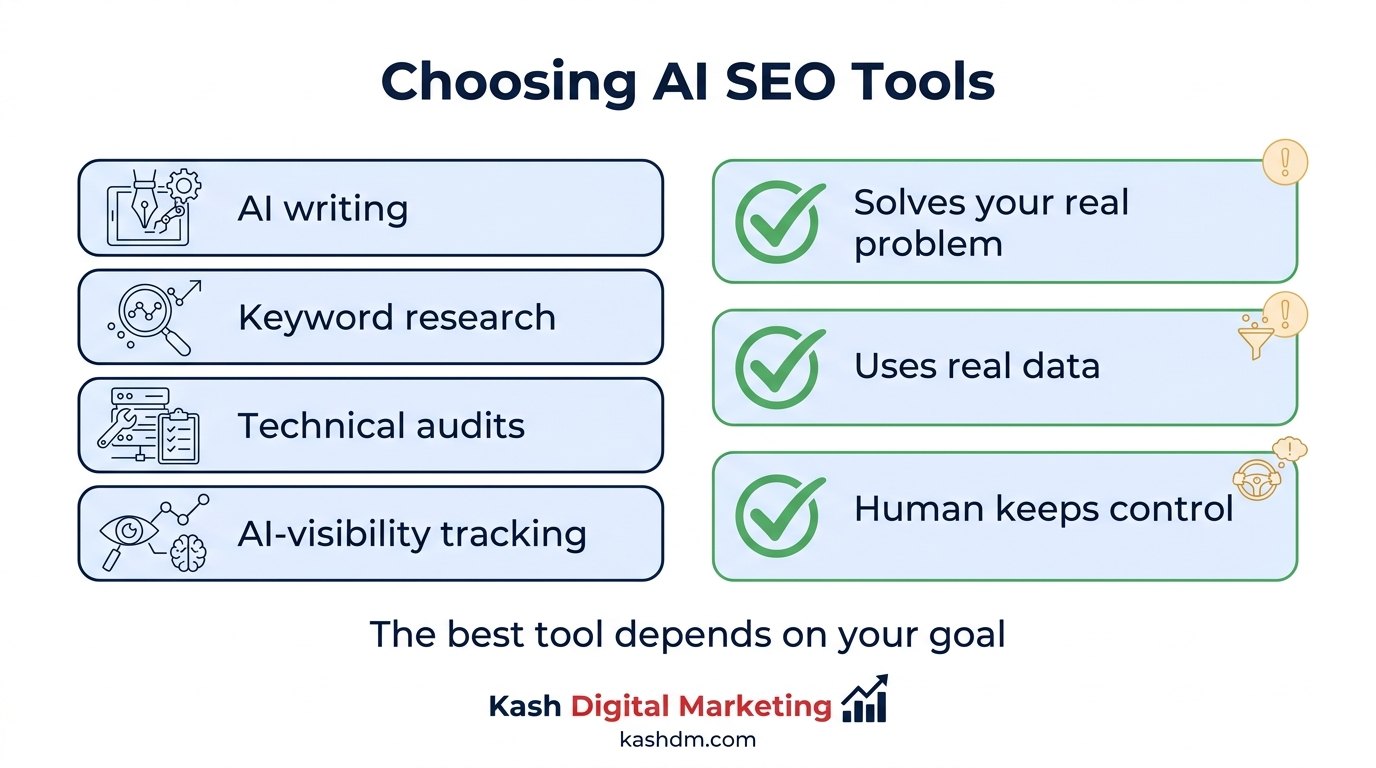
There is a fast-growing market of AI SEO tools for keyword research, content optimization, technical audits, and AI-visibility tracking. Rather than endorse any single brand, here is how to understand the categories and choose the right tools for your situation, because the best tool depends entirely on your goals.
What are the main categories of AI SEO tools?
AI SEO tools generally fall into a few buckets: AI writing and content optimization, AI-assisted keyword and topic research, automated technical SEO auditing, and AI-visibility trackers that show whether you appear in AI answers and how you are described. There are also all-in-one platforms that bundle several of these. Most businesses need one or two well-chosen tools, not the entire market.
Knowing the category you actually need prevents the common mistake of paying for a powerful platform whose main features you never use.
How to choose an AI SEO tool
Start from the problem you are solving, not the feature list. Check that the tool fits your platform and workflow, that a human can review and control its output, that it uses real search data rather than guesses, and that its cost matches the value it returns. Free tools can be a fine starting point before you commit to a paid subscription, and trials let you test fit before you buy.
Be skeptical of tools that promise to fully automate SEO or guarantee AI placements. The useful ones speed up specific tasks, they do not replace strategy or judgment.
Free vs paid AI SEO tools: what do you actually need?
Free AI SEO tools are often enough for early research, small sites, and learning the ropes. Paid tools earn their cost when you need scale, deeper data, automation, or AI-visibility tracking across many prompts and competitors. The right answer is rarely "buy the most expensive," it is "match the tool to the stage and size of your business."
For most small and mid-size businesses, a lean stack plus expert human work outperforms an expensive pile of tools nobody has time to use well.
Why tools do not replace strategy
A tool automates tasks, it does not decide what matters, judge quality, or own the outcome. The results come from the strategy behind the tool and the expertise reviewing its output. That is the part we bring to every engagement, and it is why two businesses using the same tools can get very different results.
How to Measure AI Visibility, Share of Voice and Citations
Classic keyword rankings tell only part of the story now. To know whether your AI SEO is working, you measure whether AI systems find, cite, and recommend you, and whether that turns into real business.
What is AI visibility and how do I track it?
AI visibility tracks how often, and how favorably, your brand appears in AI answers for the prompts your customers use. Tracking it means monitoring a set of important prompts across AI systems, noting when you appear, whether you are cited or merely mentioned, and how accurately you are described. That baseline is what you improve against over time.
Without tracking, AI SEO is guesswork. With it, you can see which efforts move your presence in AI answers and double down on what works.
What is share of voice in AI search?
Share of voice in AI search compares your presence against competitors across the prompts that matter, so you can see whether you are gaining or losing ground. It answers the real question behind AI SEO: when customers ask AI about your category, how often is it you being named versus someone else? Rising share of voice is the clearest sign your AI SEO is compounding.
What is prompt volume and citation analysis?
Prompt volume is a sense of how often people ask the questions where you could appear, and citation analysis looks at which sources, including yours, AI systems actually cite for those prompts. Together they show where the demand and the opportunity are, and which competitors you need to displace to win a citation.
How to measure AI SEO performance beyond rankings
The metrics that ultimately matter are still leads, calls, and revenue. AI visibility, share of voice, and citations are leading indicators, business outcomes are the proof. We report both in plain language, the same way we do for every service, so you never have to take AI progress on faith.

AI SEO for Ecommerce Stores
AI SEO is not one-size-fits-all, and online stores have specific opportunities and pitfalls. Here is how AI search changes ecommerce SEO and how to win it.
How do ecommerce businesses use AI for SEO?
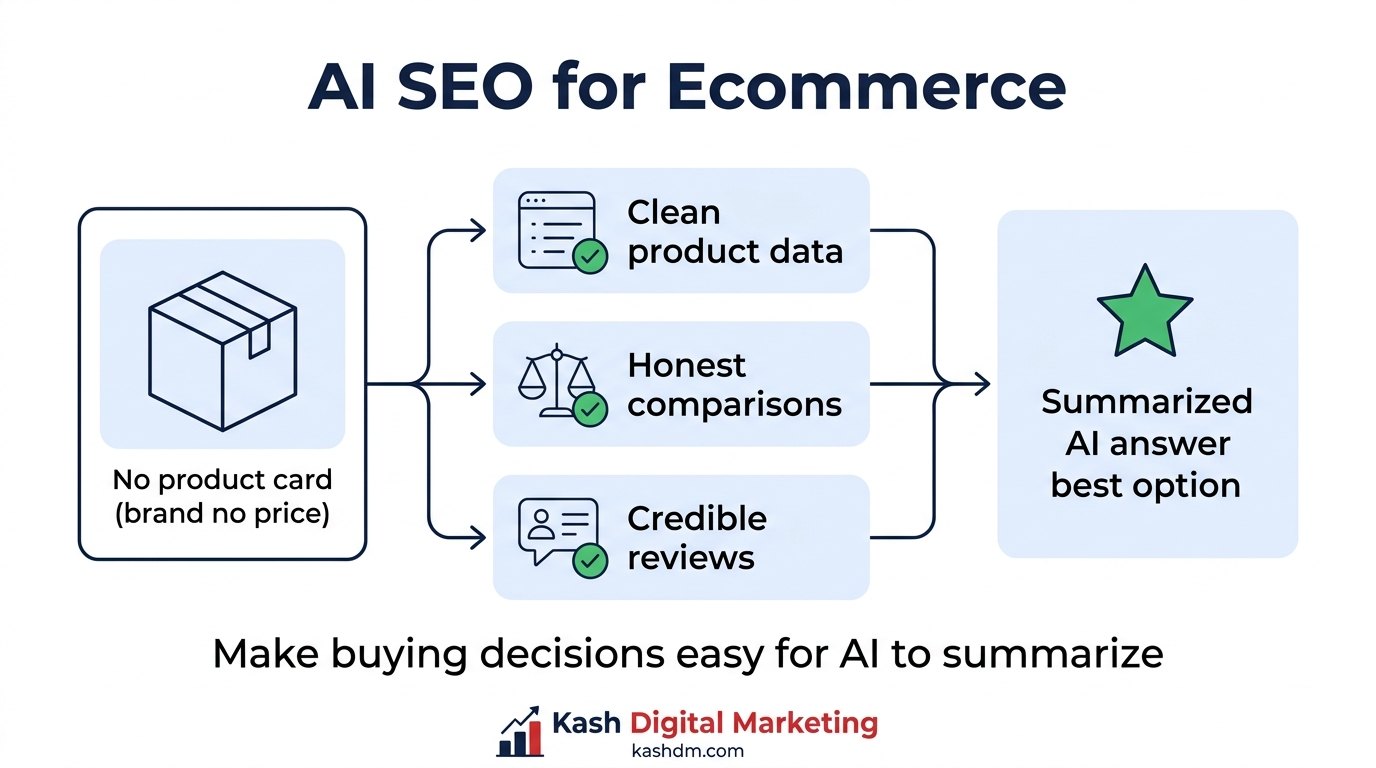
Ecommerce brands use AI to generate and optimize product and category content at scale, structure product data cleanly, analyze competitor catalogs, and answer the comparison and buying questions shoppers ask. The catch is scale without quality control creates thin, duplicative pages, so human review and strong data hygiene are essential. It builds directly on our ecommerce SEO work.
Used well, AI helps a store keep thousands of pages accurate, differentiated, and useful, which is exactly what AI search rewards.
How to optimize product content for AI answers
AI systems summarizing "best X for Y" questions favor clear specifications, honest comparisons, credible reviews, and content that genuinely helps someone choose. Structured product data and clean markup make your details easy to lift into an answer. The stores that win are the ones that make buying decisions easier, not just the ones with the most pages.
AI SEO for Shopify, WooCommerce and other platforms
The principles are the same across platforms, clean structure, strong product data, credible reviews, and helpful content, but the implementation differs by platform. We adapt the technical setup to your store, whether it runs on Shopify, WooCommerce, or something custom, so AI systems can parse and trust your catalog.
AI SEO for Local Businesses and Near Me Searches
For local businesses, AI increasingly powers recommendation-style and "near me" questions. Being the business an AI names when someone nearby asks for help is enormously valuable.
How can AI help with local SEO?
AI increasingly answers "who is the best near me" style questions by synthesizing reviews, profiles, and local information into a recommendation. To be named, you need consistent local data, strong and recent reviews, and a well-optimized profile, everything we build in local SEO, now feeding AI answers as well as the map pack. AI also speeds up local content creation and review analysis behind the scenes.
The businesses that already do local SEO well have a head start, because the same signals that win the map pack, consistency, reviews, and relevance, help AI recommend them.
How to optimize local content for AI recommendations
Publish genuinely useful local content, keep your business information identical everywhere it appears, earn and respond to reviews, and make your service areas and specialties clear. AI assembles a local recommendation from many signals, so consistency and credibility across all of them is what earns the mention.
AI SEO for service-area and multi-location businesses
For businesses serving multiple areas or locations, the challenge is keeping every location's information accurate, distinct, and credible so AI can confidently recommend the right one. We structure local content and data so each location earns its own visibility rather than blurring together.

AI SEO for Professional Services, Healthcare and SaaS
Trust-heavy and technical industries have distinct AI SEO needs, because accuracy and credibility carry even more weight when the stakes are high.
AI SEO for law firms and professional services
For professional services like law firms, accountants, and advisors, AI systems are cautious about what they cite because the answers carry real consequences. Demonstrable expertise, careful sourcing, clear author credentials, and accurate, current information are what make a model comfortable naming you. Thin or salesy content is a liability here more than anywhere.
Winning AI visibility in these fields is largely about proving genuine authority, which is exactly what earns high-value clients regardless of the channel.
AI SEO for healthcare and high-trust brands
For healthcare and other high-trust brands, accuracy and credibility are everything. AI systems are especially careful with health topics, so verifiable expertise, correct information, and responsible, well-sourced content are essential to being cited. We build this with the same care and E-E-A-T focus our healthcare clients already rely on.
AI SEO for SaaS and B2B
For SaaS and B2B brands, buyers now research with AI throughout a long, considered journey. Being the source AI cites on the problems your product solves, across comparisons, how-tos, and category questions, puts you in front of buyers early and often. It extends the authority-building work in our enterprise and SaaS SEO approach into AI surfaces.

How to Adapt Your SEO Strategy and Budget for AI Search
You do not need to tear up your SEO plan for AI search. You need to adjust where you focus and fund the work that now matters most.
How to adapt your SEO strategy for AI search
Shift some effort from chasing thin keyword pages toward complete, clearly answerable content on the questions your buyers actually ask, invest more in brand authority and mentions, and add AI-visibility tracking so you can see your progress. The strategy is not a reinvention, it is a rebalancing toward quality, trust, and measurement.
Keep your high-intent commercial pages strong, because those still drive the leads, and evolve your informational content to earn citations rather than just clicks.
How to adjust your SEO budget for AI search
Adapting your SEO budget for AI search usually means funding three things: stronger content quality, brand mentions and authority across the web, and AI-visibility tracking. It rarely means spending more overall, it means spending it on what now moves the needle instead of on low-value tactics. After a free audit, we scope this to your specific goals rather than selling a fixed package.
The businesses that overspend are usually the ones chasing every new AI tool. The ones that get results fund quality and authority, which pay off across every search surface.
How to future-proof your SEO for AI search
The durable strategy is the unglamorous one: be genuinely useful, genuinely trustworthy, and technically sound. Brands built on that foundation adapt to each new AI feature instead of scrambling after it, because the qualities AI rewards, clarity, accuracy, and authority, are stable even as the surfaces change.
Chasing hype is expensive and fragile. Building real authority is the one investment that keeps paying as the search landscape keeps shifting.

Will AI Replace SEO? Myths, Reality and the Future
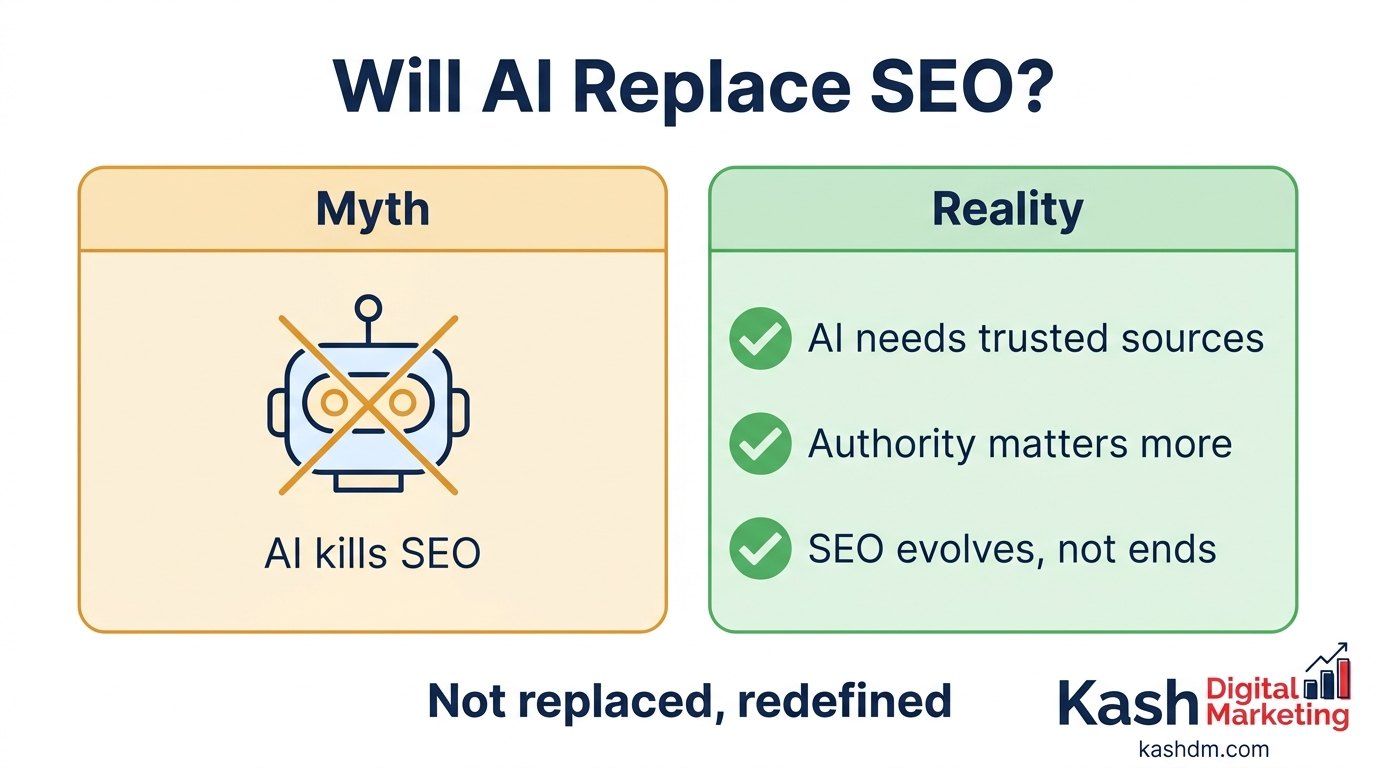
The most common questions we hear are variations of "will AI replace SEO," "will AI kill SEO," and "what is the future of SEO with AI." The short answer: AI is not replacing SEO, it is changing what SEO looks like, and the businesses that adapt will pull ahead.
Why SEO is not going away
AI systems need trustworthy sources to build their answers, and they still rely on the open web to find them. That means the work of being a clear, credible, well-structured source, which is what SEO is, matters more than ever, not less. Remove SEO and AI has nothing reliable to cite. The discipline is evolving, not disappearing.
Every past prediction that some new technology would kill SEO has been wrong for the same reason: search keeps needing good sources, and helping search find and trust yours keeps being valuable.
What actually changes in the future of SEO with AI
What changes is the mix: more emphasis on brand authority, clear answers, and visibility inside AI surfaces, and less reliance on ranking thin pages for isolated keywords. Measurement broadens from rankings to AI visibility. Content quality standards rise. The fundamentals endure, the tactics evolve, and the winners are those who treat AI as an extension of good SEO rather than a threat to it.
Why is SEO still important in the age of AI?
SEO is still important because it is how you earn the trust, structure, and authority that both classic search and AI systems reward. In an AI-first world, being the source that gets cited is more valuable than ever, and that is exactly what modern SEO produces. The channel is not dying, its ceiling is rising for brands willing to invest in quality.
Is AI Content Bad for SEO? What Google and AI Engines Actually Reward
This deserves its own section because so many businesses are anxious about it, and the anxiety often leads to the wrong decision in both directions.
What Google and AI engines reward
Both classic search and AI engines reward content that is genuinely helpful, accurate, original, and trustworthy, regardless of how it was produced. They increasingly demote content that is thin, derivative, or unreliable, again regardless of how it was made. The question is never "was AI involved," it is "is this genuinely useful and credible."
When AI content helps and when it hurts
AI content helps when it is used to work faster while a human guarantees quality, accuracy, and originality. It hurts when it is published unreviewed at scale, producing generic pages that add nothing and drag down the site's credibility. The same tool produces both outcomes, the difference is entirely in the process.
How to avoid AI content penalties
Avoid AI content problems by keeping expert humans in charge of quality, fact-checking everything, adding genuine insight and specifics, and never publishing at a scale you cannot review. If every page would make a knowledgeable person nod rather than wince, you are on safe ground.

What Is an AI SEO Agency and How to Choose One
Many businesses ask which agencies offer top AI SEO services, what an AI SEO agency actually does, and how to tell a real one from hype. Here is a clear-eyed guide.
What does an AI SEO agency do?
An AI SEO agency helps you get found in both classic and AI search by building the content, technical foundations, structured data, and brand authority that make AI systems trust and cite you, and by tracking your visibility inside AI answers. A good one treats AI SEO as an extension of proven SEO expertise, not a separate gimmick, and reports on real business outcomes.
The work spans strategy, content, technical SEO, off-page authority, and measurement, integrated so that improvements compound across every search surface.
How to choose the right AI SEO agency
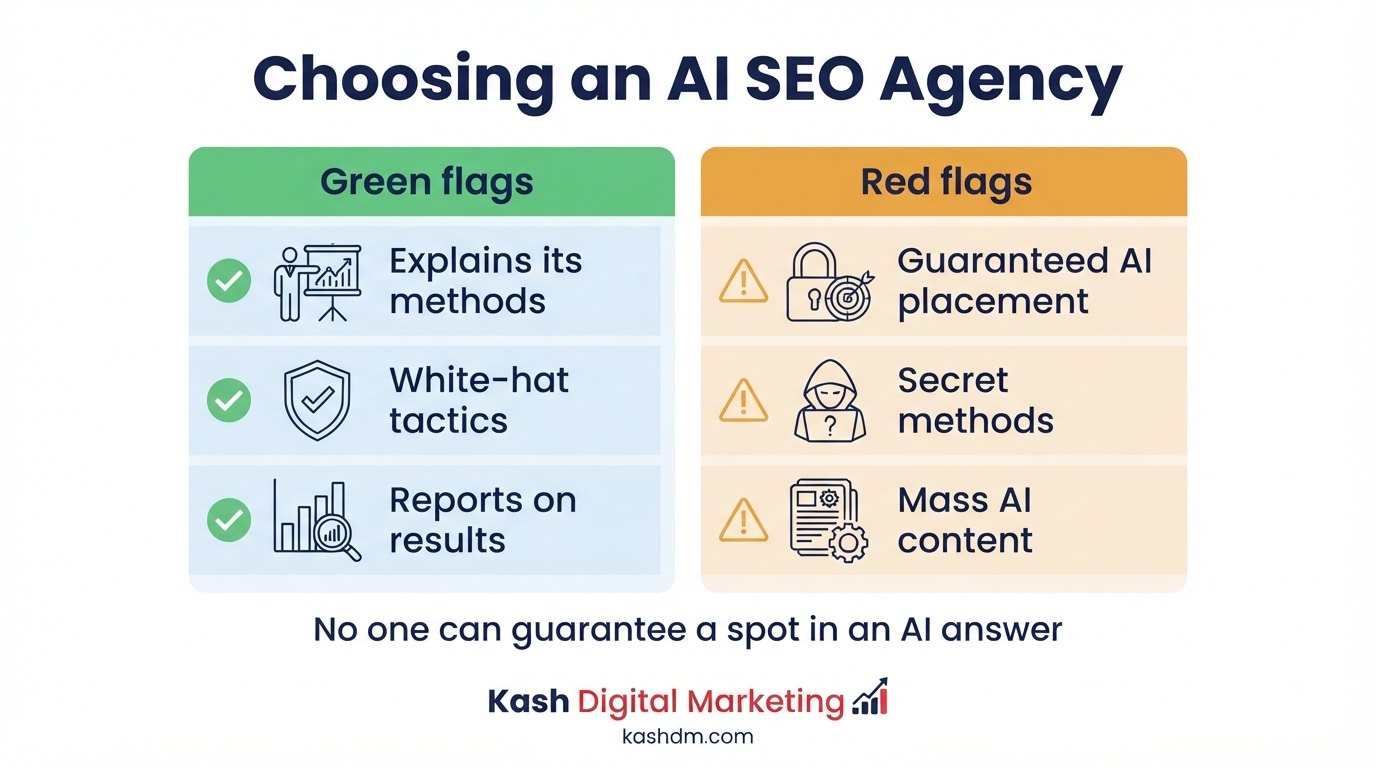
Look for a provider that explains its methods plainly, uses white-hat tactics, integrates AI SEO with strong traditional SEO, and reports on leads and revenue rather than vanity metrics. Ask how they will earn citations, how they measure AI visibility, and how they keep AI-assisted content high quality. Be wary of anyone promising guaranteed placement inside AI answers, because no one can honestly guarantee that.
The best filter is simple: a real AI SEO agency can explain exactly what they will do and why, in plain language, and can show how it ties back to your business results.
Red flags when hiring for AI SEO
Watch for guaranteed AI placements, secrecy about methods, reliance on mass-produced AI content, pressure tactics, and pricing with no connection to scope. Our best SEO services guide covers how to vet any provider, and the same standards apply, doubly, when AI is part of the pitch.
How Much Does AI SEO Cost?
Cost is one of the most common questions, and one where honesty matters most. Here is how AI SEO pricing actually works, without the games.
What drives the cost of AI SEO?
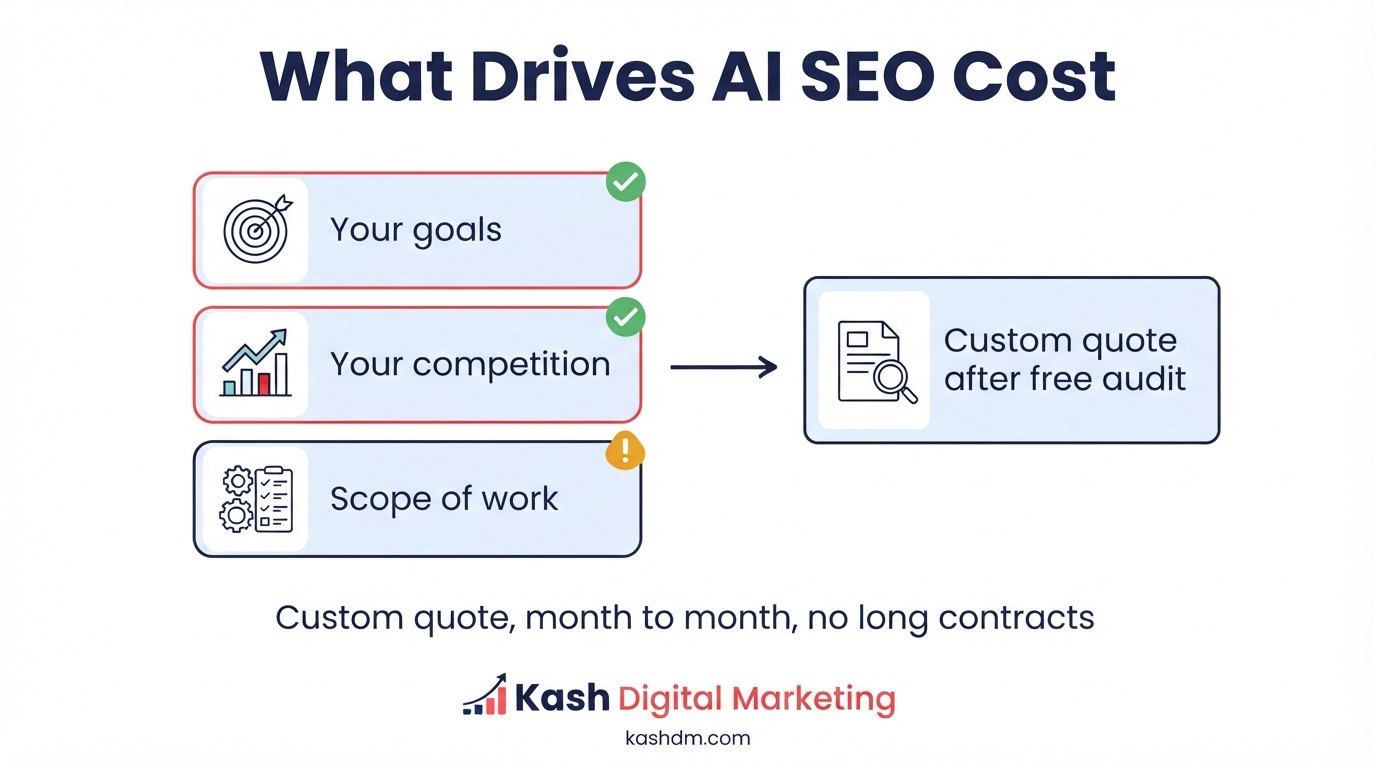
AI SEO cost depends on your goals, your competition, the size of your site, and how much content and authority work is needed to move your visibility. A local business in a light market needs far less than a national brand fighting for citations in a competitive category. Anyone quoting a firm price before understanding your situation is guessing.
Because AI SEO builds on the same foundations as traditional SEO, its cost overlaps heavily with good SEO generally, plus the added work of AI-visibility tracking and quotable-content optimization.
How we price AI SEO
We scope a custom quote after a free audit rather than selling a fixed package, and we work month to month with no long contracts. The audit tells us what your situation actually requires, so the quote reflects real scope instead of a one-size-fits-all number. You can read how our quoting works on the SEO pricing page.
This approach means you pay for the work that will actually move your business, not for a tier designed to fit the most customers into the fewest boxes.
How to get the best return on AI SEO spend
The best return comes from funding quality content, genuine authority, and measurement, and from integrating AI SEO with your traditional SEO rather than paying twice for overlapping work. Start with a free audit so your first dollar is spent on the highest-impact opportunities rather than guesswork.
Our AI SEO Services and How We Work
Kash Digital Marketing helps US businesses get found in both classic search and AI search, with one honest, white-hat approach. We do not chase shortcuts, and we do not sell hype. We build the authority and clarity that make AI systems trust and cite your brand.
What our AI SEO engagement includes
We start with an AI-readiness and visibility audit, then build a plan across content, technical foundations, structured data, brand authority, and AI-visibility tracking. Every recommendation ties back to leads and revenue, not vanity metrics, and every AI-assisted piece passes through experienced human editing before it goes live.
You get a clear picture of where you stand in AI search today, a prioritized plan to improve it, and plain-language reporting on progress, all integrated with the traditional SEO that still drives a large share of your results.
Our AI SEO process step by step
We audit your current visibility across classic and AI search, identify the highest-value queries and gaps, strengthen your content and technical foundations, build the brand authority that earns citations, and track your AI visibility over time so we can keep refining. It is the same disciplined, transparent process our clients already trust, extended to AI surfaces.
Why work with Kash Digital Marketing for AI SEO
We combine real SEO expertise with a careful, quality-first approach to AI, we explain everything in plain language, we use only white-hat tactics, and we keep you in control of your own accounts and data. We work month to month, because we would rather earn your business every month than lock you in. See our standards on the best SEO services guide.

Your AI SEO Implementation Checklist
If you want a starting point you can act on today, here is the checklist we work through with clients, in plain order of priority.
Foundations to get right first
Make sure your site is fast, crawlable, and technically sound, your most important pages answer real questions clearly, and your business information is consistent everywhere it appears. Without these, no amount of AI-specific tactics will land.
- Fast, crawlable, mobile-friendly site with clean structured data
- Priority pages that lead with clear, quotable answers
- Consistent brand and business information across the web
- Genuine expertise and credentials visible on the page
- A healthy profile of quality links and brand mentions
AI-specific moves to layer on top
Once the foundations are solid, add the AI-specific work: map which queries trigger AI Overviews, structure content for retrieval, earn citations through authority, and track your AI visibility so you can measure progress.
- Identify which target queries produce AI Overviews and who is cited
- Restructure priority pages to be directly quotable
- Build brand authority and mentions to earn citations
- Set up AI-visibility and share-of-voice tracking
- Review and improve based on what earns citations
What to avoid
Do not publish unreviewed AI content at scale, do not chase every new tool, do not trust guaranteed-placement promises, and do not treat AI SEO as separate from your real SEO. The shortcuts all lead to the same place, wasted budget and lost trust.

How to Do AI SEO: A Step-by-Step Approach
If you want the whole discipline distilled into a sequence you can follow, here is how to do AI SEO from a standing start, whether you run it yourself or brief a team.
Step one: audit your current AI visibility
Before changing anything, find out where you stand. Check whether AI Overviews, AI Mode, and answer engines currently name your brand for the questions that matter, and note who they name instead. This baseline turns a vague ambition into a specific, measurable starting point and reveals your most winnable opportunities.
An honest audit almost always surfaces surprises, queries where a weaker competitor is being cited simply because they answered more clearly. Those are the fastest wins.
Step two: fix foundations and map opportunities
Make sure your site is fast, crawlable, and technically clean, then map your priority topics to the questions your buyers ask and to which of those trigger AI answers. Prioritize by value and winnability so your effort goes where it will pay back fastest, not where it is merely easiest.
This is where AI SEO and technical SEO are inseparable. A great answer on a slow, hard-to-crawl site rarely gets chosen.
Step three: create and restructure quotable content
For each priority topic, build or rework a page that leads with a clear answer, proves real expertise, and is structured so machines can lift the right passage. Cover the topic completely, including the follow-up questions, so you become a source AI returns to across many related prompts.
Step four: build authority and track results
Earn the mentions and links that make AI systems trust you, then track your AI visibility over time and keep refining based on what earns citations. AI SEO is not a one-time project, it is a loop of publish, measure, and improve. The brands that treat it that way compound their lead.

AI SEO Trends Shaping 2025 and 2026
AI search is moving quickly, and understanding the direction of travel helps you invest in what will still matter next year rather than chasing this month's novelty.
The shift from clicks to citations
The clearest trend is that visibility increasingly means being cited inside an answer, not just ranked in a list. Brands are adapting their measurement and their content to earn and track citations, and the ones doing it early are building an advantage that is hard to catch. Expect citation-based visibility to keep growing in importance through 2026.
Brand and authority as the deciding factors
As AI systems synthesize answers, they lean harder on which brands are trusted authorities on a topic. That pushes value toward genuine expertise, digital PR, and consistent brand presence, and away from thin, keyword-built pages. Authority is becoming the most durable AI SEO asset a business can own.
AI-visibility tracking becomes standard
Just as rank tracking became standard in classic SEO, tracking your presence in AI answers is becoming a normal part of the toolkit. Businesses want to know their share of voice inside AI, and tools and services are maturing to provide it. Measuring AI visibility is shifting from nice-to-have to expected.
Quality standards keep rising
Every iteration of AI search gets better at rewarding genuinely helpful content and discounting low-effort filler. The trend punishes shortcuts and rewards depth, accuracy, and originality, which is good news for any business willing to invest in real quality.

Common AI SEO Mistakes and How to Avoid Them
Most AI SEO failures come from a handful of avoidable mistakes. Knowing them upfront saves budget and protects your credibility.
Publishing unreviewed AI content at scale
The single most damaging mistake is treating AI as a publish button, flooding a site with generic, unedited content. It dilutes quality, erodes trust, and can drag down the whole domain. Avoid it by keeping expert humans in charge of quality and never publishing at a scale you cannot properly review.
Treating AI SEO as separate from real SEO
Businesses that buy AI SEO as a bolt-on gimmick, disconnected from their fundamentals, waste money. AI SEO only works on a foundation of quality content, technical health, and authority. Integrate it with your existing SEO rather than paying twice for overlapping work.
Chasing hype and every new tool
The novelty in AI is endless, and chasing all of it is a fast way to burn budget with little to show. Focus on the durable levers, quality, trust, clarity, and measurement, and adopt new tools only when they solve a real problem you actually have.
Believing guaranteed-placement promises
No one can honestly guarantee a spot inside an AI answer, and anyone who promises it is signaling either dishonesty or misunderstanding. Treat guarantees as a red flag, and expect a credible provider to talk in terms of earning visibility, not buying it.

What Are AI SEO Agents and Autonomous AI SEO?
A newer wave of tools promises AI agents that carry out SEO tasks with less human input. Here is what that means and where it genuinely helps.
What is an AI SEO agent?
An AI SEO agent is software that can carry out multi-step SEO tasks with some autonomy, for example researching a topic, drafting content, or triaging technical issues, rather than just answering a single prompt. They are useful for automating repetitive work, but they operate best inside guardrails set and reviewed by an experienced human.
The promise is speed and scale on routine tasks. The limit is judgment, an agent does not understand your business goals, brand, or risk tolerance the way a strategist does.
Where autonomous AI SEO helps and where it does not
Autonomous tools help with high-volume, well-defined tasks like generating draft metadata, monitoring for issues, or organizing research. They do not replace strategy, quality control, or accountability, and handing them the keys without oversight is how sites end up with scaled-up mistakes. The right model is agents for speed, humans for direction and judgment.
How we use automation responsibly
We use AI automation to move faster on the repetitive parts of SEO while keeping experienced people in charge of strategy, quality, and every decision that affects your brand. That balance captures the efficiency of automation without inheriting its risks, which is exactly what clients want from a modern, careful agency.

Frequently Asked Questions About AI SEO
What is AI SEO and how does it work?
AI SEO is optimizing your website and brand so AI systems like Google AI Overviews, AI Mode, ChatGPT, and Perplexity find, trust, and cite you. It works by combining strong traditional SEO foundations, clear content, sound technical setup, and genuine authority, with content structured so AI can easily lift and quote the right answer. In short, it makes your brand a source AI is confident to name.
What is AI SEO called? Is it GEO or AEO?
You will hear AI SEO called GEO (Generative Engine Optimization), AEO (Answer Engine Optimization), AIO (AI Optimization), and LLM SEO. They all describe the same core goal from different angles: earning a place inside AI-generated answers. You do not need to pick a label, you need to build the clarity, trust, and structure they all reward.
How do I show up in Google AI Overviews?
Answer the exact question clearly and early on the page, structure content with question-style headings and clean lists, add relevant structured data, and build real trust through expertise, accurate information, and quality links and mentions. Being a complete, credible, easy-to-quote source is what earns a citation. There is no trigger word or setting that forces your way in.
Will AI replace SEO?
No. AI is changing how SEO works, but it still depends on trustworthy web sources to build its answers. The businesses that adapt, focusing on authority, clarity, and AI visibility, will gain an advantage rather than lose out. SEO is evolving into something broader, not disappearing.
How is AI SEO different from traditional SEO?
Traditional SEO focuses on ranking pages in the list of results. AI SEO extends that to being cited and recommended inside AI answers. The trust foundations are the same, but you also optimize for retrieval and being quoted, and you measure your visibility inside AI systems, not only keyword rankings. You do both, because they reinforce each other.
What are the best AI SEO tools?
The best tool depends on your goal. Categories include AI writing and content optimization, AI keyword research, automated technical audits, and AI-visibility trackers. Choose based on the problem you are solving, real data quality, platform fit, and cost, and always keep a human reviewing the output. For most businesses, a lean stack plus expert work beats an expensive pile of tools.
Is AI-generated content bad for SEO?
Unedited, mass-produced AI content is bad for SEO. AI content that is reviewed, fact-checked, and shaped by genuine expertise can perform well. The deciding factor is whether the content is genuinely helpful, accurate, and original, not whether AI helped create it. Keep experts in charge of quality and AI becomes an asset.
How much does AI SEO cost?
It depends on your goals, your competition, and how much content and authority work is needed. We scope a custom quote after a free audit rather than selling a fixed package, and we work month to month with no long contracts. Because AI SEO builds on the same foundation as traditional SEO, it often overlaps heavily with the SEO work you already need. See our SEO pricing page for how quoting works.
Which agencies offer AI SEO services, and how do I choose?
Choose an agency that treats AI SEO as an extension of proven SEO expertise, explains its methods, uses white-hat tactics, integrates AI and traditional SEO, and reports on real business results. Avoid anyone guaranteeing placement inside AI answers. Our free AI SEO audit is a low-risk way to compare us against that standard.
How do I measure whether my AI SEO is working?
Track your AI visibility and share of voice, which prompts surface your brand, and whether you are cited or merely mentioned, then tie all of it back to leads, calls, and revenue. AI visibility is the leading indicator, business outcomes are the proof. We report both so you never have to take progress on faith.
Can AI do SEO on its own?
No. AI can accelerate specific SEO tasks, research, drafting, audits, and analysis, but it cannot set strategy, verify quality, exercise judgment, or own the outcome. The best results come from AI handling speed while experienced humans handle strategy and quality. Fully automated SEO is a promise to be skeptical of.
How do I get started with AI SEO?
Start with a free audit that shows where your brand stands in AI search today and what the highest-impact opportunities are. From there, fix your foundations, restructure your priority pages to be quotable, build authority, and set up AI-visibility tracking. We can do all of this for you, or advise your team on doing it well.
Get Your Free AI SEO Audit
Request Your Free SEO Audit
Prefer to talk it through? WhatsApp US +2135622433 or WhatsApp PK +92 348 3879366. We usually reply within an hour, and always within 8 hours.
See exactly where your brand stands in AI search today, whether AI Overviews and answer engines are naming you or your competitors, and what a clear, white-hat plan to fix it would look like. Your free AI SEO audit reviews your visibility across classic and AI search, your technical foundations, your content, and your biggest opportunities, and hands you a prioritized action plan, yours to keep whether or not you work with us.
Ready to get your brand cited in AI answers? Request your free AI SEO audit and we usually reply within an hour, and always within 8 hours on business days.