The best SEO services are transparent about their methods, report on real business outcomes instead of vanity metrics, use only white-hat tactics, and treat your rankings as a long-term asset rather than a quick sale. That single sentence is worth more than most "top 10 SEO companies" listicles, because it gives you a standard you can apply to any provider you're evaluating, including us.
This guide exists because SEO is one of the easiest services to sell badly. It's technical enough that most business owners can't verify the work themselves, results take months to show up, and by the time a bad agency's shortcuts backfire, the contract is long signed and the damage is done. Search "best SEO services" and you'll mostly find agencies ranking their own listicles, which tells you nothing except that they're good at ranking listicles.
Instead, this page teaches you how to evaluate any SEO provider on your own terms: what questions to ask, what red flags mean walk away, how to read a case study without being fooled, what a fair contract looks like, and how to tell real reporting from a wall of impressive-sounding noise. We'll also be upfront about where Kash Digital Marketing fits, and why we built our own process around the same standard we're asking you to use to judge us.
⭐ 5.0 rating · ✅ Google & Meta certified · ⚡ Reply usually within an hour · 🛡️ 100% white-hat · 🇺🇸 Serving US local businesses
What "Best SEO Services" Actually Means
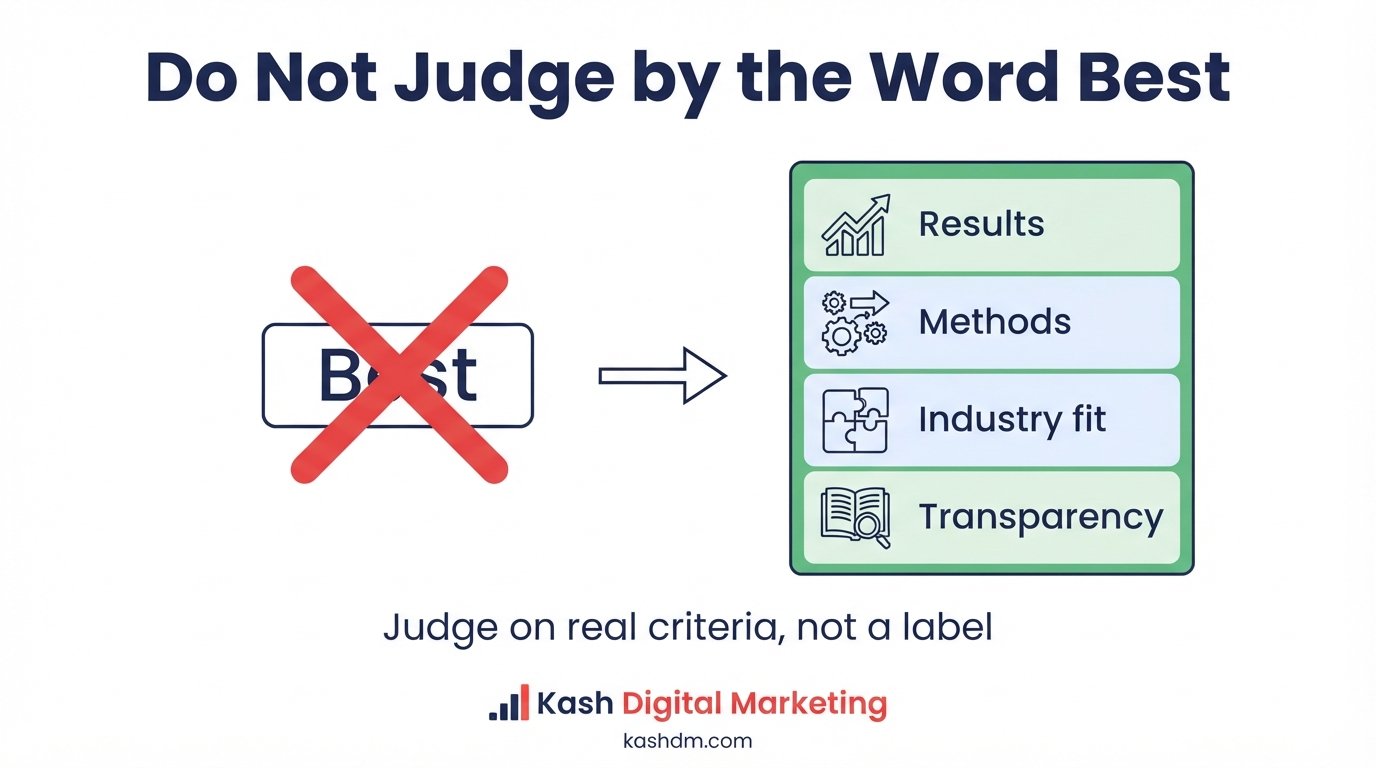
The best SEO services are not the ones with the flashiest website or the loudest guarantees, they're the ones that consistently grow qualified organic traffic and revenue while protecting your site from penalties. "Best" is a subjective word that agencies exploit constantly, but it has an objective core: results that are real, sustainable, and attributable to specific work.
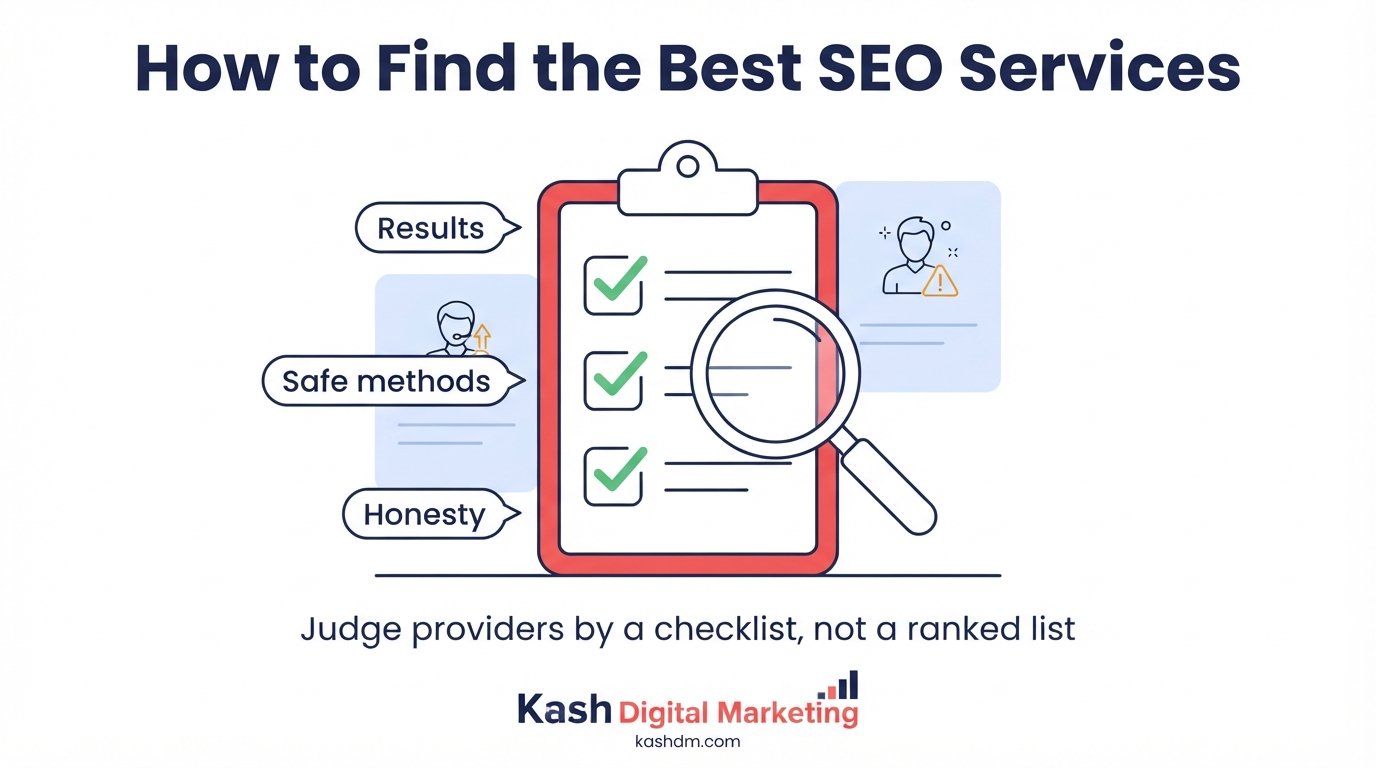
When you search for the best SEO services, you're really asking three separate questions at once. Will this provider actually improve my rankings and traffic? Will they do it safely, without risking a Google penalty that sets me back years? And will they be honest with me about what's working and what isn't? Any agency that can answer yes to all three, and prove it, belongs on your shortlist. Any agency that dodges even one of those questions should not.
Why "best" varies by business type
The best SEO services for a single-location plumbing company are not the same as the best SEO services for a national ecommerce brand or a SaaS company selling to enterprise buyers. A local business needs Google Business Profile work, citations, and review generation. An ecommerce site needs product-page optimization and technical crawl efficiency at scale. There is no universal "best," only the best fit for your specific business model, budget, and goals.
Results, safety, and honesty are the three pillars
Every evaluation in this guide comes back to these three pillars. Results without safety is a ticking time bomb, a spike in rankings built on manipulative links or content that gets wiped out in the next algorithm update. Safety without honesty leaves you unable to tell if the work is even happening. Honesty without results is just a well-reported failure. The best providers deliver all three together, and that combination is rarer than the number of agencies claiming it would suggest.
Why this guide teaches evaluation, not just recommendation
Most "best SEO agency" content is written to make one agency look good. We'd rather teach you to evaluate any agency well, because a business owner who knows what good SEO looks like makes a better decision than one who simply trusts a badge or a testimonial. If you finish this page and choose a different provider, that's fine, as long as you chose them using a real standard. If you finish this page and choose us, we want it to be because we held up under the same scrutiny we're teaching you to apply.
Why the search itself is full of noise
If you've already spent time searching "best SEO services," you've likely noticed the results are dominated by agencies ranking their own comparison pages, directories that accept paid placement, and generic listicles recycled across dozens of sites with the same ten names swapped in different orders. None of that is inherently useless, some of those names are genuinely good, but the format itself can't tell you which ones are good for your specific business. A ranked list optimized to rank well for the phrase "best SEO services" tells you the author understands SEO, not that any given agency on the list understands your industry, your market, or your budget. Treat every such list as a source of candidate names to research further, never as a final verdict you can act on directly.
Setting a realistic mental model before you start comparing
Before comparing providers, it helps to set a realistic baseline for what SEO can and can't do. SEO is not a switch you flip for instant traffic, it's a compounding investment that typically takes weeks to show early movement and months to reach its full potential on competitive terms. Any comparison you do should account for this timeline, because a provider promising unrealistically fast results on competitive terms is either overpromising or planning to use tactics that put your site at risk. Walking into your evaluation with accurate expectations makes it far easier to spot when a pitch is stretching the truth.

Top SEO Companies: How to Evaluate Them Instead of Just Ranking Them
Ranked "top SEO companies" lists are almost always unreliable, because the criteria are vague, the placements are frequently paid, and rankings say nothing about fit for your specific business. Rather than trusting a list, use a repeatable evaluation framework you control.
Why most "top 10" lists can't be trusted
Many directories and listicles accept payment for placement, prioritize agencies that pay for backlinks or ad spend, or simply rank whoever submitted a form. A high position on one of these lists tells you the agency is good at marketing itself to directories, not necessarily good at marketing you. Treat these lists as a starting point for names to research, never as a verdict.
Building your own shortlist criteria
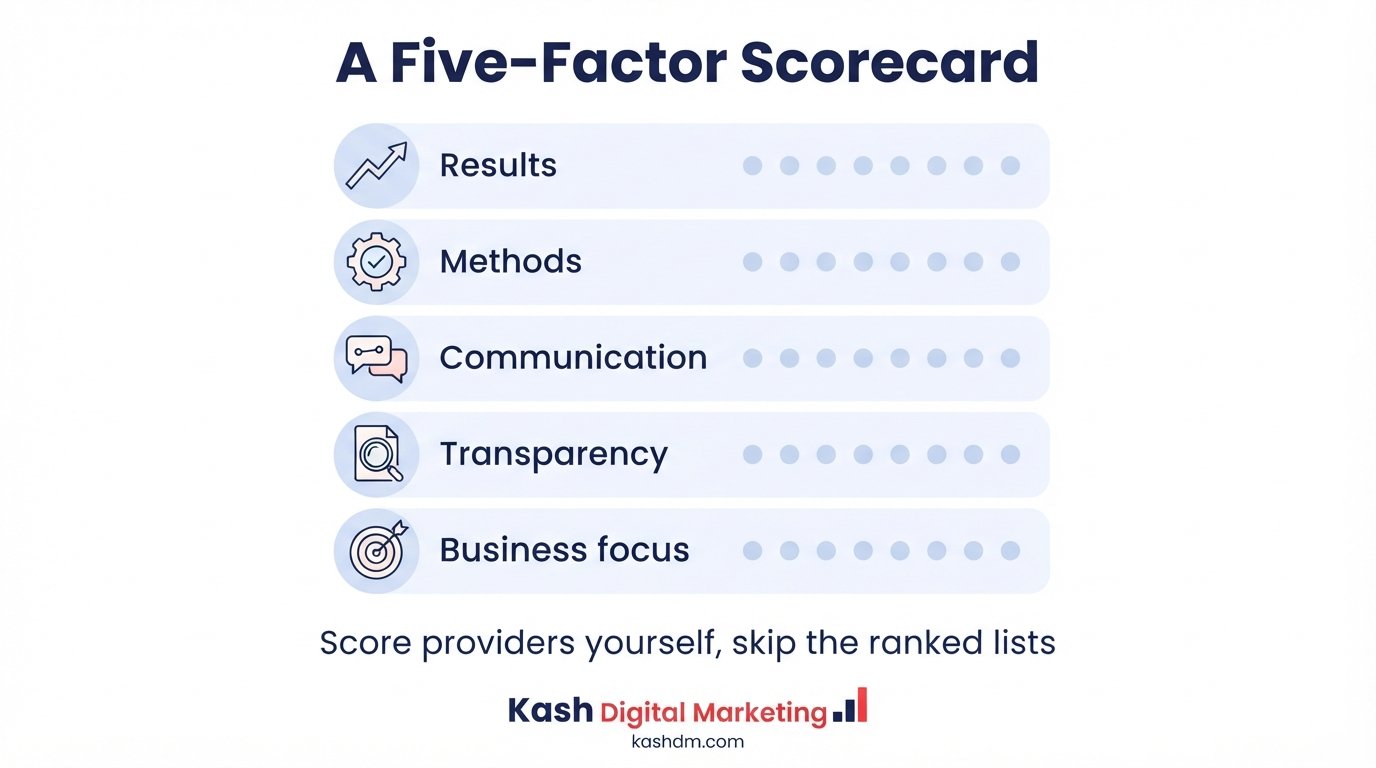
Instead of asking "who is ranked highest," ask "who has real, verifiable experience in my industry and business size, who communicates clearly during the sales process, and who is willing to explain their methods in plain language." Score every candidate against these criteria consistently, the same way you'd evaluate any other vendor for your business.
Weighting specialization over size
A large, well-known agency isn't automatically the right fit. Bigger agencies often assign junior staff to smaller accounts and apply templated processes across hundreds of clients. A smaller, specialized provider, one that focuses on local SEO or small business SEO specifically, may give your account more attention and deeper category expertise than a generalist enterprise shop. Evaluate specialization and attention against size, not size alone.
| Evaluation Factor | What to Look For | Red Flag |
|---|---|---|
| Transparency | Clear explanation of methods and reporting | Vague answers, "proprietary secret sauce" |
| Specialization | Proven work in your industry/business size | Generic "we do everything" pitch |
| Contract terms | Month-to-month or short commitment | Long lock-in required before any results |
| Reporting | Rankings, traffic, leads, revenue | Only impressions or follower counts |
| Communication | Fast, plain-English, dedicated contact | Slow replies, jargon-heavy emails |
Best SEO Agency vs Best SEO Freelancer vs In-House Team
Choosing between an agency, a freelancer, and an in-house hire depends on your budget, the complexity of your SEO needs, and how much oversight you can provide. Each model has real tradeoffs, and the "best" choice is the one that matches your situation, not a universal winner.
When an agency is the better fit
An agency gives you a full team, strategist, content writer, technical specialist, link builder, for less than the cost of hiring each individually. This breadth matters because modern SEO spans technical work, content, and off-page authority building, skills rarely found in one person. Agencies also bring cross-client pattern recognition: they've seen what works across dozens of businesses like yours, a perspective a single freelancer or a first-time in-house hire won't have.
When a freelancer makes sense
A freelancer can be a good, low-cost option for a narrowly scoped task, a technical audit, a content sprint, a one-time site migration review. The risk is capacity and breadth: one person can't realistically cover technical SEO, content, links, and local optimization at a professional level simultaneously, and if they get sick, get busy with another client, or move on, your campaign stalls with no backup.
When in-house is worth the investment
Larger businesses with sustained SEO budgets sometimes build in-house teams, and this can work well once you have enough volume to justify a full team's salary and enough internal expertise to manage them. The downside is ramp-up time, hiring risk, and the fact that a single in-house hire, even a talented one, still lacks the breadth an agency team provides. Many businesses land on a hybrid: an in-house marketing lead who directs an agency partner for execution.
A practical way to decide
Ask yourself three questions. Do I need multiple disciplines (technical, content, links, local) working together? Can I commit enough budget to make a full-time hire worthwhile? Do I have the internal expertise to manage a specialist if I hire one directly? If you answered no to the second or third question, an agency is almost always the more efficient path, which is why most small and mid-sized businesses choose one.
The hidden costs each model doesn't advertise
Every model carries costs beyond the headline price. An agency's monthly fee is easy to compare, but a freelancer's lower hourly rate can hide the cost of your own time spent managing them, filling gaps in disciplines they don't cover, and finding a replacement if they become unavailable. An in-house hire's salary is only the start, add payroll taxes, benefits, software licenses, ongoing training, and the management time required to keep them productive and current with a field that changes constantly. When you compare the true, fully-loaded cost of each option rather than just the sticker price, agencies frequently come out ahead for businesses that aren't yet large enough to fully utilize a dedicated in-house team.
A blended model as your business grows
Many businesses don't stay in one category forever. A business might start with an agency handling everything, bring on an in-house marketing coordinator once volume justifies it who manages the agency relationship and handles quick day-to-day tasks, and eventually build a larger in-house team once SEO becomes central enough to the business to warrant full ownership. There's no failure in evolving through these stages, the mistake is locking into one model permanently without revisiting whether it still fits as your business changes.

What to Look For in an SEO Provider
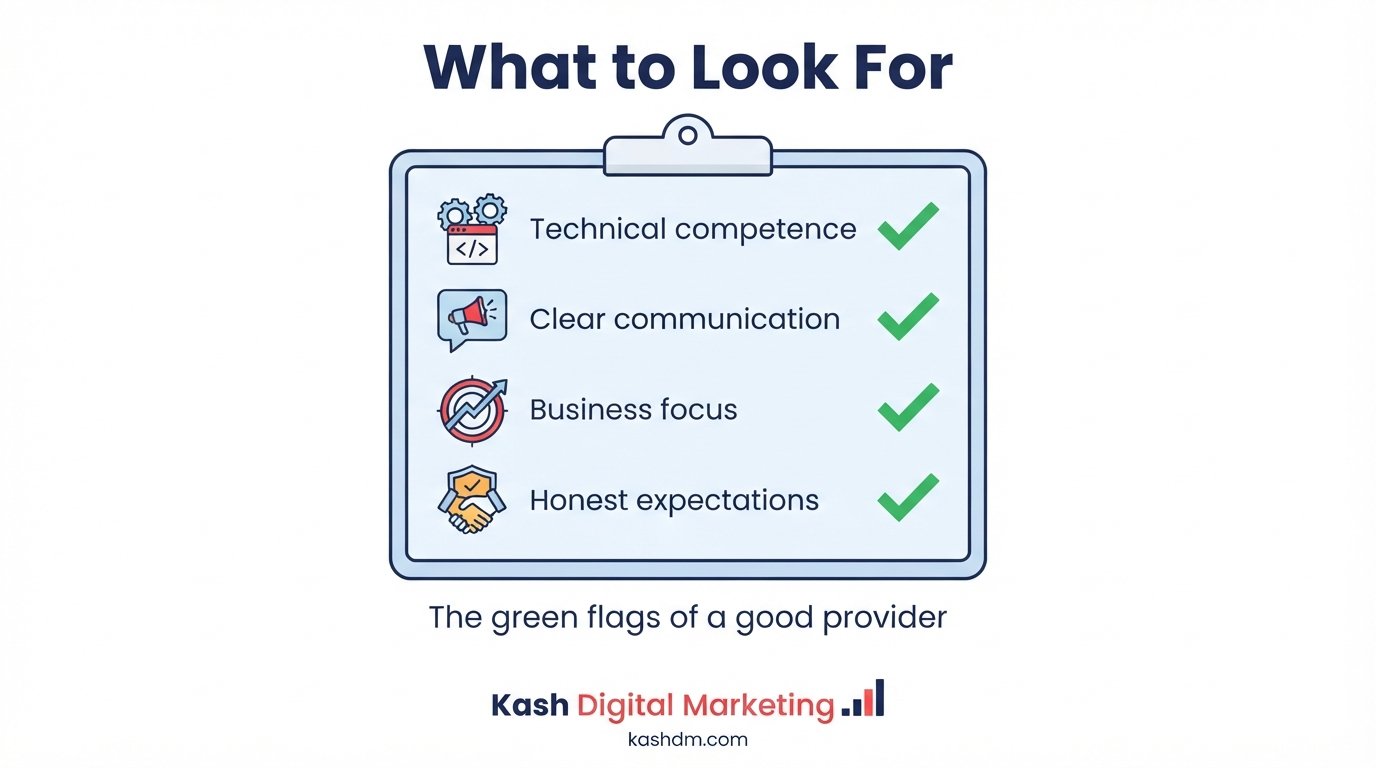
The best SEO providers combine technical competence, transparent communication, and a business-outcomes mindset, three qualities that are easy to claim and hard to fake once you know what to check. This section breaks each down into concrete, checkable signals.
Technical competence you can verify
Ask any candidate to explain, in plain terms, what technical SEO issues they'd expect to find on a site like yours before they've even looked at it. A competent provider can speak fluently about site speed, crawlability, mobile experience, and structured data without reading from a script. Our own technical SEO work is grounded in exactly these fundamentals, and we're happy to walk any prospective client through our process before they sign anything.
Communication that respects your time
Good providers explain what they're doing and why, in language you understand, on a predictable schedule. If a sales conversation is full of jargon you don't understand and nobody offers to translate it, that's a preview of what monthly reporting will feel like once you're a client, not a strategist's confidence.
A business-outcomes mindset
The best providers talk about your leads, your revenue, your booked jobs, not just rankings and traffic in isolation. Rankings and traffic are means to an end. A provider fixated on vanity numbers rather than what those numbers do for your bottom line is optimizing for the wrong scoreboard.
- Explains methods in plain language, without hiding behind jargon
- Shows real work samples or case studies specific to your industry
- Offers month-to-month terms or a reasonable initial commitment
- Reports on rankings, traffic, leads, and revenue, not just impressions
- Has a documented process for avoiding penalties
- Assigns a dedicated point of contact who responds quickly
Checking references the right way
Don't just ask for references, ask specific questions of them. How long have you worked with this agency? What results have you seen, and over what timeframe? Has anything ever gone wrong, and how was it handled? A reference who can answer specifically and comfortably is worth far more than a glowing testimonial pulled from a website. If a provider can't produce a single client willing to speak to you directly, treat that as meaningful information.
How chemistry and communication style factor in
Beyond technical checklists, consider whether the way this provider communicates actually fits how you like to work. Some businesses want frequent, detailed touchpoints; others prefer a concise monthly summary and minimal back-and-forth. Neither style is inherently better, but a mismatch between your preference and a provider's default operating style creates ongoing friction that can quietly erode an otherwise solid working relationship. Raise this preference explicitly during your evaluation conversations, and gauge how willing a candidate is to adapt to it.
Questions to Ask an SEO Agency Before You Sign
A short list of direct questions, asked before you sign anything, reveals more about an agency's quality than any pitch deck ever will. Bring these to every sales call, and pay close attention not just to the answers but to how comfortably they're given.
Questions about methods
What specific tactics do you use to build links? How do you decide what content to create and why? What's your process for technical audits? A provider who answers with confidence and specifics is showing you real expertise; one who deflects to "proprietary methods" is often hiding a lack of substance or, worse, tactics they don't want you to know about because they're risky.
Questions about reporting and results
How will you report results, and how often? Which metrics will you show me, and which will you not? Can I see an example of a report you send to an existing client? Insist on seeing an actual sample report, not a description of one. The gap between "we provide detailed monthly reporting" and an actual report full of vague charts is often enormous.
Questions about contracts and guarantees
Do you require a long-term contract? What happens if I want to leave? Do you guarantee rankings, and if so, how? Any guarantee of specific rankings, especially "#1 on Google," should immediately raise your guard, a topic we cover in depth in the guarantees section below. A confident, honest provider is comfortable answering every one of these questions without hedging.
| Question | What a Good Answer Sounds Like | What a Bad Answer Sounds Like |
|---|---|---|
| How do you build links? | Specific tactics: digital PR, partnerships, content-driven outreach | "We have relationships," no detail |
| Can I see a sample report? | Shares one immediately | Delays, offers a generic mockup |
| Do you guarantee #1 rankings? | "No one honestly can, here's what we do guarantee" | "Yes, guaranteed top rankings" |
| What's your contract length? | Month-to-month or short initial term | 12+ months required upfront |
| What happens if results stall? | Explains diagnosis and adjustment process | Blames algorithm vaguely, no plan |
Questions about your specific industry and market
Ask what experience they have with businesses like yours specifically, in your industry and roughly your size and market. A provider with genuine relevant experience can speak to the particular challenges your niche presents, competitive dynamics, typical customer search behavior, seasonal patterns, rather than offering only generic reassurance. This question also reveals whether you'd be their first client of your kind, which isn't automatically disqualifying but is worth knowing before you decide.

SEO Red Flags and Scams to Avoid
Certain patterns show up again and again in bad SEO deals, and learning to spot them early can save you months of wasted spend and a damaged website. None of these red flags are subtle once you know to look for them.
Guaranteed rankings and unrealistic promises
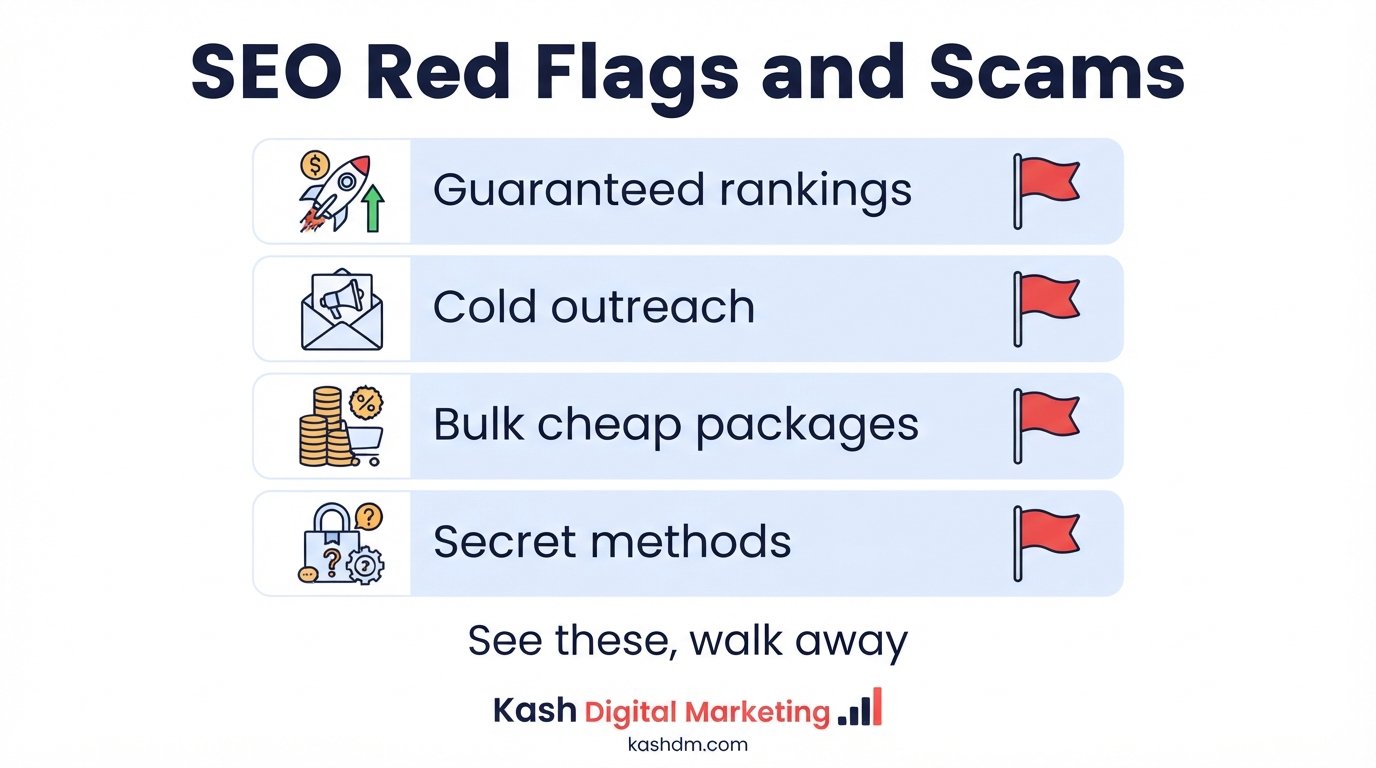
No legitimate provider can guarantee a specific ranking position, because nobody, including Google's own engineers speaking publicly, controls the algorithm with that precision. "Guaranteed #1 on Google" is one of the clearest scam signals in the industry, and it deserves its own section further down this page.
Cold outreach claiming to already audit your site
A common scam pattern: an unsolicited email or call claims your website has "critical SEO errors" they discovered without permission, paired with urgent pressure to buy a fix immediately. Legitimate agencies don't scrape and scan random websites uninvited and then pressure-sell the results. If an unsolicited message creates urgency and demands quick payment, treat it as a scam attempt, not a lead.
Suspiciously cheap, bulk-produced packages
An SEO package priced far below market rate, often bundled with "500 backlinks" or "unlimited keywords," is almost always built on low-quality, high-risk tactics: spun content, link farms, or private blog networks. These can produce a short-term bump followed by a painful correction once Google's algorithms or a manual reviewer catch up.
Refusal to explain methods or show real work
Any agency that treats its process as a total black box, refusing to explain even at a high level what they do, is asking you to trust blindly. Legitimate methods don't need to be secret. There's a difference between protecting proprietary research and refusing basic transparency, and a trustworthy agency knows exactly where that line is.
- Walk away from "guaranteed #1 rankings" claims
- Ignore unsolicited "we found errors on your site" outreach
- Question packages priced far below the market with bulk deliverables
- Insist on an explanation of methods before signing anything
- Verify any case study or testimonial independently before trusting it
Pressure tactics and artificial urgency
Watch for sales tactics designed to rush your decision, a "special price" that expires today, claims that a competitor is about to snap up "the last spot" in your market, or repeated follow-up calls pushing you to sign before you've had time to check references. Legitimate SEO work isn't a limited-inventory product, there's no real scarcity that justifies rushing a decision this consequential. Pressure itself is information: a provider confident in their work is usually happy to let you take the time you need to decide well, because they know that a well-informed client who chooses them freely becomes a better long-term partner than one who was rushed into signing.
Ghost reporting and disappearing after the sale
A particularly damaging pattern is the agency that communicates constantly and enthusiastically during the sales process, then becomes slow to respond, vague in reporting, or nearly unreachable once the contract is signed and the first payment clears. This shift is one of the clearest signs that the sales process was designed to close deals rather than build a genuine working relationship. Ask existing references specifically whether communication stayed consistent after signing, since that single question often surfaces this pattern before you experience it yourself.
White Hat vs Black Hat SEO Providers
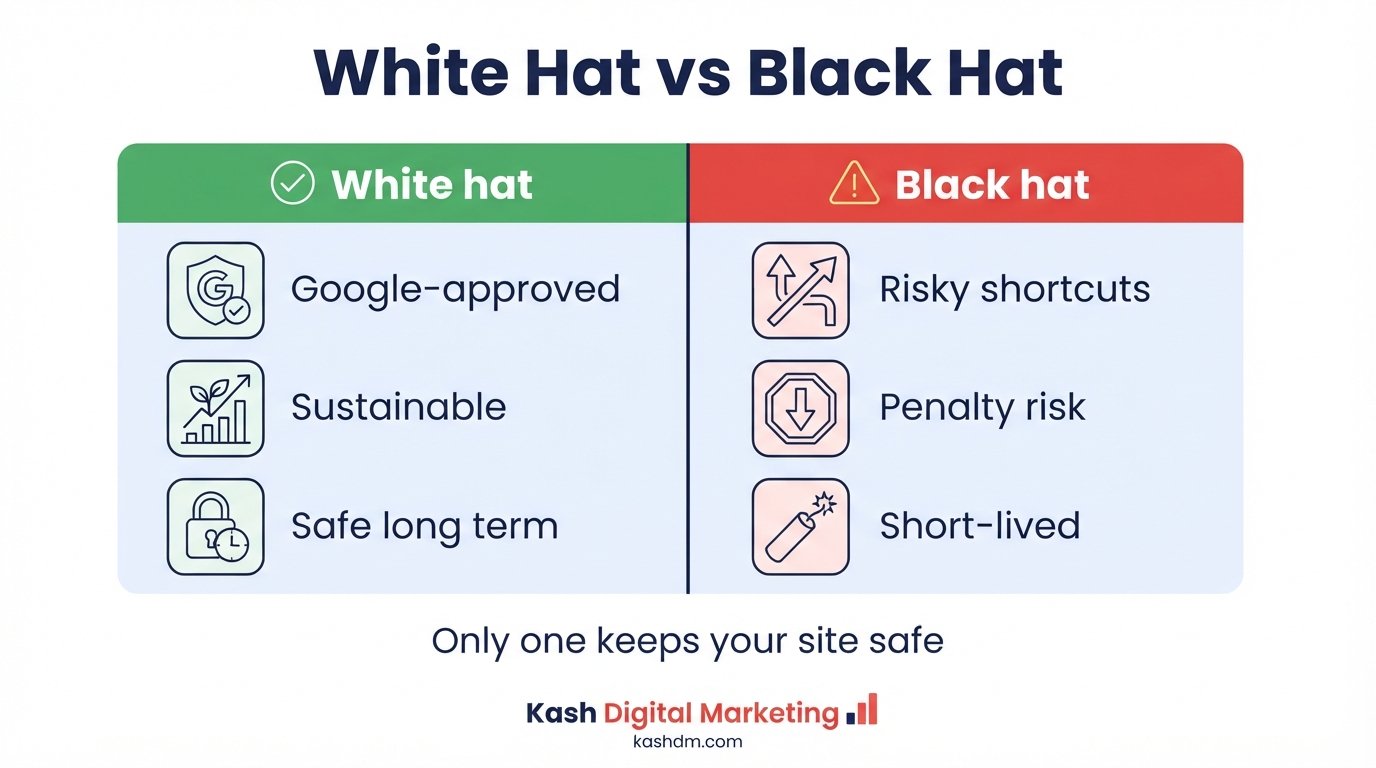
White-hat providers earn rankings through genuine value and Google-approved methods, while black-hat providers chase shortcuts that risk penalties, and the difference determines whether your rankings last or eventually collapse. Understanding this distinction is essential to evaluating any provider's long-term safety.
What white-hat SEO actually looks like
White-hat SEO means earning links through genuine outreach and valuable content, writing content for real human readers rather than stuffing it with keywords, and following Google's published guidelines. It's slower to show results than black-hat shortcuts, but it builds an asset that survives algorithm updates instead of one that's vulnerable to them. Every part of our own process, described throughout our technical SEO and link building pages, is built on this foundation.
Common black-hat and gray-hat tactics to recognize
Black-hat tactics include buying links in bulk, using private blog networks, cloaking content shown differently to Google than to users, keyword stuffing, and fabricating or incentivizing reviews. Gray-hat tactics sit in a riskier middle ground, aggressive guest-post networks, thin affiliate content, or automated content with minimal human editing. Both categories share the same risk profile: they can work temporarily, and then Google's algorithm updates or manual review teams catch up.
Why black-hat tactics eventually fail
Google invests enormous resources in detecting manipulation, and history shows the pattern repeats: black-hat tactics produce a short-term gain, followed by an algorithm update or manual penalty that erases the gain and often the site's rankings entirely, sometimes for months or years of recovery work. A provider using these tactics is effectively borrowing against your business's future visibility, and the interest rate is brutal when the bill comes due.
How to tell which kind of provider you're evaluating
Ask directly about link-building methods, content production processes, and review generation practices. A white-hat provider explains these comfortably and specifically. Watch for evasive answers, unusually fast results promised in weeks for competitive terms, or reluctance to name where links come from. If a provider can't or won't explain exactly how they build authority, assume the worst until proven otherwise.
Why white-hat SEO is also the better business decision, not just the safer one
It's tempting to frame white-hat versus black-hat purely as a risk conversation, safe methods that avoid penalties versus risky ones that might trigger them. But there's a deeper business case that goes beyond risk avoidance. White-hat SEO, done well, builds real assets: content that keeps attracting readers years after publication, relationships with local organizations that generate referrals beyond just links, and a reputation that compounds with every genuine review and every satisfied customer. Black-hat tactics, even in a best-case scenario where they're never caught, don't build any of that. They produce a ranking number and nothing else of lasting value to the business. When you weigh the full picture, not just the downside risk but the upside difference in what's actually being built, white-hat SEO wins even before you factor in penalty risk at all.
How algorithm updates specifically target black-hat patterns
Google's major algorithm updates, the ones that periodically reshuffle rankings across the web, are frequently built specifically to detect and demote the patterns black-hat SEO relies on: unnatural link profiles, thin or AI-generated content with no genuine value, and manipulated review signals. This isn't a coincidence, it's the direct, intended effect of Google continually refining its systems to reward genuine quality and penalize manipulation. A provider using black-hat tactics today is essentially betting that their particular shortcuts won't be the ones caught in the next update, a bet that gets riskier, not safer, with every year that passes as detection systems improve.
Understanding SEO Guarantees: Why "Guaranteed #1" Is a Red Flag
No honest SEO provider can guarantee a specific ranking position, because Google's algorithm weighs hundreds of signals that no outside party fully controls, so any "guaranteed #1" claim is either a misunderstanding or a deliberate misrepresentation. This single red flag deserves its own dedicated explanation because it's so common and so consistently misleading.
Why rankings can't be guaranteed
Google's ranking algorithm considers hundreds of factors, many of which change constantly, and it weighs your competitors' actions as much as your own. Even Google's own representatives have publicly stated that no one, including Google itself, can promise a specific ranking outcome. An agency promising #1 is either promising something outside their control or planning to manipulate results temporarily in ways that risk your site.
What a legitimate guarantee actually looks like
Reputable providers guarantee process and effort, not outcomes beyond their control: a defined scope of work each month, transparent reporting, adherence to white-hat methods, and often a satisfaction-based exit if you're not seeing progress. Some offer performance-based elements tied to leads or traffic growth rather than a specific rank position. These are honest guarantees because they promise what the provider can actually control.
The predictable pattern behind fake guarantees
Providers who promise guaranteed rankings typically deliver one of two outcomes: a short-lived, risky ranking boost that later collapses, or simply no result at all followed by excuses once the contract's minimum term expires. Either way, the guarantee wasn't really a guarantee, it was a sales tactic aimed at businesses who don't yet know how to evaluate the claim. Once you understand why the promise is impossible to keep honestly, it stops being persuasive and starts being a warning sign.

How to Vet SEO Reviews and Testimonials
Reviews and testimonials are easy to fabricate or cherry-pick, so verifying them properly means going beyond the star rating and reading for specificity, consistency, and independent corroboration. A five-star average tells you very little on its own.
Reading beyond the star rating
Look at the content of reviews, not just the score. Specific reviews that mention a named service, a particular result, or a detail about working with the team carry far more weight than generic five-word praise. A pattern of vague, similarly-worded five-star reviews posted in a short window is a common sign of incentivized or fabricated reviews.
Cross-checking across independent platforms
Check the same agency across Google, industry-specific review sites, and independent forums, not just the testimonials curated on their own website. An agency that looks flawless on its own site but has a thinner or more mixed record elsewhere deserves a closer look. Consistency across independent, harder-to-manipulate platforms is a stronger signal than a curated testimonials page.
Asking for direct references, not just written reviews
The strongest verification is a conversation with an actual current or recent client, ideally one in a similar industry or business size to yours. Written reviews can be selectively curated; a live reference call, where you can ask follow-up questions, is far harder to fake and gives you a much clearer picture of what working with the agency is actually like month to month.
| Verification Method | Reliability | How to Use It |
|---|---|---|
| Website testimonials | Low, curated by the agency | Use only as a starting point |
| Google/third-party reviews | Medium, harder to fully curate | Check volume, specificity, patterns |
| Case studies with named clients | Medium-high, verifiable | Contact the named client if possible |
| Direct reference calls | High, hardest to fabricate | Always request at least one before signing |
Watching for review timing patterns
A cluster of many five-star reviews posted within a very short window, especially after a long stretch of few or no reviews, can indicate an incentivized review push rather than organic, ongoing satisfaction accumulating naturally over time. This isn't automatically disqualifying on its own, legitimate businesses do run review campaigns, but it's worth factoring in alongside the other signals here rather than reading it in isolation. A steady, gradual accumulation of reviews over months and years, mixed with the occasional less-than-perfect one handled professionally, generally paints a more trustworthy picture than a suspiciously uniform, tightly clustered set of five-star ratings.

How to Read an SEO Case Study Without Being Misled
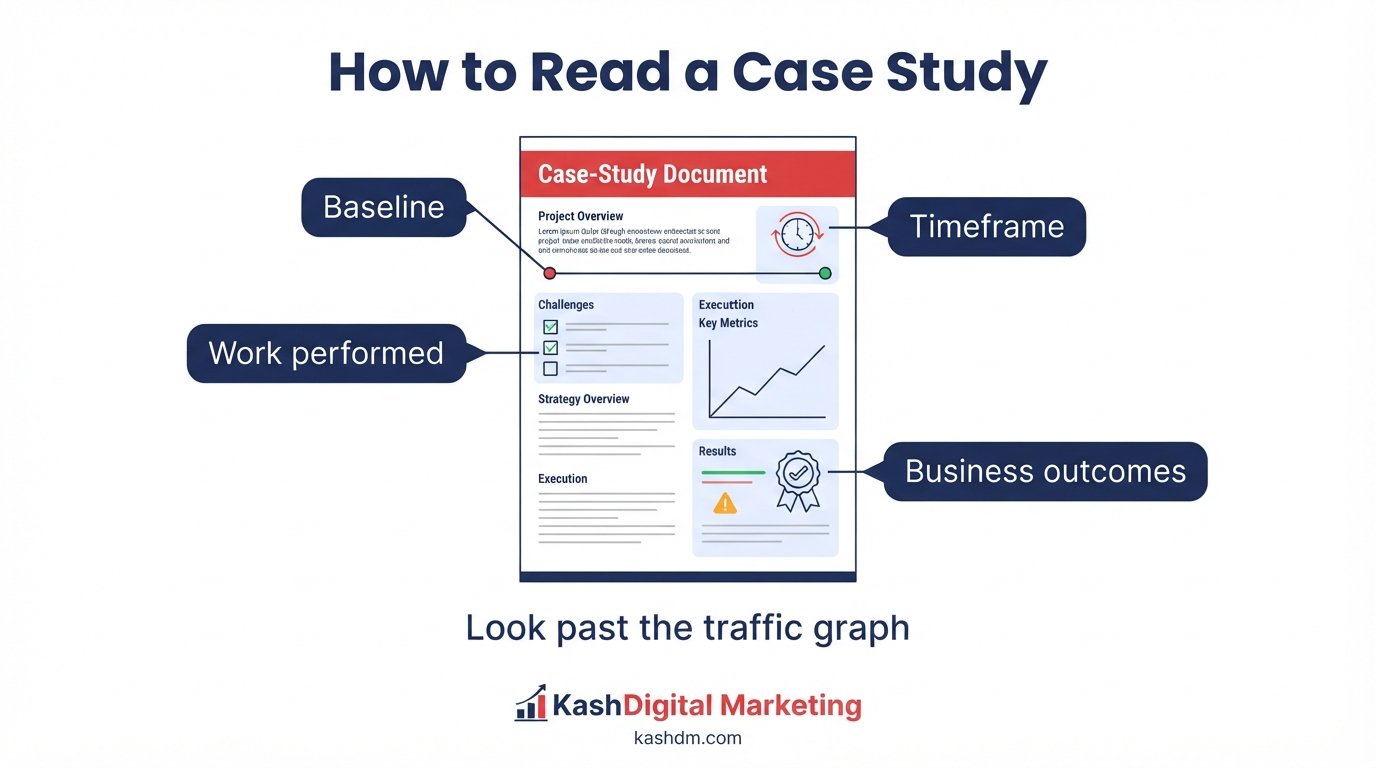
A trustworthy SEO case study shows the starting point, the specific work performed, the timeframe, and business outcomes, not just an impressive-looking traffic graph with no context. Learning to read case studies critically protects you from being persuaded by numbers that look impressive but mean very little.
What a complete case study includes
Look for a clear before-and-after baseline, a description of the actual work done, a realistic timeframe, and outcomes tied to the business, leads, calls, revenue, not just traffic or rankings in isolation. If any of these elements is missing, ask for it directly before treating the case study as evidence.
Common ways case studies mislead
A traffic graph showing a dramatic spike means little without knowing the starting traffic level, since going from 10 to 100 visits is a 900% increase that changes nothing for the business. Watch for cherry-picked date ranges that hide a longer flat or declining period, keyword rankings shown without search volume (ranking #1 for a term nobody searches is meaningless), and case studies that never mention the client's name or industry, which makes independent verification impossible.
The questions to ask about any case study you're shown
Was this client's starting point similar to mine? Over what timeframe did these results happen? What specifically was done to produce them? Can I speak to this client directly? A provider proud of genuine results will answer all four questions readily; one relying on a misleading graph will hedge on at least one.
Industry and competitive context matters too
A case study from a business in an uncompetitive niche with almost no established local competition isn't a reliable predictor of what's achievable in a fiercely contested market with dozens of established players. When reviewing a case study, ask about the competitive landscape the client operated in, not just their own before-and-after numbers, since the same amount of work can produce very different outcomes depending on how hard the competition is fighting back. A provider who volunteers this context without being asked is demonstrating exactly the honesty this guide is built around.
Understanding SEO Reporting and Transparency
Genuinely transparent SEO reporting shows rankings, traffic, leads, and the specific work completed each month, in language you can understand without a marketing degree. Reporting is where a lot of agencies quietly reveal whether they're actually delivering.
The metrics that actually matter
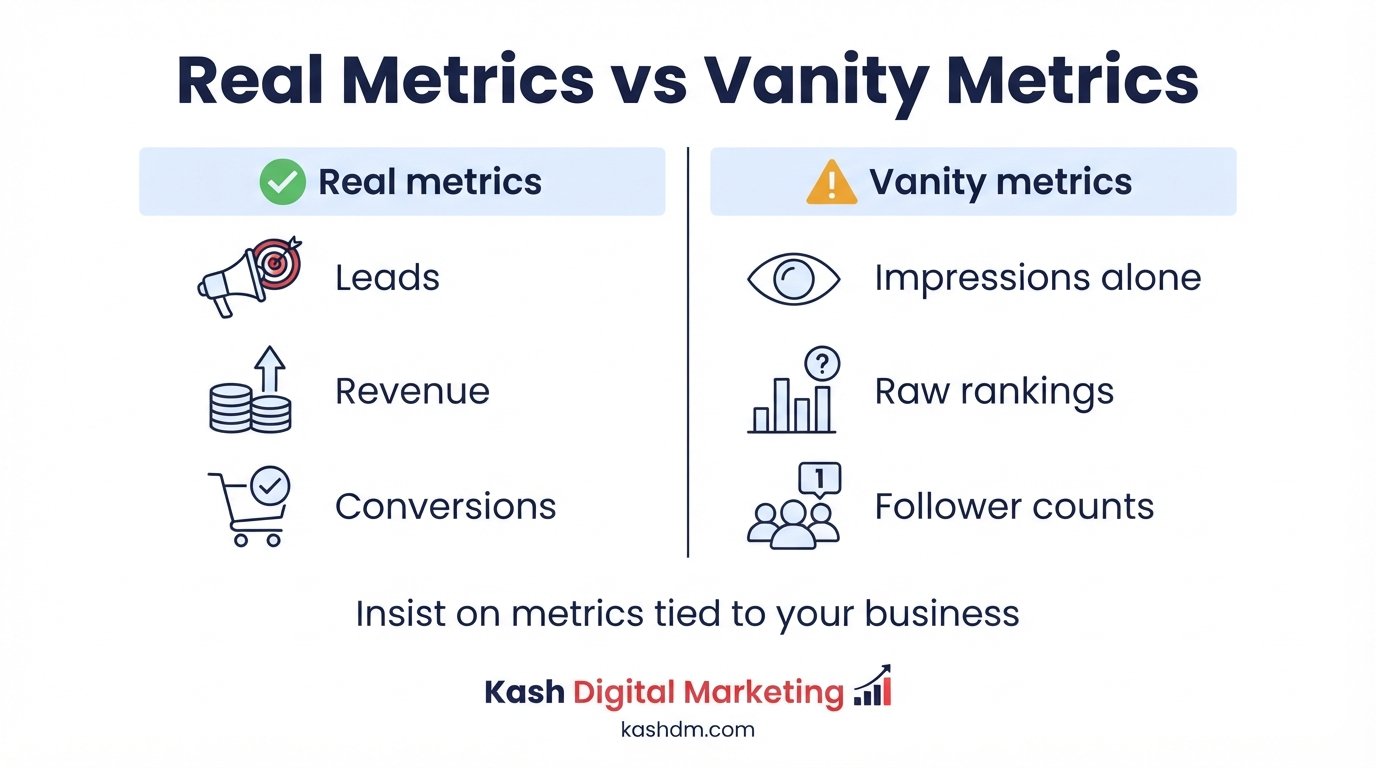
Rankings for your priority keywords, organic traffic trends, and, most importantly, the leads, calls, and conversions your campaign generates are the metrics that connect directly to your revenue. A monthly report that centers these numbers is doing its job. Everything else is supporting detail.
Vanity metrics to watch for
Total keyword count with no context, raw impression numbers with no click-through data, or "SEO score" figures from a proprietary tool with no clear methodology are common ways to make a report look busy without saying much. These aren't necessarily dishonest, but leaning on them instead of leads and revenue is a sign the underlying results may be thin.
What good reporting cadence looks like
Monthly reporting, at minimum, with the option for a live conversation to walk through progress, is the standard for a healthy SEO relationship. Reports should be timely, consistent in format month to month so you can compare progress, and accompanied by a plain-English summary, not just raw data you're left to interpret alone.
- Rankings for your actual priority keywords
- Organic traffic with context on trend direction
- Leads, calls, or conversions attributed to the campaign
- A plain-English summary of work completed and what's next
- Consistent monthly cadence and format
Attribution and connecting SEO to revenue
The most mature reporting goes a step further than showing leads, it connects those leads to actual revenue where possible, through call tracking, form-tracking, or CRM integration that follows a lead from first click to closed sale. This level of attribution turns SEO from a marketing line item you take on faith into a measurable investment with a calculable return, and it's increasingly the standard the best providers hold themselves to rather than a nice-to-have extra.
How to request better reporting from your current provider
If your current reporting feels thin, you're allowed to ask for more. Request that future reports include the specific keywords you care about most, a plain-English summary of work completed, and, if you're not already getting it, some form of lead or call attribution. A provider who resists reasonable requests to improve transparency is telling you something important about how they operate, while one who adjusts their reporting to better serve you is demonstrating the client-first mindset this entire guide is built around.
SEO Contracts: What to Avoid Before You Sign
A fair SEO contract protects both sides with clear scope and reasonable exit terms, while a predatory one locks you in long before you can judge whether the work is any good. Reading the contract carefully, not just the pitch, is one of the most important steps before hiring anyone.
Contract length and lock-in clauses
Be wary of contracts requiring 12 months or more upfront with no early exit option, especially from a provider you haven't worked with before. SEO does take time to show results, so some minimum initial term (often three to six months) is reasonable, but a long lock-in signed before you've seen any evidence of quality shifts the risk entirely onto you.
Ownership of your assets
Confirm in writing that you own your website, your content, your Google Business Profile, and any accounts created during the engagement. Some agencies build campaigns on assets they control, then hold your rankings hostage if you try to leave. This clause matters more than almost any other line in the contract, because it determines whether leaving a bad relationship costs you your work or just the relationship itself.
Vague scope of work
A contract that describes deliverables only in broad terms, "ongoing SEO optimization," with no specifics on what's actually included each month gives the provider enormous room to under-deliver without technically breaching anything. Insist on a scope of work detailed enough that you could hold the provider accountable to it.
Auto-renewal and cancellation terms
Check for auto-renewal clauses that lock you in for another full term unless you cancel within a narrow window, and confirm the actual notice period required to leave. These clauses aren't automatically a scam, but they should be clearly disclosed and reasonable, not buried in fine print designed to trap distracted clients.
Payment terms and what they signal
Look closely at payment terms too. Reasonable providers bill monthly for work as it's delivered. Be cautious of large upfront payments demanded before any work begins, especially from a new relationship with no track record yet, since this shifts significant financial risk onto you before you've seen a single deliverable. A payment structure tied to ongoing monthly delivery keeps the provider's incentives aligned with continuing to earn your business, which is a healthier dynamic for both sides over the life of the relationship.
Getting a contract reviewed before you sign
For any engagement above a modest monthly spend, it's worth a short conversation with whoever handles your business's legal or financial review, even if that's simply a trusted advisor rather than a lawyer, before signing. This isn't about distrust, it's the same due diligence you'd apply to any vendor relationship involving recurring payments and access to your digital assets. A reputable provider won't object to a brief review period, and a provider who pressures you to skip it is, once again, showing you information about how they operate.

Best SEO Services for Small Business
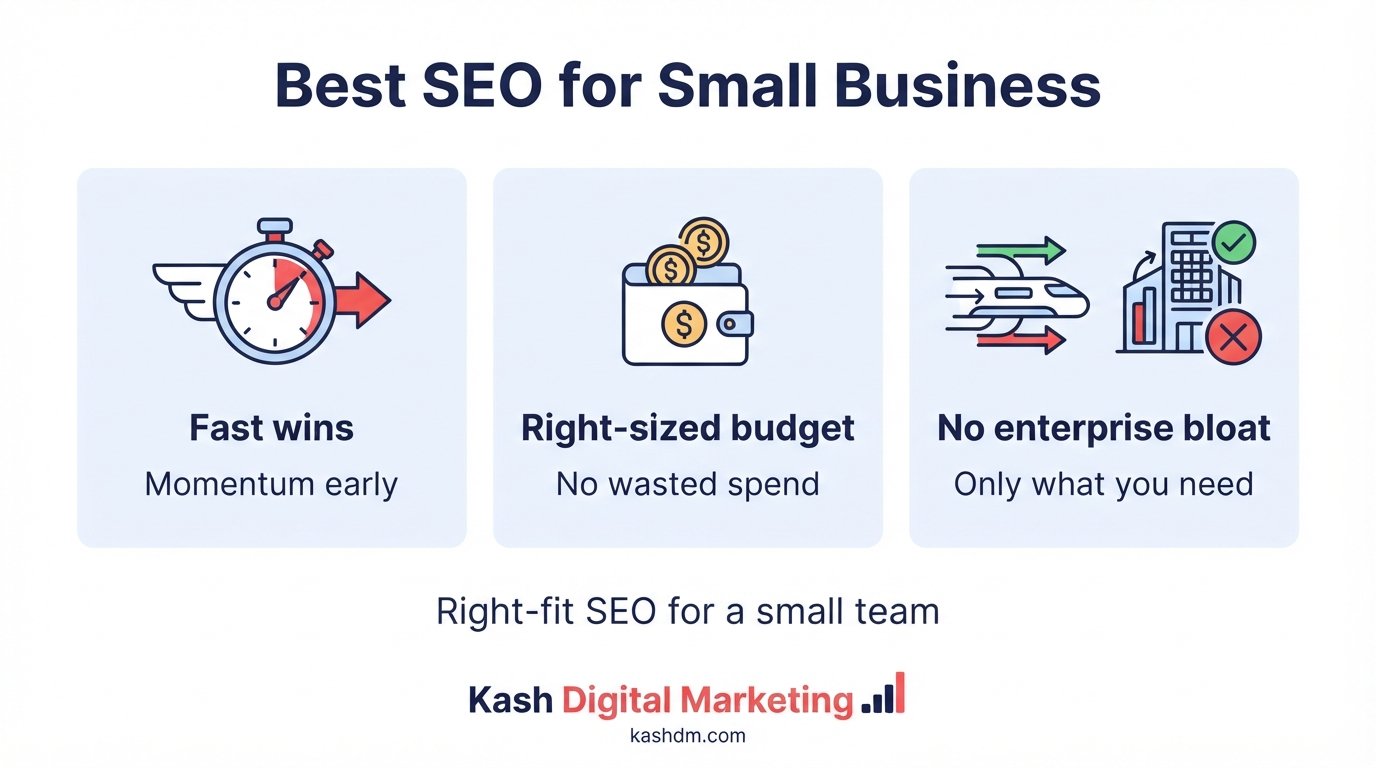
The best SEO services for a small business prioritize fast, affordable wins first, scale with results rather than requiring a large upfront commitment, and speak in plain language rather than corporate jargon. Small businesses have real constraints that should shape how you evaluate providers.
What small businesses should prioritize
Look for a provider who leads with longtail, lower-competition keywords that can produce results in weeks rather than months, and who's transparent that competitive head terms take longer. Our own small business SEO approach is built around exactly this sequencing, generating early wins that help fund further investment.
Budget-conscious evaluation
A small business should ask directly what results are realistic for a given budget, rather than assuming more spend automatically means proportionally more results. A good provider will tell you honestly where your budget puts you competitively, and suggest a focused strategy rather than spreading a modest budget too thin across too many keywords.
Avoiding overkill enterprise packages
Some agencies sell small businesses the same tiered package structure built for enterprise clients, complete with services (extensive digital PR campaigns, large-scale content operations) that don't make sense at a small business's scale or budget. The best fit is a provider willing to right-size the engagement to your actual business, not upsell you into services built for a different kind of company.
Best Local SEO Services: What Sets Great Local Providers Apart
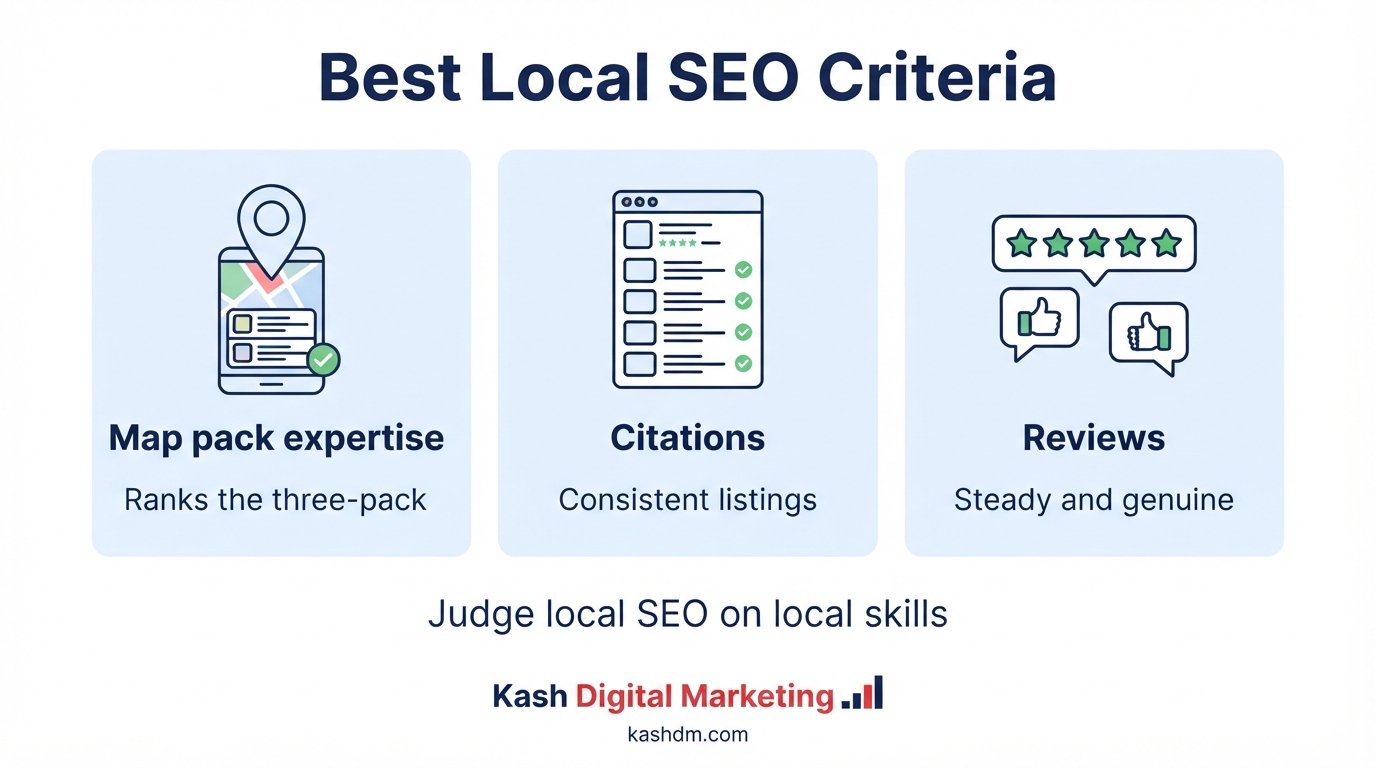
The best local SEO services specialize specifically in the map pack, citations, and review systems that drive nearby customers to call, not a generic national SEO package applied to a local business. Local SEO has its own evaluation criteria worth calling out separately.
Local-specific expertise to look for
Ask any candidate how they approach Google Business Profile optimization, citation consistency, and review generation specifically, since these are the levers that move local rankings and they're distinct from traditional organic SEO. A provider who can't speak fluently about the map pack's ranking factors likely isn't a local specialist, even if they claim to be.
Verifying local results
Ask for examples of businesses similar to yours, ideally in a comparable industry and market size, that moved into the map pack's top three. Map-pack position is verifiable in a way that's harder to fake than a vague traffic graph, since you can often check current rankings for the keywords they claim to have won.
Our full local SEO services page details everything a genuine local SEO program should include, and we encourage using it as a checklist against any provider you're evaluating, including us.
Best Ecommerce SEO Services: What to Check
The best ecommerce SEO services understand product-page optimization, category structure, and technical crawl efficiency at scale, challenges that a generalist agency accustomed to five-page local sites often hasn't faced. Ecommerce SEO has genuinely different technical demands.
Scale-specific technical competence
Ecommerce sites often have thousands of product and category pages, which introduces crawl budget, duplicate content, and faceted navigation challenges that simply don't exist on a small business website. Ask candidates directly how they've handled these issues before, and listen for specific, technical answers rather than generalities.
Product content and structured data
Great ecommerce SEO providers write genuinely useful product and category content rather than thin, templated descriptions, and they implement product schema markup correctly so listings can show rich results like pricing and reviews directly in search. Ask to see examples of actual product pages they've optimized.

Best Enterprise SEO: Evaluating Providers at Scale
The best enterprise SEO providers can manage complex approval workflows, multiple stakeholders, and large site architectures, while still moving fast enough to matter in a competitive market. Enterprise SEO introduces organizational complexity on top of the technical challenge.
Process maturity for large organizations
Enterprise clients need providers with a documented process for stakeholder sign-off, legal and brand review, and coordination across marketing, IT, and development teams. Ask how a candidate has navigated these layers before, since an agency built only for fast-moving small businesses may struggle with enterprise approval cycles.
Reporting that speaks to multiple audiences
Enterprise SEO reporting often needs to serve both a marketing team that wants tactical detail and executives who want a business-outcomes summary. The best providers build reporting that serves both audiences without forcing you to translate technical detail into executive language yourself.

White Label SEO Services: Evaluating a Fulfillment Partner
The best white label SEO services deliver consistent quality under your brand, communicate clearly with you as the intermediary, and never put your agency's reputation at risk with your end clients. If you're an agency or consultant evaluating a white-label partner, the criteria shift slightly.
Quality consistency across client volume
Ask any white-label candidate how they maintain quality as client volume grows, and request to see sample deliverables, reports, and content they'd produce under your brand. A partner whose quality degrades as they scale will eventually damage relationships you've spent years building.
Communication and turnaround as your fulfillment engine
Since you own the client relationship, your white-label partner needs to be fast and reliable in their communication with you, not just competent in the underlying work. Clarify turnaround times, escalation processes, and how they handle client-specific requests before committing.
We offer white-label local SEO services for agencies and consultants who want to expand their offering without building an in-house team, and we hold ourselves to the same transparency standard described throughout this page in every white-label relationship.

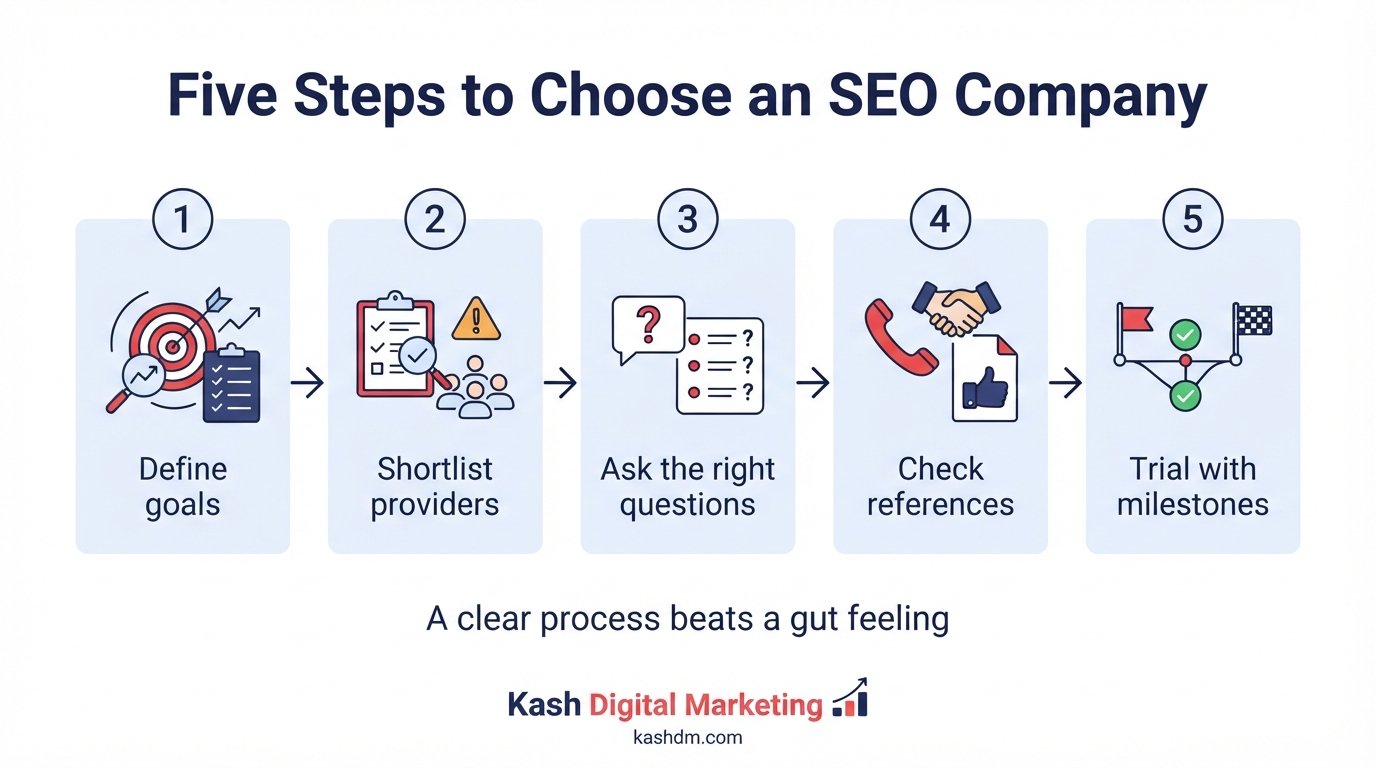
How to Choose an SEO Company: A Step-by-Step Process
Choosing an SEO company well means researching candidates, interviewing them against a consistent standard, checking references, and starting with a trial period before committing long term. Here's the process laid out step by step.
Step one, define your goals and budget first
Before contacting any provider, get clear internally on what you're trying to achieve, more calls, more online sales, more qualified leads, and roughly what budget you can commit consistently for at least six months. Providers can give you far better, more honest guidance when you walk in with clarity rather than asking them to define your goals for you.
Step two, build a shortlist using real research
Use the evaluation criteria from this guide, specialization, transparency, contract terms, reporting style, rather than a paid ranking list. Aim for three to five candidates worth a real conversation, not dozens of surface-level inquiries.
Step three, interview with the questions from this guide
Bring the specific questions from the section above to every sales call, and take notes on how comfortably and specifically each candidate answers. The quality of the sales conversation is a genuine preview of what ongoing communication will feel like as a client.
Step four, verify references and case studies independently
Don't rely solely on what's presented to you. Cross-check reviews across independent platforms, request direct reference conversations, and read case studies critically using the framework from earlier in this guide.
Step five, start with a trial period and clear milestones
Where possible, start with a shorter initial engagement, three to six months, with clearly defined early milestones (technical fixes completed, profile optimized, initial content published) you can check against actual delivery before committing to a longer relationship. A confident provider will be comfortable proving themselves this way.
Step six, put the decision in writing before work starts
Once you've chosen a provider, make sure the scope of work, reporting cadence, contract length, and ownership terms discussed during the sales process are all reflected accurately in the written agreement, not just implied verbally. Verbal promises made during a pitch are easy to forget or dispute later; written terms protect both sides and give you something concrete to hold the relationship accountable to as the engagement unfolds.
Onboarding: What a Good Start With an SEO Agency Looks Like
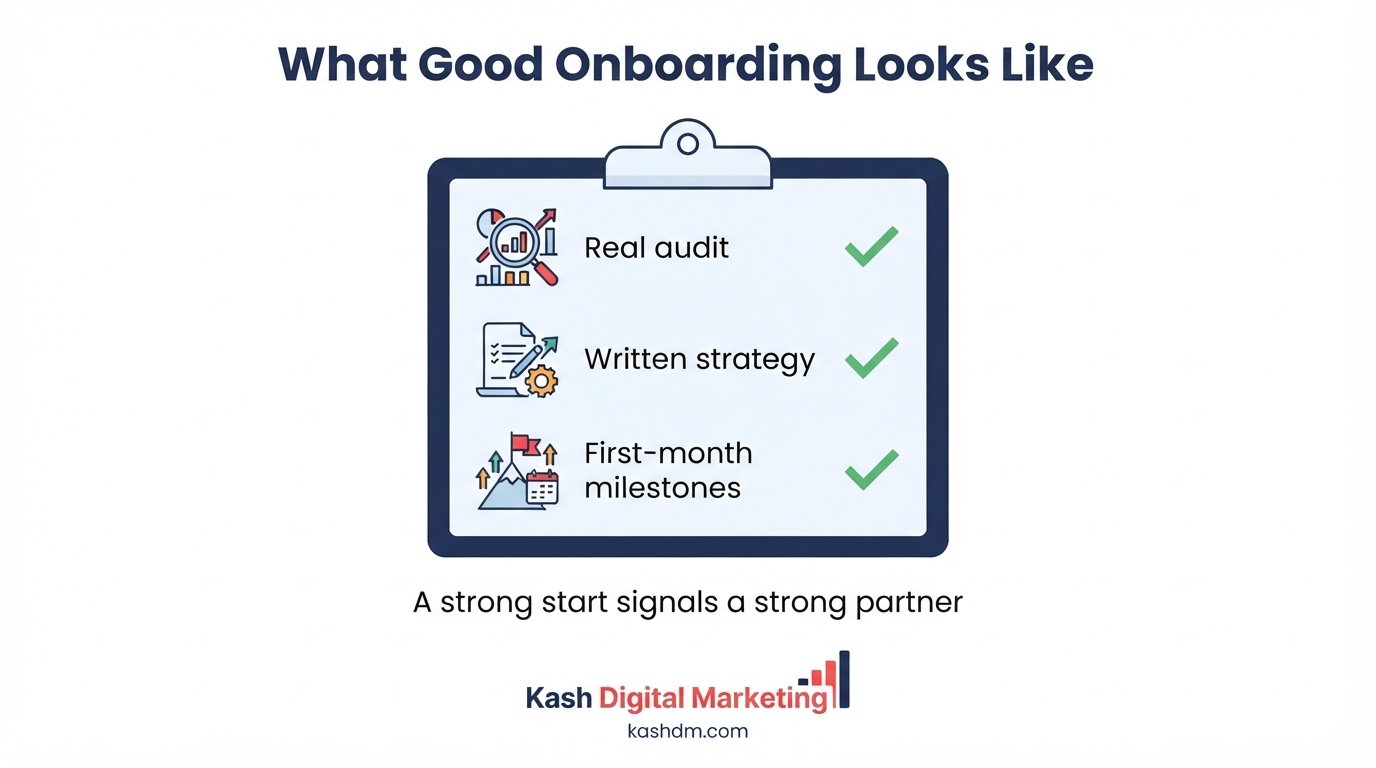
A good SEO onboarding begins with a real audit, a clear strategy document, and defined milestones, not a vague "we'll get started" with no visible plan. How an agency handles your first thirty days tells you a great deal about how the rest of the relationship will go.
What the first month should include
Expect a genuine audit of your current site, rankings, and competitors, a written strategy that prioritizes the highest-impact work first, and a clear explanation of what will happen in month one versus later months. If the first month feels like a black box with no visible deliverable, that's worth questioning early rather than waiting to see if it improves.
Setting expectations on timeline together
A good onboarding conversation sets realistic expectations for when you'll see movement, typically weeks for low-competition longtail terms and months for genuinely competitive ones, so you're not left guessing whether the campaign is working during the early quiet period before results show up in reports.
Access and account setup done right
A good onboarding also handles access carefully: the provider requests appropriate permissions to your website, analytics, and Google Business Profile without demanding full ownership transfer or account takeover, and they document exactly what access they have and why. This protects you in two directions, it ensures the provider can actually do the work they were hired for, and it ensures you retain control of your own digital assets throughout the relationship, consistent with the ownership principle discussed in the contracts section earlier in this guide.
The first check-in call
Beyond the written strategy, expect a real conversation, not just an emailed document, within the first few weeks where the provider walks you through their plan, answers your questions, and confirms they understand your business goals correctly. This early dialogue catches misunderstandings before they turn into wasted months of work built on a mistaken assumption about what you actually wanted.
When to Switch SEO Agencies (and When to Stay)
Switching SEO agencies makes sense when reporting stays vague after repeated requests for clarity, results stall for an extended period with no explained plan to fix it, or you discover risky tactics being used without your knowledge, but switching too early can also reset progress that was about to compound. Knowing the difference protects you from both mistakes.
Signs it's time to leave
Watch for consistently vague reporting despite repeated requests for specifics, a long stretch of flat results with no clear diagnosis or adjusted plan, discovery of black-hat tactics you didn't approve, or a provider who becomes hard to reach once the contract is signed. Any one of these, sustained over a couple of months, is a legitimate reason to start looking elsewhere.
Why patience matters before switching too early
SEO genuinely takes months to show its full effect, and switching agencies resets a meaningful portion of that progress, since a new provider needs time to understand your site and often restarts elements of the strategy. If a provider is communicating clearly, showing real incremental progress, and has a credible explanation for any slow patches, staying the course is often the better call, even when patience feels difficult.
How to switch without losing your progress
If you do switch, make sure you retain full ownership and access to your website, your Google Business Profile, your analytics accounts, and any content produced, the same ownership clause discussed in the contracts section above. A clean transition preserves the value already built rather than starting entirely from zero.

Why Choose Kash Digital Marketing for SEO
We built our process around the same standard laid out in this guide: transparent methods, white-hat tactics only, reporting on leads and revenue rather than vanity metrics, and no long contracts holding your business hostage. Rather than asking you to simply trust that, we'd rather you hold us to the checklist above.
Specialization in local and small-to-mid-sized business SEO
We focus specifically on local SEO and social media marketing for US local businesses, rather than trying to be everything to everyone. That specialization means deep, repeated experience with the exact challenges local and small business clients face, not a generalist approach spread thin across every industry and business size.
Transparent, plain-English reporting
Every client receives monthly reporting on rankings, traffic, and the leads and calls the campaign generates, explained in language that doesn't require a marketing degree to understand. If a report doesn't make sense, our team explains it until it does, because informed clients make better long-term partners than confused ones.
White-hat only, always
We never buy links, fabricate reviews, or use tactics that risk a Google penalty. Every method we use is explained openly, and we welcome being asked exactly how we build rankings, the same question this guide encourages you to ask any provider.
No long contracts
We work month-to-month because we believe a provider should earn a client's business every single month with actual results, not lock them in and coast. If we're not delivering value, you're free to leave, a structure that keeps our incentives aligned with yours.
A dedicated point of contact who actually answers
You'll have a dedicated account manager who knows your business, not a rotating cast of anonymous support tickets, and who responds quickly when you have a question or concern. This consistency matters more than it might initially seem, because a provider who genuinely understands your business's context can make better day-to-day decisions and catch issues faster than one starting from scratch on every interaction.
Holding ourselves to the checklist in this guide
Every section of this guide, the questions to ask, the contract terms to avoid, the reporting standards to expect, describes exactly what we build into our own client relationships. We'd rather you use this page as a genuine evaluation tool against us than take our word for it, because a provider confident in their own practices has nothing to lose by being measured against a clear, honest standard.
What Our Process Looks Like in Practice
Our process follows the same audit, strategy, execution, and transparent-reporting arc described throughout this guide as the standard to look for in any provider. Here's what that looks like day to day.
The free audit as your starting point
Every engagement starts with a free SEO audit reviewing your website, technical health, current rankings, and competitors, producing a prioritized action plan that's yours to keep whether or not you become a client. This mirrors exactly the kind of real, verifiable starting point this guide recommends demanding from any provider.
Building the strategy around your actual goals
We build a strategy prioritized around your specific goals and budget, drawing on the same technical SEO, content, and link building foundations we've referenced throughout this page, sequenced so early, achievable wins come first.
Monthly execution and reporting
Each month includes the actual on-page, technical, content, and authority-building work, followed by a clear report on rankings, traffic, and the leads generated, plus a plain-English summary of what happened and what's next. Our full SEO pricing page explains how custom quotes are built around this same transparency.
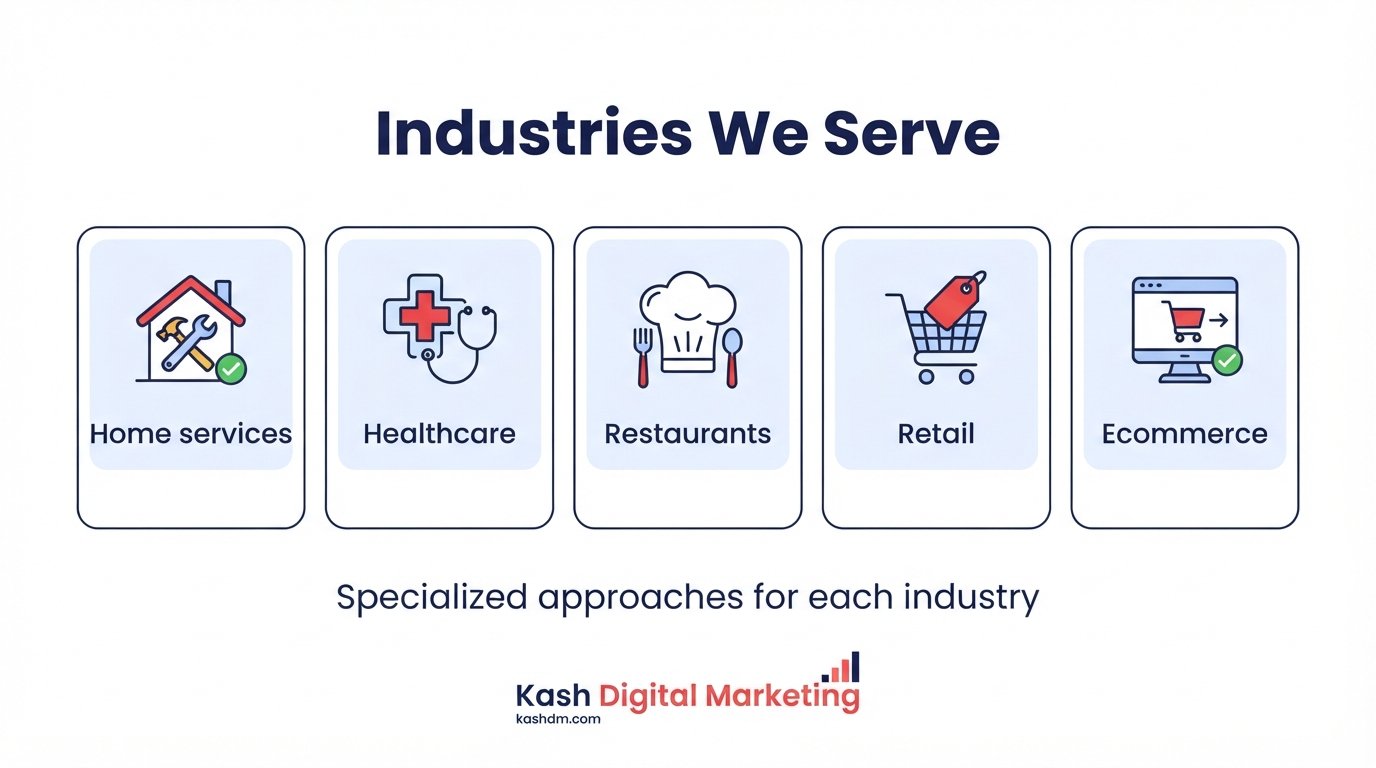
Industries We Serve
Great SEO looks different across industries, and the best providers adapt their approach to the specific search behavior, sales cycle, and trust requirements of your field. Here's a quick look at how we tailor our work.
Home services, healthcare, and professional practices
Home-services businesses need urgent, emergency-intent optimization and seasonal planning. Healthcare and professional practices need trust signals, credentials, and compliance-aware content. We tailor our approach to each, and our technical SEO and content services flex to fit these different demands.
Restaurants, retail, and ecommerce
Restaurants and local retail depend heavily on visual content, accurate hours, and reviews, while ecommerce depends on product-page optimization and technical crawl efficiency at scale, discussed earlier in the ecommerce section of this guide.
| Industry | Primary SEO Focus | Key Signal |
|---|---|---|
| Home services | Emergency and "near me" intent | Reviews, response speed, licensing |
| Healthcare and legal | Trust and expertise signals | Credentials, compliance-aware content |
| Restaurants and retail | Visual and reputation signals | Photos, hours, review volume |
| Ecommerce | Product and category optimization | Crawl efficiency, structured data |
What Working With Us Costs
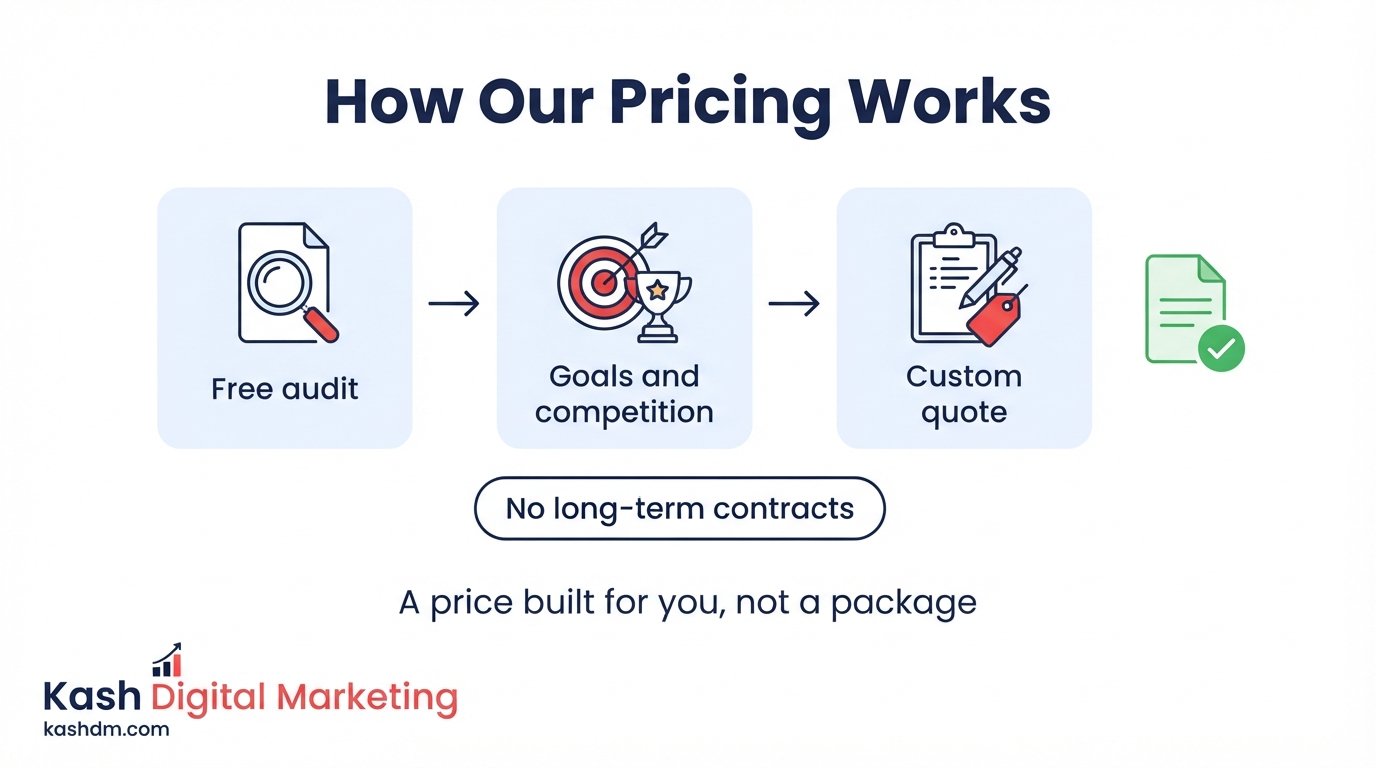
Our pricing depends on your goals, competition, and market, which is why we start with a free audit and a custom quote rather than a one-size-fits-all package, a practice this guide recommends looking for in any provider. Fixed generic packages rarely fit real businesses well.
Why custom quotes beat fixed packages
A business in a low-competition niche needs a different scope than one competing in a crowded metro against a dozen established competitors. A fixed package either overcharges the first business or under-delivers for the second. Our SEO pricing page explains exactly how we build a quote around your specific situation.
No long-term contracts required
Consistent with the standard laid out throughout this guide, we don't require long lock-in contracts. You're free to start focused, evaluate the results, and scale or leave based on what you actually see, not what you were promised on a sales call.
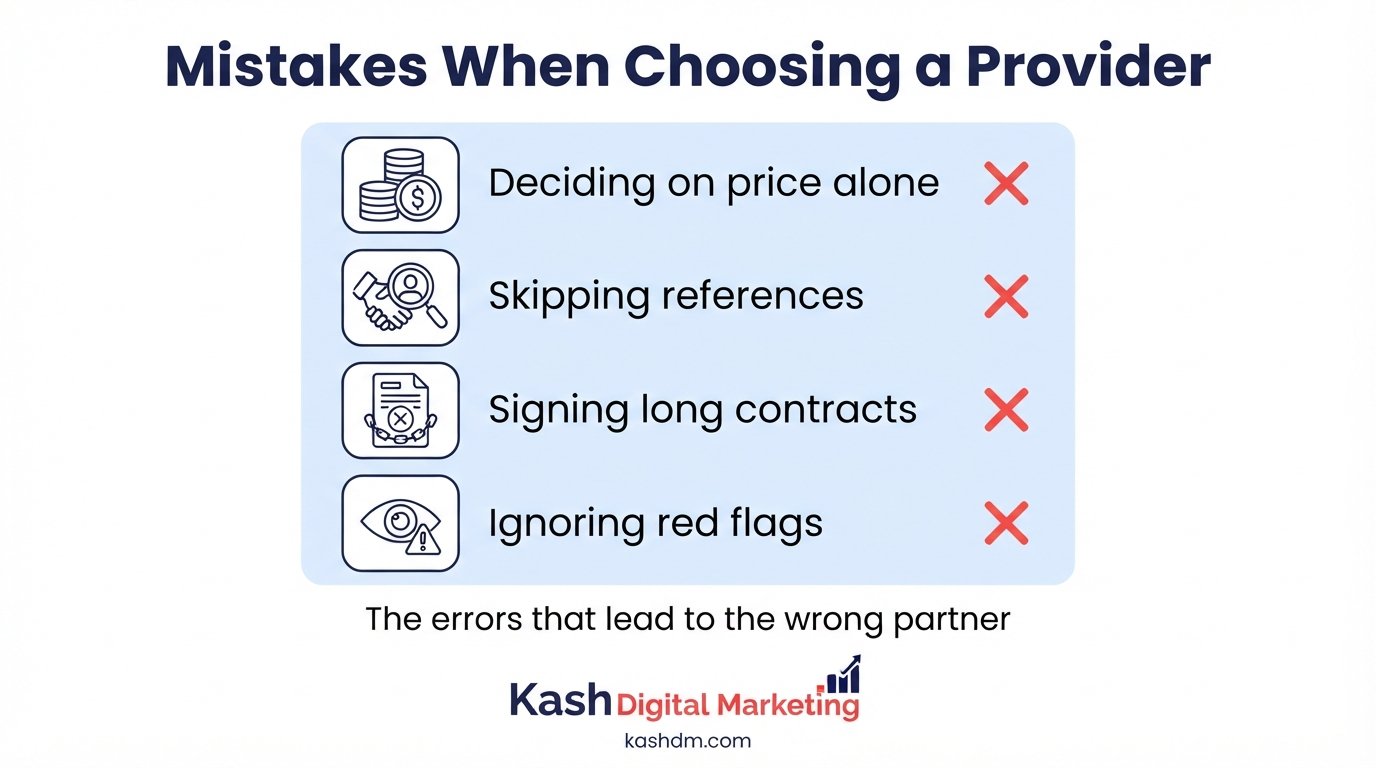
Common Mistakes Businesses Make When Choosing an SEO Provider
Most bad SEO hires trace back to a handful of repeatable mistakes: choosing on price alone, skipping reference checks, signing long contracts before seeing any results, and failing to ask about methods. Avoiding these mistakes is often more valuable than any single positive selection criterion.
Choosing on price alone
The cheapest bid is frequently cheap because it's built on low-quality, high-risk tactics or minimal actual work. Evaluate price relative to scope and method, not in isolation, since an unusually low price is itself a piece of evidence worth investigating rather than celebrating.
Skipping the reference and case-study verification steps
It's tempting to trust a polished pitch and skip the verification steps outlined in this guide, but that shortcut is exactly where bad hires happen. The extra hour spent checking references and reading case studies critically routinely prevents months of wasted spend.
Signing long contracts before seeing any evidence
Committing to twelve months before a provider has proven anything shifts all the risk onto you. Insist on a shorter initial term with clear milestones, as described earlier in this guide, so you have a real off-ramp if the relationship isn't working.
- Compare price against scope and method, not in isolation
- Always verify at least one reference directly
- Read case studies critically, not just the headline numbers
- Avoid long contracts before any evidence of quality
- Ask about methods explicitly, every time
Failing to define success upfront
Many businesses hire an SEO provider without ever agreeing internally, let alone with the provider, on what success actually looks like: a specific number of leads, a target ranking for named keywords, a revenue goal. Without that shared definition, it's nearly impossible to evaluate performance objectively months later, and disagreements about whether the campaign is "working" become subjective arguments instead of factual reviews against an agreed standard. Set this definition explicitly during onboarding, in writing, so both sides are measuring the same thing.
Treating SEO as a project instead of a channel
SEO is sometimes purchased with a project mindset, a fixed scope of work expected to produce a permanent result, when in reality it functions more like an ongoing marketing channel that requires sustained investment to maintain and grow. Businesses that stop investment the moment rankings improve often watch those rankings slowly erode as competitors continue investing and Google's landscape keeps shifting. Understanding SEO as an ongoing channel rather than a one-time project sets more accurate expectations for the long-term commitment required to keep results compounding rather than fading.
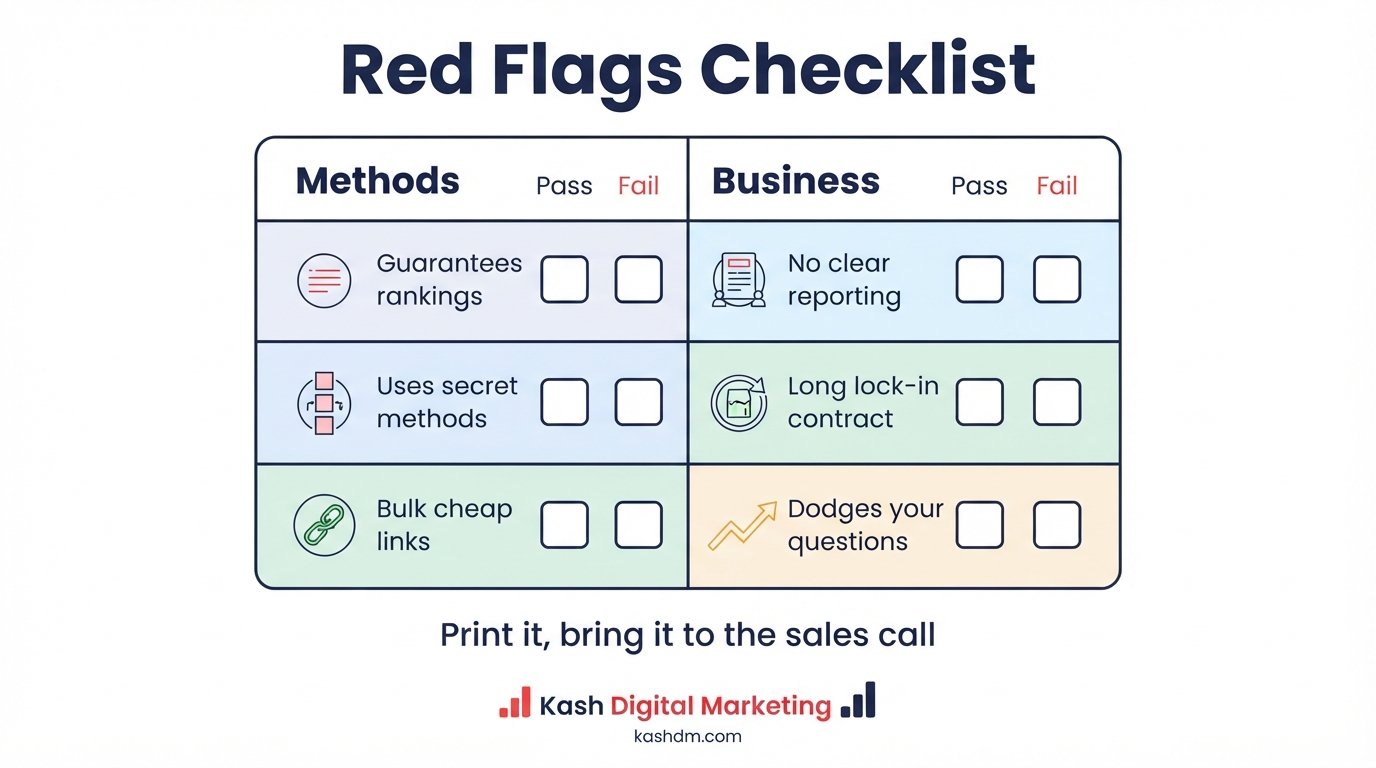
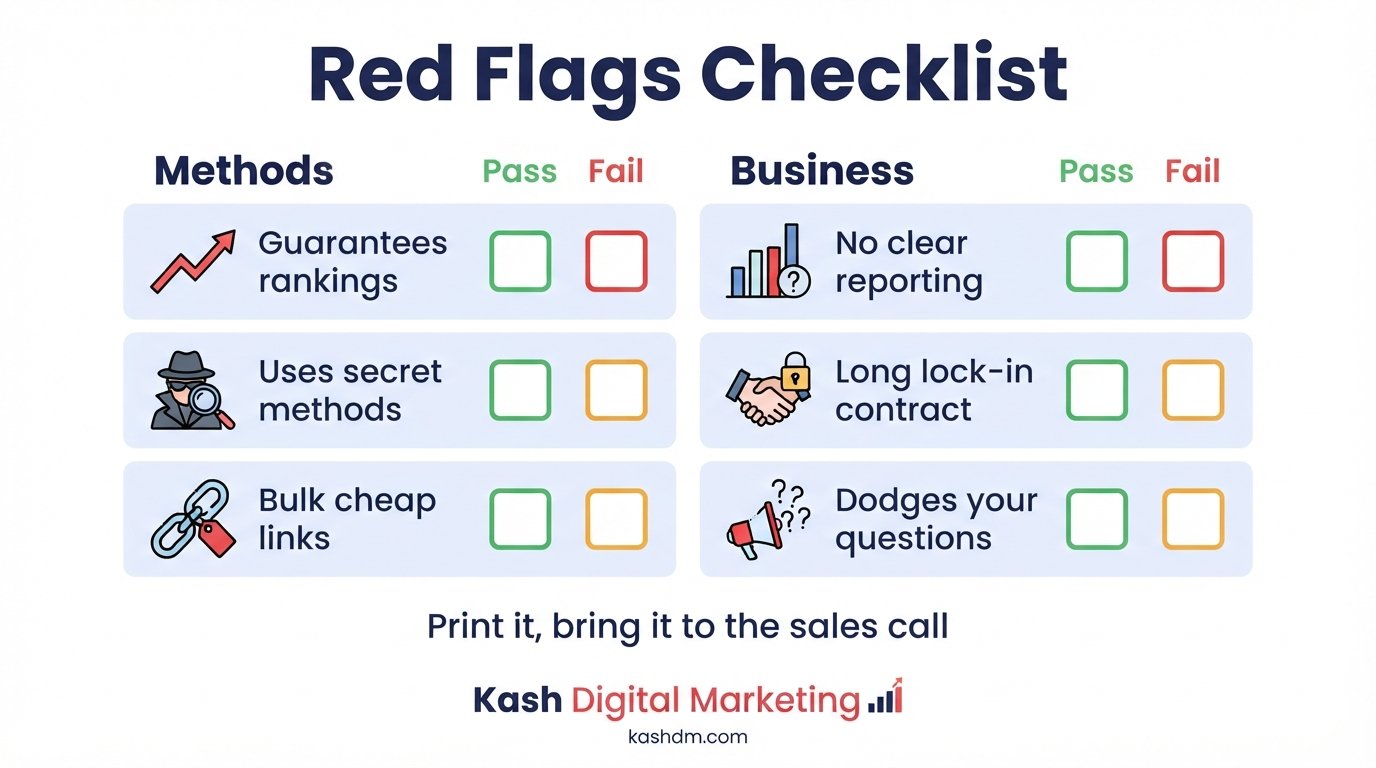
Red Flags Checklist: Print This Before Your Next SEO Sales Call
A simple checklist, printed or saved before your next sales call, keeps you objective even when a pitch is polished and persuasive. Bring this into every conversation.
| Check Before You Sign | Pass | Fail |
|---|---|---|
| Explains link-building methods specifically | ✅ | Vague "proprietary" answer |
| Offers month-to-month or short initial term | ✅ | Requires 12+ months upfront |
| Shows a real sample report | ✅ | Refuses or delays |
| Provides a direct client reference | ✅ | No references available |
| Guarantees process, not ranking position | ✅ | Guarantees "#1 on Google" |
| You retain full ownership of your assets | ✅ | Provider holds accounts hostage |
- Run this checklist against every candidate before signing
- Score each candidate consistently, not just by gut feeling
- Treat any single hard failure as reason for real caution
What Genuine SEO Expertise Sounds Like
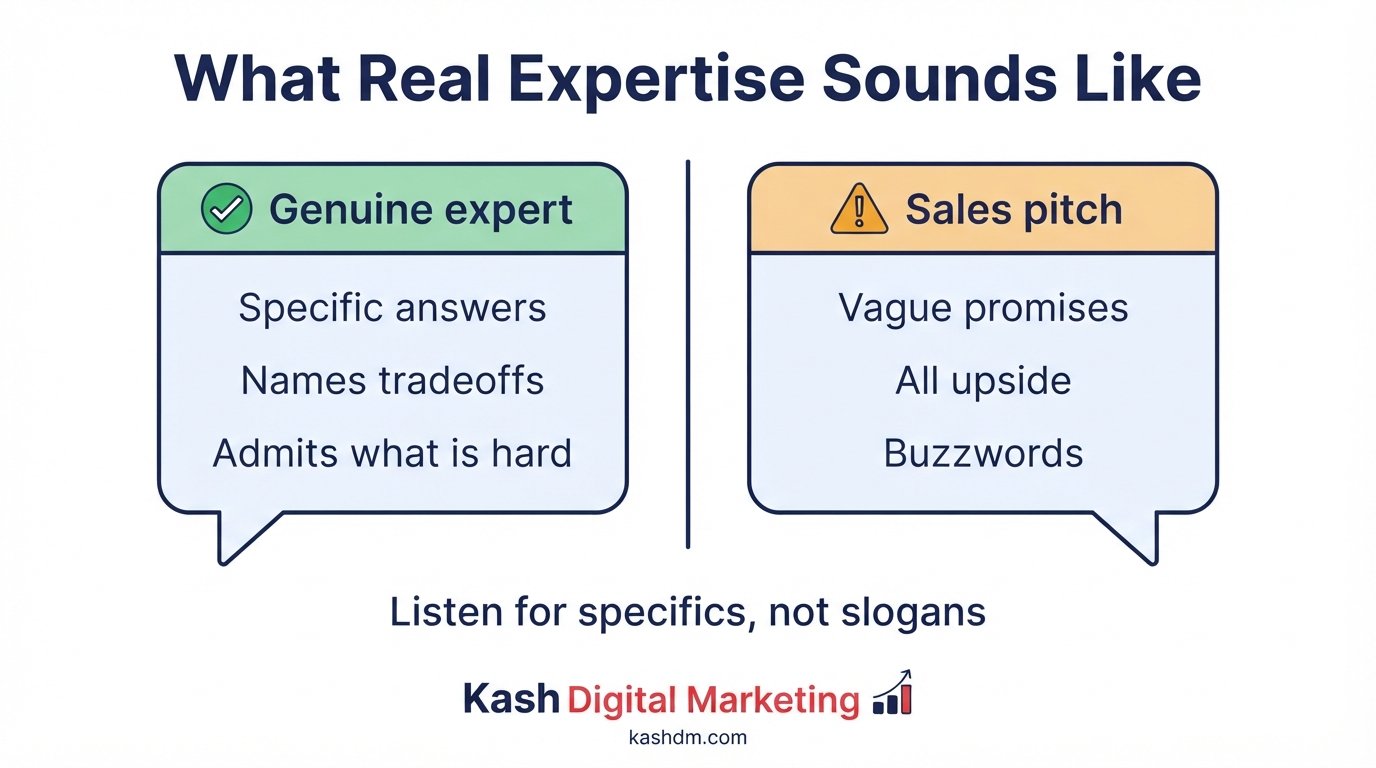
Genuine SEO expertise sounds specific, admits uncertainty where it genuinely exists, and explains tradeoffs rather than promising everything at once, a tone that's surprisingly rare in a sales-driven industry. Learning to recognize this tone helps you separate real expertise from confident-sounding marketing.
Specificity over broad claims
An expert explains what they'd actually do for your specific site, "I'd start by fixing your crawl budget waste from these faceted URLs," not generic claims like "we'll boost your SEO." Specificity that references your actual situation is a strong signal of real expertise rather than a rehearsed pitch.
Comfortable admitting uncertainty
Real experts say "I'd need to look at your data before committing to a timeline" rather than promising a specific number by a specific date on a first call. This comfort with genuine uncertainty, paired with confidence about process, is a mark of expertise rather than a weakness in the pitch.
A Final Word on Trust and SEO
Trust in an SEO relationship is built the same way trust is built anywhere: through consistent, verifiable follow-through over time, not through a single persuasive pitch. No amount of research eliminates all risk, but the framework in this guide meaningfully reduces it.
Why the first ninety days matter most
The early months of any SEO relationship are the clearest window into whether a provider will follow through, because expectations are freshest and deliverables are easiest to check against what was promised. Pay close attention during this period, and don't hesitate to ask direct questions if something feels unclear.
Treating your provider as a long-term partner, once earned
Once a provider has demonstrated real transparency and real results over several months, the relationship shifts from vigilant evaluation to genuine partnership, and that's when SEO's compounding value really shows up. Trust earned this way tends to be durable, because it's built on evidence rather than a first impression.
What to do with this guide right now
If you're actively evaluating providers, the most useful next step is simple: take the checklist from earlier in this guide, the questions to ask, and the red flags to avoid, and use them on your very next sales call, whether that's with us or anyone else. Write down the answers. Compare candidates against each other using the same criteria rather than judging each in isolation against your general impression. A structured comparison, even a rough one, consistently produces a better decision than relying on which pitch simply felt the most polished or persuasive in the moment.
Revisiting the decision periodically, even after you've chosen
Choosing a provider well isn't a one-time decision you never revisit. Even a great relationship benefits from an occasional honest check-in: is reporting still clear, are results still tracking toward the goals you defined at onboarding, is communication still responsive. Building this periodic review into your own routine, every quarter or twice a year, keeps any relationship, including one with us, accountable to the same standard that earned your business in the first place.

Best SEO Company vs Best SEO Services: Providers, Industries, and Common Questions
The best SEO company for your business is the one whose focus, methods, and communication fit your goals, not whichever agency claims to be the biggest. Whether you searched for the best SEO company near me, the best SEO services provider in the USA, or the best SEO company for a specific industry, here is how to find the right one and answers to the questions buyers ask most.
Best SEO company, agency, or services provider: what to look for
Whether you searched for the best SEO company, the best SEO services provider, the best SEO services company, or the best SEO services agency, the evaluation is the same: proven results, transparent reporting, white-hat methods, and clear communication without long contracts. A great SEO agency shows its work rather than leaning on the word "best." The best SEO marketing services and best SEO optimization services tie their efforts to real business outcomes, and that is exactly the standard we hold ourselves to.
Best SEO company near me and in the USA
Searches like the best SEO company near me and the best SEO services USA reflect a real preference for a provider who understands your market and works in your time zone. Because we work with clients remotely across the country, we deliver top SEO services in every US metro, so businesses looking for the best SEO company in the USA get local-market understanding with national-level skill. People also search for the best SEO company in the world, but the honest truth is there is no single best, only the best fit for your business. Explore coverage on our locations page.
Best SEO services by business type: local, small business, ecommerce, and enterprise
The best provider depends on what you sell. For location-based businesses, look at the best local SEO services and the best local SEO services near me; for smaller operations, the best SEO company for small business and the best affordable SEO services for small business websites; and for stores and large sites, the best ecommerce SEO services and the best enterprise SEO services. We deliver all of these, and dedicated pages explain each: local SEO, small business SEO, ecommerce SEO, and enterprise SEO. Startups and new sites should also read our take on the best SEO services for startups.
Best SEO company for your industry
Many buyers search for the best SEO company for their exact field, and specialization matters. Whether you need the best SEO company for real estate, doctors, lawyers, dentists, plumbers, or contractors, the right partner understands how customers in that industry actually search. We build industry-specific strategies and go deep in our home services, healthcare, professional services, and restaurant and retail guides. We also offer specialized work like YouTube and video SEO for brands that need it.
Who has the best SEO, is it worth it, and what should you pay?
Buyers often ask what the best SEO company really is, who has the best SEO, or check the best SEO services on Reddit before deciding, and the smart consensus there is worth repeating: favor transparent, white-hat providers and be wary of anyone guaranteeing instant number-one rankings. Is SEO worth it, and are SEO services worth it? For almost any business with real competition, yes, because organic search delivers high-intent customers at a cost per lead that falls over time. As for how much you should pay for SEO services, the right price is the one where the results clearly outweigh the cost, which is why we start with a free audit and a custom quote. See our SEO pricing guide for details.
Frequently Asked Questions About Choosing SEO Services
What are the best SEO services for a small local business?
For most local businesses, the best fit is a provider specializing in local SEO, Google Business Profile optimization, citations, and reviews, rather than a generalist national SEO package. Look for transparent reporting, month-to-month terms, and case studies from businesses of a similar size.
How much should I expect to pay for good SEO services?
Pricing varies widely based on competition, industry, and scope, so be wary of both unusually cheap bulk packages and vague, unexplained high quotes. A trustworthy provider explains what drives the price and offers a custom quote after understanding your specific situation. See our SEO pricing page for how custom quotes typically work.
How do I know if an SEO agency is using black-hat tactics?
Ask directly how they build links and generate reviews. Vague or evasive answers, unusually fast results on competitive terms, or reluctance to name specific methods are all signs worth investigating further before signing anything.
Is it better to hire an SEO agency or do it myself?
DIY SEO can work for a very small, patient business willing to invest significant time learning the discipline, but most businesses get faster, more consistent results from a specialized agency team that already has the expertise, tools, and cross-client experience built in.
How long does it take to see results from a new SEO provider?
Low-competition longtail terms and Google Business Profile improvements often move within four to eight weeks; competitive terms typically take three to six months. Be skeptical of any provider promising dramatically faster results on competitive terms.
Should I ever guarantee myself out of a contract if results are guaranteed?
Any provider guaranteeing specific rankings has already made a claim no one can honestly back, so the safer path is avoiding that provider entirely rather than relying on a contractual exit clause to fix a fundamentally dishonest promise.
What's the difference between SEO and paid search (PPC)?
SEO builds organic, unpaid rankings that compound over time and keep working after the active work slows; PPC buys immediate visibility that stops the moment you stop paying. Many businesses benefit from both, but SEO typically delivers a better long-term return per dollar invested.
Can I switch SEO agencies without losing my rankings?
Yes, as long as you retain ownership of your website, Google Business Profile, and analytics accounts, a clean switch preserves most of the value already built. A short adjustment period while a new provider gets oriented is normal.
What size business is too small for professional SEO services?
Very few businesses are genuinely too small, since even modest, focused SEO investment often outperforms other marketing channels for local and small businesses. The right question isn't whether you're big enough, it's whether a provider is willing to right-size their approach to your actual budget, as discussed in the small business section above.
How do I get a second opinion on my current SEO provider?
A free audit from an independent provider is a low-risk way to get a second opinion, comparing your current rankings, technical health, and reported progress against what an outside review finds. Our free SEO audit is exactly this kind of no-obligation second look.
Get Your Free SEO Audit
Request Your Free SEO Audit
Prefer to talk it through? WhatsApp US +2135622433 or WhatsApp PK +92 348 3879366. We usually reply within an hour, and always within 8 hours.
See exactly where your current SEO stands and what a genuinely transparent, white-hat strategy would look like for your business. Your free SEO audit reviews your website, technical health, current rankings, and competitors, and hands you a clear, prioritized action plan, yours to keep whether or not you work with us.
Ready to evaluate us against the standard in this guide? Request your free audit and we'll usually reply within an hour, and always within 8 hours on business days.
- 💬WhatsApp: +2135622433
- ✉️Email: [email protected]
- 📝Free audit form: start here

Choosing an SEO provider is one of the highest-leverage marketing decisions a business makes, and the difference between a great choice and a bad one compounds for years in either direction. Use the checklist, the questions, and the red flags in this guide with every provider you talk to, including us. If we hold up under that scrutiny, we'd be glad to earn your business, starting with a free, no-obligation audit.
Kash Digital Marketing, honest SEO services for US local businesses, built on the same transparency standard we're asking you to demand from anyone you hire. No spam. No long contracts. Just results.