Local SEO for a taxi company is the work that puts your business in Google Maps and local search results when someone nearby needs a ride, so the call comes to you instead of to a competitor or an app. At Kash Digital Marketing, our taxi SEO services combine Google Business Profile optimization, airport and city landing pages, service pages for the rides you actually sell, review generation and technical site work into one system built to turn "taxi near me" into a booked fare.
Taxi is one of the few industries where the search and the purchase happen in the same minute. Somebody lands at an airport, walks out of a hotel lobby, or finishes a hospital appointment, pulls out a phone, and books whoever appears first and looks legitimate. There is no research phase, no comparison shopping, and no second chance.
That immediacy is why local search decides so much of a taxi company's revenue, and why the companies still growing in 2026 are the ones that treated Google Maps as infrastructure rather than as advertising.
This page is a complete guide to local SEO for taxi and cab companies across the United States, written so you can evaluate any provider, including us, against a real standard. It covers how riders search, where taxi companies genuinely beat the rideshare apps, how airport and city pages should be built, what the work costs and how long it takes.

What Local SEO for a Taxi Company Actually Is
Local SEO for a taxi company is the process of optimizing your Google Business Profile, website and local signals so your business appears in Maps and local results when nearby riders search for a taxi, cab, or airport transfer. It differs from general SEO because almost every valuable search is tied to a place, a time and an immediate need.
Nobody searches for a taxi three weeks in advance, except for airport runs. The rest of the time the searcher wants a car now, and the businesses that appear in the first three Maps results collect most of that demand.
The three places a taxi company can appear
Paid ads sit at the top, the local map pack shows three businesses on a map beneath them, and organic results follow. Local SEO targets the second and third. The map pack matters most because it carries a call button and needs no website visit at all.
Why taxi search is local before anything else
A cab company in Tampa competes with cab companies in Tampa. Google resolves ride queries geographically by default, so proximity, service-area definition and local prominence outweigh nearly every general SEO tactic that works in other industries.
The two halves of the work
The first half is the Google Business Profile and local signals, which decide the map pack. The second half is the website, which wins organic rankings and converts the visitor once they land. Doing one and skipping the other is the most common reason taxi operators conclude that SEO does not work.
What local SEO for taxi companies is not
It is not stuffing city names into a footer, and it is not buying links. Both worked a decade ago and both now carry real risk. It is also not a project with an end date, because competitors keep publishing and Google keeps re-evaluating.
How a search becomes a booked fare
A rider searches, sees your profile in the map pack, glances at the rating, taps to call or lands on an airport page that names their terminal, and books. Every link in that chain is something local SEO work can improve, which is why the discipline should be judged on booked rides rather than rankings.

Why Local Search Decides So Much of a Taxi Company's Revenue
Taxi companies depend on local search more than most local businesses because the decision window is minutes long and the customer almost never has a preferred provider in mind. There is no annual service visit building loyalty, and for most riders there is no remembered company name at all.
The result is that nearly every fare is competed for again, in public, at the moment of need. Search is where that competition happens.
The purchase decision is measured in minutes
A homeowner comparing roofers takes weeks. A rider standing outside a terminal takes ninety seconds. Compressed decisions reward whoever is visible and credible immediately, and punish everyone else regardless of fleet quality.
Riders rarely remember a cab company's name
Even a satisfied customer usually searches again rather than recalling who drove them last month. That makes brand recall unreliable and search visibility the practical substitute for it.
Airport and hospital demand is predictable and searchable
Unlike street hails, airport runs, medical appointments and hotel transfers are planned minutes to days ahead, and they are researched on a phone. This is the demand that local SEO can capture reliably.
Dispatch phones ring from Google, not from billboards
For most operators the majority of inbound calls now originate from a Maps listing or an organic result. That makes the Google Business Profile a piece of operating infrastructure rather than a marketing extra.
Visibility compounds where advertising does not
Every review, citation and page keeps working after it is paid for. A well-built airport page produces bookings for years, while a paid campaign stops producing the day the budget stops.
How Riders Actually Search for a Taxi
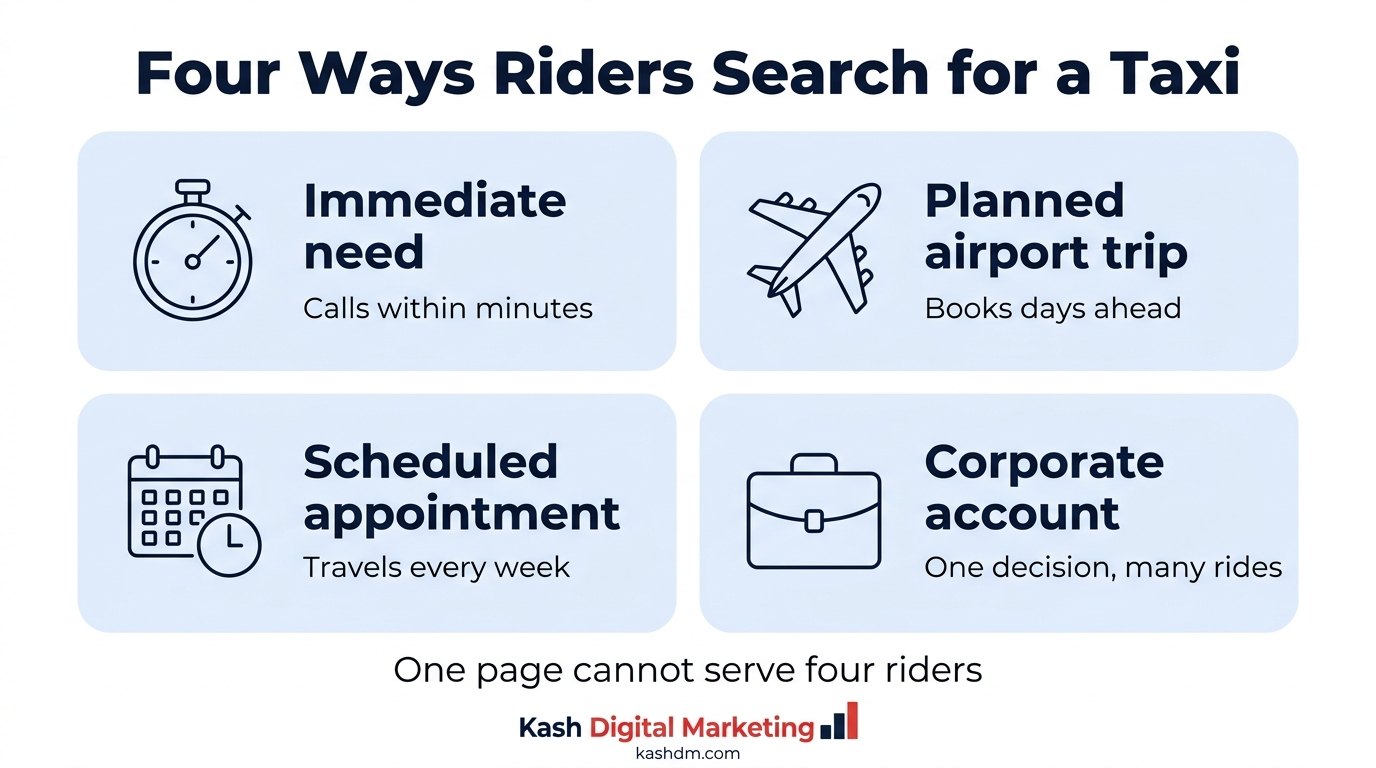
Riders search for a taxi in four distinct modes, and each one needs a different page on your website. Building for only the first, which is what most taxi sites do, leaves the majority of bookable demand unclaimed.
Understanding these modes is the difference between a site that ranks for words nobody valuable types and one built around how riders behave.
The immediate-need search
A car is needed now. Queries are short: "taxi near me," "cab service near me," "24 hour taxi." The rider calls within minutes and rarely looks past the first three results. Speed, a tappable phone number and honest hours decide this one.
The planned airport search
A flight is booked and the ride is arranged in advance. Queries name the airport and often the terminal. This searcher compares two or three options, cares about reliability and fixed pricing, and is the most valuable repeat customer in the business.
The scheduled appointment search
Medical visits, court dates, dialysis, elder care. These riders book ahead, travel regularly, and frequently need specific vehicle types or assistance. They are searched for by the rider or by a family member on their behalf.
The account and corporate search
Office managers and travel coordinators searching for a company that can invoice, handle repeat bookings and provide receipts. Low volume, high value, and almost entirely uncontested by other taxi operators.
Why mode determines page type
Immediate searches need fast, phone-first pages. Airport searches need terminal detail and clear pricing. Appointment searches need accessibility and reliability information. Corporate searches need invoicing and account terms. One generic homepage cannot serve four different readers.
Where Taxi Companies Actually Beat the Rideshare Apps
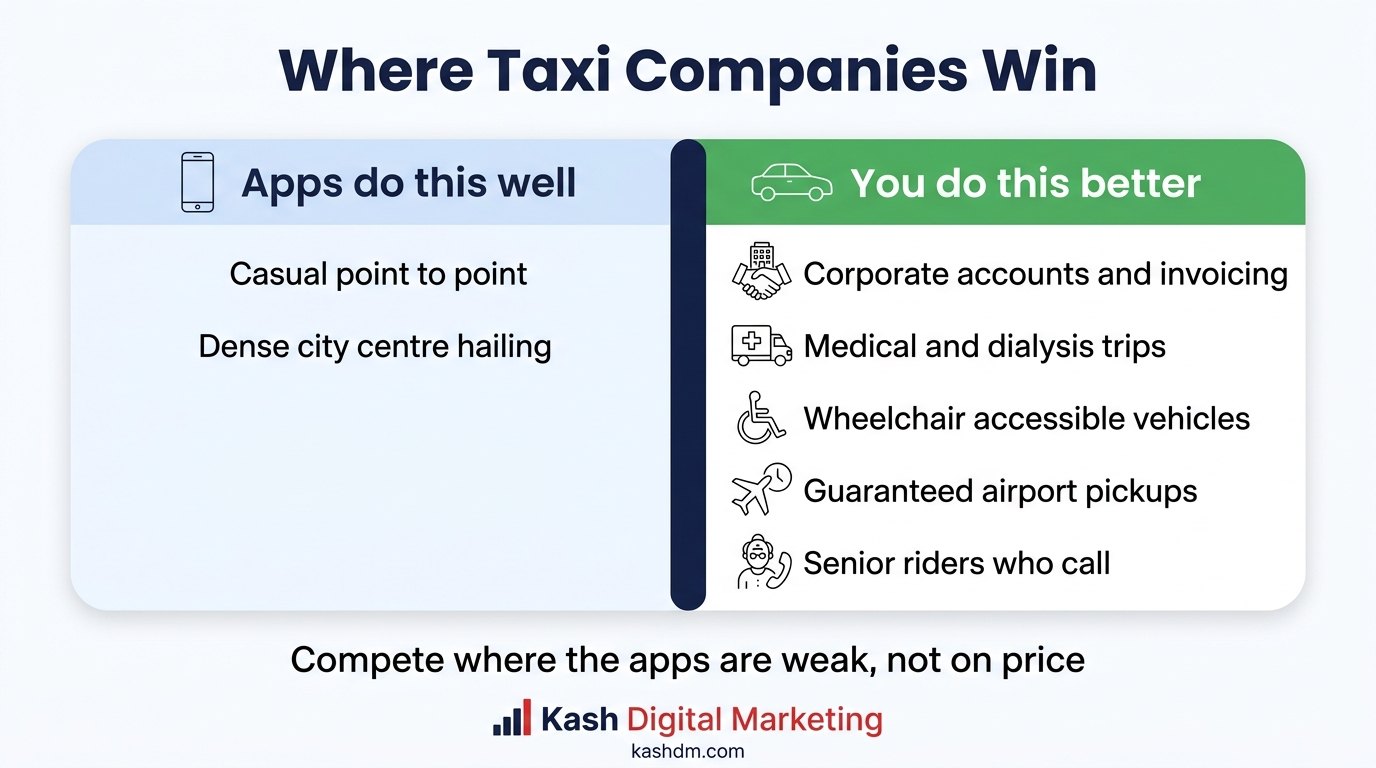
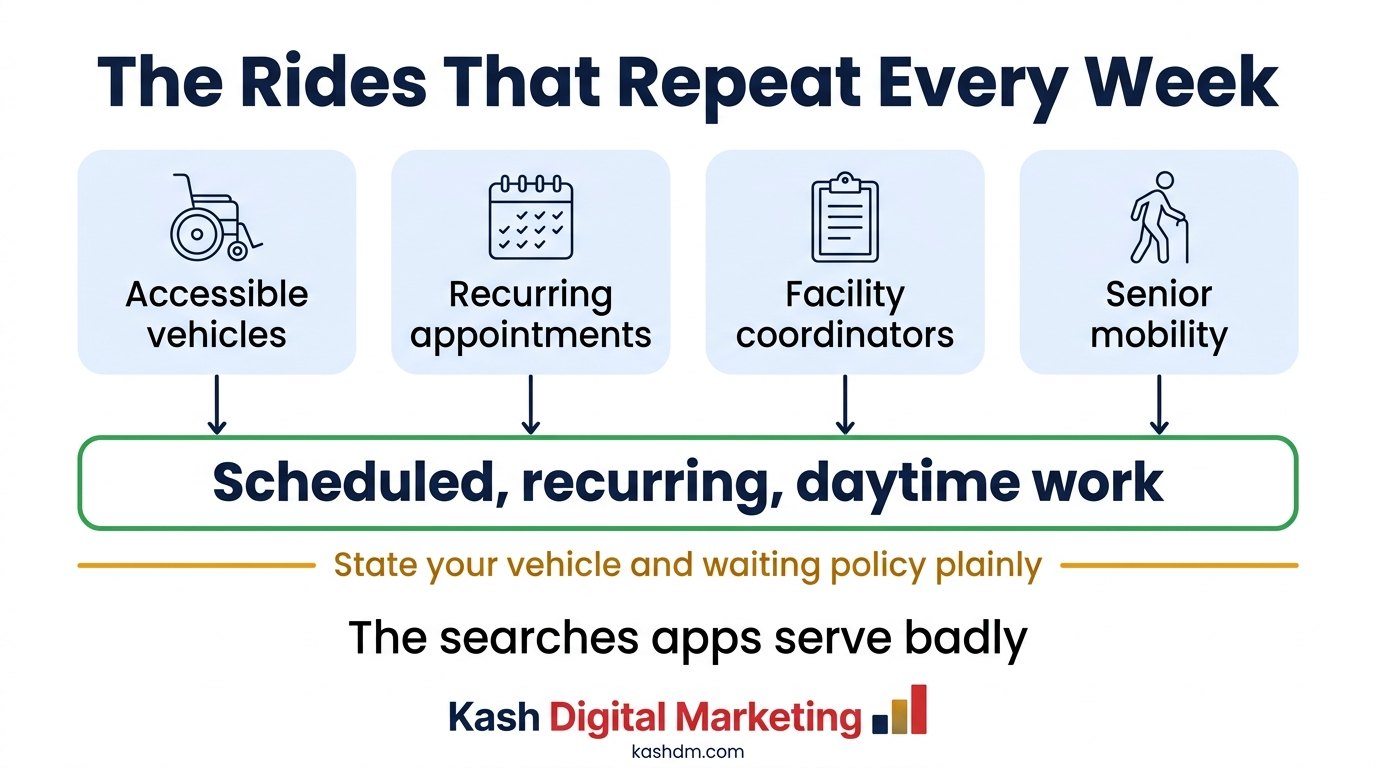
Taxi companies do not win by competing with rideshare apps on hailing a car across town, they win in the segments the apps serve badly: contracted corporate travel, medical transportation, wheelchair-accessible vehicles, airport contracts, senior mobility and group transport. Local SEO is how a taxi company gets found for exactly those searches.
This is the strategic point most taxi marketing misses. Ride-hailing dominates the casual point-to-point market, and trying to win that fight on price is a losing position. The searches worth ranking for are the ones an app cannot fulfil properly.
What the apps genuinely do better
Instant casual hailing, dense urban coverage and a frictionless first-time experience. There is no advantage in pretending otherwise, and no SEO strategy that changes it. Accepting this is what frees a taxi company to compete where it can actually win.
Contracted and account-based work
Businesses that need invoicing, monthly billing, receipts for expense reports and a guaranteed pickup do not want an app. They want a supplier with a phone number and a contract, and they search for one.
Non-emergency medical transportation
Dialysis, chemotherapy, physical therapy and discharge rides need reliability, trained drivers and often a wheelchair-capable vehicle. These are recurring, scheduled and frequently reimbursed, and rideshare coverage is inconsistent at best.
Wheelchair-accessible and assisted travel
A rider needing a ramp-equipped vehicle cannot rely on a casual app match. A taxi company with genuine accessible vehicles has something the apps cannot reliably supply, and the search volume is small, specific and highly convertible.
Airport contracts and guaranteed pickups
Travellers who have been stranded by a cancelled app pickup once will book a confirmed car the next time, especially for an early-morning flight. Reliability is a real product, and it can be sold in search.
Senior riders and repeat local customers
Many older riders prefer a phone number, a familiar company and a driver who helps with the door. This is a durable customer base that never migrates to an app, and it is reached through Maps and local search rather than through app stores.
Why this changes the whole keyword strategy
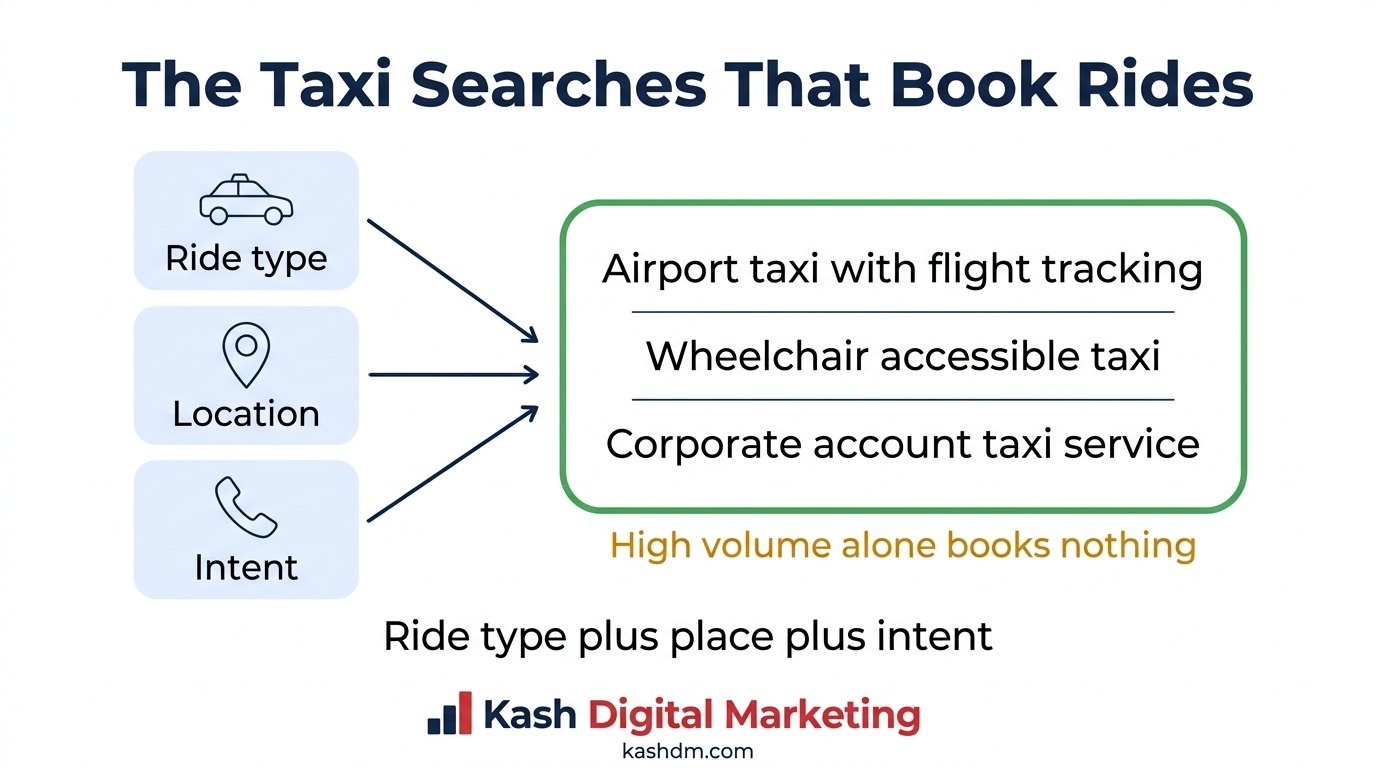
If the plan is to outrank rideshare for "cheap ride downtown," the plan is wrong. If the plan is to own "wheelchair accessible taxi," "airport taxi with flight tracking" and "corporate account taxi service," the plan matches where the margin actually is.
Google Maps and the Local Three-Pack for Taxi Companies
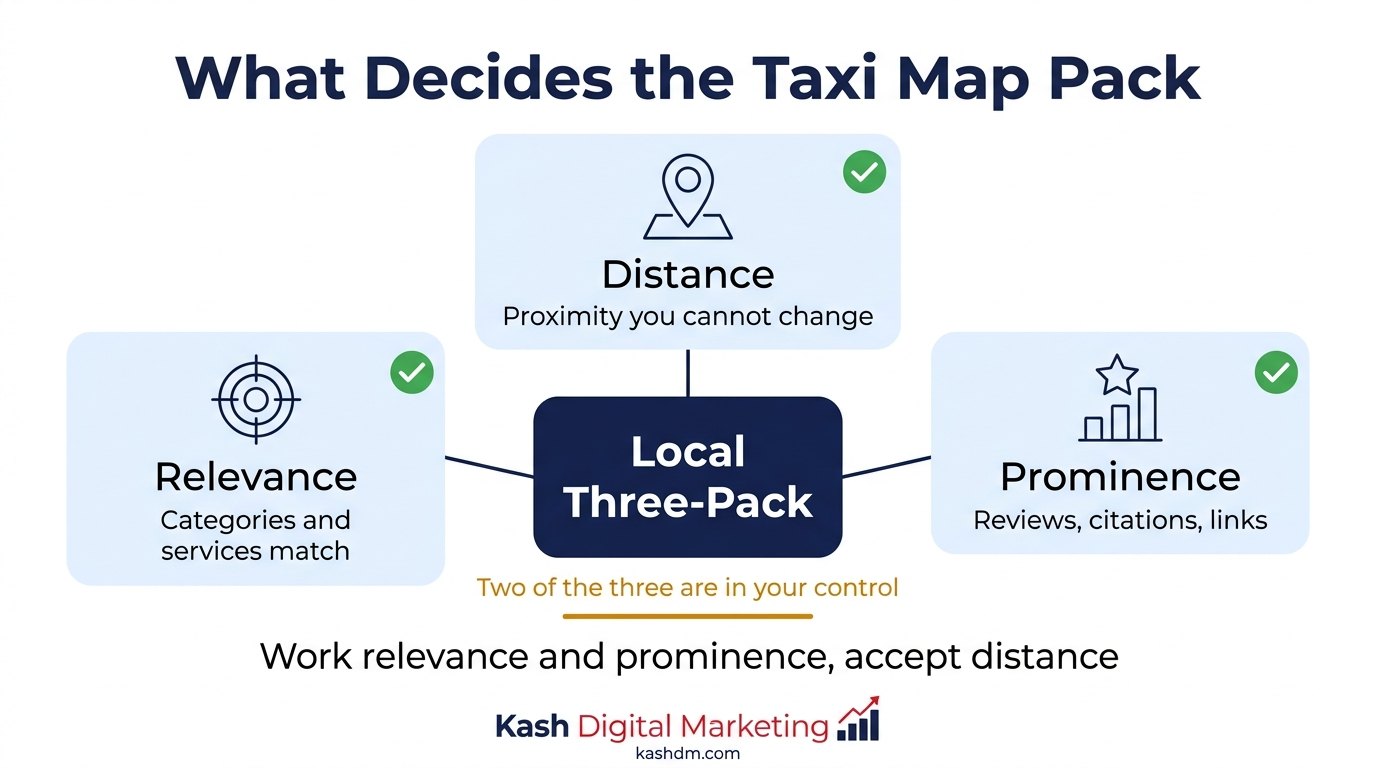
The three-result map pack produces more calls for most taxi companies than every other channel combined, and Google ranks it on three things: relevance, distance and prominence. Only two of the three are in your control.
Knowing which two is the fastest way to stop wasting effort on the one that is not.
Relevance: does Google understand what you do
Relevance comes from your profile categories, your listed services and your website content. A company listed under a vague transportation category is telling Google something imprecise about a specific business, and it ranks accordingly.
Distance: the factor you cannot change
Google favours businesses near the searcher. You cannot relocate to every neighbourhood you serve, and you must never fake an address, which risks suspension. What you can do is compete harder on the other two and build genuine local content for target areas.
Prominence: the factor most operators neglect
Prominence is how established the business appears, built from reviews, citations, links and mentions. It is the slowest signal to build and the hardest for a competitor to copy quickly, which makes it the most durable advantage available.
Why the map pack beats organic for taxi work
Map results sit above organic listings, carry a call button and show your rating. For immediate-need searches, most of the contact volume never reaches an organic result at all.
Service-area businesses and the address question
Many taxi companies operate from a dispatch office or a lot rather than a walk-in storefront. Google supports this as a service-area business with the address hidden and service areas defined. Configuring it correctly matters, because a mishandled address is a common cause of suspension.
One profile cannot cover an entire metro
A single profile ranks strongly near its own location and weakens with distance. Covering a wide metro means building real local relevance through city pages, local links and reviews naming those areas, not expecting one pin to reach fifty miles.
Google Business Profile Optimization for Taxi Companies
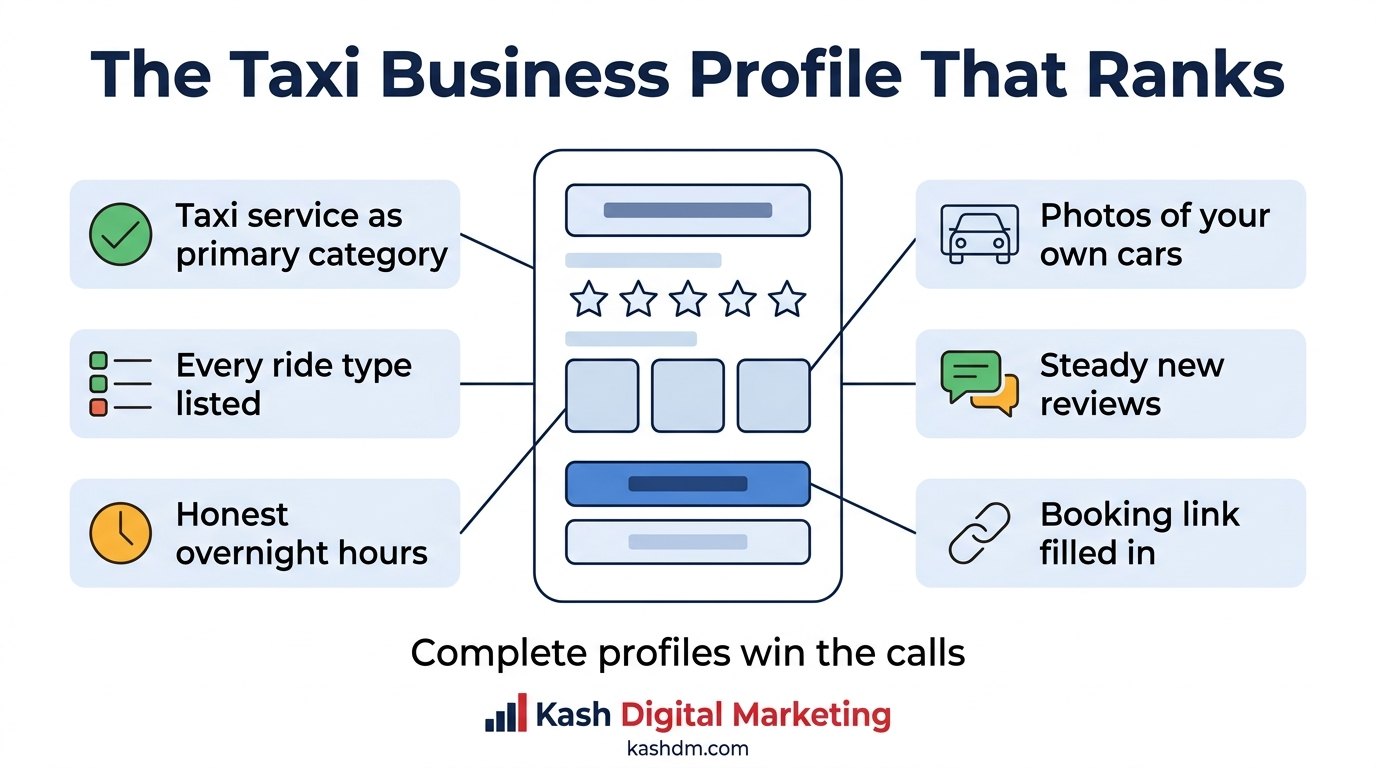
Your Google Business Profile is the highest-return asset in taxi local SEO, and most operators have fixable errors sitting in theirs right now. It is also the fastest-moving part of the job, because Google re-crawls profiles constantly rather than on a slow content schedule.
This is where we start with almost every taxi client, because it is common to find years of lost calls traceable to a category setting or a duplicate listing nobody knew existed.
Primary category decides more than anything else
"Taxi Service" is correct for most operators. Airport shuttle, chauffeur service, limousine service and medical transportation belong in secondary categories where you genuinely offer them. Getting the primary wrong is the single most expensive setting error available.
List every service you actually sell
Airport transfers, hourly hire, wheelchair-accessible rides, corporate accounts, long-distance trips, parcel or courier runs where offered. Each entry is a relevance signal, and an empty services section tells Google almost nothing about a business that does a great deal.
Real photos of real vehicles and drivers
Stock imagery is transparent to riders and adds nothing. Photographs of your actual cars, livery, drivers and airport pickup points support both ranking and the credibility judgment a rider makes in a few seconds.
Duplicate listings quietly suppress everything
Duplicates are common in transportation, created by old dispatch software, previous owners or directory scrapers. They split reviews across two profiles and can suppress both. Finding and merging them is often the highest-value hour of an engagement.
Hours that tell the truth about overnight service
If you genuinely run 24 hours, say so, and then answer. If you do not, do not claim it. Late-night searches convert on the phone being picked up, and an unanswered call listed as available produces a one-star review rather than a fare.
The booking link and call-to-action fields
Google lets a profile carry a booking URL and appointment link. For a taxi company these are direct conversion paths that many operators leave empty, sending riders to a homepage instead of a booking form.
Never manipulate the business name
Adding keywords to the business name field is a violation, it is widely reported by competitors, and the penalty ranges from a filtered listing to suspension. An operator with a real fleet has far too much to lose.
Taxi Keyword Research That Produces Bookings
The taxi keywords worth ranking for combine a service, a place and an intent, and they usually have lower search volume than the generic terms operators ask about. "Taxi" gets enormous volume and books almost nothing useful. "Wheelchair accessible taxi Dallas" gets a fraction of it and books recurring work.
Chasing volume instead of intent is the most common way taxi marketing budgets are wasted, and it is easy to spot in a report full of impressive traffic and a quiet dispatch phone.
Service plus place plus intent
The formula that produces revenue is a ride type, a location and a word signalling a decision: near me, book, 24 hour, airport, accessible, corporate. Each element narrows the audience and raises the chance the searcher is ready to call.
Immediate-need keyword families
"Taxi near me," "cab service near me," "24 hour taxi," "taxi company near me," "late night taxi." Highest conversion rate in the category, heavily weighted to the map pack, and won mostly through profile and prominence work rather than content.
Airport keyword families
"Airport taxi [city]," "taxi to [airport code]," "[airport] terminal pickup," "airport transfer [city]," "early morning airport taxi." Higher fare values, planned in advance, and the strongest single content opportunity most taxi companies have.
Accessibility and medical keyword families
"Wheelchair accessible taxi," "ADA accessible cab," "non emergency medical transportation," "dialysis transportation," "senior transportation service." Specific, recurring, underserved and rarely contested by other taxi operators.
Corporate and account keyword families
"Corporate taxi service," "business account taxi," "executive car service," "taxi with invoicing." Searched during business hours by someone who will produce many rides from one decision.
Long-tail questions that build authority
"How much is a taxi from the airport to downtown," "do taxis take card," "can I book a taxi in advance," "how early should I book an airport taxi." Individually small, collectively substantial, and they are what convinces Google your site covers ground transport properly.
Keywords worth deliberately ignoring
Rideshare brand comparisons you cannot win, cities you do not serve, and generic transportation terms with no local intent. Ranking for these produces healthy-looking traffic reports and no additional fares.
Ranking for "Taxi Near Me" Searches
No business ranks for "near me" as a phrase, because Google resolves it into the searcher's actual location and returns nearby businesses that look relevant and established. Winning these searches is therefore a profile, proximity and prominence problem rather than a content problem.
This is worth stating plainly because "near me" is the term taxi operators ask about most, and a great deal of marketing is sold against a misunderstanding of it.
What Google actually does with "near me"
It discards the phrase and applies the searcher's coordinates. The results are businesses matching the service, ranked by relevance, distance and prominence. There is no page you can write that contains "near me" and thereby wins it.
Why your rankings differ block by block
Two riders a mile apart see different results. This is why a single reported ranking position is misleading for a taxi company and why visibility should be measured across a grid of points in your service area instead.
What genuinely improves near-me visibility
A complete profile with the right primary category, a steady flow of recent reviews, accurate service areas, consistent citations, and real pages for the areas you serve. Unglamorous, and it is the entire answer.
Why more coverage beats more keywords
Adding a genuine presence in a second and third part of the metro does more for near-me visibility than any amount of on-page optimization on a single page. Coverage is the lever.
The honest limit
You will not appear for every rider in every neighbourhood, and any provider promising that is describing something they cannot deliver. The goal is to appear for as much of your operating area as your real presence justifies.
Airport Taxi SEO
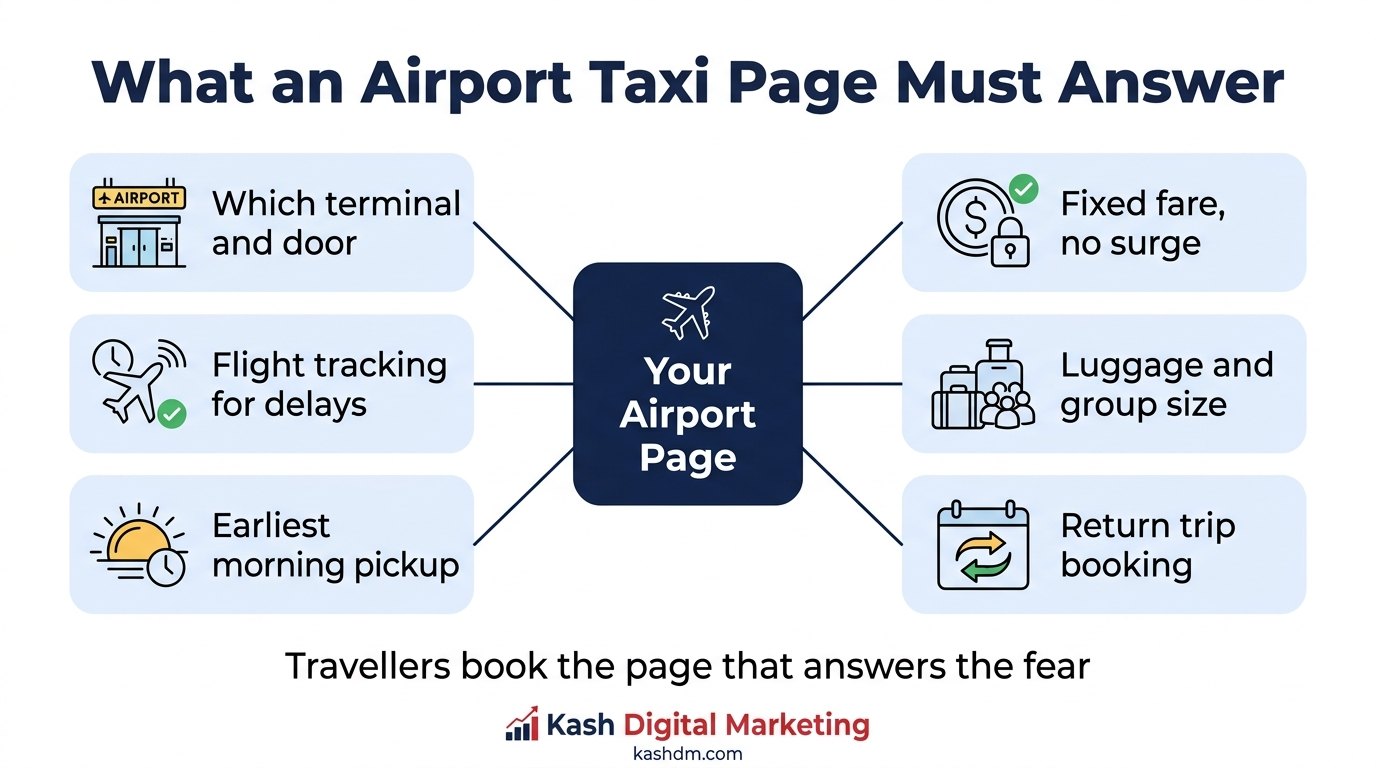
Airport searches are the single most valuable content opportunity a taxi company has: the fares are larger, the bookings are planned in advance, and the riders repeat. They are also the searches where a thin, generic page loses most obviously to a detailed one.
Someone searching "taxi to the airport" at eleven at night before a six a.m. flight is not browsing. They want confirmation that a car will be outside at four, and the page that answers that question gets the booking.
One page per airport you serve
Each airport deserves its own page, named for the airport and its code, covering pickup, drop-off, travel times from the areas you serve and how to book. A single "airport transfers" page cannot rank for several airports at once.
Terminal-level detail is the differentiator
Which door, which level, which pickup zone, where rideshare pickup differs from taxi pickup, and what happens with multiple terminals. This is information competitors rarely publish and travellers genuinely need.
Flight tracking and delayed arrivals
If you monitor flight numbers and adjust pickups, say so explicitly and explain how it works. It is one of the clearest advantages a real taxi operation holds over an app, and it directly addresses the traveller's actual fear.
Early-morning and late-night reliability
The four a.m. airport run is the fare riders most want guaranteed and most fear losing. A page that states your earliest booking, confirmation process and what happens if a driver is delayed converts unusually well.
Fixed pricing and what it is worth
Where you offer a flat airport rate, publish how it works even if you do not publish the number. Predictability is the specific thing surge pricing has taught travellers to value, and saying so plainly is a competitive statement.
Luggage, groups and vehicle types
Families with cases, golf clubs, oversized baggage and groups of five or more are poorly served by a standard app match. Stating vehicle capacity captures searches that never reach your competitors.
Return trips and round-trip booking
The rider you take to the airport is the same rider landing a week later. A page that makes booking the return simple converts one fare into two, which no ranking improvement on its own can do.
City and Neighborhood Landing Pages for Taxi Companies
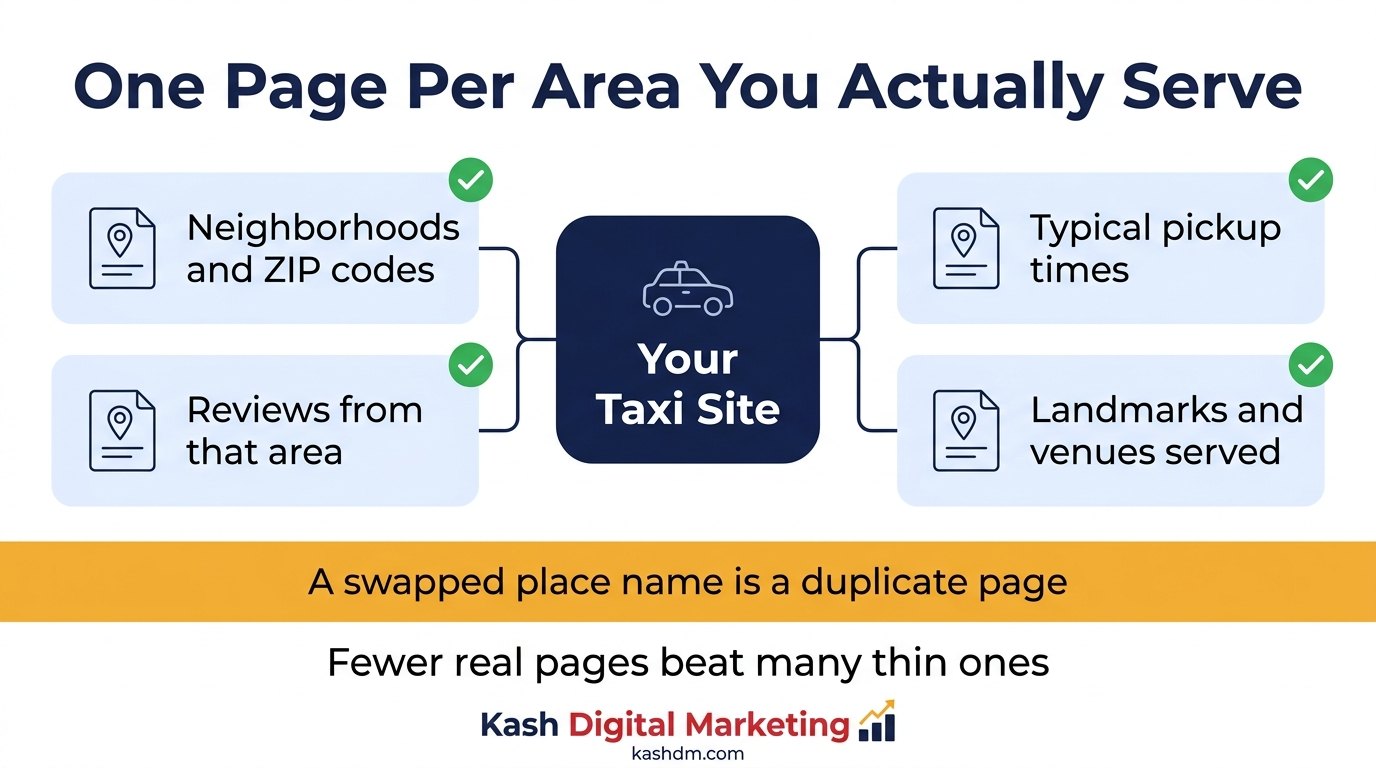
A taxi company ranks in the areas where it has genuine local content, not in every city it claims to serve. One page per market you actually operate in, carrying real local detail, outperforms fifty templated pages with the place name swapped.
This is where taxi SEO most often goes wrong, because bulk location pages are easy to produce and look like progress on a report while doing active harm.
What belongs on a real city page
The neighbourhoods and ZIP codes covered, typical pickup times to that area, the landmarks and venues riders name, reviews from customers there, and the services in demand locally. None of it can be copied by a competitor.
Why templated location pages backfire
Pages identical except for a place name are treated as duplicates. At best they are ignored, at worst they dilute the authority of pages that were working. Transportation is among the worst affected because the temptation to mass-produce is so strong.
Local knowledge is real content
Event traffic at a stadium, hospital campus entrances, university move-in weekends, which downtown streets close for a farmers market. This is exactly the knowledge a local operator has and an app does not, and it makes a page impossible to fake.
Choose areas by revenue, not by map coverage
Rank the markets producing real fares and build those first. A page for a suburb you would rather not dispatch to competes for attention with one you would.
Hotels, venues and transport hubs
Pages for the hotels, convention centres, stadiums and rail stations you regularly serve capture searches that name the destination rather than the city, and they support partnership conversations offline.
Internal linking between areas and services
Each area page should link to the services in demand there, and each service page should link back to the areas where you sell it. This structure is what tells Google you cover a service area properly rather than claiming to.
Service Pages for Every Ride You Sell
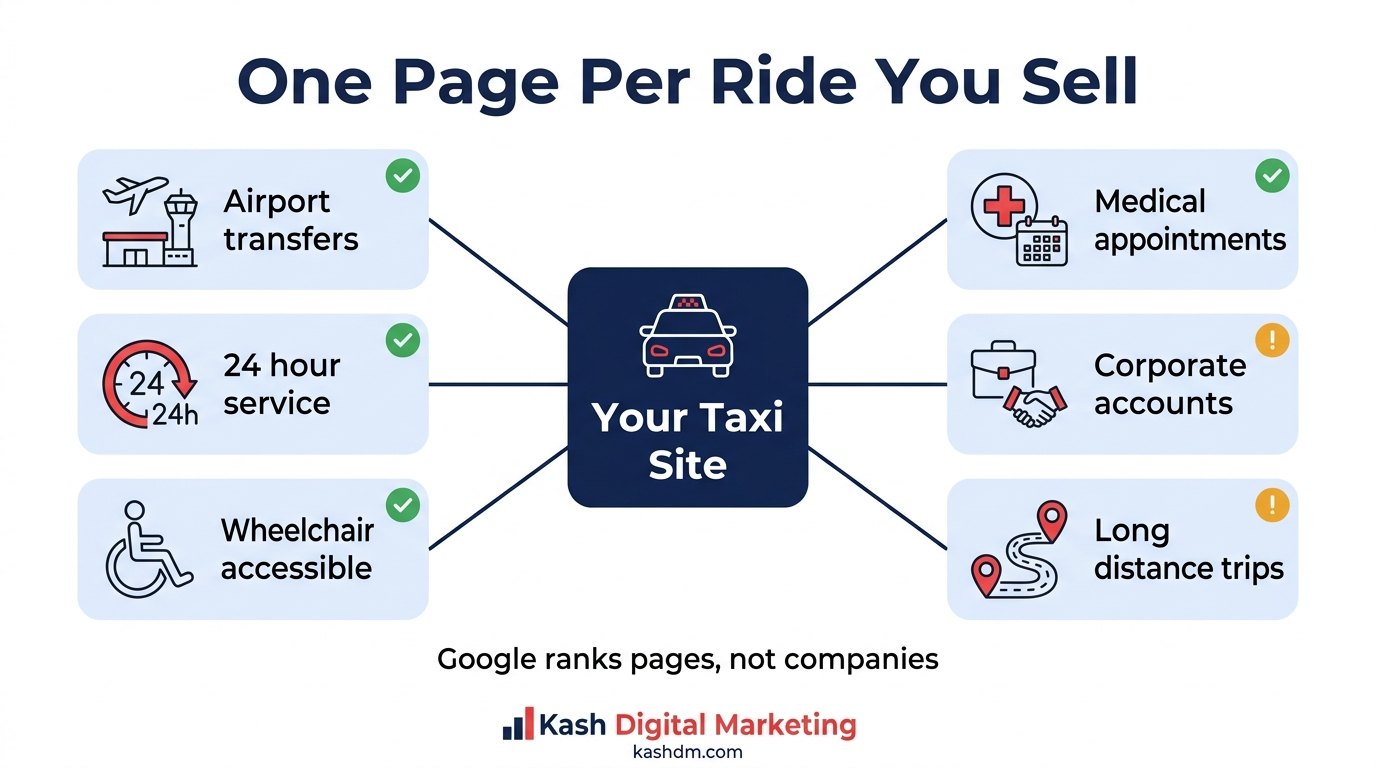
Every ride type you want to sell needs its own page, because Google ranks pages rather than companies and one services page cannot rank for airport, accessible, corporate and long-distance work at once. This is the most reliable structural upgrade available to a typical taxi website.
Most taxi sites we audit have two or three pages covering work that deserves ten or twelve. The missing pages are a revenue problem, because each absent page is a service that simply cannot be found.
Airport transfers
Usually the highest-value page on the site and covered in its own section above. It should exist separately from the general booking page.
24-hour and late-night service
A short, fast, phone-first page for the searches that happen after midnight. State honestly when you are staffed, because this is the page most likely to generate a complaint if it overpromises.
Wheelchair-accessible and assisted rides
Describe the vehicles, the ramp or lift, securement, how much notice you need and whether an attendant can assist. Riders and their families are searching for specifics, not reassurance.
Non-emergency medical transportation
Dialysis, oncology, physical therapy, hospital discharge. Cover scheduling, waiting time policy, whether you bill facilities directly and what documentation you provide. This is recurring revenue that competitors rarely pursue.
Corporate and business accounts
Invoicing, monthly billing, receipts, booking on behalf of staff, and a named contact. Written for an office manager rather than a rider, because that is who searches.
Long-distance and intercity trips
Longer fares with different pricing and planning. Riders comparing a two-hour drive against a train want travel times, vehicle comfort and a clear quoting process.
Hourly hire, events and group transport
Weddings, funerals, conferences, nights out and airport runs for groups. These searches name the occasion rather than the service, and pages should be written the same way.
What separates a real service page from a thin one
Real operational detail, the questions riders ask dispatch every day, honest limits, and a specific next step. A page that could belong to any cab company in America will rank like one.
Corporate Accounts and Business Travel SEO
Corporate account searches are low volume, high value and almost entirely uncontested, because most taxi websites are built for riders rather than for the office manager who books forty rides a month. One account decision produces recurring revenue that no single fare matches.
The reader here is different in every respect, and a page written for a traveller will not persuade them.
Who is actually searching
Office managers, executive assistants, HR coordinators and travel bookers. They search during business hours, compare two or three suppliers, and need to justify the choice to someone else.
What they need to see
Invoicing and payment terms, monthly statements, receipts suitable for expense reporting, a named account contact, booking on behalf of others, and what happens when a driver fails to arrive.
Reliability is the product
A missed pickup for a rider is an inconvenience. A missed pickup for a client visit is a business problem. Content should address consequences at that level rather than talk about comfort.
Insurance, licensing and driver vetting
Corporate buyers ask about coverage limits, licensing and background checks, and they ask early. Publishing this removes a barrier that otherwise ends the conversation before it starts.
Why the apps struggle here
Expense reconciliation, centralised billing, guaranteed pickup windows and a human to call are all weak points of app-based transport. Saying so factually is a legitimate and effective competitive position.
Medical, Accessible and Senior Transportation SEO
Non-emergency medical transportation and wheelchair-accessible service are the most underserved high-intent searches in the entire taxi category, and they produce recurring rather than one-off revenue. A dialysis rider travels several times a week, every week.
Most taxi websites mention accessibility in a sentence. That leaves a substantial, specific and repeat-heavy search category effectively open.
Why this work is worth pursuing
Scheduled, predictable, repeat trips that fill otherwise quiet daytime hours, booked by riders, families and facility coordinators who value reliability far above price.
What an accessible-transport page must state
Vehicle types, ramp or lift, wheelchair dimensions accommodated, securement method, whether a companion travels free, notice required and driver training. Vagueness here loses the booking.
Dialysis, oncology and recurring appointments
Standing bookings, waiting policies, and what happens when a treatment runs long. Publishing your waiting policy is a genuine differentiator because it is the thing that goes wrong most often.
Working with facilities and coordinators
Hospitals, clinics, dialysis centres and care homes book on behalf of patients. A page addressed to a discharge coordinator is a page no competitor has written.
Senior mobility and door-through-door service
Assistance to the door, help with bags, patience at pickup, and a phone number rather than an app. Describing this plainly reaches an audience that will never be won through a smartphone interface.
Claims to avoid
Do not imply medical qualification you do not hold, do not describe non-emergency service in terms that suggest ambulance capability, and do not promise reimbursement outcomes. Regulation differs by state and overstating is a real liability.
Taxi Website SEO
A taxi website has one job: turn a visitor into a call or a booking in under a minute, on a phone, often outdoors. Everything technical serves that, and a site that is beautiful but slow or hard to book on is failing at the only thing it exists to do.
We fix technical problems before publishing anything new, because adding pages to a broken foundation is the most common way transportation marketing budgets get spent without result.
The phone number is the primary call to action
It should be visible without scrolling, tappable, and present on every page. A surprising number of taxi sites hide the number in a header image or a contact page, which is the most expensive design decision available.
Crawlability and indexation
If a page is not indexed it cannot rank. Taxi sites frequently have entire service or location sections excluded by an old robots directive, a stray noindex tag or a booking system that generates uncrawlable URLs.
Site architecture that mirrors the operation
Services, locations, airports and resources should each sit in a clear section, with no important page more than a few clicks from the homepage. Flat, sprawling structures make it hard for Google to identify which pages matter.
Booking widgets that block crawlers
Third-party booking systems often load in an iframe or behind JavaScript that search engines never see. The booking tool can stay, but the page around it needs real indexable content describing what is being booked.
Duplicate content across location pages
The most common technical fault in this industry. Near-identical pages need genuine differentiation or consolidation, and canonical tags are a signal rather than a fix for pages that should not exist.
Internal linking as a ranking instrument
Links from strong pages to weaker ones distribute authority and signal importance. On taxi sites this is usually the fastest technical improvement available, because most have almost none.
Mobile SEO, Click-to-Call and Booking Conversion
The overwhelming majority of taxi searches happen on a phone, frequently outdoors, often on a weak connection and sometimes in the dark. Mobile experience is not a subsection of this work, it is the whole context for it.
Google evaluates the mobile version of your site, and the same qualities that make it rank make it convert.
Click-to-call and the sticky call button
A persistent, thumb-reachable call button is the highest-impact conversion element a taxi site can have. It should dial directly, never open a contact form, and never be hidden behind a menu.
Booking forms that survive a phone
Minimal fields, large tap targets, a sensible keyboard for each input, and no requirement to create an account. Every field removed measurably raises completion.
Largest Contentful Paint
How quickly the main content appears. On taxi sites the usual culprit is an oversized hero photograph loading before anything else. Correct sizing and priority hints fix most of it.
Cumulative Layout Shift
Content jumping as the page loads, which makes a rider tap the wrong thing. Images without declared dimensions are the primary cause and it is entirely preventable.
Interaction to Next Paint
How quickly the page responds to a tap. Chat widgets, tracking scripts and booking embeds stacked together are the usual cause, and taxi sites accumulate them from successive vendors.
Pricing transparency as a conversion factor
Riders trained by upfront app pricing want to know roughly what a trip costs. A fare estimate, a flat airport rate or even a clear explanation of how fares are calculated reduces the number of people who leave to check elsewhere.
What to remove
Every widget should justify its place. Taxi sites frequently carry scripts for tools nobody has opened in years, each one adding delay to a page whose entire purpose is speed.

Schema Markup for Taxi Companies
Schema markup turns your business into machine-readable facts, which matters more every year as results are assembled rather than listed. For a local service business the return is high relative to the effort, and it is almost always missing on taxi sites we audit.
Schema.org includes a type specifically for this industry, which most operators have never used.
TaxiService and LocalBusiness
Schema.org defines a TaxiService type alongside the general LocalBusiness. Using the most specific accurate type, with correct name, phone, hours, service area and coordinates, states plainly what a search engine would otherwise infer.
Service schema for each ride type
Airport transfer, accessible transport, corporate account and long-distance work can each be described as a distinct service with its own area served. This supports page-level relevance that business-level markup cannot.
Service area and geographic coverage
areaServed lets you state the cities and regions you cover without fabricating addresses in each one. For a service-area business this is the honest way to express coverage.
FAQ schema on pages that answer questions
Question-and-answer content marked up correctly is eligible for expanded presentation and is used heavily by AI-generated answers. It is the highest-yield schema type for a content-rich taxi site.
Review markup used honestly
Reviews may be marked up when they are genuine and shown on the page. Fabricated review markup is a manual-action risk, and transportation is a category where Google watches closely.
Validate before deploying, and keep it truthful
Markup must describe what a visitor actually sees. Hours in code that contradict the profile, or services listed only in markup, turn a helpful signal into a liability. Validate every template before it ships.
Reviews and Reputation for Taxi Companies
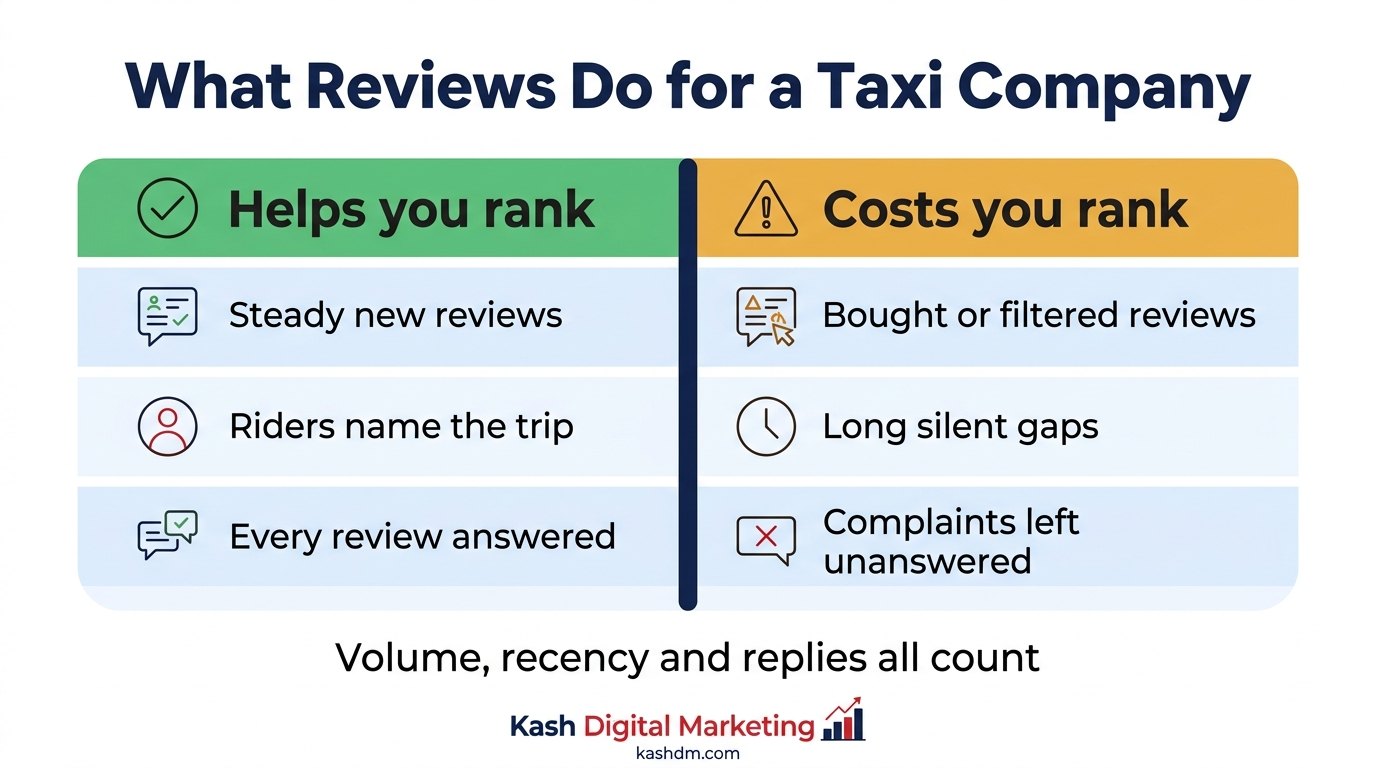
Reviews are both a ranking factor and the deciding factor for a rider choosing between three unfamiliar companies in a map pack. Volume, recency, rating and your replies all count.
Reputation is also the part of prominence a taxi company controls most directly, which makes it the highest-leverage ongoing work available.
Recency matters as much as volume
A profile with many reviews and none this year reads as a business in decline. A steady arrival of recent reviews signals an operating company, and freshness is weighted as well as count.
A system your drivers will actually use
Review requests fail when they depend on someone remembering. A card in the vehicle with a QR code, or a link in the booking confirmation, is what produces consistency. Complexity is why most review programmes quietly stop.
Reviews that mention the trip and the place
"On time for our 5am pickup to DFW" carries relevance that a bare five stars does not. Asking customers what trip you did, rather than asking for a favour, produces these naturally.
Responding to every review, especially the bad ones
A calm, specific, non-defensive reply to a complaint persuades far more readers than the complaint dissuades. Transportation attracts occasional friction and riders know it; how you handle it is the real signal.
Driver-level service is a marketing input
Most negative taxi reviews describe behaviour rather than pricing. Reputation work that ignores dispatch and driver standards is cosmetic, and we will say so rather than paper over it.
Never buy reviews
Purchased and incentivised reviews are detectable and the penalty ranges from filtered reviews to a suspended profile. A company with a real fleet and real licences has too much at stake.
Local Citations and NAP Consistency
Citations are mentions of your business name, address and phone number across the web, and their job is to corroborate that your company is real, established and where it says it is. Consistency matters far more than quantity.
Transportation businesses accumulate inconsistent listings faster than most industries, because dispatch software, booking platforms, insurance directories and previous marketing vendors all create them.
Why consistency is the whole point
Two versions of your phone number across the web is a contradiction a search engine has to resolve, and it resolves it by trusting you slightly less. Cleaning this up is unglamorous work with a measurable effect.
The listings that actually matter
The major data aggregators, the mainstream business directories, and the platforms riders genuinely use. A few dozen accurate listings beat several hundred automated submissions to sites nobody visits.
Transportation and travel directories
Airport ground-transport pages, travel and tourism sites, hotel concierge resources and regional transport listings are relevant in a way generic directories are not.
Old listings from previous owners and vendors
Almost every established taxi company has stale listings carrying a disconnected number or a former address. Each one quietly contradicts the current record, and finding them is part of the audit.
What to avoid
Bulk submission packages, directories that exist only to sell listings, and anything promising hundreds of citations for a flat fee. They add noise, not authority, and cleaning up afterwards costs more than the listings did.
Local Link Building for Taxi Companies
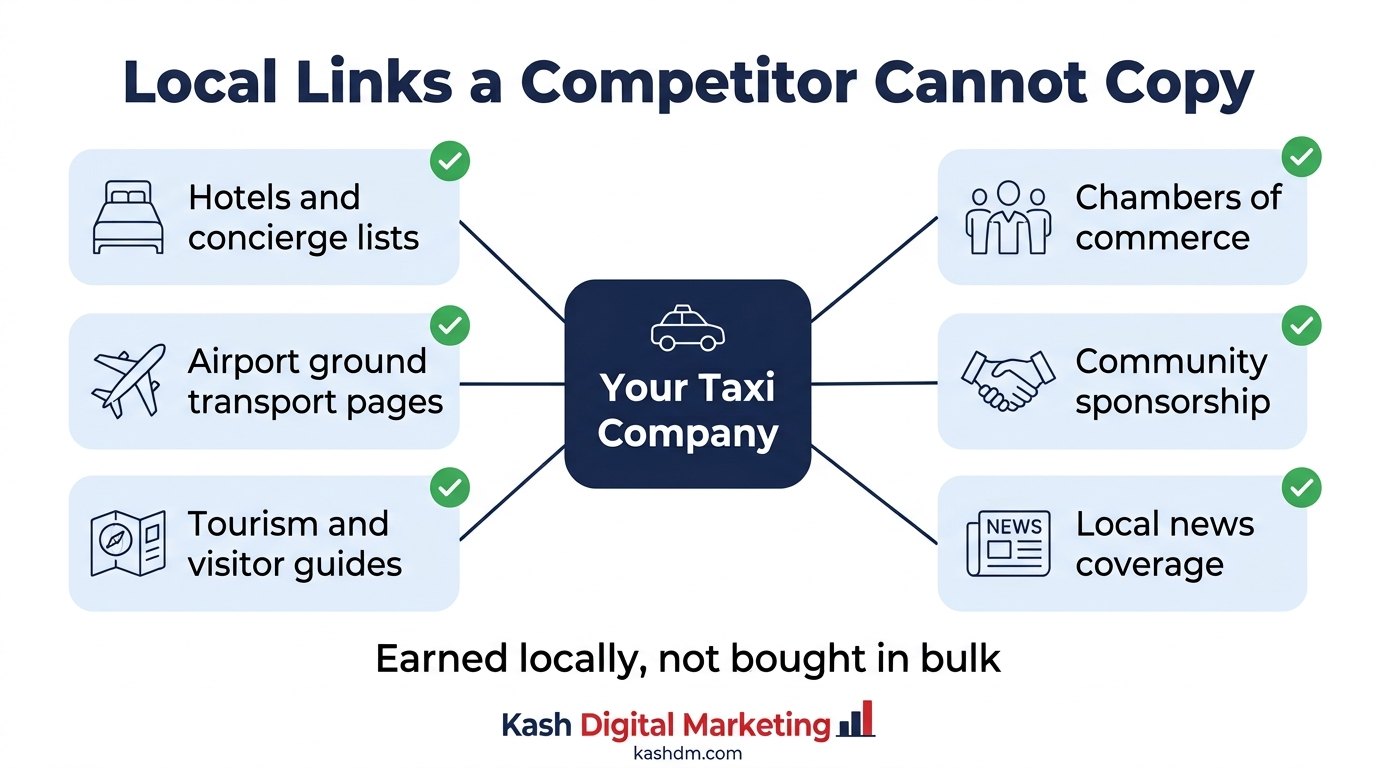
Links from real local organisations are what separate a taxi company that ranks from one that merely has a tidy website, and transportation has unusually good access to them. You are already embedded in your city's hotels, venues, hospitals and events.
The goal is not a monthly quota. It is a durable set of genuine associations that a search engine reads as evidence the business is established where it claims to operate.
Hotels, venues and concierge pages
Hotels publish transport recommendations, conference venues publish getting-here pages, and wedding venues publish supplier lists. These are relevant, local and frequently available simply by asking.
Airport ground transportation pages
Many airports list licensed ground transport operators. If you hold a permit, being listed is both a link and a credibility signal that no competitor can replicate without the same permit.
Tourism boards and visitor guides
Visitor bureaus and city guides publish practical transport information for travellers. A well-written local resource is genuinely useful to them and earns a link on merit.
Chambers, trade bodies and licensing authorities
Chambers of commerce, transportation associations and regional business groups all provide legitimate, locally relevant listings. Unglamorous and effective.
Community sponsorship and local events
Sponsoring a school event, a charity run or a local festival typically earns a mention on the organiser's site. It is real community involvement that happens to produce exactly the signal local search rewards.
Local press and practical stories
Local reporters cover transport disruption, event logistics, airport changes and holiday travel. A taxi operator is a natural source, and a single local news mention often outweighs months of low-quality link acquisition.
What to refuse
Purchased link packages, private blog networks, irrelevant guest posting and anything sold by volume. The penalty risk is not worth a temporary gain for a licensed business with a real reputation.
Content Strategy and Topical Clusters
Topical authority is what makes a taxi site rank for searches it never explicitly targeted, and it comes from covering a subject completely rather than publishing occasionally. Google is judging whether your site is a credible source on local ground transport.
The cluster model organises that coverage, and it is the difference between a neglected blog and a content library that lifts the pages which actually sell rides.
Pillar and cluster structure
A substantial pillar page on a major topic, supported by focused pages answering specific questions, all linked to each other and back to the pillar. Airport transport, accessible travel and corporate accounts each deserve this treatment.
Cover a topic completely or leave it alone
Half a cluster performs worse than none, because it signals shallow coverage. Choosing three subjects and covering them thoroughly beats touching ten.
Practical travel content riders actually search
How early to leave for a flight, whether taxis take cards, how to book a car seat, what happens if a flight is delayed, how fares are calculated. These are asked constantly and answered badly across the industry.
Local event and seasonal content
Marathon road closures, festival park-and-ride, graduation weekends, holiday airport peaks. Published ahead of the event, this content ranks when demand arrives and demonstrates local knowledge no national competitor has.
Questions your dispatchers hear every day
Your phone staff already know the real questions: can you take five people and luggage, do you go to that county, can you wait during an appointment. These make better content than any keyword tool suggestion.
Updating old content beats writing new content
Refreshing a page already sitting on page two usually produces faster gains than publishing something new. Most taxi sites have several of these unexamined.
AI SEO: Getting a Taxi Company Cited in AI Answers
Search results are increasingly assembled into direct answers rather than listed as links, and local businesses now compete to be the source those answers cite. For taxi companies this matters because so many ride questions are exactly the kind an assembled answer addresses.
The techniques overlap heavily with good SEO, but the emphasis shifts toward clear, extractable, verifiable statements.
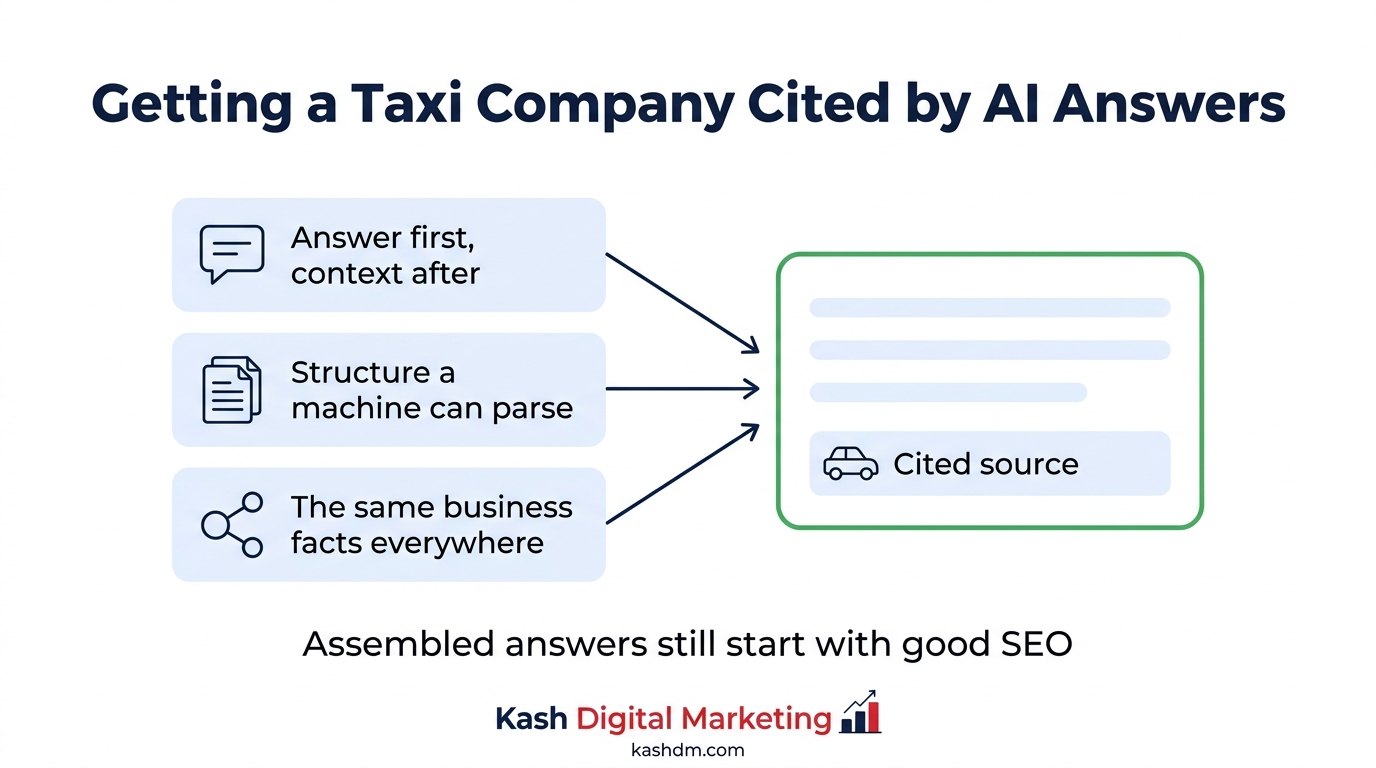
Answer the question in the first sentence
Content structured so each heading is followed immediately by a direct, complete answer is far more likely to be quoted. Burying the answer three paragraphs into context is the most common reason good content is passed over.
Consistent business facts everywhere
Your name, phone, service area, hours and services should agree across your site, your profile and every directory. A system assembling an answer about taxi companies in your city is resolving an entity, and contradictions are a reason to omit you.
Structure a machine can parse
Clear heading hierarchy, short paragraphs, lists where lists fit, tables for comparisons, and schema describing what the page is. Structure is now a distribution decision as much as a design one.
Original operational detail cannot be summarised away
Terminal pickup points, local travel times, event road closures and vehicle capacities are things no competitor can restate from a generic source. Content that only repeats what is already published has nothing to be cited for.
Traditional rankings still underpin all of it
Being cited in a generated answer correlates strongly with ranking well conventionally. AI SEO is a layer on competent SEO, not a replacement, and anyone selling it as a shortcut is selling something else.
Measuring Taxi SEO: Calls and Booked Rides
The only taxi SEO metrics that matter are calls, completed bookings, repeat riders and revenue by service line. Impressions, keyword counts and traffic graphs are diagnostic at best.
If a report cannot connect the work to fares on the road, it is not a report on business performance, and an operator is entitled to insist on the difference.
Calls attributed to organic search and the profile
Call tracking should separate contacts originating from the Google Business Profile, from organic search and from paid. Without this attribution every subsequent number is guesswork.
Bookings completed, not just started
Booking forms abandon heavily on mobile. Measuring started versus completed bookings isolates whether the problem is visibility or the booking experience itself, and those need very different fixes.
Revenue by service line
Airport, accessible, corporate and local fares have very different values and margins. Reporting by line shows which SEO work is paying and which is producing volume without profit.
Map pack visibility across the service area
Rankings vary by the searcher's location, so a single position number misleads. Grid-based local visibility across your operating area shows where you genuinely appear and where the next area page is needed.
Repeat and account customers
A corporate account or a recurring medical rider is worth many single fares. Attribution that stops at the first booking systematically undervalues exactly the work that matters most.
Metrics that mislead
Traffic without a baseline, rankings for terms nobody searches, impressions, and percentage improvements quoted without a starting number. Each can be technically accurate and completely uninformative.
How Long Local SEO Takes for a Taxi Company
Profile corrections can move within weeks, long-tail area and service terms usually enter the top ten within two to four months, and competitive city-level terms take six months or longer. Anyone promising faster is describing a smaller starting point than yours.
There is no fixed timeframe, and any provider quoting one before looking at your market is quoting a sales figure rather than an estimate.
What decides your timeline
Domain history and existing authority, how many established competitors are in the metro, city size, the strength of your profile, your review position, the condition of the website and your current rankings. These vary enormously between operators.
Weeks: the profile and the obvious faults
Duplicate listings, a wrong primary category, missing services and unindexed pages are corrections rather than campaigns. They frequently produce the first movement, because most taxi companies are held back by something broken rather than something absent.
Two to four months: area and service terms
Specific service-and-place combinations face thinner competition and move first. This is where a well-built airport or accessible-transport page earns its cost and where the first attributable bookings usually appear.
Six months and beyond: city-level terms
"Taxi service [major city]" and similar are contested by established operators with years of accumulated authority. Reaching them requires sustained content, links and reviews rather than a technical fix.
Your starting point changes everything
A company with a suspended profile, a slow site and no recent reviews has more available upside than one already ranking fifth, and will show larger percentage gains for identical work. This is why improvements quoted without a baseline mean nothing.
What happens if you stop
Rankings decay rather than collapse. Content keeps working, reviews age, competitors keep publishing, and position erodes over quarters. It is an asset that depreciates slowly, unlike advertising which stops the same day.
What Changes the Cost of Taxi SEO
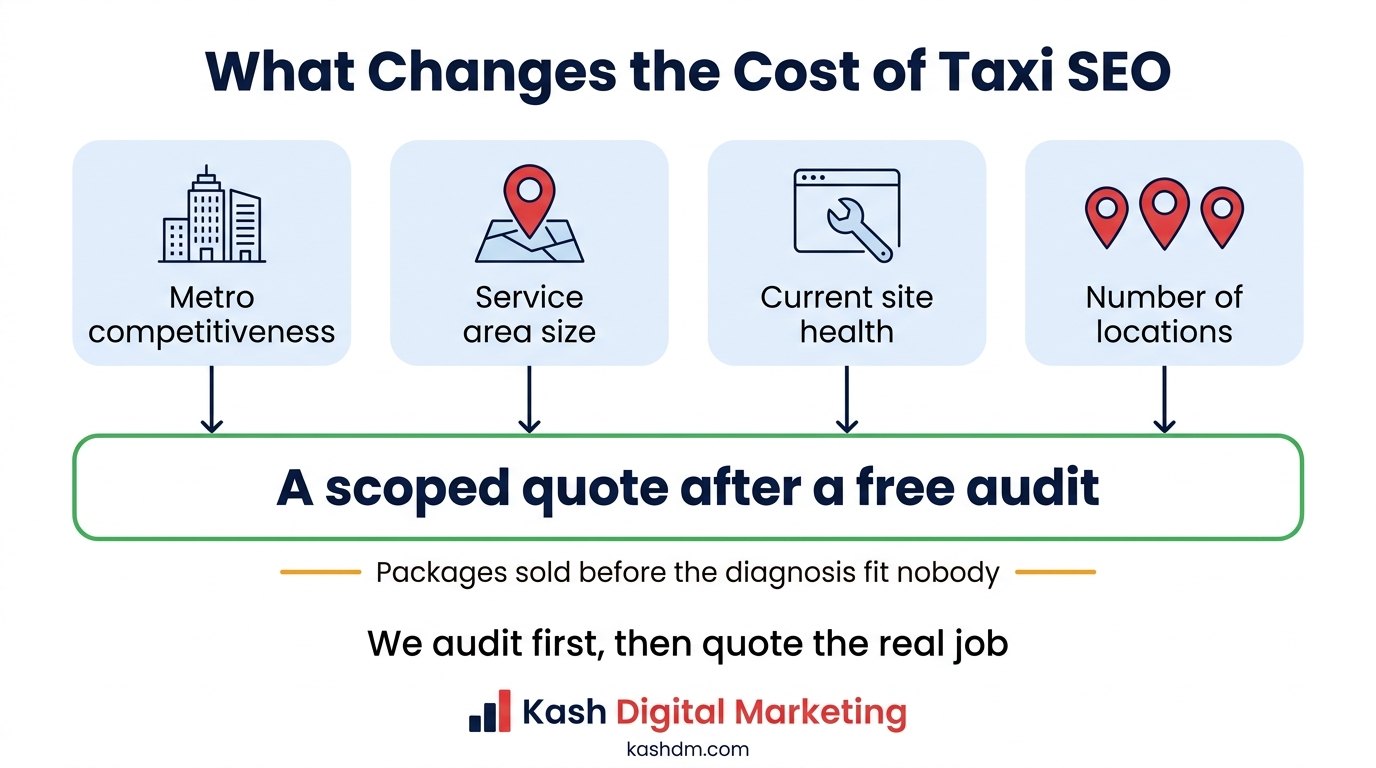
Taxi SEO is priced by the size of the job, and the job is defined by your market's competitiveness, how many areas and airports you serve, the condition of your website and how many locations you run. Anyone quoting before examining those four is quoting a package rather than your business.
We do not publish a price list for this reason. A single-city operator with a healthy site and a multi-metro fleet with a suspended profile are different jobs, and pretending otherwise serves the agency rather than the operator.
Metro competitiveness
Ground transport is fiercely contested in large metros where established operators, airport permit holders and rideshare-adjacent services all compete. The same work costs more there because more of it is required to move.
Size of the service area
One city is a different scope from twelve suburbs and two airports. Every additional area needs its own page, its own local signals and its own review flow, and cost scales with genuine coverage rather than claimed coverage.
Condition of your current website
A fast, well-structured site needs growth work. A slow site with duplicate location pages, an uncrawlable booking widget and indexation problems needs repair before growth work produces anything.
Number of locations and profiles
Each physical base needs its own profile, landing page and review stream. Multi-location operators gain the most from local SEO and require the most coordination to get it.
How many service lines you run
Airport, accessible, medical, corporate and long-distance each need their own content track. An operator running five lines is effectively running five campaigns, and the scope should say so honestly.
Why we audit before we quote
The audit tells us which of the above actually apply to you. It is free, it is yours to keep, and it means the number we give describes your situation rather than an average.
Common Taxi SEO Mistakes
Most taxi companies are not failing at local SEO because of anything exotic. They are failing because of six or seven predictable mistakes that appear on audit after audit. Every one of them is fixable.
We list them here because an operator who recognises three of these has just learned more about their situation than a sales call would have told them.
Only the homepage is optimised
One page trying to rank for airport, accessible, corporate and city searches at once. It is the single most common structural fault in the industry and the easiest to correct.
No airport pages at all
The highest-value, most planned, most repeated search category, and a great many taxi sites do not address it with a dedicated page for even one airport.
Mass-produced location pages
Dozens of pages identical but for a place name. Treated as duplicates, and capable of holding back the pages that were working.
The phone number is hard to find or not tappable
A conversion failure severe enough to make rankings irrelevant. On a phone, at night, a rider will not hunt for a contact page.
Neglecting the Google Business Profile
The asset producing the most calls is frequently the least maintained. Wrong category, no services, stock photos, unanswered reviews and duplicate listings are all common and all consequential.
A booking widget search engines cannot read
A page whose entire content sits inside a third-party iframe has nothing to rank. The widget can stay; the page needs real content around it.
No call tracking
Without attribution nobody can say whether the work is producing rides. Operators in this position usually cancel good campaigns and continue bad ones, because they cannot tell them apart.
Competing with rideshare on price instead of on capability
The losing position. The winnable searches are the ones the apps serve badly, and a strategy aimed at undercutting them ignores where the margin actually is.
How to Choose a Taxi SEO Company
Judge a taxi SEO company on its diagnosis, not its pitch, and ask four questions that a competent provider answers without hesitation. Hesitation on any of them is the answer.
We publish this checklist knowing it will be used on us, which is the point. A provider unwilling to be judged by the standard it recommends is not worth hiring.
Which transportation clients can I speak to directly
References you can actually call are the strongest evidence available. A provider with genuine results will connect you; one relying on an anonymous graph will find reasons not to.
What specifically happens in the first ninety days
A real answer names the audit, the profile work, the technical repairs and the first pages. A vague answer about strategy and optimisation means there is no plan, only a retainer.
Who owns the website, the domain and the Google profile
Get it in writing. Agencies that build on their own platform can hold the entire asset, and operators discover this at exactly the moment they want to leave.
How do you report, and does it name booked rides
Reporting on impressions and keyword counts is reporting on activity. Reporting on calls, bookings and revenue by service line is reporting on business. Ask to see an example before signing.
Warning signs worth walking away from
Guaranteed rankings, guaranteed "near me" placement, a fixed number of links per month regardless of need, long contracts, quotes given before any audit, and reluctance to explain what will actually be done.
Beware anyone promising to rank you for "near me"
It is not a phrase you can rank for, it is a location signal Google resolves. A provider selling it as a keyword either does not understand local search or is relying on you not to.
How to judge a newer agency fairly
Judge the diagnosis. Request the free audit, see whether the findings are specific to your business or generic boilerplate, and check whether the recommended work matches the problems found. An agency that correctly diagnoses your site before being paid is demonstrating the exact skill you are hiring for.
What Our Taxi SEO Services Include
Our taxi SEO services cover the four things that decide whether a taxi company ranks: the Google Business Profile, the website's technical health, service, airport and area page coverage, and local prominence. Every engagement includes all four, because fixing three and ignoring the fourth is how operators end up paying for SEO that never moves.
Taxi company local SEO audit
We assess the website, the Google Business Profile, competitors, current rankings, citations, reviews, backlinks, technical health and local landing pages, then tell you in plain language what is holding you back and in what order to fix it.
Google Business Profile management, not just setup
Categories, services, service areas, hours, attributes and booking links corrected, duplicate listings removed, and the profile kept active with real vehicle photos and posts. This continues every month, because it is the asset producing the calls.
Technical repair before growth work
Mobile speed, Core Web Vitals, crawl and index errors, schema markup, redirect chains, duplicate location pages, uncrawlable booking widgets and broken internal structure. This comes first, always.
Airport, service and area pages
Dedicated pages for each airport you serve, each ride type you sell and each area that produces real fares, written with genuine operational detail rather than a swapped place name.
Local keyword research and mapping
Keyword groups mapped to specific URLs so that no two pages compete for the same term, covering immediate-need, airport, accessible, medical and corporate families.
Citations, reviews and local links
Citation cleanup across the listings that matter, a review system your drivers will actually use, and local link building through hotels, venues, tourism bodies, chambers and community sponsorship.
Reporting that names booked rides
Monthly reporting on calls, completed bookings and revenue by service line, with next month's priorities set by what the numbers show. If a month underperforms, the report says so and explains what changes.
| Included every month | What it produces |
|---|---|
| Google Business Profile management | Map pack visibility and direct calls |
| Technical monitoring and fixes | Pages that load fast and stay indexed |
| Airport, service and area pages | Rankings for the rides you want to sell |
| Local keyword mapping | No two pages competing for one term |
| Review and citation work | Prominence, the third ranking factor |
| Local link building | Authority a competitor cannot copy quickly |
| Reporting on calls and bookings | Evidence instead of impressions |
Your First 90 Days of Taxi SEO With Us
We tell you exactly what happens in the first ninety days before you sign anything, because that is the question we tell operators to ask every agency they consider. It would be a poor guide that refused to answer its own test.
Days 1 to 15, audit and diagnosis
We audit your profile, technical health, current rankings, competitor positions and the gap between the areas you serve and the areas you rank in. You get the findings in plain language, and they are yours whether or not you continue with us.
Days 15 to 45, foundation repair
Duplicate listings removed, categories and services corrected, name, address and phone inconsistencies cleaned across directories, mobile speed fixed, click-to-call made prominent and indexation errors cleared.
Days 45 to 75, coverage build
The airport pages, the highest-value service pages and the priority area pages get written and published, internally linked so the structure reads as genuine service-area coverage.
Days 75 to 90, prominence and first reporting
Review generation starts with your drivers, citations get built out, local partnerships are approached, and you receive the first full report showing calls and bookings attributed to organic search.
What we need from you
Access to the website and Google profile, a list of the areas and airports that actually produce fares, photographs of your vehicles and drivers, and dispatchers willing to ask satisfied riders for a review. That is genuinely all.
Our Taxi SEO Process
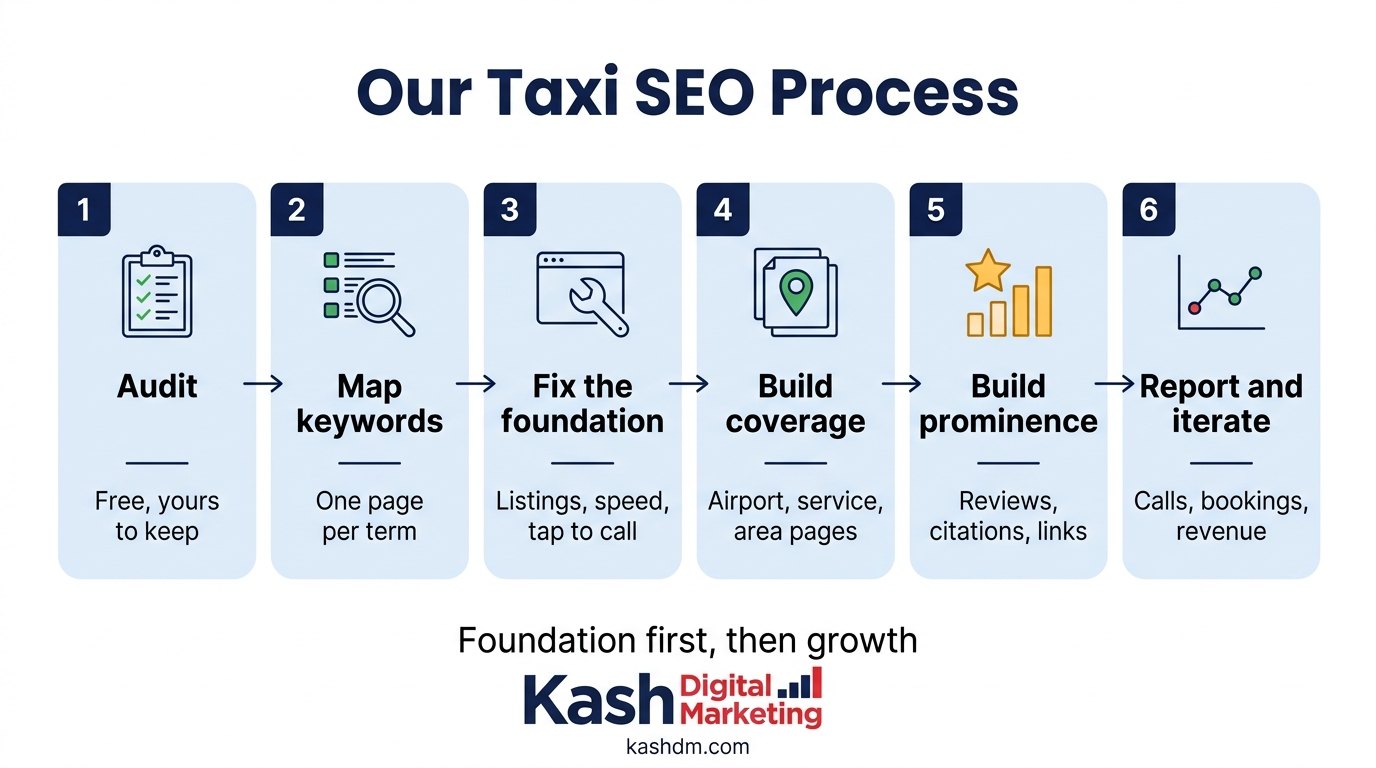
Our process runs in the same order every time, because the sequence is what makes it work: diagnose, repair, cover, build prominence, then report and iterate. Skipping ahead to content is the most common way local SEO fails.
Step one, audit and competitor analysis
A full assessment of profile, technical health, content coverage, competitors and local visibility across your service area. Free, and yours to keep regardless of what you decide.
Step two, keyword research and mapping
Keyword groups assigned to specific URLs so that airport, accessible, corporate and area terms each have one page responsible for them.
Step three, fix the foundation
Listings, speed, indexation, duplicates, click-to-call and structure. Unglamorous, frequently the source of the first ranking movement, and pointless to skip.
Step four, build coverage
Airport pages, service pages and area pages in priority order, each written properly and linked into a structure Google can read as genuine expertise across a service area.
Step five, build prominence
Reviews, citations and local links accumulating month over month. The slowest signal and the one a competitor cannot buy past quickly.
Step six, report and iterate
Calls, bookings and revenue by service line, with the next month's priorities set from the numbers rather than from a fixed deliverable list.
Why Taxi Companies Choose Kash Digital Marketing
We work the way we would want an agency to work for us: diagnose before quoting, no long contracts, plain reporting on booked rides, and no promises about rankings nobody can guarantee. That is the whole pitch, and it is deliberately easy to verify.
We audit before we quote, not after
Most transportation marketing proposals arrive before anyone has looked at the Google profile or run a speed test. Ours arrives after. A two-airport operator with duplicate listings is a different job from a single-city company with a healthy site.
No long contracts
We keep clients by producing results, not by holding them to a twelve-month term. If we stop earning the work you should be free to leave that month. Long contracts exist to protect the agency.
You own everything, during and after
Your website, your domain, your Google Business Profile, your content, and every citation and link we build. Some agencies build on their own platform, so leaving means starting from zero. If we part ways, you keep the asset.
White-hat only, because a penalty costs more than a ranking
No purchased links, no manufactured reviews, no keyword-stuffed business names, no fake addresses in cities you do not operate in. Transportation is a category where profile violations are reported by competitors quickly.
Reporting that names booked rides
You get calls, completed bookings and revenue by service line. Impressions and keyword counts appear nowhere, because an operator cannot dispatch a car to an impression.
We usually reply within an hour, and always within 8 hours
Transportation runs on responsiveness and so do we. Audit requests get a reply usually within an hour, and always within 8 hours during business hours, which is a fair preview of what working together looks like.
We will tell you when SEO is not the answer
If your profile is suspended, your phone goes unanswered at night, or your fleet cannot absorb more volume, we will say so rather than sell you a retainer. Sometimes the honest recommendation is to fix dispatch first.
| How taxi marketing is often sold | How we work |
|---|---|
| Quoted from a package sheet | Free audit first, then a scoped quote |
| "We'll rank you for near me" | An explanation of why that is not a keyword |
| Twelve-month contract | No long contracts |
| Agency owns the site or the profile | You own every asset |
| Rankings guaranteed | No guarantees, documented method instead |
| Reporting on impressions | Reporting on calls and booked rides |
Taxi and Transportation Companies We Work With
We work with taxi, cab and ground transportation operators across the United States, from single-vehicle owner-operators to multi-city fleets. The strategy changes considerably between them.
Independent and owner-operator taxi services
One vehicle, one profile and a tight service area. Often the fastest to move, because a complete profile and a handful of genuine area pages will outrank larger competitors who never did the basics.
Established local cab companies
A fleet, a dispatch office and years of local history that has never been turned into search visibility. Usually the largest gap between real-world reputation and online presence.
Airport transfer and shuttle specialists
Businesses built around one or two airports, where terminal-level content, flight tracking and fixed pricing carry most of the ranking and conversion weight.
Medical and accessible transportation providers
Recurring, scheduled work that fills daytime capacity. Content is written for riders, families and facility coordinators simultaneously, which is a different job from consumer copy.
Executive car and chauffeur services
A different buyer, a different vocabulary and a different set of searches. Corporate accounts, event transport and hourly hire rather than point-to-point fares.
Multi-city and multi-location operators
Each base needs its own profile, landing page and review stream. Coordinating that across markets is a process problem before it is a marketing problem, and it is where an outside team usually earns its cost several times over.
What Realistic Taxi SEO Results Look Like
Realistic results follow a predictable shape: profile and long-tail movement within the first two months, area and service terms from month three, and competitive city terms from month six onward. Anyone showing a faster curve is showing a smaller starting point than yours.
What moves first, and why
Google Business Profile corrections move fastest because the profile is re-crawled constantly and most operators have obvious errors sitting in theirs. Duplicate listings or a wrong primary category can suppress a profile for years and take days to fix.
What a normal curve looks like
Long-tail area and service terms enter the top ten first, because competition on them is thin. City-level terms follow much later. The curve is slow, then compounding, which is the opposite shape of paid advertising.
Why call volume can move before rankings do
Fixing a profile category or adding a booking link can raise calls before any ranking changes, simply because more of the people already seeing you can now act. This is common early and should be reported honestly as what it is.
Results depend on your starting point
An operator with a suspended profile, a slow site and no recent reviews has more available upside than one already ranking fifth, and will show larger percentage gains for identical work. This is exactly why percentages quoted without a baseline are meaningless.
How to verify any provider's results claims
Ask what the starting position was, over what timeframe, in which metro, and what else changed during the period. Ask to speak to the operator named in the case study. A provider confident in genuine results answers all four without hedging.
| Claim you might be shown | What to ask before believing it |
|---|---|
| Traffic up 400% | Up from what number, over how long? |
| Ranked #1 in 30 days | For which term, in which city, at what volume? |
| 200 new leads | Calls, completed bookings, or form fills? |
| Case study with no name | Can I speak to that operator directly? |
Our Position on Case Studies and Client Privacy
Kash Digital Marketing is a growing agency, and we publish no taxi case studies yet because we will not invent them. This page argues that operators should demand verifiable proof, and it would be worthless if we broke that rule on our own page.
Why there are no taxi case studies here
We would rather tell you plainly that our transportation portfolio is still being built than publish a stock graph and an unnamed client. Every claim here is a claim about method, not about results we cannot evidence. When we have taxi results worth publishing they will appear here with the starting baseline, the timeframe and the work performed.
Client privacy when we do publish
Client work is published only with written permission. Many operators would rather competitors in their own metro not know who handles their search visibility, which is entirely reasonable in a market where a handful of companies fight for the same map pack slots. Where a client prefers anonymity we publish the metro size, the timeframe and the mechanism, and omit the name.
What you can verify about us today
Our method is documented in full on this page, including the ninety-day plan, what is included every month and what we report. You own every asset we build, there is no long contract, and the audit that starts the relationship is free and yours to keep.
Taxi SEO Across the United States
We provide local SEO to taxi and ground transportation companies in every US state and metro, and the strategy shifts with airport traffic, city density and how strong the rideshare presence is locally. A transportation market is defined by its airports and its geography.
Major airport metros
Dallas–Fort Worth, Atlanta, Chicago, Denver, Phoenix and comparable hubs, where airport content, terminal detail and permit-holder credibility carry most of the ranking weight.
Dense urban markets
New York, Boston, Philadelphia, San Francisco and similar, where competition is fiercest, rideshare presence is heaviest, and success depends on neighbourhood-level targeting and specialised services rather than general taxi terms.
Tourism and resort markets
Orlando, Las Vegas, coastal Florida and mountain resort towns, where hotel partnerships, visitor guides and seasonal event content produce a disproportionate share of the bookings.
Suburban and secondary metros
Lower competition, lower volume, and a much shorter path to visibility. Operators here frequently see the fastest results in the whole category, because the basics done properly are enough to lead.
Rural and long-distance markets
Fewer competitors, larger service areas and longer fares, where intercity and airport-run content matters more than city-level terms and where a single well-built page can carry a lot of revenue.
Medical corridor markets
Cities built around large hospital systems, where non-emergency medical transportation is a substantial and recurring revenue line that most local operators have never targeted in search.
Get Your Free Taxi SEO Audit
Request Your Free SEO Audit
Prefer to talk it through? WhatsApp US +2135622433 or WhatsApp PK +92 348 3879366. We usually reply within an hour, and always within 8 hours.
Your free taxi SEO audit shows where you rank now, what is holding you back, and what a competitor is doing that you are not, and it is yours to keep whether or not you work with us. There is no obligation and no catch.
What the audit covers
Your current rankings for core service, airport and area terms, an assessment of your Google Business Profile, technical and mobile speed issues, competitor positions in your metro, your citation and review position, and the gap between the areas you serve and the areas you actually rank in.
What you receive
A plain-language document naming specific problems and the order in which they should be fixed. Not a template, and not a sales deck with your logo on it.
What happens next
If the findings suggest we can help, we scope the work and quote it. If they suggest something other than SEO is your bottleneck, we will tell you that instead. Either way the audit is yours.
How to request it
Send us your website, the areas you serve and the airports you cover. We usually reply within an hour, and always within 8 hours during business hours, which is also a fair preview of how we communicate once we are working together.
Local SEO for Taxi Companies FAQs
These are the questions taxi and transportation operators ask us most often, answered directly. If yours is not here, ask it and we will answer it plainly.
What is local SEO for a taxi company?
It is the work that makes your business appear in Google Maps and local search results when nearby riders look for a taxi, cab or airport transfer. It covers your Google Business Profile, your website, your reviews and citations, and the local pages that describe the areas and services you actually cover.
How can SEO help my taxi company get more customers?
By making you visible at the moment somebody needs a ride. Most taxi searches convert within minutes, so appearing in the three-result map pack with a good rating and a tappable phone number captures demand that otherwise goes to whoever does appear. It also builds pages for planned bookings like airport runs and medical trips.
How do taxi companies rank higher on Google Maps?
Through relevance, distance and prominence. Set the correct primary category, list every service, keep the profile active with real photos, earn a steady flow of recent reviews, keep your business details consistent across directories, and build genuine local pages for the areas you serve. Distance is not something you can change.
How do I rank my taxi company for "taxi near me"?
You do not rank for "near me" as a phrase. Google discards it and uses the searcher's location, then returns nearby businesses that look relevant and established. Improving near-me visibility means improving your profile, your reviews, your citations and your genuine presence across the areas you serve. Any provider selling "near me" as a keyword is misleading you.
How important is Google Business Profile for a taxi company?
It is the single highest-return asset in taxi local SEO. It decides the map pack, which sits above organic results and carries a call button, so many riders contact you without ever visiting your website. Most operators have fixable errors in theirs right now.
How can I get more Google reviews for my taxi business?
Build a system that does not depend on anyone remembering: a card with a QR code in each vehicle, or a review link in the booking confirmation. Ask riders to mention the trip they took. Respond to every review, including the critical ones. Never buy reviews, which risks a filtered or suspended profile.
Should a taxi company create pages for different cities?
For the areas that genuinely produce fares, yes. Each needs real local content: neighbourhoods covered, typical pickup times, landmarks and venues served, and reviews from that area. Templated pages that only swap the place name get treated as duplicates and can hold back the rest of the site.
How long does taxi SEO take?
Profile corrections can move within weeks. Long-tail area and service terms usually enter the top ten within two to four months, and competitive city terms take six months or more. There is no fixed timeframe: it depends on your domain history, competition, city size, review position and website condition.
How much does local SEO for a taxi company cost?
It depends on your metro's competitiveness, how many areas and airports you serve, the condition of your website and how many locations you run. We do not publish a package price because those factors change the job substantially. We audit first, then quote the actual work.
Is SEO better than Google Ads for a taxi company?
They do different jobs. Ads buy immediate visibility and are useful for a new company or a new market, but they stop producing the day the budget stops. SEO takes months and then keeps working, and it builds an asset you own. Most established operators run both and reduce their dependence on ads over time.
Can SEO help an airport taxi business?
Yes, and it is usually the strongest opportunity available. Airport searches are planned in advance, carry higher fares and repeat. A dedicated page per airport with terminal pickup detail, travel times, flight tracking and clear booking instructions consistently outperforms a generic transfers page.
How do taxi companies compete with Uber and Lyft?
Not by fighting for casual point-to-point fares. The winnable ground is where apps serve badly: corporate accounts that need invoicing, non-emergency medical transport, wheelchair-accessible vehicles, guaranteed early-morning airport pickups, group travel and senior riders who want a phone number. Local SEO is how you get found for exactly those searches.
Do I need a mobile app to compete?
No. An app is expensive to build and harder to get installed than most vendors admit. A fast mobile website with one-tap calling and a short booking form solves the same problem for a fraction of the cost, and it is what search actually sends people to.
Can you help taxi companies in multiple US cities?
Yes. We work remotely with operators in every US state and metro, from owner-operators to multi-city fleets. Each location needs its own profile, landing page and review stream, and coordinating that is a large part of what we do for multi-location clients.
What makes Kash Digital Marketing different from other taxi marketing agencies?
Three things you can verify before paying us anything. We audit before we quote instead of selling from a package sheet, we do not use long contracts, and you own your website, domain, Google Business Profile and every asset we build. Our reporting names calls and booked rides rather than impressions.
What do I get in the free taxi SEO audit, and is there a catch?
You get your current rankings for core service, airport and area terms, an assessment of your Google Business Profile, technical and mobile speed issues, competitor positions in your metro, and the gap between the areas you serve and the areas you rank in. No catch and no obligation. The findings are yours to act on yourself or with another provider.