Roofing SEO is the practice of ranking a roofing company at the top of Google search and the local map pack so homeowners with a leak, storm damage or a failing roof call you first instead of a competitor. At Kash Digital Marketing, our roofing SEO services combine Google Business Profile optimization, city pages for every market you cover, service and material pages for repair, replacement and restoration, insurance-claim content, review generation and technical site work into one system built to turn urgent searches into signed contracts.
Roofing sits in an unusual position among the trades. A roof is one of the largest single purchases a homeowner ever makes, and most people buy one perhaps twice in a lifetime. There is no habit to fall back on, no regular contractor to call, and often no useful referral. So the search happens cold, on a phone, frequently in the hours after a storm, and the roofing companies that appear credible in those first three results get to quote the job.
This page is a complete guide to roofing SEO across the United States, written so you can evaluate any provider, including us, against a real standard. It covers what roofing SEO actually involves, why local search decides the outcome, how storm season and insurance claims change the strategy, what the work costs and how long it takes, and the specific mistakes that keep roofing contractors on page two while a competitor with fewer crews takes the calls.
What Roofing SEO Is and How It Actually Works
Roofing SEO is the process of optimizing a roofing company's website, Google Business Profile and local signals so the business appears at the top of search results when nearby homeowners look for roof repair, roof replacement or storm damage restoration. It differs from generic SEO because nearly every valuable roofing search carries local intent, high job value and, often, real urgency at the same time.
Most people searching for a roofer are not browsing. Water is coming through a ceiling, shingles are in the yard after a windstorm, or an insurance adjuster has told them the roof will not pass. They are going to contact two or three companies within the day. That compressed decision window, attached to a five-figure job, is what makes roofing SEO both more competitive and more valuable than SEO in most other industries.
The three places a roofing company can appear
Paid ads sit at the very top, the local map pack sits beneath them showing three businesses on a map, and organic results follow. Roofing SEO targets the second and third of these. The map pack is usually the most valuable because it carries a call button and requires no click to a website at all.
Why roofing SEO is local before it is anything else
A roofing company in Tampa competes with roofing companies in Tampa, not with a national brand. Google resolves roofing queries geographically by default, which means proximity, service-area definition and local prominence outrank almost every generic SEO tactic that works in other industries.
The two halves of the work
The first half is your Google Business Profile and local signals, which decide the map pack. The second half is your website, which decides organic rankings and converts the visitor once they arrive. Doing one and skipping the other is the most common reason roofing contractors report that "SEO did not work."
What roofing SEO is not
It is not buying links, and it is not stuffing a page with city names. Both worked a decade ago and both now carry real risk. It is also not a one-time project. Competitors keep publishing and Google keeps re-evaluating, so visibility is maintained rather than achieved.
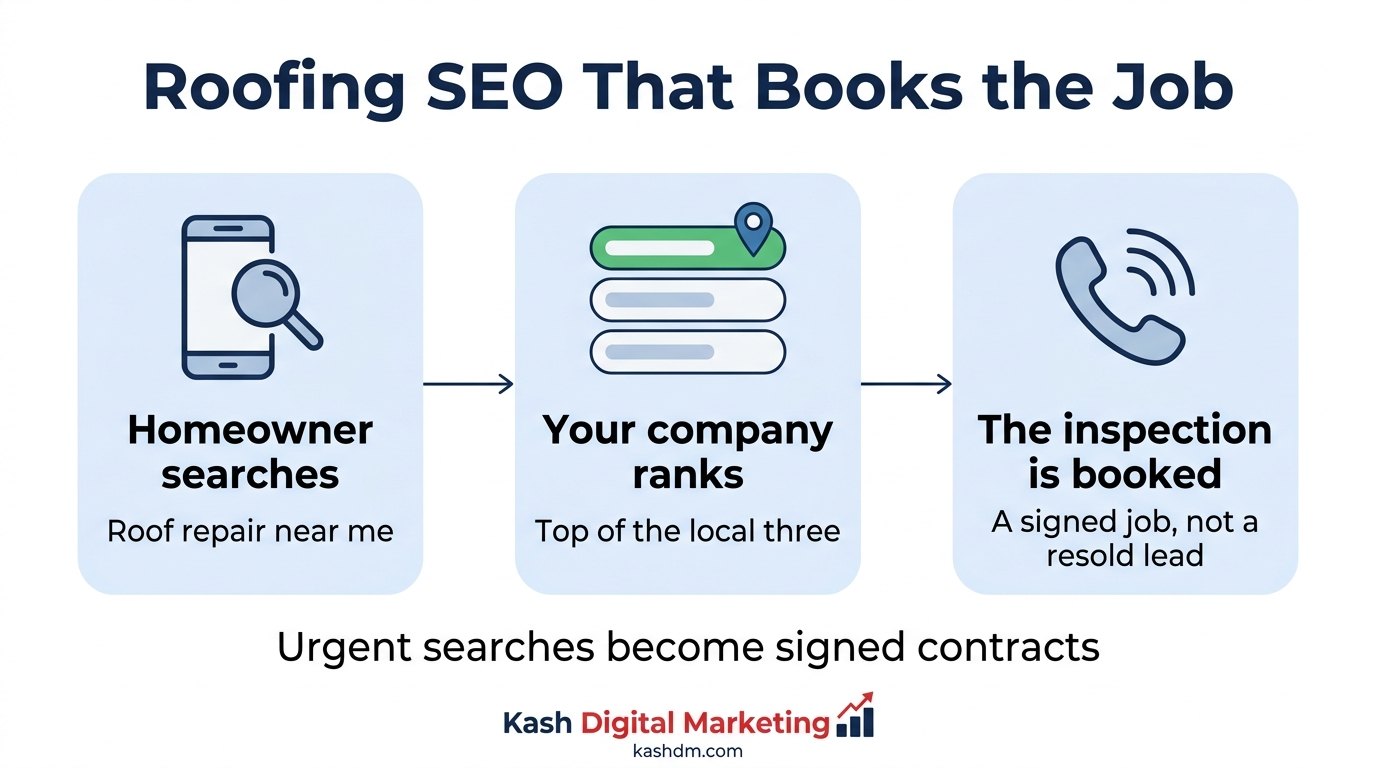
How roofing SEO produces a booked job
A homeowner searches, sees your profile in the map pack, reads recent reviews, taps to call or lands on a city page that names their neighborhood, and requests an inspection. Every step in that chain is something SEO work can improve, which is why the discipline is judged on booked jobs rather than rankings alone.

Why Roofing Companies Depend on Search More Than Most Trades
Roofing depends on search more than most trades because a roof is a rare, expensive, unplanned purchase that almost nobody has a trusted provider for. There is no annual service visit building the relationship in advance, so the search result is very often the first contact a homeowner has with any roofing company at all.
Compare this to plumbing or HVAC, where a homeowner may have used the same company for years and simply calls them back. Roofing rarely gets that advantage. Even a customer you re-roofed a decade ago will likely search again, because they have long forgotten your company name.
The purchase is rare, so the brand memory is weak
Most homeowners replace a roof once or twice in a lifetime. Recall of a roofing company after ten years is close to zero, which means every job is competed for again on the open market, and search is where that competition happens.
The job value makes every search worth fighting for
A single roof replacement can be worth more than dozens of jobs in other trades. That changes the arithmetic entirely: a modest improvement in visibility on a handful of high-intent terms can pay for a year of SEO work several times over.
Storms create demand faster than any marketing channel can react
Severe weather generates a spike in roofing searches within hours. Paid campaigns can be adjusted quickly, but budgets get exhausted and costs spike exactly when everyone else is bidding. Companies already ranked organically absorb that demand without paying more for it.
Referral flow is thinner than most owners assume
Roofing referrals happen, but they arrive slowly and unpredictably, and they rarely scale with crew capacity. A company that adds a second or third crew usually discovers that referral volume does not grow to match, and search becomes the difference between a full schedule and idle labor.
Trust has to be established before the first call
A homeowner about to spend the price of a car on a roof is looking for reassurance. Reviews, real project photos, licensing information and a professional website do that work before anyone picks up the phone, and all of them live inside the search experience.
How Homeowners Actually Search for a Roofer
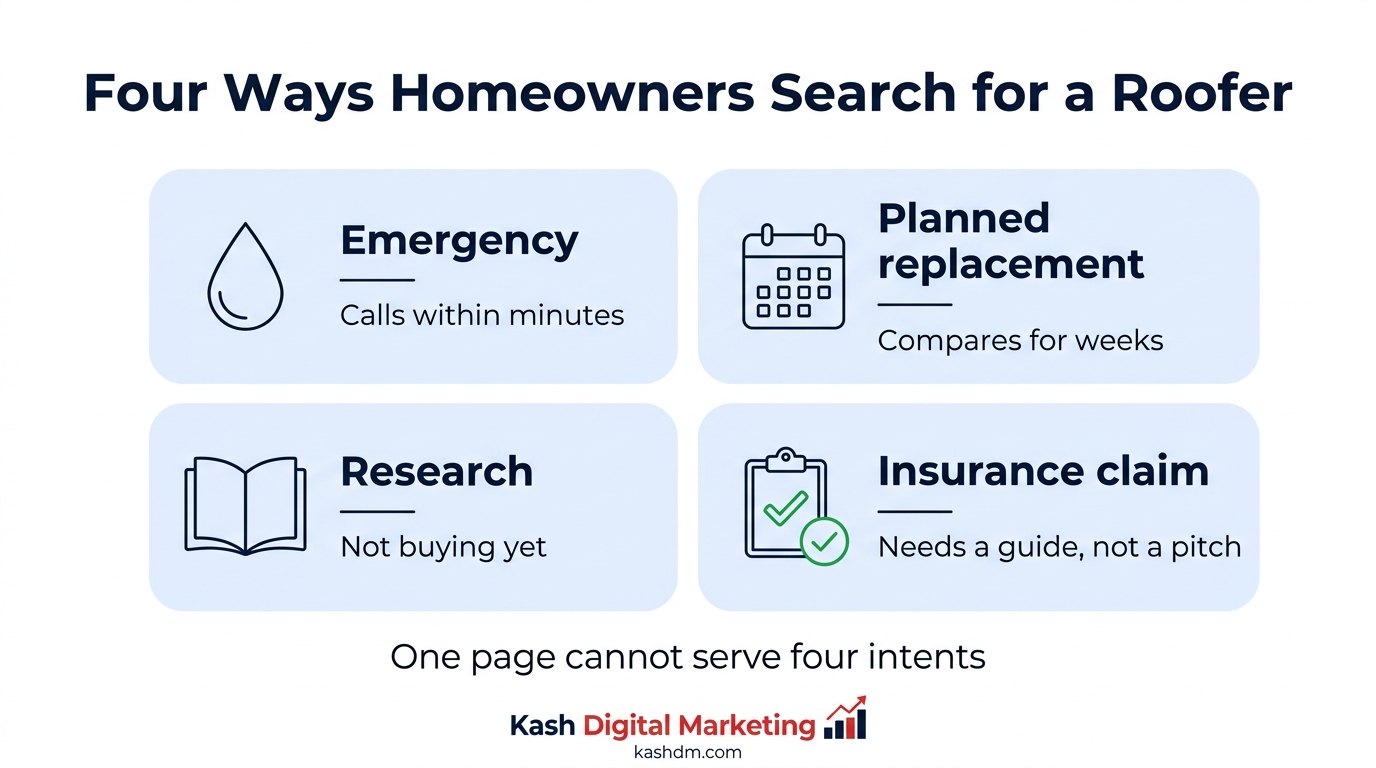
Homeowners search for a roofer in three distinct modes: emergency, planned replacement and research, and each one requires different pages on your website. Building only for one of them, which is what most roofing sites do, leaves the majority of the available demand unclaimed.
Understanding these modes is the difference between a website that ranks for terms nobody valuable is typing and one built around the way roofing customers behave in the real world.
The emergency search
A leak is active or a storm has just passed. Queries are short and urgent: "emergency roof repair," "roof leak repair near me," "roof tarp service." The searcher will call within minutes and rarely compares more than three companies. Speed, a visible phone number and honest emergency availability decide this one.
The planned replacement search
The roof is old, a home sale is coming, or an inspection failed. Queries are longer and comparative: "roof replacement cost," "best roofing company in Austin," "metal vs shingle roof." This searcher takes days or weeks, reads several sites and requests two or three estimates.
The research and education search
No purchase is imminent. The homeowner wants to know how long a roof lasts, whether a repair is possible, or what a warranty covers. These searches convert poorly today and enormously over a year, and they are how a roofing company builds the topical authority that lifts its commercial pages.
The insurance-driven search
A storm has passed and the homeowner is navigating a claim for the first time. Queries revolve around adjusters, deductibles, documentation and denied claims. This is the highest-value and least contested search territory in the entire roofing category.
Why mode determines page type
Emergency searches need fast, local, phone-first pages. Replacement searches need detailed service and material pages with real photos. Research and insurance searches need genuinely useful articles. One generic services page cannot serve four different intents, which is why thin roofing sites plateau.
Local SEO for Roofing Contractors and the Map Pack
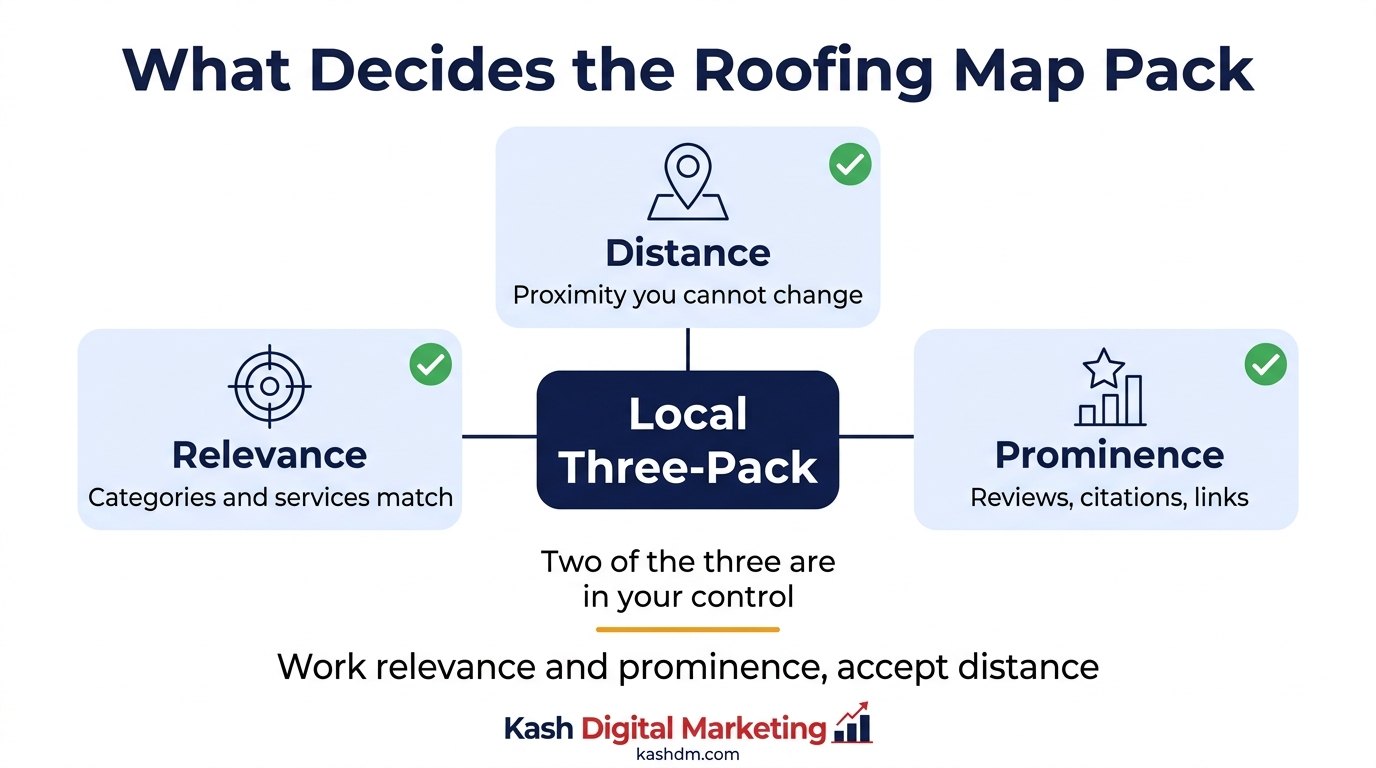
Local SEO for roofing contractors is the work that decides whether your company appears in the three-result map pack, and for most roofing companies it produces more calls than every other channel combined. Google ranks that map pack on three things: relevance, distance and prominence.
Only two of the three are within your control, and understanding which two is the fastest way to stop wasting effort on the one that is not.
Relevance: does Google understand what you do
Relevance comes from your Google Business Profile categories, your listed services, and the content on your website. A roofing company with "Contractor" as its primary category instead of "Roofing Contractor" is telling Google something vague about a specific business, and it ranks accordingly.
Distance: the factor you cannot change
Google favors businesses physically near the searcher. You cannot relocate to the center of every city you serve, and you should never fake an address, which is a suspension risk. What you can do is compete harder on the other two factors and build genuine local content for the markets you want.
Prominence: the factor most roofers neglect
Prominence is how well known and well regarded the business appears to be, built from reviews, citations, links and mentions across the web. It is the slowest signal to build and the hardest for a competitor to copy quickly, which makes it the most durable advantage available to you.
Why the map pack outperforms organic for roofing
Map pack results appear above organic listings, carry a call button, display your rating, and let a homeowner contact you without visiting a website at all. For emergency roofing searches especially, most of the contact volume never reaches an organic result.
Service-area businesses and the hidden-address question
Many roofing companies work from a yard or a home office rather than a storefront. Google supports this as a service-area business, with the address hidden and service areas defined. Configuring this correctly matters, because a mishandled address is one of the most common causes of profile suspension in the trades.
Why one profile cannot rank everywhere
A single Google Business Profile ranks strongly near its own location and weakens with distance. Covering a wide metro means building genuine local relevance through city pages, local links and reviews that name those cities, rather than expecting one pin to cover a hundred miles.
Google Business Profile Optimization for Roofing Companies
Your Google Business Profile is the single highest-return asset in roofing SEO, and most roofing contractors have obvious, fixable errors sitting in theirs right now. Profile work is also the fastest-moving part of the job, because Google re-crawls profiles constantly rather than on a slow content schedule.
This is where we start with almost every roofing client, because it is common to find years of lost calls attributable to a category setting or a duplicate listing nobody knew existed.
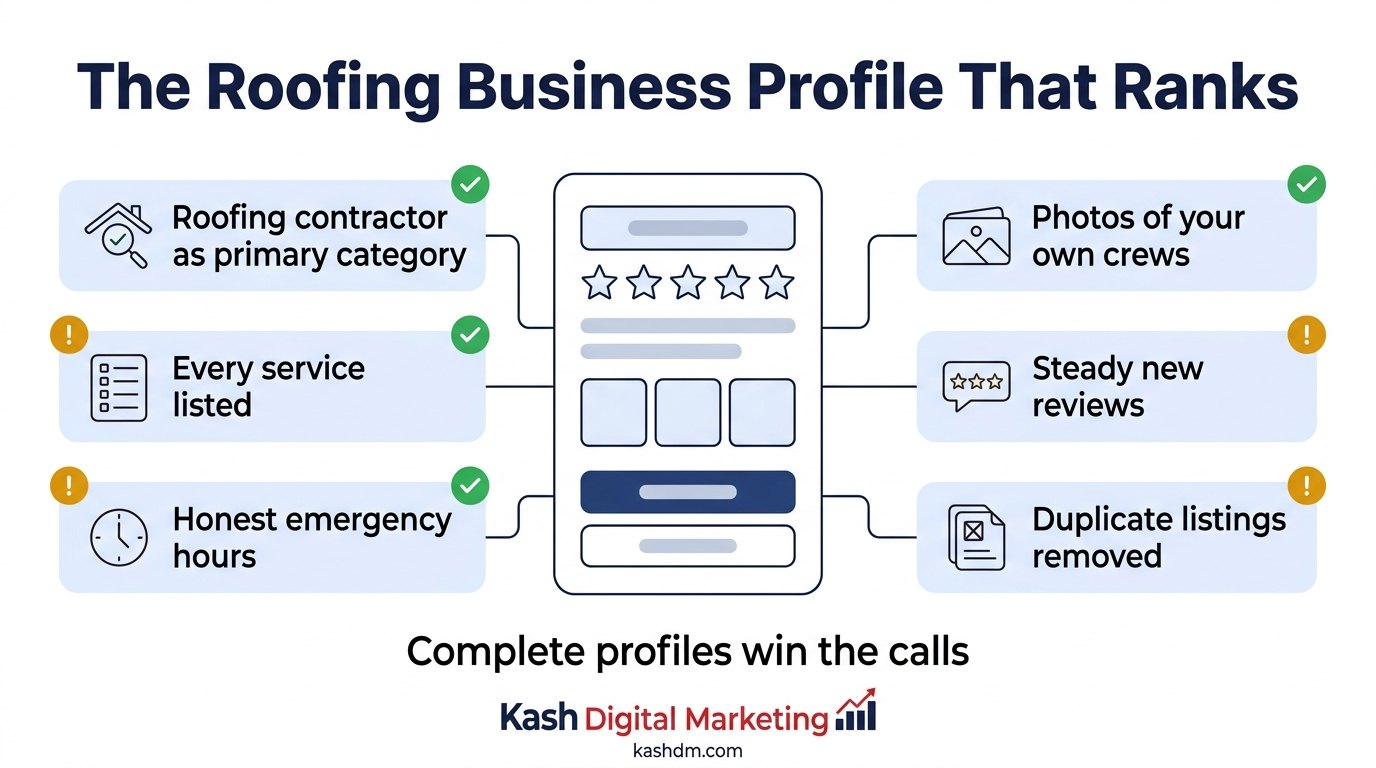
Primary category decides more than anything else on the profile
"Roofing Contractor" should be the primary category for almost every roofing company. Secondary categories can then carry roof repair, gutter service, siding or storm damage restoration. Getting the primary wrong is the single most expensive setting error in the trade.
List every service you actually sell
Repair, replacement, inspection, emergency tarping, gutters, ventilation, skylights, flat and commercial systems. Each service entry is a relevance signal, and an empty services section is a profile telling Google almost nothing about a business that does a great deal.
Real photos of real crews and real roofs
Stock imagery is transparent to homeowners and adds nothing. Photographs of your own trucks, crews and completed roofs, added regularly rather than once, support both ranking and the credibility judgment a homeowner makes in the few seconds they spend on your listing.
Duplicate listings quietly suppress everything
Duplicates are extremely common in roofing, created by old marketing agencies, previous owners or automated directory tools. They split reviews and signals across two profiles and can suppress both. Finding and merging them is often the highest-value hour of the entire engagement.
Hours that tell the truth about emergencies
If you genuinely answer after hours, say so, and then answer. If you do not, do not claim it. Emergency roofing searches convert on the phone being picked up, and an unanswered call listed as available produces a one-star review rather than a job.
Posts, questions and the profile as a living asset
Google Posts, a seeded and answered questions section, and regular photo uploads all signal an active business. Profiles that sit untouched for a year drift down against competitors who maintain theirs, regardless of how good the underlying company is.
Google Maps Ranking for Roofing Companies
Ask most roofers where their best leads come from and the answer is the map pack. Ask them how map rankings are decided and the answer is usually a shrug.
Google ranks the local three-pack on three things, and they are not weighted equally for every search.
Relevance is how well your Business Profile and your website match what was searched. This is the part most under your control and the part most roofers neglect, because the profile is set up once and then never touched.
Distance is how close you are to the searcher. You cannot change where your office is, but you can change your service-area configuration, and you can build genuine location pages so the organic results underneath the map carry you where proximity will not.
Prominence is how established Google believes you are: reviews, review velocity, citations, links, and how much the wider web mentions your company. This is the slowest to move and the hardest for a competitor to copy, which is precisely why it is worth building.
What "maps ranking services" should actually mean when you buy them
- A profile audited against the roofers currently outranking you, category by category, not against a generic checklist
- Service areas set to where you genuinely work, because inflated areas dilute rather than extend your reach
- Photos and posts added on a real schedule, tied to jobs you actually did
- A review process your crews can follow without being nagged, producing a steady stream rather than a burst
- Rank tracking sampled from several points across your service area, so the report reflects what your customers see rather than what a single downtown check shows
Be careful with anyone selling map rankings as a standalone product with a fast guarantee. In this niche that usually means fake listings, keyword-stuffed business names or review buying. All three get profiles suspended, and getting a suspended profile back is far harder than ranking one honestly.
Roofing Keyword Research That Books Jobs
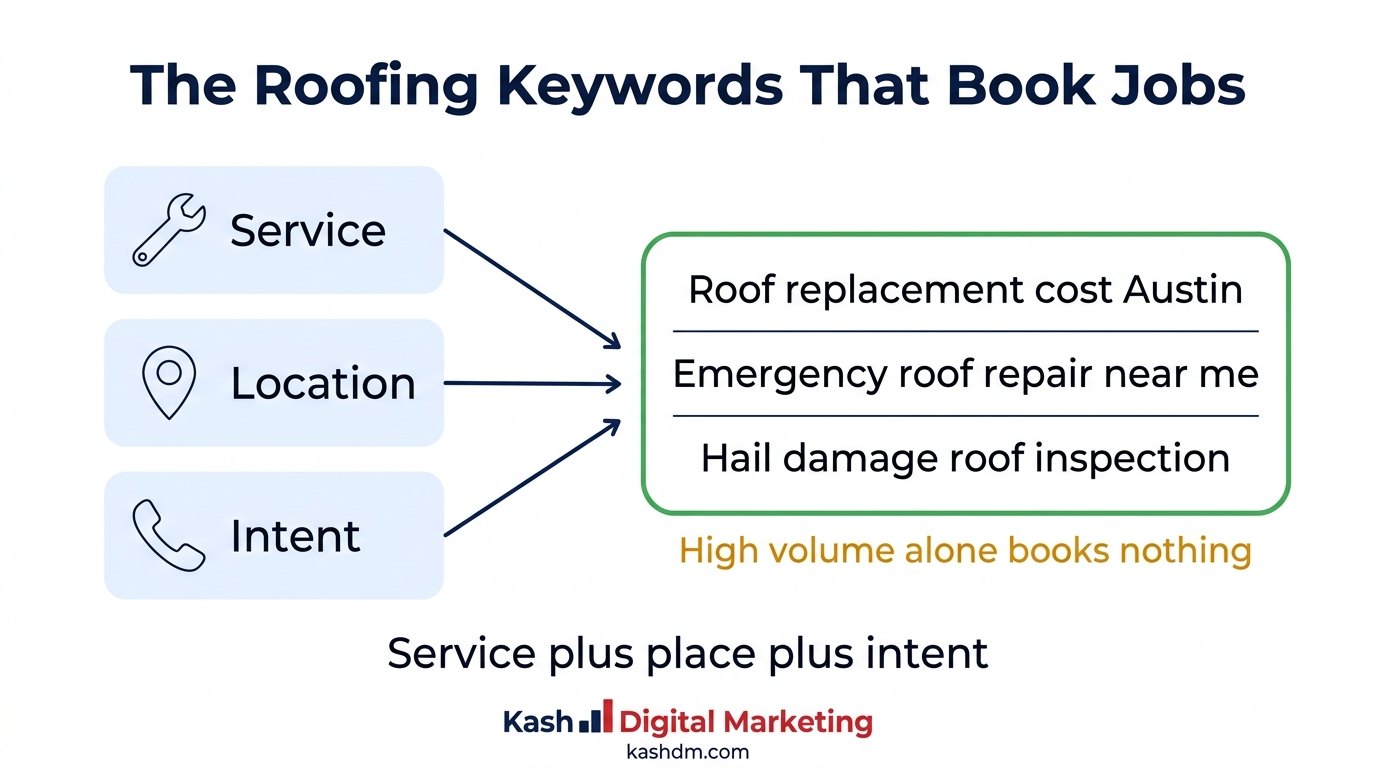
The roofing keywords worth ranking for combine a service, a location and buying intent, and they almost always have lower search volume than the generic terms contractors ask about. "Roofing" gets enormous volume and books nothing. "Roof replacement cost Dallas" gets a fraction of it and books contracts.
Chasing volume rather than intent is the most common way roofing SEO budgets are wasted, and it is easy to spot in a report full of impressive traffic numbers and an empty schedule.
Service plus place plus intent
The formula that produces revenue is a service term, a location, and a word that signals a decision: cost, near me, best, emergency, company, contractor. Each element narrows the audience and raises the probability the searcher is ready to talk to somebody.
Emergency and storm keyword families
"Emergency roof repair," "roof leak repair near me," "storm damage roof repair," "hail damage roof inspection," "roof tarp service." These convert at the highest rate in the category and spike unpredictably with weather, which is exactly why they must be ranked before the storm rather than after.
Replacement and material keyword families
"Roof replacement," "new roof cost," "metal roof installation," "asphalt shingle replacement," "tile roof repair," "flat roof replacement." These carry the largest job values and the longest decision cycles, and they reward genuinely detailed pages over short ones.
Commercial roofing keyword families
"Commercial roofing contractor," "TPO roof installation," "EPDM roof repair," "commercial roof maintenance," "industrial roofing." These are searched by facilities managers and property owners during business hours, and they need separate pages written for a completely different reader.
Insurance and claim keyword families
"Roof insurance claim," "insurance adjuster roof inspection," "roof claim denied," "does insurance cover roof replacement." These are high-value, high-trust searches that most roofing competitors ignore entirely, leaving the territory unusually open.
Long-tail questions are where the authority is built
"How long does a roof last," "can a roof be repaired instead of replaced," "how many layers of shingles are allowed," "what does a roof inspection include." Individually small, collectively enormous, and they are what convinces Google your site covers roofing properly rather than superficially.
The keywords worth deliberately ignoring
National terms with no local intent, DIY queries from people who will never hire anyone, materials you do not install, and cities you cannot actually serve. Ranking for these produces traffic reports that look healthy and a phone that does not ring.
Service Pages for Every Roofing Job You Sell
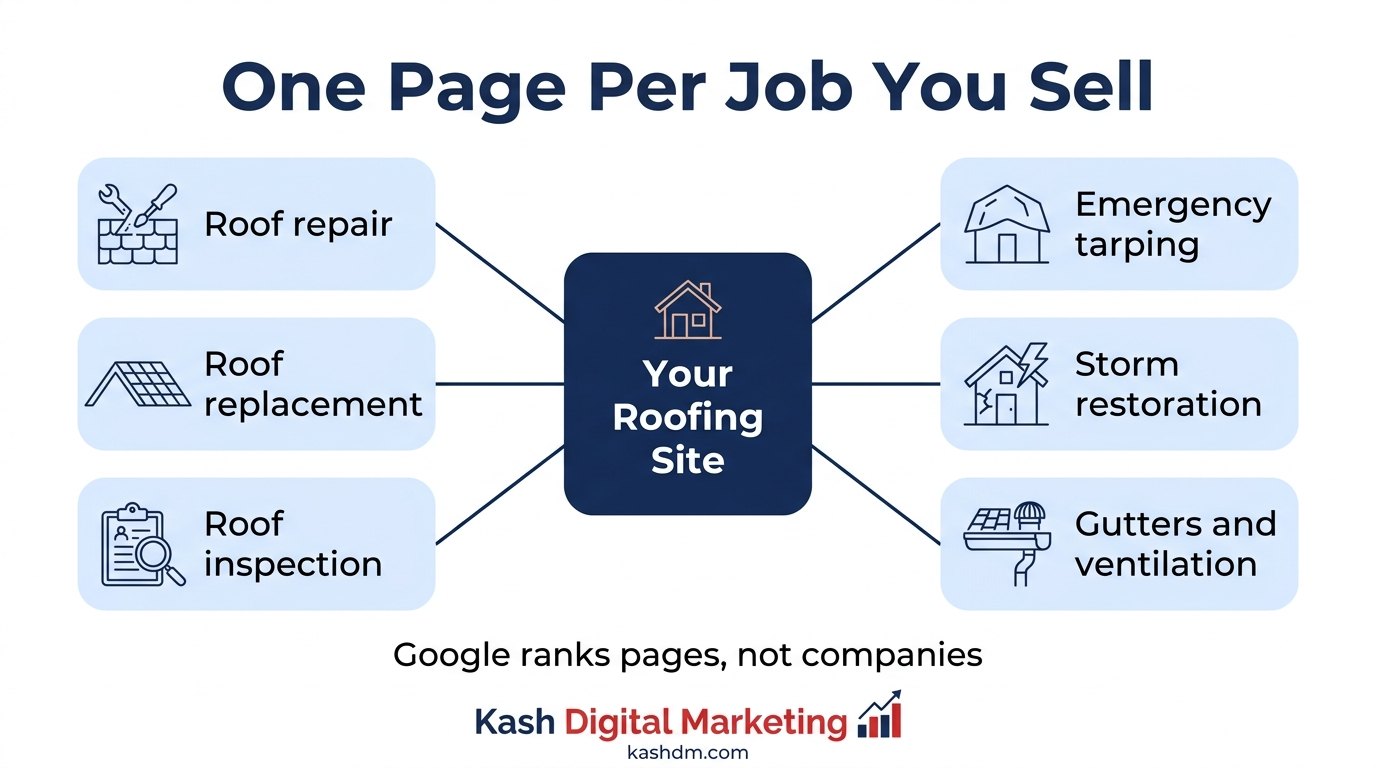
Every roofing service you want to sell needs its own dedicated page, because Google ranks pages rather than companies and a single services page cannot rank for repair, replacement, inspection and restoration at once. This is the most reliable structural upgrade available to a typical roofing website.
Most roofing sites we audit have three or four pages covering work that deserves twelve or fifteen. The missing pages are not a content problem, they are a revenue problem, because each absent page is a service that simply cannot be found.
Roof repair
The highest-frequency service and often the entry point for a relationship that later produces a replacement. The page should cover leak diagnosis, common causes, what repair costs depend on, and when repair genuinely is not the right answer.
Roof replacement
The highest-value residential page on the site. It should walk through the process end to end, tear-off through cleanup, cover timelines, explain what changes the price, and answer the question every homeowner has about disruption to their household.
Roof inspection
An inspection page captures pre-purchase, post-storm and maintenance searches, and it is the lowest-friction call to action a roofing company can offer. It should say exactly what is checked and what the homeowner receives afterward.
Emergency tarping and leak response
A short, fast, phone-first page for the worst moment in a homeowner's week. It should state availability honestly, explain what temporary protection does and does not accomplish, and make contacting you a single tap.
Storm and hail damage restoration
This page bridges the roofing work and the insurance process, and it should treat both. It is the page most likely to be found by a homeowner who does not yet know whether they have a claim.
Gutters, ventilation, skylights and adjacent work
Each adjacent service supports the core business and captures searches that competitors leave alone. They also strengthen the profile's service list and give city pages something meaningful to link to.
What separates a real service page from a thin one
Photographs of your own work, the actual process, honest discussion of cost drivers, the questions homeowners ask, and a specific next step. A page that could belong to any roofing company in America will rank like one.
Roofing Material Pages: Shingle, Metal, Tile, Flat and Slate
Material pages capture a large, high-intent search category that most roofing contractors leave completely unbuilt, because homeowners research materials long before they choose a company. Someone comparing metal against asphalt is early in the process and entirely winnable.
Material searches also carry unusually clear commercial intent once a location is attached, and they are among the easiest wins available on a roofing site that already ranks reasonably for repair terms.
Asphalt shingle
The default residential material and the highest-volume material term. The page should cover types, expected lifespan, what drives cost, and how shingle compares with the alternatives without dismissing them.
Metal roofing
A fast-growing and heavily researched category with an enormous question set around noise, cost, lifespan, energy performance and resale value. Metal roofing searches are among the most valuable material terms in the category.
Tile and clay
Regionally concentrated and high value, particularly across the Southwest and Florida. Tile carries specific concerns about weight, underlayment and repair that generic roofing pages never address.
Flat and low-slope systems
TPO, EPDM and modified bitumen bridge residential and commercial work. These terms are searched by a more technical reader and reward precise, unpadded writing.
Slate, cedar and premium materials
Low volume, very high job value, and almost no competent competing content. For a company that genuinely installs them, these pages are among the cheapest authority a roofing site can acquire.
Comparison pages that catch the undecided
"Metal vs shingle," "tile vs metal," "shingle vs synthetic." These answer the exact question a homeowner is asking mid-decision, and they are natural places to demonstrate expertise rather than push a preference.
Only publish materials you actually install
A page for a material you do not offer generates enquiries you must decline, damages trust and wastes crawl budget. Coverage should match capability, always.
City and Location Pages for Your Real Service Area
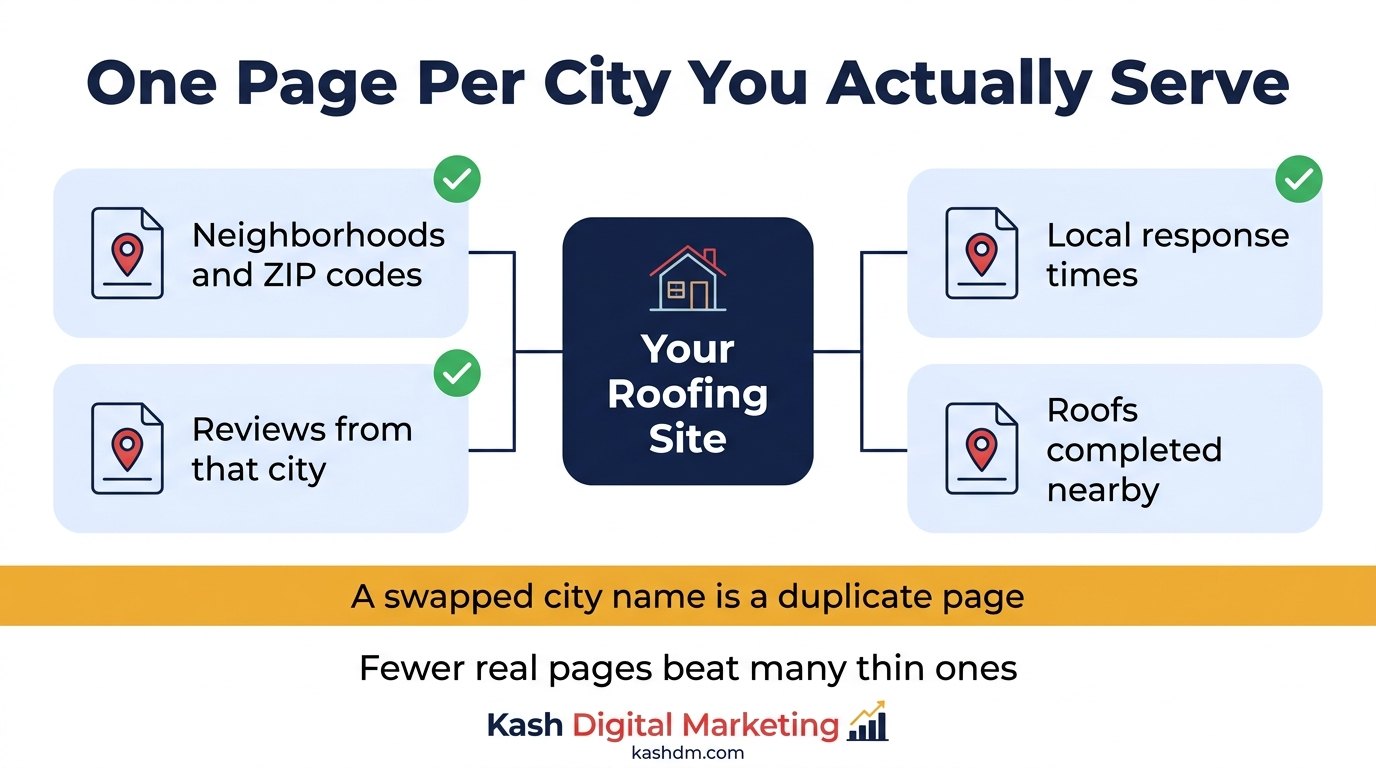
A roofing company ranks in the cities where it has genuine local content, not in every city it claims to serve. One page per market you actually work in, carrying real local detail, outperforms fifty templated pages with the city name swapped.
This is where roofing SEO most often goes wrong, because bulk city pages are easy to generate and look like progress on a report while doing active harm to the site.
What belongs on a real city page
The neighborhoods and ZIP codes you cover, your response time to that area, reviews from customers in that city, photographs of roofs you completed there, and the specific services in demand locally. Every element is something a competitor cannot copy.
Why templated city pages backfire
Pages identical except for a city name are treated as duplicates. At best they are ignored, at worst they dilute the authority of the pages that were working. Roofing is one of the worst-affected industries because the temptation to mass-produce is so strong.
Local roofing conditions are real content
Hail frequency in the Front Range, hurricane codes in Florida, ice dams in the upper Midwest, wind uplift requirements on the Gulf Coast, wildfire-rated materials in California. Each of these gives a city page substance that no template can fake.
Choose cities by revenue, not by map coverage
Rank the markets that produce actual jobs and build those first. A page for a town you would rather not drive to is a page competing for attention with one you would.
How many city pages is right
Fewer than most agencies sell. Start with the markets producing revenue now, add the ones you want next, and only expand when each existing page has real content behind it. Ten strong city pages beat a hundred thin ones every time.
Internal linking between cities and services
Each city page should link to the services in demand there, and each service page should link back to the cities where you sell it. This structure is what tells Google you cover a service area properly rather than claiming to.
Storm and Hail Damage SEO
Storm SEO has to be built months before the storm, because the demand spike lasts days and rankings take months. A page published the week after a hailstorm arrives long after the homeowners have already chosen contractors.
This is the single largest strategic difference between roofing SEO and SEO in almost any other trade, and it is why the off season is the correct time to invest rather than the time to pause.
The demand curve is a spike, not a season
Severe weather produces a sharp rise in roofing searches within hours and it decays within days. Companies already ranked capture it. Companies that begin reacting when the storm hits are competing for attention they cannot yet earn.
Build storm pages in the quiet months
Hail, wind and hurricane damage pages should be written, published, indexed and matured well ahead of the season they serve. The work feels premature at the time and pays entirely at the moment demand arrives.
Storm-chasing competitors and how to outlast them
Out-of-state crews flood a market after a major event, often with temporary websites and no local history. Established local prominence, real reviews and a physical presence are exactly the signals that outrank them, and they are signals a temporary operation cannot manufacture.
Free inspection offers and how they rank
Post-storm searchers are looking for an assessment rather than a quote. A clear, honest inspection offer with a defined scope converts this traffic far better than a general contact form, and it gives storm pages a natural call to action.
Emergency tarping as a first contact
Tarping is a small job that frequently becomes a replacement. Ranking for emergency tarp searches puts your company on the roof before any competitor has been called, which is a structural advantage in the claim that follows.
Reputation risk during storm season
Storm work attracts complaints across the whole industry, and homeowners know it. Content that explains how to check a contractor's license, what a legitimate inspection involves and what a fair contract looks like earns trust precisely when it is scarcest.

Insurance Claim Content: The Cluster Most Roofers Skip
Insurance claim content is the highest-value and least contested territory in roofing SEO, because homeowners navigating a first claim are anxious, searching heavily, and almost nobody is answering them properly. The company that explains the process usually gets the inspection.
Most roofing websites mention insurance in a sentence and move on. That leaves a large, high-intent search category effectively open to whoever decides to treat it seriously.
Why claim searches convert so well
A homeowner researching a claim already has damage, already expects to hire someone, and is looking for a guide rather than a salesperson. Being genuinely helpful at that moment is a stronger sales position than any offer.
The questions worth answering properly
What insurance typically covers and does not, how deductibles work, what an adjuster looks for, what documentation helps, how long a claim takes, and what to do when a claim is denied. Each is a page, and each is searched constantly.
Documentation and the inspection report
Explaining what a thorough damage report contains, and why photographs and measurements matter, positions your company as the one that does the job properly. It also sets an expectation your competitors may not meet.
Denied claims are an underserved search
"Roof claim denied" and its variants are searched by homeowners in a difficult position with nowhere useful to turn. Honest content about appeals, second inspections and realistic options earns extraordinary trust.
Where the ethical line sits
Content should educate about the claims process, never coach anyone toward misrepresentation, and never promise an outcome with an insurer. Deductible handling in particular is regulated differently by state, and pages should say so rather than imply a workaround.
Why this cluster lifts the whole site
Detailed, genuinely useful claim content is exactly the kind of material that earns links and citations from outside the roofing industry, and that authority flows to the commercial pages that actually sell work.
Commercial Roofing SEO
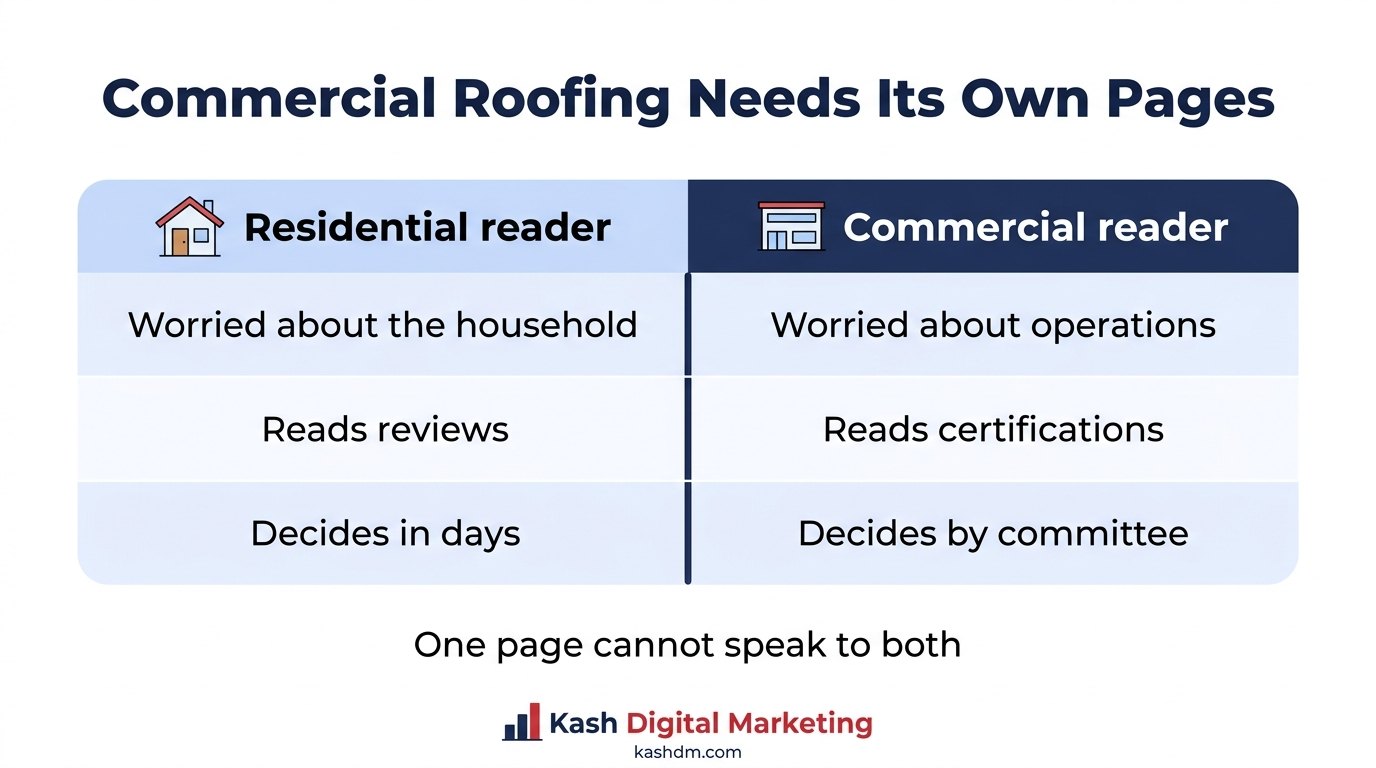
Commercial roofing needs its own pages, its own keywords and its own proof, because a facilities manager and a homeowner are looking for completely different things. Serving both from residential pages generally wins neither.
Commercial searches carry lower volume and dramatically higher contract values, and the competition is usually weaker because most roofing sites are built entirely around residential work.
A different reader with different questions
Facilities managers, property managers and building owners care about disruption to operations, warranty terms, response times, safety records and certifications. Very little of the residential message applies to them.
System-specific pages rank better than a generic commercial page
TPO, EPDM, PVC, modified bitumen, built-up and metal systems each have their own searches for installation, repair, restoration and maintenance. A single "commercial roofing" page cannot compete with dedicated pages for the systems you actually install.
Maintenance contracts are the recurring-revenue keyword set
"Commercial roof maintenance," "roof asset management," "preventive roof maintenance program." These searches come from buyers looking for an ongoing relationship rather than a single job, which is the most valuable outcome commercial SEO can produce.
Proof looks different in commercial
Named project types, square footage handled, certifications, manufacturer approvals, safety statistics and insurance limits carry the weight that residential reviews carry. Where a client permits it, project detail is powerful; where they do not, describing the project type without naming them still works.
Commercial buyers research during business hours
The search pattern is weekday and daytime, the decision cycle is long, and multiple people are involved. Content should be printable, forwardable and detailed enough to survive being read by someone who was not the original searcher.
Industrial and institutional niches
Schools, warehouses, healthcare facilities, churches and multifamily properties each have specific requirements and almost no competing content. For a contractor with genuine experience in one, this is unusually cheap authority.
Technical SEO for Roofing Websites
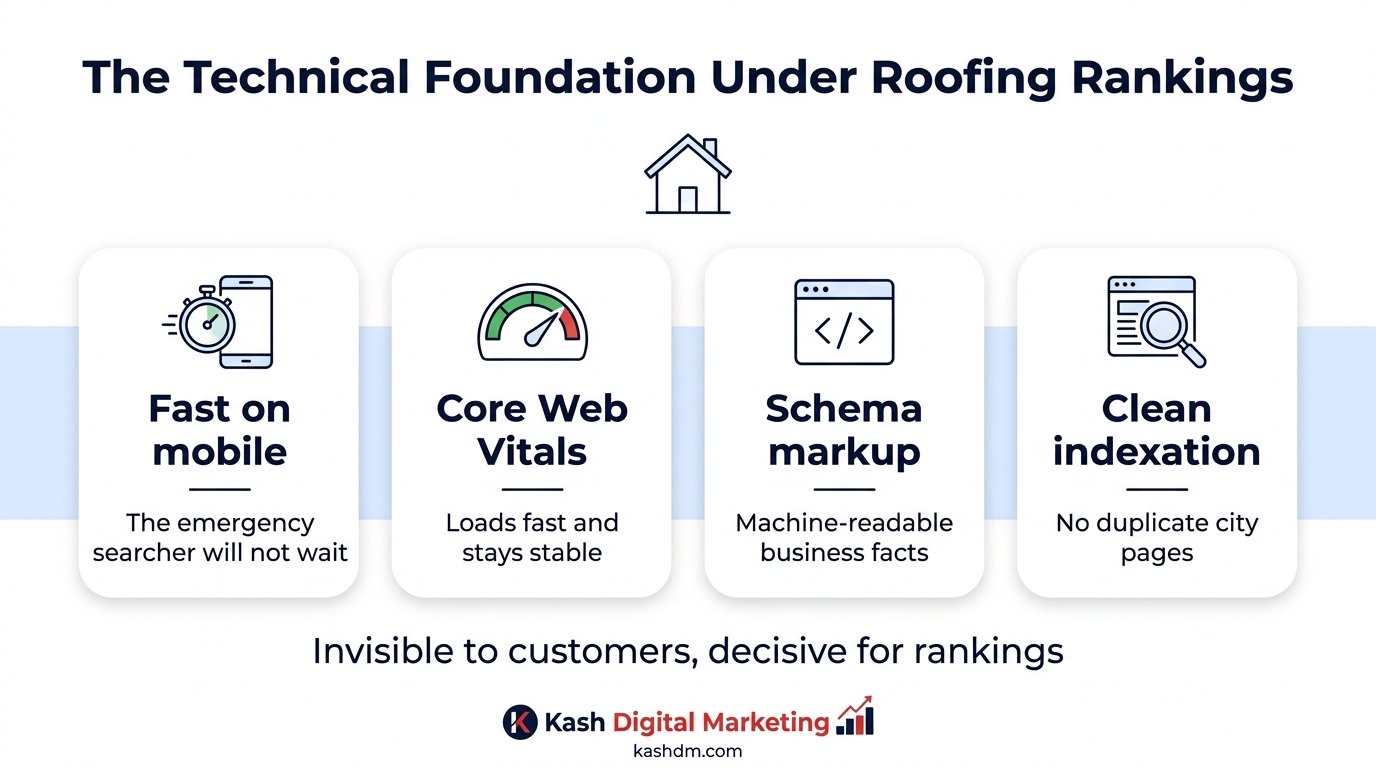
Technical SEO is the foundation under every ranking a roofing company earns, and it is invisible to customers right up until it costs you a job. A roofing site can have excellent content and still fail because Google cannot crawl it or a homeowner will not wait for it to load.
We fix technical problems before publishing anything new, because adding content to a broken foundation is the most common way roofing SEO budgets get spent without result.
Crawlability and indexation
If a page is not indexed it cannot rank, and roofing sites frequently have entire service or city sections excluded by an old robots directive, a stray noindex tag or a broken internal link structure nobody has audited.
Site architecture that reflects the business
Services, materials, locations and resources should each sit in a clear section, with no important page more than a few clicks from the homepage. Flat, sprawling structures make it hard for Google to identify which pages matter.
URL structure and redirect hygiene
Clean, readable, stable URLs, and proper redirects when pages move. Roofing sites that have been rebuilt two or three times over a decade commonly carry redirect chains and broken links that quietly bleed authority.
Duplicate content across city and service pages
The most common technical fault in roofing specifically. Near-identical pages need either genuine differentiation or consolidation, and canonical tags are a signal rather than a fix for pages that should not exist.
HTTPS, security and trust signals
A homeowner about to submit an address and phone number to request an inspection needs to see a secure connection. Mixed content warnings and expired certificates end sessions immediately.
Image weight on a photo-heavy site
Roofing sites are unusually image-dependent because project photography sells the work. Unoptimized galleries are the leading cause of slow roofing websites, and modern formats with correct dimensions solve most of it.
Internal linking as a ranking instrument
Links from strong pages to weaker ones distribute authority and tell Google which pages are important. On roofing sites this is usually the fastest technical improvement available, because most have almost no internal linking at all.
Core Web Vitals and Mobile Speed for Roofing Sites
Most roofing searches happen on a phone, frequently outdoors and often on a weak connection, so mobile speed is not a technical nicety but the difference between a call and a bounce. A homeowner standing in a yard looking at storm damage will not wait for a slow gallery to load.
Core Web Vitals are Google's measurement of that experience, and they are both a ranking input and an accurate predictor of whether your traffic converts.
Largest Contentful Paint
How quickly the main content becomes visible. On roofing sites the culprit is almost always a large hero photograph loading at full resolution before anything else. Correct sizing and priority hints fix most of it.
Interaction to Next Paint
How quickly the page responds when tapped. Heavy scripts, chat widgets and tracking tags stacked on top of each other are the usual cause, and roofing sites accumulate them from years of different marketing vendors.
Cumulative Layout Shift
Content jumping as the page loads, which causes a homeowner to tap the wrong thing. Images without declared dimensions are the primary source, and it is entirely preventable.
Mobile-first means mobile-designed
Google evaluates the mobile version of your site. Tap targets, readable text without zooming, a phone number that dials on tap and forms that work on a small screen are ranking factors and conversion factors simultaneously.
Project galleries without the weight
Photography is a roofing company's strongest sales asset and its heaviest technical liability. Lazy loading, modern formats and correctly sized variants let you keep the photographs and lose the delay.
Third-party scripts and their real cost
Every chat widget, review embed, heat-map tool and pixel adds delay. Each should justify its place. Roofing sites frequently carry scripts for tools nobody has used in years.
Schema Markup for Roofing Companies
Schema markup translates your roofing business into machine-readable facts, which matters more every year as search results are increasingly assembled rather than listed. It does not directly raise rankings, but it strongly influences how your business is understood and displayed.
For a local service business the return is unusually high relative to the effort, and it is almost always missing on roofing sites we audit.
RoofingContractor and LocalBusiness
Schema.org includes a specific RoofingContractor type. Using it, with accurate name, address, phone, hours, service area and geographic coordinates, states plainly what a search engine would otherwise have to infer.
Service schema for each offering
Repair, replacement, inspection and restoration can each be described as a distinct service with its own area served. This supports the page-level relevance that a single business-level markup cannot.
FAQ schema on the pages that answer questions
Question and answer content marked up correctly is eligible for expanded presentation and is heavily used by AI-generated answers. It is the highest-yield schema type for a content-rich roofing site.
Review and aggregate rating markup, used honestly
Reviews may be marked up when they are genuine and displayed on the page. Fabricated or self-serving review markup is a manual-action risk, and roofing is a category Google watches closely.
Breadcrumb and site structure markup
Breadcrumbs clarify hierarchy and improve how listings display. On a site with services, materials and dozens of city pages they also help search engines understand the relationship between sections.
Consistency between markup and the visible page
Schema must describe what a visitor actually sees. Marked-up hours that contradict the profile, or services listed only in code, are the two errors that turn a helpful signal into a liability.
Content Strategy and Topical Clusters for Roofers
Topical authority is what makes a roofing site rank for terms it never explicitly targeted, and it is built by covering a subject completely rather than publishing occasionally. Google is evaluating whether your site is a credible source on roofing, not whether one page mentioned a keyword.
The cluster model is how that coverage gets organized, and it is the difference between a blog nobody reads and a content library that lifts the commercial pages.
Pillar and cluster structure
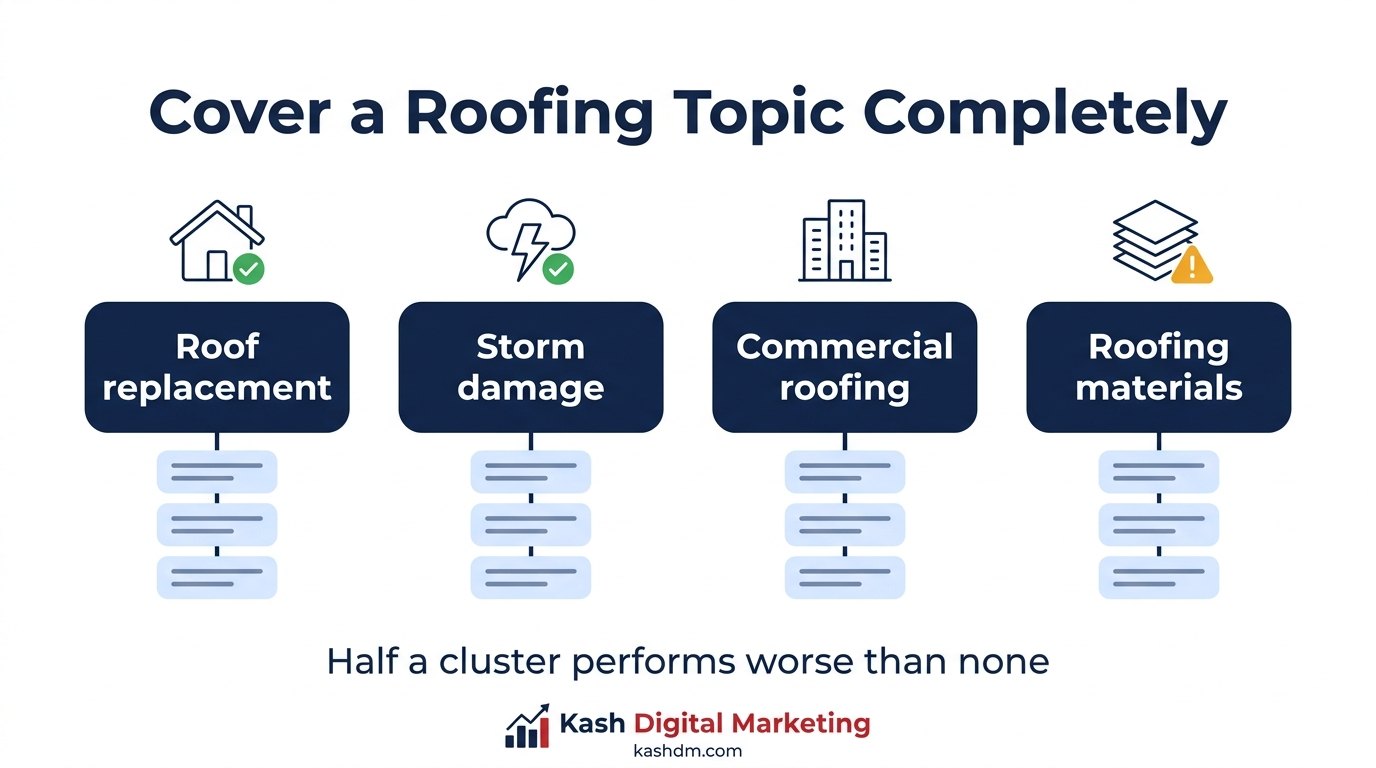
A substantial pillar page on a major topic, supported by focused pages answering specific questions, all linked to each other and back to the pillar. Roof replacement, storm damage, commercial roofing and materials each deserve this treatment.
Cover a topic completely or leave it alone
Half a cluster performs worse than none, because it signals shallow coverage. Choosing three subjects and covering them thoroughly beats touching ten.
Seasonal content published ahead of season
Ice dam content in early autumn, hail content before spring, ventilation and heat content before summer. Published in the season it describes, content arrives too late to have ranked.
Answer the questions homeowners actually ask on site visits
Your crews hear the real questions every day: how long will this take, will it damage the landscaping, what happens if it rains mid-job, how do I know the old roof was removed properly. These make better content than any keyword tool suggestion.
Project stories without breaching client privacy
A job described by type, scope, challenge and outcome is compelling without naming anyone. Where a client is happy to be named, that is stronger, but anonymity does not prevent the content from working.
Publishing rhythm beats publishing volume
Consistent, useful publication over a year outperforms a burst of content followed by silence. For most roofing companies a sustainable pace is far more valuable than an ambitious one that stops in month three.
Updating old content is usually higher return than new content
Refreshing a page that already ranks on the second page frequently produces faster gains than writing something new. Most roofing sites have several of these sitting unexamined.
Reviews and Reputation for Roofing Contractors
Reviews are both a ranking factor and the deciding factor for a homeowner about to spend a large sum with a stranger, and roofing is a category where buyers read them unusually carefully. Volume, recency, rating and your replies all count.
Reputation is also the part of prominence a roofing company controls most directly, which makes it the highest-leverage ongoing work available.
Recency matters as much as volume
A profile with many reviews and none in the last year reads as a business in decline. A steady arrival of recent reviews signals an active company, and Google weights freshness as well as count.
A system your crews will actually use
Review requests fail when they depend on someone remembering. A short, specific moment in the job close, with a simple link or a QR card, is what produces consistency. Complexity is why most review programs quietly stop.
Reviews that mention the service and the city
A review saying "replaced our roof in Round Rock after the hailstorm" carries relevance a five-star rating alone does not. Asking customers what job you did and where, rather than for a favor, produces these naturally.
Responding to every review, especially the difficult ones
A calm, specific, non-defensive reply to a complaint persuades far more readers than the complaint dissuades. Roofing buyers expect to see some friction, and how you handle it is the actual signal.
Never buy reviews
Purchased and incentivized reviews are detectable, and the penalty ranges from filtered reviews to a suspended profile. A roofing company with a real reputation has too much to lose to gamble it on a shortcut.
Reviews beyond Google
Google carries the most ranking weight, but homeowners cross-check on other platforms and manufacturers' contractor directories. Consistency across them supports both trust and the citation signals behind local prominence.

Link Building and Local Authority for Roofing Companies
Links from real local organizations are what separate a roofing company that ranks from one that merely has a nice website, and they are the hardest signal for a competitor to replicate quickly. Roofing has unusually good access to them because the business is embedded in its community by nature.
The goal is not a monthly quota of links. It is a durable set of genuine associations that a search engine reads as evidence the business is established where it claims to operate.
Manufacturer and supplier directories
Shingle and metal manufacturers maintain certified contractor directories, and suppliers list their dealers. These are among the most relevant links a roofing company can hold, and most contractors already qualify without realizing it.
Chambers, trade associations and licensing bodies
Local chambers of commerce, roofing and contractor associations and regional builder groups all provide legitimate, locally relevant listings. They are unglamorous and they work.
Community sponsorship that produces a real link
Sponsoring a youth team, a school event or a local charity typically earns a mention on an organization's website. It is genuine community involvement that happens to produce exactly the signal local search rewards.
Storm response and local media
Roofing companies are a natural source for local reporters covering severe weather, permit changes or building code updates. A single local news mention often outweighs months of low-quality link acquisition.
Citations and NAP consistency
Your name, address and phone number must match everywhere they appear. Inconsistencies accumulate through old listings, previous agencies and directory scrapers, and cleaning them up is unglamorous work with a measurable effect.
What to refuse
Purchased link packages, private blog networks, irrelevant guest posting and anything sold by volume. These carry penalty risk that a contractor with a twenty-year local reputation should not accept for a temporary gain.
AI SEO: Getting a Roofing Company Cited in AI Answers
Search results are increasingly assembled into direct answers rather than listed as links, and roofing companies now compete to be the source those answers cite. The techniques overlap heavily with good SEO, but the emphasis shifts toward clear, extractable, verifiable statements.
This matters more in roofing than in many categories, because so many roofing searches are questions a generated answer can address directly.
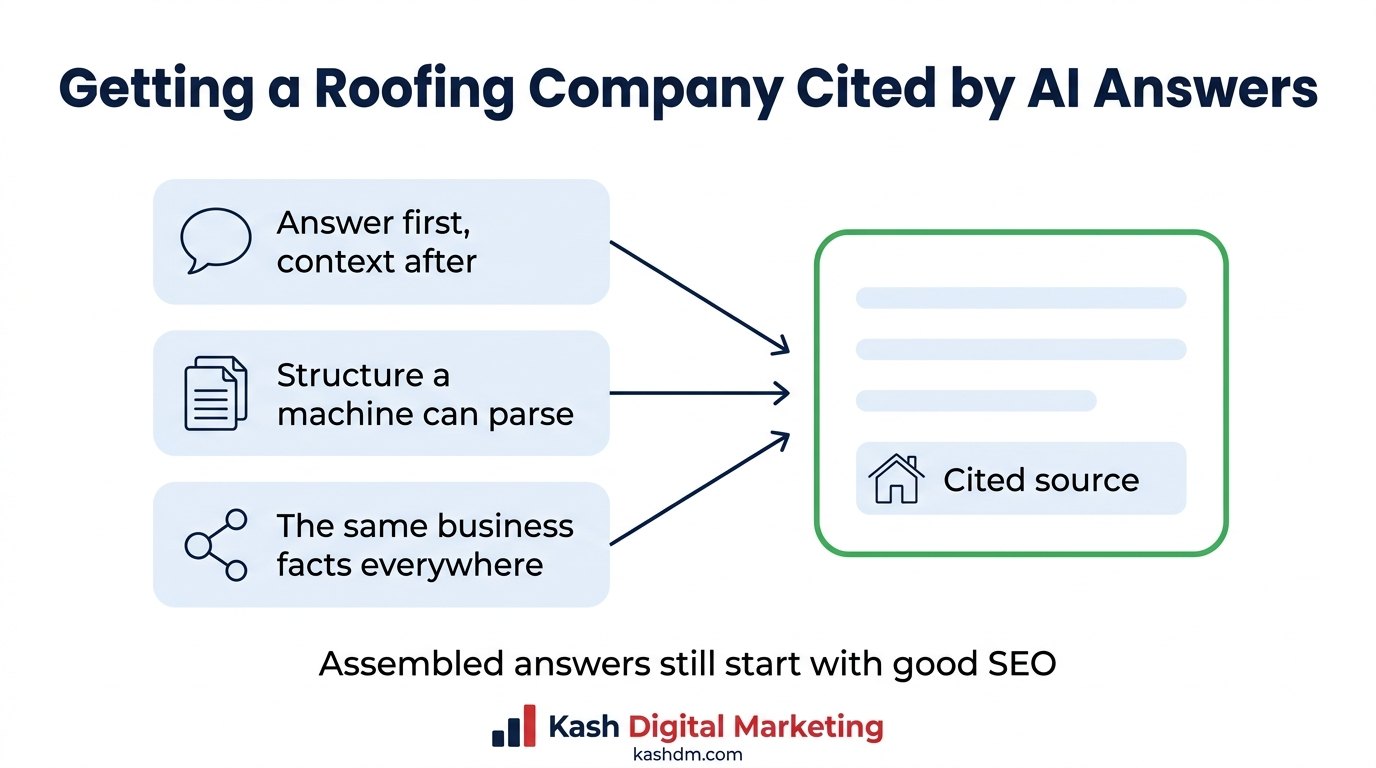
Answer the question in the first sentence
Content structured so that each heading is followed immediately by a direct, complete answer is far more likely to be quoted. Burying the answer three paragraphs into context is the single most common reason good content is passed over.
Experience, expertise, authority and trust
Named authors with real roofing credentials, licensing details, service-area clarity and content that reflects actual field experience. Generic content assembled from other websites is exactly what these systems are designed to filter out.
Structure that machines can parse
Clear heading hierarchy, short paragraphs, lists where lists are appropriate, tables for comparisons and schema markup describing what the page is. Structure is now a distribution decision as much as a design one.
Entity consistency across the web
Your business name, address, phone, services and profiles should agree everywhere. Systems assembling an answer about roofing companies in your city are resolving an entity, and contradictory information is a reason to omit you.
Original information cannot be summarized away
Field observations, regional code specifics, material behavior in your climate and process detail from real jobs are things no competitor can restate. Content that only repeats what is already published has nothing to be cited for.
Traditional rankings still underpin all of it
Being cited in a generated answer overwhelmingly correlates with ranking well conventionally. AI SEO is an additional layer on competent SEO, not a replacement for it, and anyone selling it as a shortcut is selling something else.
Roofing SEO Versus Paid Ads and Purchased Leads
SEO builds an asset the roofing company owns, while ads and purchased leads rent attention that stops the moment payment does. Most successful roofing contractors use both, but they should understand precisely which one they are buying.
Roofing is among the most expensive categories in paid search, and it is also the category most heavily targeted by lead resellers, which makes the distinction unusually consequential.
What paid search does well
Immediate visibility, precise control of geography and timing, and the ability to surge during a storm. For a new roofing company or a new market, it buys presence while SEO matures. It is a legitimate and useful channel.
What paid search does poorly
It stops instantly when the budget stops, costs rise as competitors bid, and during exactly the storm weeks when demand peaks, so does the price. Dependence on it means marketing cost scales with every job forever.
The problem with shared lead platforms
A purchased lead is typically sold to several contractors at once. You pay for the privilege of competing on price against companies that also paid, with a homeowner who did not choose any of you. Margin erodes from both directions.
Why an organic call is a different conversation
A homeowner who found you, read your reviews and chose to call has already made a preliminary decision. That call closes at a different rate and at a different price than a lead contacted by four companies in an hour.
The compounding difference
Every page, review and link keeps working after it is paid for. A page published this year still produces inspections in three years. Advertising produces nothing the day after it stops, and that difference compounds across a decade.
The sensible combination
Use paid to cover gaps and capture storm surges, build SEO so the baseline schedule does not depend on it, and measure both against booked jobs rather than clicks. The goal is not to eliminate ads but to stop being hostage to them.

Measuring Roofing SEO: Booked Jobs, Not Impressions
The only roofing SEO metrics that matter are calls, inspections booked, contracts signed and revenue by service line. Impressions, keyword counts and traffic graphs are diagnostic at best and decorative at worst.
If a report cannot connect the work to jobs on the schedule, it is not a report on business performance, and a roofing contractor is entitled to insist on the difference.
Calls and forms attributed to organic search
Call tracking and analytics should show which contacts came from organic search and from the Google Business Profile specifically. Without this attribution, every subsequent number is guesswork.
Inspections booked, not just contacts made
Roofing has a distinct middle step: the inspection or estimate visit. Tracking how many organic contacts become scheduled inspections isolates whether SEO is producing genuine opportunities or merely enquiries.
Contracts signed and revenue by service line
Repair, replacement, commercial and restoration have very different values. Reporting revenue by line shows which SEO work is actually paying and which is producing volume without margin.
Map pack visibility across the service area
Rankings vary by the searcher's location, so a single position number is misleading. Grid-based local visibility across your service area shows where you genuinely appear and where the next city page is needed.
Metrics that mislead
Traffic without a baseline, rankings for terms nobody searches, impressions, and percentage improvements quoted without a starting number. Each can be technically accurate and completely uninformative.
Seasonality has to be handled honestly
Comparing a storm month against a quiet one proves nothing. Roofing reporting should compare like periods year over year, or state plainly when weather rather than work explains the movement.
What Changes the Cost of Roofing SEO
Roofing SEO is priced by the size of the job, and the job is defined by your market's competitiveness, your service area, the state of your website and how many locations you run. Anyone quoting before looking at those four is quoting a package rather than your business.
We do not publish a price list for this reason. A single-city contractor with a healthy site and a five-metro company with a suspended profile are different jobs, and pretending otherwise serves the agency rather than the contractor.
Metro competitiveness
Roofing is fiercely contested in storm-prone metros, where dozens of established companies and out-of-state operators compete for the same terms. The same work costs more there because more of it is required to move.
The size of the service area
One city is a different scope from twelve. Every additional market needs its own page, its own local signals and its own review flow, and cost scales with genuine coverage rather than with claimed coverage.
The condition of your current website
A fast, well-structured site needs growth work. A slow site with duplicate city pages and indexation problems needs repair before growth work can produce anything, and that repair is real effort.
Number of locations and profiles
Each physical location needs its own Google Business Profile, its own landing page and its own review stream. Multi-location roofing companies gain the most from SEO and require the most coordination to get it.
Residential, commercial or both
Commercial requires a separate content track written for a different buyer. Companies doing both are effectively running two campaigns, and the scope should say so honestly.
Why we audit before we quote
The audit tells us which of the above actually apply to you. It is free, it is yours to keep, and it means the number we give you describes your situation rather than an average.

How Long Roofing SEO Takes
Profile corrections can move within weeks, long-tail city and service terms usually enter the top ten within two to four months, and competitive head terms take six months or longer. Anyone promising faster is describing a smaller starting point than yours or is not describing rankings at all.
Roofing has an additional complication: the season. Rankings earned in a quiet month prove themselves only when demand returns, which means judging the work requires patience the sales process rarely encourages.
Weeks: the profile and the obvious faults
Duplicate listings, wrong categories, missing services and unindexed pages are corrections rather than campaigns. They frequently produce the first movement, because most roofing companies are held back by something broken rather than something absent.
Two to four months: long-tail and city terms
Specific service-and-city combinations face thinner competition and move first. This is where a well-built city page earns its cost, and where the first attributable inspections usually appear.
Six months and beyond: head terms
"Roofing contractor [major metro]" and similar terms are contested by established companies with years of accumulated authority. Reaching them requires sustained content, links and reviews rather than a technical fix.
Why the season decides when rankings become revenue
A hail damage page that reaches position three in December proves nothing until spring. Ranking movement and revenue movement are separated by the weather, and honest reporting acknowledges the gap.
Your starting point changes everything
A company with a suspended profile, a slow site and no reviews has more available upside than one already ranking fifth, and will show larger gains for identical work. This is exactly why improvements quoted without a baseline mean nothing.
What to expect if you stop
Rankings decay rather than collapse. Content keeps working, reviews age, competitors keep publishing, and position erodes over quarters. It is an asset that depreciates slowly, unlike advertising which stops the same day.
Common Roofing SEO Mistakes
Most roofing companies are not failing at SEO because of something exotic. They are failing because of five or six predictable mistakes that appear on audit after audit. Every one of them is fixable.
We list them here because a contractor who recognizes three of these has just learned more about their situation than a sales call would have told them.
Depending entirely on paid advertising
Ads produce jobs while the budget runs and nothing afterward. A roofing company with no organic baseline is a company whose schedule is a direct function of monthly ad spend, permanently.
Mass-produced city pages
The most damaging and most common roofing mistake. Dozens of pages identical but for a city name get treated as duplicates and can hold back the pages that were working.
Thin service pages
Three paragraphs about roof replacement cannot compete with a page that genuinely explains the process. Roofing buyers are making a large decision and read carefully, and so does Google.
Ignoring the Google Business Profile
The asset producing the most calls is frequently the least maintained. Wrong category, no services listed, stock photos, unanswered reviews and duplicate listings are all common and all consequential.
A slow, image-heavy website
Roofing sites are photo-dependent by nature, and unoptimized galleries make them among the slowest in any trade. Mobile searchers with an active leak do not wait.
No internal linking
Pages published in isolation, linked from nowhere. Authority never flows between them and Google never learns which pages matter. This is usually the cheapest available improvement.
Not tracking anything that matters
Without call tracking and attribution, nobody can say whether the work is producing jobs. Contractors in this position usually cancel good campaigns and continue bad ones, because they have no way to tell them apart.
Stopping during the slow season
Cutting SEO in winter guarantees weak rankings in spring, because the work takes months to mature. The quiet season is when the next busy season is won.
How to Choose a Roofing SEO Company
Judge a roofing SEO company on its diagnosis, not its pitch, and ask four questions that a competent provider answers without hesitation. Hesitation on any of them is the answer.
We publish this checklist knowing it will be used on us, which is the point. A provider unwilling to be evaluated by the standard it recommends is not a provider worth hiring.
Which roofing contractors can I speak to directly
References you can actually call are the strongest evidence available. A provider with genuine results will connect you; one relying on an anonymous graph will find reasons not to.
What specifically happens in the first ninety days
A real answer names the audit, the profile work, the technical repairs and the first pages. A vague answer about strategy and optimization means there is no plan, only a retainer.
Who owns the website, the domain and the Google profile
Get it in writing. Agencies that build on their own platform can hold the entire asset hostage, and roofing contractors discover this at the exact moment they want to leave.
How do you report, and does it name booked jobs
Reporting on impressions and keyword counts is reporting on activity. Reporting on calls, inspections and contracts is reporting on business. Ask to see an example report before signing anything.
Warning signs worth walking away from
Guaranteed rankings, a fixed number of links per month regardless of need, long contracts, quotes given before any audit, and reluctance to explain what will actually be done. Any one of these is enough.
Specialist or generalist
An agency that has worked in roofing understands storm seasonality, insurance content and the map pack economics of a high-value trade. That is not a small advantage, and it is a fair question to ask directly.
How to judge a newer agency fairly
Judge the diagnosis. Request the free audit, see whether the findings are specific to your business or generic boilerplate, and check whether the recommended work matches the problems found. An agency that correctly diagnoses your site before being paid is demonstrating the exact skill you are hiring for.
What Our Roofing SEO Services Include
Our roofing SEO services cover the four things that decide whether a roofing company ranks: the Google Business Profile, the website's technical health, service, material and city page coverage, and local prominence. Every engagement includes all four, because fixing three and ignoring the fourth is how roofing contractors end up paying for SEO that never moves.
Google Business Profile management, not just setup
We audit and correct categories, services, service areas, hours and attributes, remove duplicate listings, and keep the profile active with real project photos and posts. This work continues every month, because this is the asset producing the map pack calls.
Technical repair before growth work
Mobile speed, Core Web Vitals, crawl and index errors, schema markup, redirect chains, duplicate city pages and broken internal structure. This comes first, because publishing onto a broken foundation is the most common way roofing budgets are wasted.
Service and material pages for every job you sell
Dedicated pages for repair, replacement, inspection, emergency tarping, storm restoration and gutters, plus material pages for the systems you actually install, each written to answer what a homeowner asks before calling.
City pages for the markets that produce revenue
Real local pages carrying the neighborhoods you cover, your response times, reviews from that city and roofs completed there, internally linked to the services available in each market. Never a template with the city name swapped.
Storm and insurance content built ahead of season
Hail, wind and claim content written and indexed before the season it serves, so it ranks at the moment demand spikes rather than arriving weeks late.
Reviews, citations and local links
Review generation your crews will actually use, citation cleanup across the directories that matter, and local link building through chambers, suppliers, manufacturer contractor directories and community sponsorship.
Reporting that names booked jobs
Monthly reporting on calls, form submissions, inspections booked and revenue by service line, with next month's priorities set by what the numbers show. If a month underperforms, the report says so and explains what changes.
| Included every month | What it produces |
|---|---|
| Google Business Profile management | Map pack visibility and direct calls |
| Technical monitoring and fixes | Pages that load fast and stay indexed |
| Service, material and city page build-out | Rankings for the jobs you want to sell |
| Storm and insurance content | Visibility when demand spikes |
| Review and citation work | Prominence, the third ranking factor |
| Local link building | Authority a competitor cannot copy quickly |
| Reporting on calls and booked jobs | Evidence instead of impressions |
Your First 90 Days of Roofing SEO With Us
We tell you exactly what happens in the first ninety days before you sign anything, because that is the question we tell contractors to ask every agency they consider. It would be a poor guide that refused to answer its own test.
Days 1 to 15, audit and diagnosis
We audit your Google Business Profile, technical health, current rankings, competitor positions and the gap between the cities you serve and the cities you rank in. You get the findings in plain language, and they are yours whether or not you continue with us.
Days 15 to 45, foundation repair
Duplicate listings removed, categories and services corrected, name, address and phone inconsistencies cleaned across directories, mobile speed fixed, duplicate city pages resolved and indexation errors cleared.
Days 45 to 75, coverage build
The highest-value service and material pages and the priority city pages get written and published, internally linked so the structure reads as genuine service-area coverage rather than a scatter of unrelated pages.
Days 75 to 90, prominence and first reporting
Review generation starts with your crews, citations get built out, storm and claim content goes into production ahead of season, and you receive the first full report showing calls, forms and inspections attributed to organic search.
What we need from you
Access to the website and Google profile, a list of the cities that actually produce revenue, project photographs as jobs complete, and crews willing to ask satisfied customers for a review. That is genuinely all.
Our Roofing SEO Process
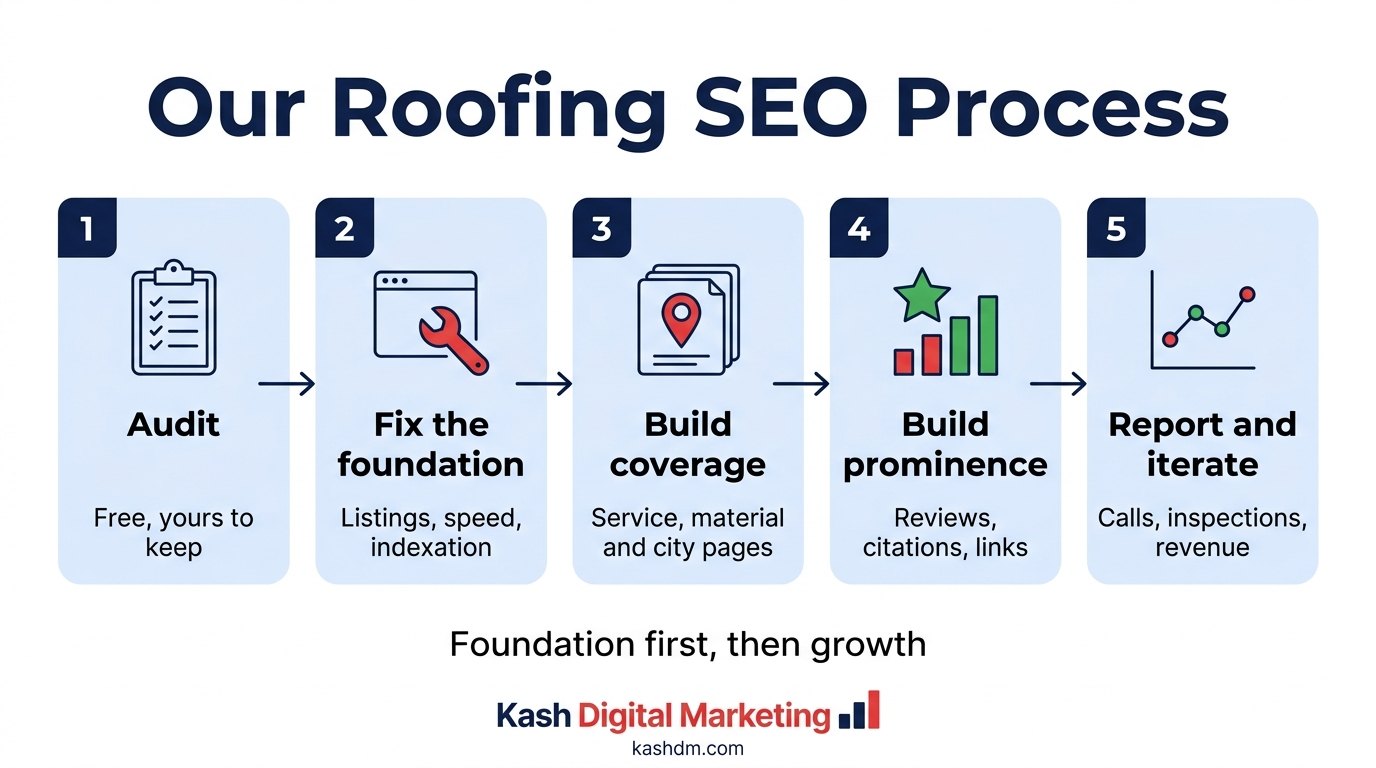
Our process runs in the same order every time, because the sequence is what makes it work: diagnose, repair, cover, build prominence, then report and iterate. Skipping ahead to content is the most common way roofing SEO fails.
Step one, audit
A full assessment of profile, technical health, content coverage, competitors and local visibility across your service area. Free, and yours to keep regardless of what you decide.
Step two, fix the foundation
Listings, speed, indexation, duplicates and structure. Unglamorous, frequently the source of the first ranking movement, and pointless to skip.
Step three, build coverage
Service pages, material pages and city pages in priority order, each written properly and linked into a structure that Google can read as genuine expertise across a service area.
Step four, build prominence
Reviews, citations and local links, accumulating month over month. This is the slowest signal and the one a competitor cannot buy their way past quickly.
Step five, report and iterate
Calls, inspections and revenue by service line, with the next month's priorities set from the numbers rather than from a fixed deliverable list.
Why Roofing Contractors Choose Kash Digital Marketing
We work the way we would want an agency to work for us: diagnose before quoting, no long contracts, plain reporting on booked jobs, and no promises about rankings nobody can guarantee. That is the whole pitch, and it is deliberately easy to verify.
We audit before we quote, not after
Most roofing marketing proposals arrive before anyone has looked at the Google profile or run a speed test. Ours arrives after. A five-city contractor with duplicate listings is a different job from a single-city contractor with a healthy site, and the quote should say so.
No long contracts
We keep clients by producing results, not by holding them to a twelve-month term. If we stop earning the work, you should be free to leave that month. Contracts that lock a contractor in for a year exist to protect the agency.
You own everything, during and after
Your website, your domain, your Google Business Profile, your content, and every citation and link we build. Some agencies build on their own platform, so leaving means starting from zero. If we part ways, you keep the entire asset.
White-hat only, because a penalty costs more than a ranking
No purchased links, no manufactured reviews, no keyword stuffing, no private blog networks. Roofing is a category Google scrutinizes closely, and a contractor with a long local reputation has too much at stake to gamble it.
Reporting that names booked jobs
You get calls, form fills, inspections booked and revenue by service line. Impressions and keyword counts appear nowhere in our reporting, because a contractor cannot deposit an impression.
We usually reply within an hour, and always within 8 hours
Roofing runs on urgency and so do we. Audit requests get a response usually within an hour, and always within 8 hours during business hours, which is also a fair preview of what working together looks like.
We will tell you when SEO is not the answer
If your Google profile is suspended, your phone goes unanswered during storm weeks, or your service area is too small to support the investment, we will say so rather than sell you a retainer.
| How roofing marketing is often sold | How we work |
|---|---|
| Quoted from a package sheet | Free audit first, then a scoped quote |
| Twelve-month contract | No long contracts |
| Agency owns the site or the profile | You own every asset |
| Rankings guaranteed | No guarantees, documented method instead |
| Reporting on impressions and rankings | Reporting on calls and booked jobs |
| Fixed number of links per month | Work chosen by what the audit found |
Roofing Companies We Work With
We work with residential and commercial roofing contractors across the United States, from single-crew operations to multi-location companies covering several metros. The strategy changes considerably between them.
Single-location residential roofers
The most common case and often the fastest to move. One profile, a strong service-area structure, genuine city pages and consistent reviews will outrank larger competitors who never did the basics properly.
Multi-location and multi-metro roofing companies
Each location needs its own profile, its own landing page and its own review stream. Coordinating that across markets is a process problem before it is a marketing problem, and it is where an outside team usually earns its cost several times over.
Storm restoration specialists
Companies built around storm response need content ranked well ahead of season and a local reputation strong enough to outrank the out-of-state crews who arrive after an event. Both are long-lead work by nature.
Commercial and industrial roofing contractors
Separate pages, separate keywords and proof aimed at facilities managers rather than homeowners: systems installed, certifications, response-time commitments and maintenance contract terms.
Roofing companies with siding, gutters or solar
Parallel page structures for each trade, a profile whose primary category reflects the dominant revenue line, and shared review and citation strength working across several verticals at once.
Newer roofing companies building from zero
No rankings, few reviews and no citation history is a real disadvantage, and also the cleanest starting point, because nothing has to be undone first. Long-tail city terms are usually winnable within the first few months.
What Realistic Roofing SEO Results Look Like
Realistic roofing SEO results follow a predictable shape: profile and long-tail movement within the first two months, city and service terms from month three, and competitive head terms from month six onward. Anyone showing you a faster curve is showing you a smaller starting point than yours.
What moves first, and why
Google Business Profile corrections move fastest because the profile is re-crawled constantly and most roofing contractors have obvious errors sitting in theirs. Duplicate listings, a wrong primary category or missing services can suppress a profile for years and take days to fix.
What a normal ranking curve looks like
Long-tail city and service terms enter the top ten first, because competition on them is thin. Head terms follow much later. The curve is slow, then compounding, which is the opposite shape of paid advertising.
Why job volume lags ranking movement
Ranking third instead of eleventh changes visibility immediately, but weather and season decide when those rankings convert into signed contracts. A hail damage page that reaches position four in November proves nothing until spring.
Results depend on your starting point, not just the work
A contractor with a suspended profile, a four-second website and no reviews has more available upside than one already ranking fifth, and will show larger percentage gains for identical work. This is exactly why percentages quoted without a baseline are meaningless.
How to verify any roofing SEO provider's results claims
Ask what the starting position was, over what timeframe, in which metro, and what else changed during the period. Ask to speak to the contractor named in the case study. A provider confident in genuine results answers all four without hedging.
| Claim you might be shown | What to ask before believing it |
|---|---|
| Traffic up 400% | Up from what number, over how long? |
| Ranked #1 in 30 days | For which term, in which city, at what volume? |
| 200 new leads | Leads, inspections or signed contracts? |
| Case study with no name | Can I speak to that contractor directly? |
Our Position on Case Studies and Client Privacy
Kash Digital Marketing is a growing agency, and we publish no roofing case studies yet because we will not invent them. This page argues that contractors should demand verifiable proof, and it would be worthless if we broke that rule ourselves on our own page.
Why there are no roofing case studies on this page
We would rather tell you plainly that our roofing portfolio is still being built than publish a stock graph and an unnamed client. Every claim here is a claim about method, not about results we cannot evidence. When we have roofing results worth publishing, they will appear here with the starting baseline, the timeframe and the work performed.
Client privacy when we do publish
Client work is published only with written permission. Many contractors would rather competitors in their own metro not know who handles their search visibility, and that preference is entirely reasonable in a market where several companies fight for the same map pack slots. Where a client prefers anonymity, we publish the metro size, the timeframe and the mechanism, and omit the name.
What you can verify about us today
Our method is documented in full on this page, including the ninety-day plan, what is included every month and what we report. You own every asset we build, there is no long contract, and the audit that starts the relationship is free and yours to keep. Those are commitments you can test cheaply before committing anything meaningful.
Roofing SEO Across the United States
We provide roofing SEO services to contractors in every US state and metro, and the strategy shifts with the local climate, building codes and competitive density. A roofing market is defined by its weather as much as by its population.
Hail alley and the storm-driven metros
Denver, Dallas–Fort Worth, Oklahoma City, Kansas City, San Antonio and the Front Range generally. Storm and hail content, insurance claim coverage and pre-season ranking matter more here than anywhere else in the country.
Hurricane and high-wind coastal markets
Florida, the Gulf Coast and the Carolinas, where wind uplift requirements, code compliance and post-hurricane demand shape both the work and the search behavior around it.
Snow, ice and freeze-thaw markets
The upper Midwest, New England and the mountain states, where ice dams, snow load and ventilation drive a search pattern concentrated in late autumn and winter.
Sun, heat and tile markets
Arizona, Nevada, southern California and much of Texas, where UV exposure, tile systems and cooling performance dominate the material conversation.
Dense metros and competitive saturation
Los Angeles, Chicago, Houston, Phoenix, Atlanta and comparable markets carry dozens of established roofing companies competing on the same terms. Success here depends on neighborhood-level targeting rather than city-level.
Small metros and rural service areas
Lower competition, lower volume and a much shorter path to visibility. Contractors in these markets frequently see the fastest results in the whole category, because the basics done properly are enough to lead.
Get Your Free Roofing SEO Audit
Request Your Free SEO Audit
Prefer to talk it through? WhatsApp US +2135622433 or WhatsApp PK +92 348 3879366. We usually reply within an hour, and always within 8 hours.
Your free roofing SEO audit shows where you rank now, what is holding you back, and what a competitor is doing that you are not, and it is yours to keep whether or not you work with us. There is no obligation and no catch.
What the audit covers
Your current rankings for core service, material and city terms, an assessment of your Google Business Profile, technical and mobile speed issues, competitor positions in your metro, and the gap between the cities you serve and the cities you actually rank in.
What you receive
A plain-language document naming specific problems and the order in which they should be fixed. Not a template, and not a sales deck with your logo on it.
What happens next
If the findings suggest we can help, we scope the work and quote it. If they suggest something other than SEO is your bottleneck, we will tell you that instead. Either way the audit is yours.
How to request it
Send us your website and the cities you serve. We usually reply within an hour, and always within 8 hours during business hours, which is also a fair preview of how we communicate once we are working together.
Roofing SEO FAQs
These are the questions roofing contractors ask us most often, answered directly. If yours is not here, ask it and we will answer it plainly.
How long does roofing SEO take to work?
Profile corrections can move within weeks. Long-tail city and service terms usually enter the top ten within two to four months, and competitive head terms take six months or more. Roofing adds a seasonal layer: rankings earned in a quiet month prove themselves when demand returns, so the work is judged over quarters rather than weeks.
How much does roofing SEO cost?
It depends on your metro's competitiveness, how many cities you serve, the condition of your current website and how many locations you run. We do not publish a package price because those four factors change the job substantially. We audit first, then quote the actual work.
Is local SEO different from regular SEO for roofers?
Yes. Local SEO focuses on the map pack, Google Business Profile, service-area coverage and proximity signals, because nearly every valuable roofing search carries local intent. Regular SEO still applies to the website, but on its own it will not win the three-result map pack where most roofing calls originate.
What are the best keywords for a roofing company?
The ones combining a service, a location and buying intent: "roof replacement cost Austin," "emergency roof repair near me," "hail damage roof inspection," "metal roof installation." These have lower volume than "roofing" and convert far better because the searcher is ready to act.
Do I need a separate page for every city I serve?
For the cities that genuinely produce revenue, yes. Each needs real local content: neighborhoods covered, response times, local reviews and roofs completed there. Templated pages that only swap the city name get treated as duplicates and can hold back the rest of the site.
How important is my Google Business Profile?
It is the single highest-return asset in roofing SEO. It decides the map pack, which sits above organic results and carries a call button. Most roofing contractors have fixable errors in theirs right now, and correcting them is usually the fastest movement available.
Does roofing SEO work for storm and hail damage leads?
Yes, but only if the content is built before the storm. Demand spikes within hours and decays within days, while rankings take months. Companies already ranked capture the surge; companies that start reacting when the storm hits are too late for that event.
Should I write content about insurance claims?
Yes, and it is the most underused opportunity in roofing SEO. Homeowners navigating a first claim search heavily and find little useful guidance. Content should educate about the process, never coach anyone toward misrepresentation, and note that deductible rules vary by state.
Can roofing SEO help with commercial work, not just residential?
Yes, but commercial needs its own pages and keywords. Facilities managers search for systems like TPO and EPDM, research during business hours, and need proof such as project types, certifications and response-time commitments. Serving them from residential pages usually wins neither audience.
Should roofing companies do SEO or Google Ads?
Most successful contractors run both. Ads buy immediate visibility and cover storm surges while SEO matures, and SEO reduces dependence on paid channels over time. The difference is that SEO builds an asset you own, while ads stop producing the moment the budget stops.
Are purchased roofing leads worth it?
They work as a supplement and fail as a foundation. Shared lead platforms resell the same homeowner to several contractors, so you pay to compete on price with companies that also paid. Organic search delivers a caller who chose your company specifically.
How do reviews affect roofing rankings?
Heavily. Volume, recency, rating and your replies all feed the prominence signal behind map pack rankings, and roofing buyers read them unusually carefully before spending a large sum. Never buy reviews; the risk ranges from filtered reviews to a suspended profile.
What makes Kash Digital Marketing different from other roofing marketing agencies?
Three things you can verify before paying us anything. We audit before we quote instead of selling from a package sheet, we do not use long contracts, and you own your website, domain, Google Business Profile and every asset we build. Our reporting names calls and booked jobs rather than impressions.
Do you work with roofing contractors in my state?
Yes. We work remotely with roofing contractors in every US state and metro, from single-crew operations to multi-location companies. SEO does not require a local office, and what matters far more is understanding your market's climate, codes and competition, which we research per client.
What do I get in the free roofing SEO audit, and is there a catch?
You get your current rankings for core service and city terms, an assessment of your Google Business Profile, technical and mobile speed issues, competitor positions in your metro, and the gap between the cities you serve and the cities you rank in. No catch and no obligation. The findings are yours to act on yourself or with another provider.
How do I know a roofing SEO company is not just taking my money?
Ask for contractor references you can actually call, ask what specifically happens in the first ninety days, confirm in writing who owns the website and Google profile, and require reporting that names booked jobs. Any provider that hesitates on those four has answered the question. We publish our own ninety-day plan on this page for exactly that reason.
Can you get my roofing company into the Google map pack?
We can do the work that map rankings actually respond to: profile optimisation, service-area configuration, review generation, citations, local links and location content. What we will not do is promise you a map pack position, because Google decides that and proximity to the searcher is a factor nobody controls. Be wary of anyone who does promise it, because in roofing that promise is usually backed by fake listings or bought reviews, and both end in a suspended profile.