Kitchen remodeling SEO is the work that puts a remodeling company in front of homeowners while they are researching a kitchen project, so the consultation request comes to you instead of to a competitor or a lead marketplace. At Kash Digital Marketing, our kitchen remodeling SEO services combine Google Business Profile optimization, cost and design content, city pages, portfolio galleries built to rank, review generation and technical site work into one system aimed at booked consultations rather than traffic.
Kitchen remodeling sits at an unusual intersection. It is the highest-value project most remodelers sell, the decision takes weeks or months rather than minutes, and it is judged almost entirely on photographs. A homeowner will read cost articles, scroll galleries, compare three companies and request two estimates before anyone signs anything.
That long, visual, high-consideration journey is exactly what generic SEO advice fails to address. Ranking for "kitchen remodeling" alone does very little. Owning the cost question, the design search, the before-and-after gallery and the map pack in your metro is what fills a consultation calendar.
This page is a complete guide to kitchen remodeling SEO across the United States, written so you can evaluate any provider, including us, against a real standard. It covers how homeowners search, why portfolio and cost content outperform service pages, how to stop renting leads from marketplaces, what the work costs and how long it takes.

What Kitchen Remodeling SEO Actually Is
Kitchen remodeling SEO is the process of optimizing a remodeling company's website, Google Business Profile and local signals so the business appears when homeowners search for kitchen remodelers, remodeling costs, design ideas and completed projects in their area. It differs from generic SEO because the buying cycle is long, the decision is visual, and the job value is high enough that a handful of extra consultations changes the year.
Most homeowners planning a kitchen are not ready to hire on the first search. They are gathering information, forming a budget expectation and building a shortlist. SEO for this industry has to meet them early and stay useful until they are ready.
The three places a remodeler can appear
Paid ads sit at the top, the local map pack shows three businesses on a map beneath them, and organic results follow. Kitchen remodeling SEO targets the second and third, plus the image results that this industry uniquely depends on.
Why remodeling search is local and visual at once
A remodeler in Charlotte competes with remodelers in Charlotte, and competes on photographs. Google resolves the commercial queries geographically, and homeowners resolve the shortlist by looking at kitchens. Both have to be addressed or the campaign underperforms.
The three halves of the work, not two
Most trades have two: the profile and the website. Remodeling has a third, the portfolio, which drives image search, supports the map pack and does most of the persuading. Treating galleries as decoration rather than as ranking assets is the most common structural mistake in this industry.
What kitchen remodeling SEO is not
It is not ranking for one head term. It is not stuffing city names into a footer, and it is not buying links. It is also not a project that finishes, because competitors keep publishing and Google keeps re-evaluating.
How a search becomes a signed project
A homeowner searches a cost question, finds your article, browses your gallery, checks your reviews, sees you in the map pack a week later, and requests a consultation. Every step in that chain is something SEO work can improve, which is why the discipline should be judged on booked consultations rather than rankings.

Why Kitchen Remodelers Depend on Search More Than Most Contractors
A kitchen is typically the largest single project a remodeling company sells, and almost every one of them starts with a search rather than a referral. The value of a single additional project makes remodeling SEO arithmetic unlike almost any other local service.
One kitchen can be worth more than dozens of jobs in a service trade. That changes what a modest ranking improvement is worth, and it changes how much competition you should expect.
The job value makes each ranking position expensive to lose
Moving from position eight to position three on a handful of commercial terms can change the number of consultations meaningfully, and each consultation carries a large contract value behind it. This is why remodeling search is contested so heavily.
Referrals arrive slowly and do not scale with crew capacity
Referrals happen, and they are excellent, but they are unpredictable and they do not grow when you add a second crew or a designer. Companies that expand discover this quickly, and search becomes the difference between a full calendar and idle capacity.
Homeowners research for weeks before contacting anyone
The window to influence a decision is long, which is a disadvantage for advertising and an advantage for content. A cost article read in March can produce a consultation in June, and nothing about paid media works that way.
Trust has to be established before the first conversation
A homeowner about to spend a large sum with a stranger who will occupy their home for weeks is looking for reassurance. Reviews, real project photography, licensing details and a professional website do that work before anyone picks up the phone.
Visibility compounds where advertising does not
Every gallery page, review and cost article keeps working after it is paid for. A well-built project page produces enquiries for years, while a paid campaign stops producing the day the budget stops.
How Homeowners Actually Search for a Kitchen Remodeler
Homeowners move through four distinct search stages before hiring a remodeler, and each one needs different pages on your website. Building only for the last stage, which is what most remodeling sites do, forfeits the audience while it is still forming a shortlist.
Understanding these stages is the difference between a site that ranks for terms nobody valuable types and one built around how remodeling customers actually behave.
The inspiration stage
No budget yet, no timeline, no shortlist. Searches are about ideas: "modern kitchen remodel ideas," "small kitchen layouts," "open concept kitchen." These convert poorly today and enormously over a year, and they are how a remodeler builds the authority that lifts commercial pages.
The cost stage
The most important stage in the entire journey. "How much does a kitchen remodel cost," "kitchen remodel cost [city]," "cost to replace kitchen cabinets." The homeowner is forming a budget and deciding whether the project is possible at all.
The comparison stage
Now they are choosing between approaches and materials: "cabinet refacing vs replacement," "quartz vs granite," "custom vs semi-custom cabinets," "remodel vs renovation." This is where expertise is demonstrated rather than claimed.
The hiring stage
Shortlist time: "kitchen remodeler near me," "best kitchen remodeling company [city]," "kitchen remodeling contractor [city]," plus a great deal of gallery browsing and review reading. This is the smallest volume and the highest intent.
Why stage determines page type
Inspiration needs galleries and design content. Cost needs honest, locally specific cost pages. Comparison needs genuinely useful explainers. Hiring needs service pages, city pages, reviews and an easy consultation request. One services page cannot serve four different readers.

Owning Your Leads Instead of Renting Them
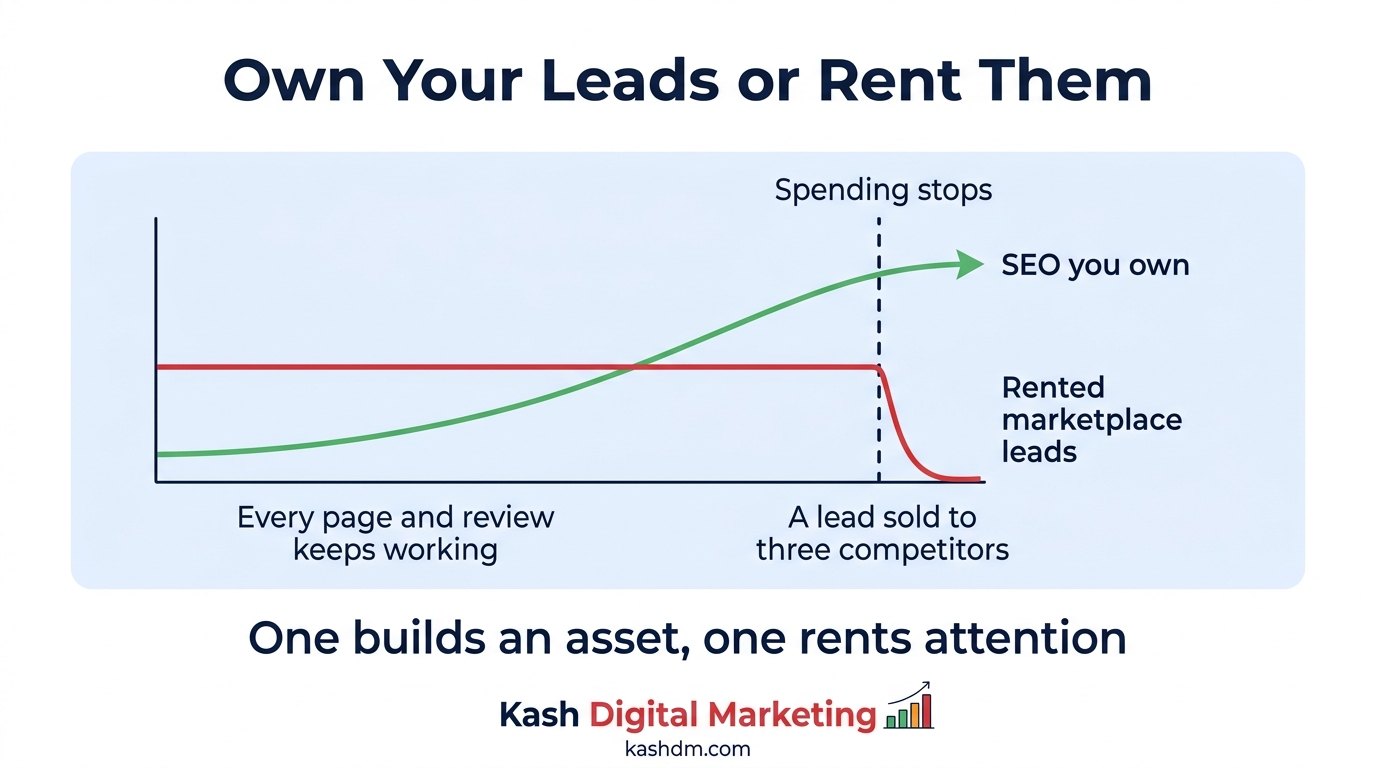
Marketplace platforms rent you access to a homeowner who did not choose your company, while SEO builds an asset that sends you homeowners who did. Most established remodelers use both, but they should understand precisely which one they are buying.
Remodeling is among the most heavily targeted categories by lead resellers, and the economics deserve to be stated plainly rather than argued emotionally.
What the marketplaces genuinely do well
They produce volume quickly, they require no ramp-up period, and for a new company with no rankings and no reviews they are a legitimate way to fill a calendar while other channels mature. There is no advantage in pretending otherwise.
The structural problem with shared leads
A shared lead is typically sold to several contractors at once. You pay for the privilege of competing on price against companies that also paid, with a homeowner who chose none of you. Margin erodes from both directions at once.
Platforms change their terms and you do not control it
Marketplaces reprice, restructure and reposition their lead products on their own schedule. A channel that can change its economics without asking you is a channel your business should not depend on entirely.
Why an organic enquiry is a different conversation
A homeowner who found your cost article, browsed your gallery, read your reviews and then requested a consultation has already made a preliminary decision. That conversation starts from a different place than one with a homeowner contacted by four companies in an hour.
The compounding difference
Every gallery, review and article keeps working after it is paid for. Marketplace spending produces nothing the day after it stops, and that difference compounds across a decade of operating.
The sensible combination
Use marketplaces and paid search to cover gaps and fill capacity, build SEO so the baseline calendar does not depend on them, and measure every channel against signed projects rather than lead count. The goal is not to eliminate paid channels but to stop being hostage to them.
Local SEO and the Map Pack for Kitchen Remodelers
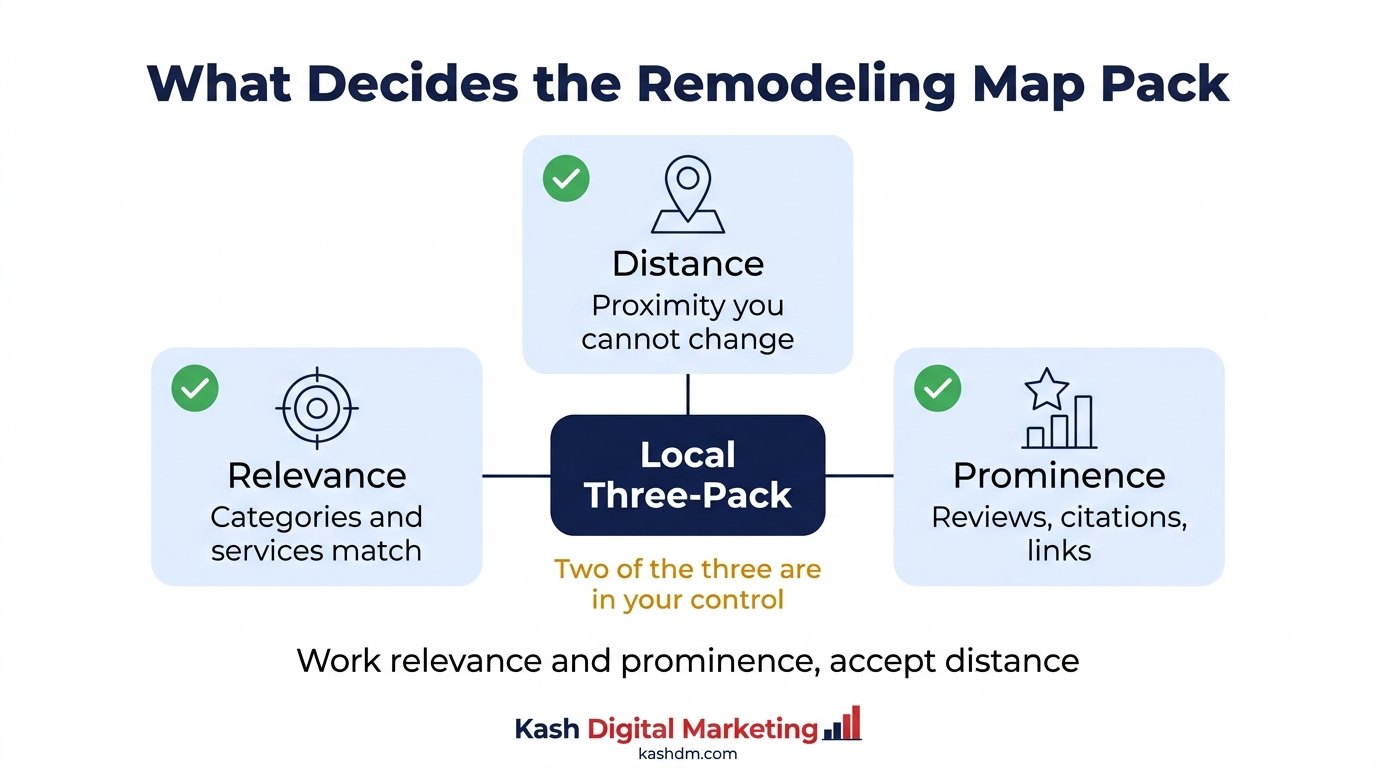
The three-result map pack sits above organic listings and produces a large share of the consultation requests most remodelers receive, and Google ranks it on relevance, distance and prominence. Only two of the three are within your control.
Knowing which two is the fastest way to stop wasting effort on the one that is not.
Relevance: does Google understand what you do
Relevance comes from your profile categories, your listed services and your website content. A company listed under a broad contractor category rather than a kitchen remodeling category is telling Google something vague about a specific business, and it ranks accordingly.
Distance: the factor you cannot change
Google favours businesses near the searcher. You cannot relocate to every suburb you serve, and you must never fake an address, which is a suspension risk. What you can do is compete harder on the other two and build genuine local content for target areas.
Prominence: the factor most remodelers neglect
Prominence is how established the business appears, built from reviews, citations, links and mentions. It is the slowest signal to build and the hardest for a competitor to copy quickly, which makes it the most durable advantage available.
Why the map pack matters even for a long decision
Homeowners return to search several times across a project's research phase. Appearing in the map pack repeatedly across those visits builds familiarity that a single organic listing does not, and familiarity is what produces the shortlist.
Showrooms, offices and service-area businesses
Remodelers with a showroom should use the address. Those working from an office or home should configure a service-area business with the address hidden and service areas defined. Handling this incorrectly is a common cause of profile suspension.
One profile cannot cover an entire metro
A single profile ranks strongly near its own location and weakens with distance. Covering a wide metro means building real local relevance through city pages, local links and reviews naming those areas, rather than expecting one pin to reach across a county.
Google Business Profile Optimization for Kitchen Remodelers
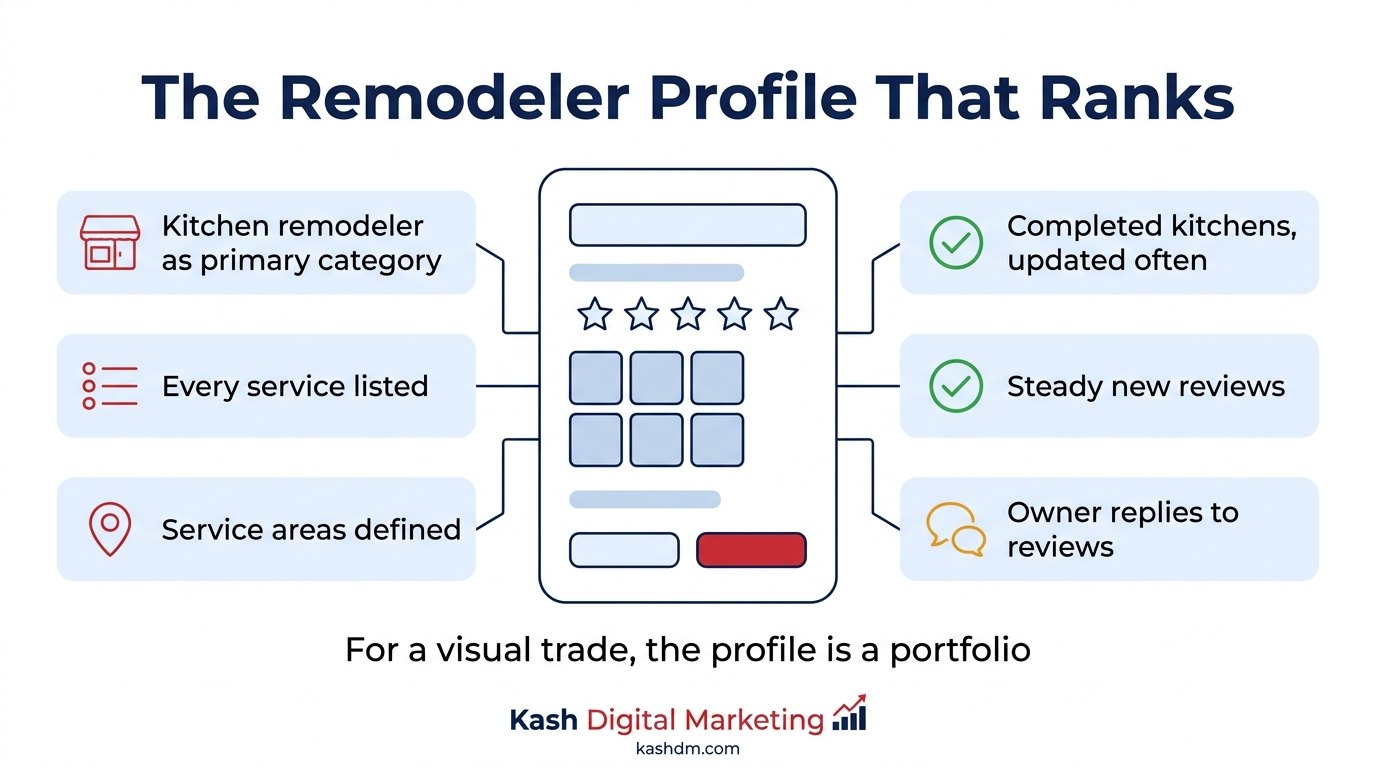
Your Google Business Profile is the highest-return asset in kitchen remodeling SEO, and for a visual trade it doubles as a portfolio that many homeowners see before your website. It is also the fastest-moving part of the job, because Google re-crawls profiles constantly.
This is where we start with almost every remodeling client, because it is common to find years of lost enquiries traceable to a category setting, an empty services section or a gallery nobody has updated.
Primary category decides more than anything else
"Kitchen Remodeler" is correct for most specialists. General contractor, bathroom remodeler, cabinet maker, countertop installer and interior designer belong in secondary categories where you genuinely offer them. Getting the primary wrong is the single most expensive setting error available.
List every service you actually sell
Kitchen remodeling, kitchen design, cabinet installation and refacing, countertop installation, island construction, lighting and layout changes. Each entry is a relevance signal, and an empty services section tells Google almost nothing about a business that does a great deal.
The profile gallery is a portfolio, not an afterthought
For a visual trade this is the strongest asset on the profile. Completed kitchens, before and after pairs, work in progress and your team, added regularly rather than once. A profile with a stale gallery reads as a business that has stopped working.
Duplicate listings quietly suppress everything
Duplicates are common in remodeling, created by previous marketing agencies, former business names or directory scrapers. They split reviews across two profiles and can suppress both. Finding and merging them is often the highest-value hour of an engagement.
Products, posts and the profile as a living asset
Google Posts, a seeded and answered questions section and regular photo uploads all signal an active business. Profiles left untouched for a year drift down against competitors who maintain theirs, regardless of how good the underlying company is.
Never manipulate the business name
Adding keywords to the business name field is a violation, it is reported by competitors routinely, and the penalty ranges from a filtered listing to suspension. An established remodeler has far too much to lose.
Kitchen Remodeling Keyword Research
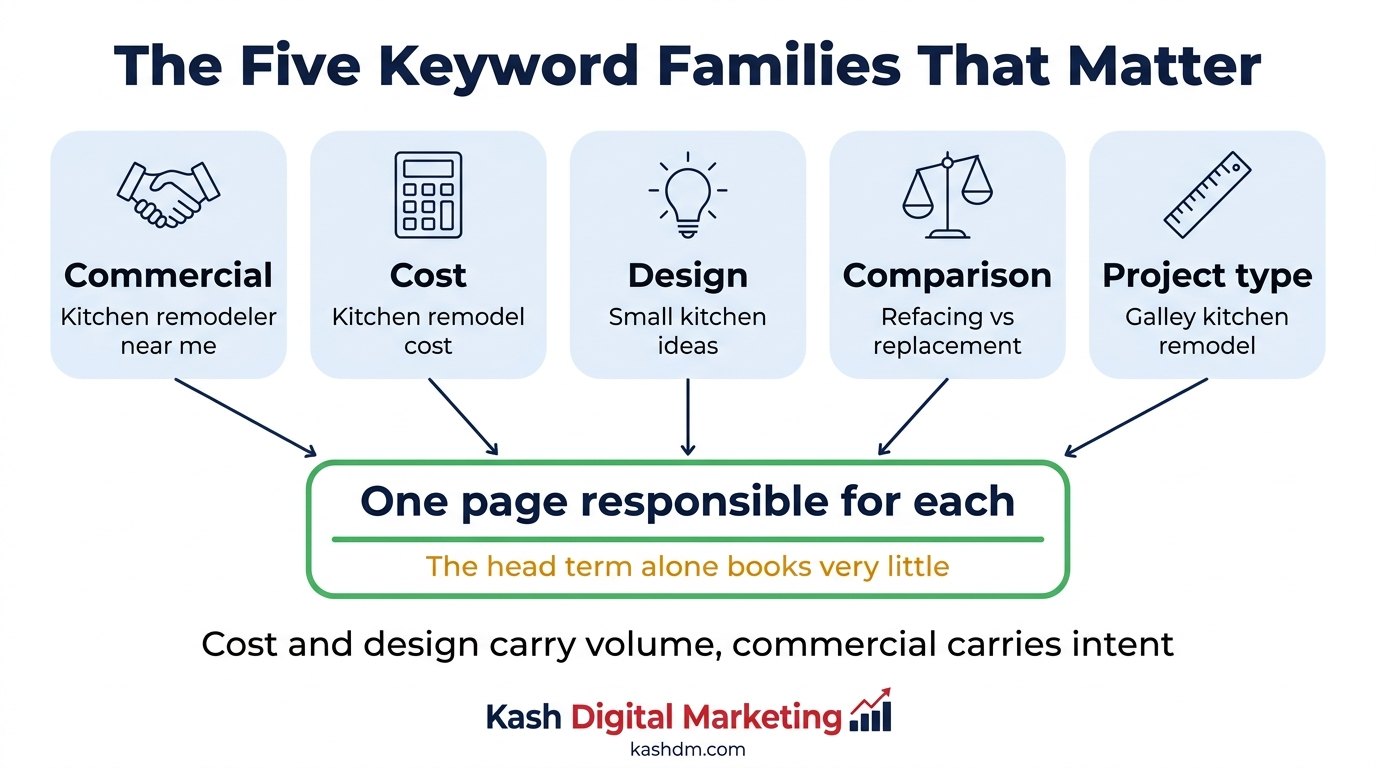
The kitchen remodeling keywords worth ranking for split into four families, and only one of them is the head term everybody asks about. "Kitchen remodeling" carries enormous volume and produces relatively few consultations on its own. Cost, design, comparison and city terms produce most of the pipeline.
Chasing head-term volume rather than intent is the most common way remodeling marketing budgets are wasted, and it is easy to spot in a report full of impressive traffic and a quiet consultation calendar.
Commercial and hiring terms
"Kitchen remodeler near me," "kitchen remodeling company [city]," "kitchen remodeling contractor [city]," "best kitchen remodeler [city]," "custom kitchen remodeling." Lowest volume, highest intent, most contested, and heavily weighted to the map pack.
Cost and budget terms
"Kitchen remodel cost," "kitchen remodel cost [city]," "cost to replace kitchen cabinets," "average kitchen renovation cost," "small kitchen remodel cost." Very high volume, genuine buying intent, and the single largest content opportunity in this industry.
Design and inspiration terms
"Modern kitchen remodel ideas," "small kitchen remodel ideas," "kitchen layout ideas," "open concept kitchen," "farmhouse kitchen design." Enormous volume, early stage, and the primary route into image search results.
Comparison and material terms
"Cabinet refacing vs replacement," "quartz vs granite countertops," "custom vs semi-custom cabinets," "kitchen remodel vs renovation." Mid-funnel, low competition from other remodelers, and the easiest place to demonstrate genuine expertise.
Project-type and scope terms
"Small kitchen remodeling," "luxury kitchen remodeling," "galley kitchen remodel," "kitchen island installation," "cabinet refacing." These match the specific job a homeowner has in mind and convert far better than the generic term.
Adjacent remodeling terms
Most kitchen remodelers also sell bathrooms, basements and whole-home work. Those keyword families deserve their own pages rather than being crammed into the kitchen page, and they strengthen the site's overall topical authority.
Keywords worth deliberately ignoring
DIY queries from homeowners who will never hire anyone, materials you do not install, cities you cannot serve, and national terms with no local intent. Ranking for these produces healthy-looking traffic and an empty calendar.
Cost Content: The Most Valuable Page You Are Not Writing
"How much does a kitchen remodel cost" and its local variants are the highest-value searches in this industry, and most remodeling websites refuse to answer them. The company that answers honestly earns the trust of a homeowner at exactly the moment they are deciding whether to proceed at all.
The reluctance is understandable. Every kitchen is different and nobody wants to be held to a number. But refusing to engage sends the homeowner to a national cost calculator that knows nothing about your market, and you lose the relationship before it starts.
Why remodelers avoid this and why that is a mistake
The fear is being quoted back a figure and losing flexibility. The reality is that homeowners will find a number regardless, and it is better that it comes from a local expert who can explain what drives it than from a generic national estimate.
How to publish cost content without quoting a price you regret
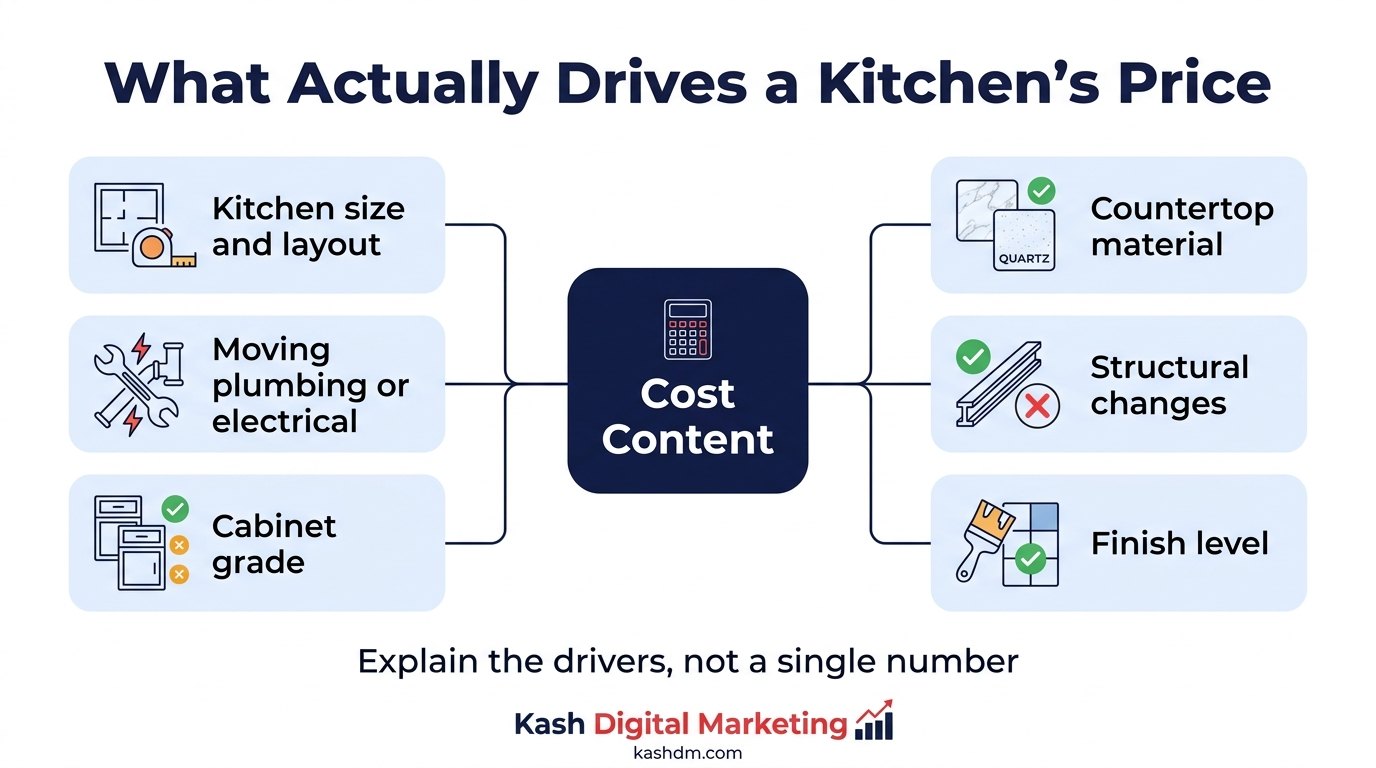
Explain what drives cost rather than promising a figure: kitchen size, layout changes, whether plumbing or electrical moves, cabinet grade, countertop material, appliance level and finish quality. Ranges tied to scope are defensible in a way a single number is not.
Local cost content beats national cost content
Labour rates, permit requirements and material availability vary by metro. A cost page written for your specific market is more useful than any national average, and it is the version that ranks for the city-modified searches.
Cost by project type
Small kitchen, galley kitchen, full gut renovation, cabinet refacing only, countertop replacement only, layout change with wall removal. Each is a distinct search and a distinct budget conversation.
What changes the price, explained honestly
Moving plumbing, relocating gas, electrical upgrades to code, structural changes, subfloor problems discovered mid-project and custom cabinetry. Explaining these in advance both ranks and prevents difficult conversations later.
Financing and payment as content, not a footnote
For a purchase of this size, financing availability is a genuine decision factor. Stating plainly what options exist removes a barrier that otherwise stops a homeowner from enquiring at all.
Cost content is how you set expectations before the consultation
A homeowner who arrives at your consultation already understanding what drives the price is a better conversation and a shorter sales cycle. The article does part of the selling before anyone meets.
Portfolio and Before-and-After Gallery SEO
In kitchen remodeling the portfolio is a ranking asset, not a decoration, and most remodelers waste it by dumping every photograph into one undifferentiated gallery page. Structured properly, project pages rank, earn links and do most of the persuading before anyone contacts you.
This is the single largest opportunity that separates remodeling SEO from every other local trade. No amount of service-page copy substitutes for organised, searchable proof of work.
One page per project, not one page for everything
A single gallery holding sixty photographs ranks for nothing in particular. Individual project pages, each covering one kitchen with its own narrative, rank for the style, the scope and often the neighbourhood.
What belongs on a project page
Before and after photography, the scope of work, the layout change, the materials and finishes chosen, the challenge the kitchen presented, roughly how long it took, and the area it was in. This is content no competitor can copy.
Galleries organised by style, not by date
Modern, traditional, transitional, farmhouse, contemporary. Homeowners search by style and browse by style. A chronological dump serves neither the searcher nor the search engine.
Galleries organised by scope and kitchen type
Small kitchen, galley, U-shaped, open concept conversion, island addition, cabinet refacing only. These match how homeowners describe their own kitchen and how they search for examples of it.
Before and after is proof-seeking content
"Kitchen remodel before and after" is searched by homeowners who want to see transformation rather than read claims. It deserves its own destination that links onward to service and cost pages.
Photograph quality is a ranking factor by proxy
Poor photography reduces time on page, reduces sharing, reduces links and reduces enquiries. Professional photography of completed kitchens is one of the highest-return marketing investments a remodeler can make, and it feeds every channel at once.
Client permission and privacy
Photograph and publish only what the homeowner has agreed to. Many clients are happy for the kitchen to appear and not the address or their name. Publishing the work while omitting identifying detail respects that and loses nothing.

Image SEO and Winning the Image Results
Kitchen remodeling is one of the few local industries where image results drive genuine enquiries, and almost nobody optimises for them properly. A homeowner searching for kitchen ideas is browsing pictures, and every one of those pictures is a potential entry point to your site.
Image optimisation here is not a technical afterthought. It is a distribution channel.
Descriptive filenames before upload
A file named for what it shows carries meaning that a camera's default name does not. This is a thirty-second habit at upload time that compounds across hundreds of photographs.
Alt text that describes the kitchen, not the keyword
Alt text exists to describe the image to someone who cannot see it. Written properly it happens to contain the relevant terms naturally. Written as a keyword list it fails both purposes and reads as manipulation.
Compression without destroying the photography
Remodeling sites are heavy by nature because photographs are the product. Modern formats and correct dimensions cut weight dramatically while preserving the detail that sells the work.
Context around the image is what ranks it
An image on a page that explains the project, the materials and the layout ranks far better than the same image in a bare gallery grid. Search engines read the surrounding content to understand the picture.
Structured data for images and projects
Marking up images and project pages appropriately helps search engines associate the photograph with the business, the service and the location. It is a small effort with a disproportionate effect in a visual category.
Original photography beats stock every time
Stock kitchens are recognisable, they appear on dozens of competing sites, and they are worthless as proof. They also cannot rank as your work because they are not your work.
Content That Reaches Homeowners at Every Stage
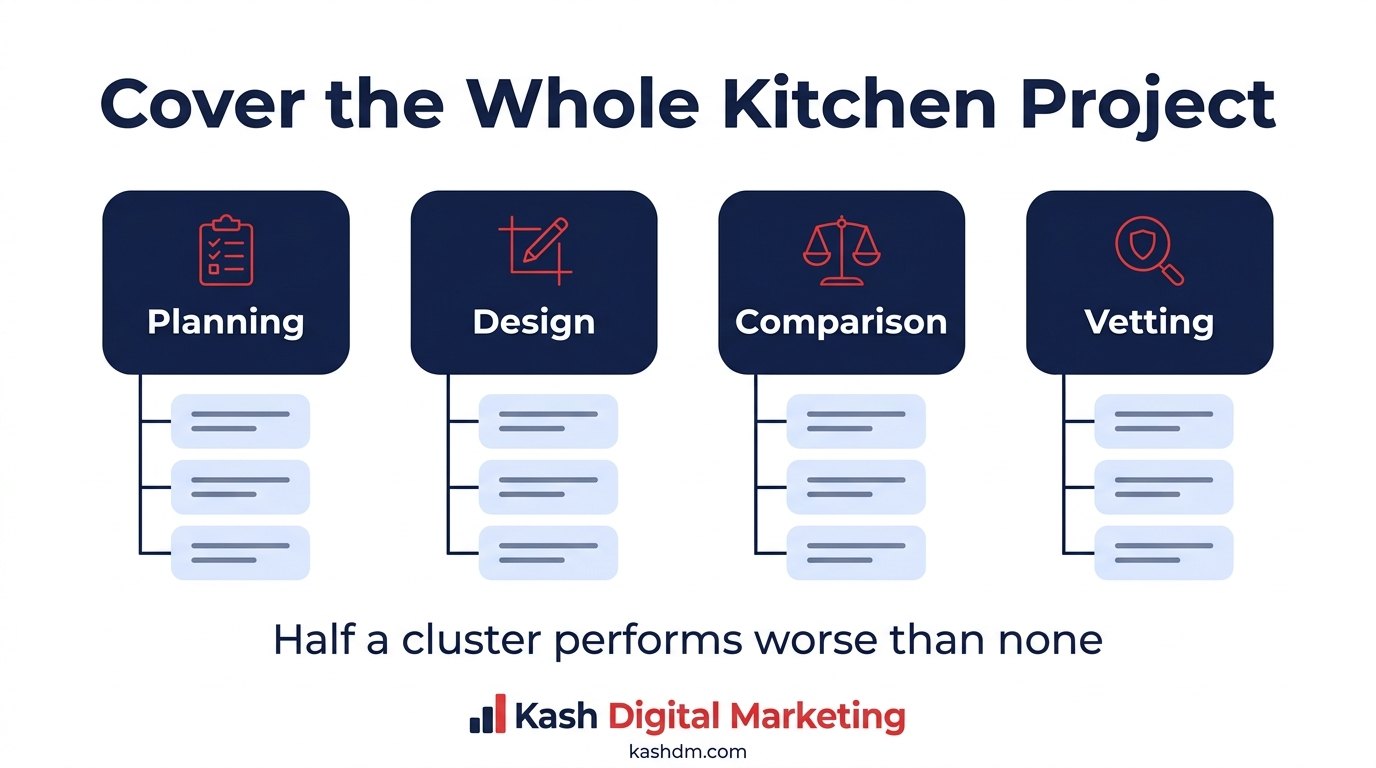
Topical authority is what makes a remodeling site rank for terms it never explicitly targeted, and it is built by covering the kitchen project completely rather than publishing occasionally. Google is judging whether your site is a credible source on kitchen remodeling.
The cluster model organises that coverage, and it is the difference between a neglected blog and a library that lifts the pages which actually sell projects.
Educational content for the planning stage
How the remodeling process works, how long a kitchen takes, what happens to the household during construction, how to plan a layout, what permits are needed. These answer real anxieties and rank for large question volumes.
Design and idea content for the inspiration stage
Style guides, layout options, cabinet and countertop material overviews, lighting and storage ideas. This is where image results are won and where a homeowner first encounters your name.
Comparison content for the decision stage
Refacing against replacement, quartz against granite, custom against semi-custom, remodel against renovation. Low competition from other remodelers, high usefulness, and a natural place to demonstrate expertise without pushing a preference.
Vetting content for the hiring stage
How to choose a remodeler, what questions to ask, how to compare estimates, what a fair contract looks like, how to check licensing and insurance. Publishing this positions you as the company confident enough to be examined.
Local content that only you can write
Permit processes in your municipality, common layouts in local housing stock, what older homes in your area tend to hide behind the walls. This is the content a national competitor structurally cannot produce.
Cover a topic completely or leave it alone
Half a cluster performs worse than none because it signals shallow coverage. Choosing three subjects and covering them thoroughly beats touching ten.
Updating old content usually beats writing new content
Refreshing a cost page already sitting on page two frequently produces faster gains than publishing something new. Most remodeling sites have several of these sitting unexamined.
Service Pages for Every Job You Sell
Every service you want to sell needs its own page, because Google ranks pages rather than companies and one page cannot rank for full remodels, cabinet refacing, countertops and design at once. This is the most reliable structural upgrade available to a typical remodeling website.
Most remodeling sites we audit have two or three pages covering work that deserves ten or twelve. Each absent page is a service that simply cannot be found.
Full kitchen remodeling
The flagship page and the highest-value one. It should walk the homeowner through the process end to end, address disruption honestly, and explain what changes the scope.
Kitchen design and layout
Many homeowners search for design help before they search for a contractor. If you have designers on staff, this page captures an audience that competitors treat as an afterthought.
Cabinet installation, refacing and refinishing
Three different jobs at three very different price points, frequently searched separately. Refacing in particular attracts budget-conscious homeowners who become full-remodel clients later.
Countertops and surfaces
Material-specific content for quartz, granite, butcher block and solid surface. Homeowners research materials intensively and these searches are far less contested than the head term.
Small and galley kitchen remodeling
Scope-specific pages that match how homeowners describe their own space. A homeowner with a small kitchen wants to see small kitchens, not a page about luxury renovation.
Luxury and custom kitchen remodeling
A different buyer with different expectations and vocabulary. Where you genuinely serve this market, it deserves its own page rather than a paragraph.
Adjacent remodeling services
Bathrooms, basements, whole-home and additions. Each supports the core business, captures searches competitors ignore, and strengthens the site's authority across remodeling generally.
What separates a real service page from a thin one
Photographs of your own work, the actual process, honest discussion of cost drivers, the questions homeowners ask, and a specific next step. A page that could belong to any remodeler in America will rank like one.

City and Location Pages for Remodelers
A remodeling company ranks in the areas where it has genuine local content, not in every city it claims to serve. One page per market you actually work in, carrying real local detail and real local projects, outperforms fifty templated pages with the city name swapped.
This is where remodeling SEO most often goes wrong, because bulk location pages are easy to generate and look like progress on a report while doing active harm.
What belongs on a real city page
The neighbourhoods you cover, kitchens you have completed there with photographs, the housing stock and typical layouts in that area, local permit notes, and reviews from customers in that city. None of it can be copied.
Why templated location pages backfire
Pages identical except for a city name are treated as duplicates. At best they are ignored, at worst they dilute the authority of pages that were working. Remodeling is badly affected because the temptation to mass-produce is strong.
Local housing stock is genuine content
Post-war ranches with closed-off kitchens, older homes with load-bearing walls between kitchen and dining room, condo buildings with plumbing restrictions. This is exactly the knowledge a local remodeler has and a national competitor cannot fake.
Projects are what make a city page credible
A city page with three completed kitchens from that city is persuasive. A city page with no local work on it is a claim. Where you have not worked in an area yet, consider whether the page should exist at all.
Choose areas by revenue, not by map coverage
Rank the markets producing real projects and build those first. A page for a town you would rather not drive to competes for attention with one you would.
Internal linking between cities, services and projects
Each city page should link to the services in demand there and the projects completed there, and each service page should link back. This structure is what tells Google you cover a service area properly rather than claiming to.

Kitchen Remodeling Website SEO and Conversion
A remodeling website has one job: turn a researching homeowner into a booked consultation, and for a high-ticket long-cycle purchase that means building confidence rather than pushing urgency. Everything technical serves that.
We fix structural and technical problems before publishing anything new, because adding content to a broken foundation is the most common way remodeling budgets get spent without result.
What the homepage must communicate immediately
What you do, where you work, who you serve, why you can be trusted, and how to request a consultation. A homeowner should know within seconds whether you are relevant to them.
The consultation request is the conversion, not a phone call
Unlike urgent trades, most remodeling enquiries arrive as forms rather than calls, often outside business hours after an evening of research. The form should be short, visible on every page and honest about what happens next.
Trust signals that matter for a large purchase
Licensing and insurance, years in business, warranty terms, named team members, association memberships, financing options and real reviews. Each removes a specific hesitation.
Crawlability and indexation
If a page is not indexed it cannot rank. Remodeling sites frequently have entire project or location sections excluded by an old directive, a stray noindex tag, or a gallery plugin generating uncrawlable URLs.
Site architecture that mirrors the business
Services, projects, locations and resources should each sit in a clear section, with no important page more than a few clicks from the homepage. Flat, sprawling structures make it hard for Google to identify which pages matter.
Duplicate content across location and service pages
The most common technical fault in this industry. Near-identical pages need genuine differentiation or consolidation, and canonical tags are a signal rather than a fix for pages that should not exist.
Internal linking as a ranking instrument
Links from strong pages to weaker ones distribute authority and signal importance. On remodeling sites this is usually the fastest technical improvement available, because galleries and projects are typically linked from nowhere.
Core Web Vitals on a Photo-Heavy Site
Remodeling websites are among the heaviest local business sites on the web because photography is the product, and that weight is the most common cause of poor mobile performance in this industry. The photographs must stay; the delay does not have to.
Google evaluates the mobile version of your site, and the same qualities that make it rank make it convert.
Largest Contentful Paint
How quickly the main content appears. On remodeling sites the culprit is almost always a full-resolution hero kitchen loading before anything else. Correct sizing and priority hints fix most of it.
Cumulative Layout Shift
Content jumping as images load, which makes a homeowner tap the wrong thing. Images without declared dimensions are the primary cause and it is entirely preventable.
Interaction to Next Paint
How quickly the page responds to a tap. Gallery scripts, chat widgets and tracking tags stacked together are the usual cause, and remodeling sites accumulate them from successive vendors.
Galleries without the weight
Lazy loading below the fold, modern formats, correctly sized variants and thumbnails that are actually thumbnails rather than full images scaled down in the browser.
Mobile-first means mobile-designed
Most remodeling research happens on a phone in the evening. Tap targets, readable text, galleries that swipe properly and forms that work on a small screen are ranking factors and conversion factors at once.
Third-party scripts and their real cost
Every widget should justify its place. Remodeling sites frequently carry scripts for review tools, chat systems and pixels from vendors nobody has worked with in years.
Schema Markup for Kitchen Remodeling Companies
Schema markup turns your business into machine-readable facts, which matters more every year as results are assembled rather than listed. For a local service business the return is high relative to the effort, and it is almost always missing on remodeling sites we audit.
Schema does not automatically produce rich results, and anyone promising that is overselling it. What it does is remove ambiguity about who you are and what you offer.
LocalBusiness and HomeAndConstructionBusiness
Use the most specific accurate type available, with correct name, address or service area, phone, hours and coordinates. This states plainly what a search engine would otherwise have to infer.
Service schema for each offering
Full remodels, cabinet refacing, countertop installation and design can each be described as a distinct service with its own area served. This supports page-level relevance that business-level markup cannot.
Image and project markup
In a visual industry, helping search engines associate photographs with the business, the service and the location is worth the effort. Project pages benefit more from this than any other page type on the site.
FAQ schema where it genuinely fits
Question-and-answer content marked up correctly is used heavily by AI-generated answers. It should mark up questions you actually answer on the page, not questions invented to carry markup.
Review markup used honestly
Reviews may be marked up when they are genuine and displayed on the page. Fabricated or self-serving review markup is a manual-action risk, and home services is a category Google watches closely.
Validate before deploying and keep it truthful
Markup must describe what a visitor actually sees. Hours in code that contradict the profile, or services listed only in markup, turn a helpful signal into a liability. Validate every template before it ships.
Reviews and Reputation for Remodelers
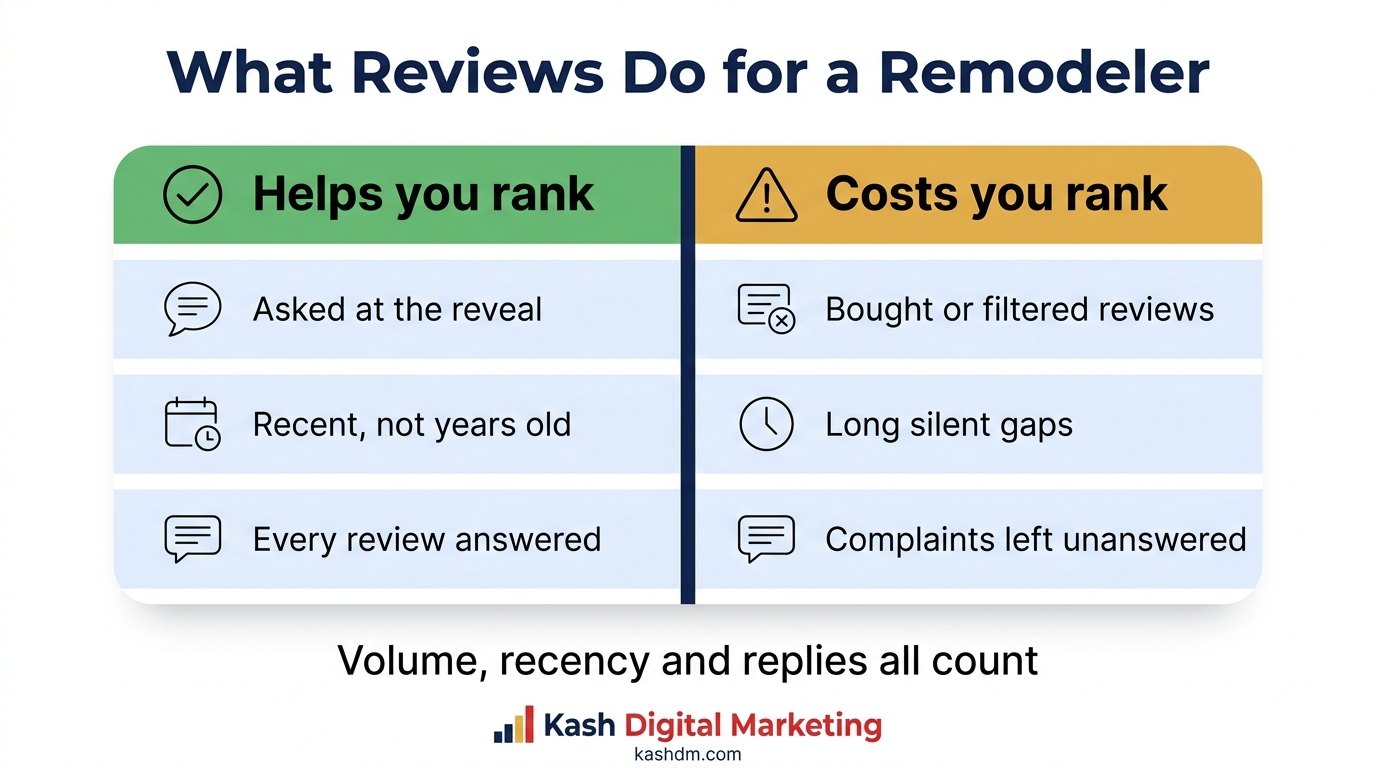
Reviews carry unusual weight in remodeling because the homeowner is inviting a company into their home for weeks and spending a large sum on trust. Volume, recency, rating and your replies all count, both for ranking and for the decision itself.
Reputation is also the part of prominence a remodeler controls most directly, which makes it the highest-leverage ongoing work available.
Recency matters as much as volume
A profile with many reviews and none this year reads as a business in decline. A steady arrival of recent reviews signals an operating company, and freshness is weighted as well as count.
Ask at the right moment
The reveal at the end of a kitchen project is the strongest emotional moment in the entire relationship, and it is the natural time to ask. Waiting until the invoice is paid and the crew has gone loses most of that goodwill.
Reviews that mention the project and the place
"They opened up our galley kitchen in Brookhaven and finished on schedule" carries relevance that a bare five stars does not. Asking customers what work you did and where produces these naturally.
Responding to every review, especially the difficult ones
Remodeling projects have friction: delays, change orders, surprises behind walls. Homeowners know this. A calm, specific, non-defensive reply to a complaint persuades far more readers than the complaint dissuades.
Reviews across the platforms homeowners actually check
Google carries the most ranking weight, but remodeling buyers cross-check on industry platforms and directories. Consistency across them supports both trust and the citation signals behind local prominence.
Never buy reviews
Purchased and incentivised reviews are detectable, and the penalty ranges from filtered reviews to a suspended profile. A remodeler with a long local reputation has far too much at stake.
Local Citations and NAP Consistency
Citations are mentions of your business name, address and phone number across the web, and their job is to corroborate that your company is real, established and where it says it is. Consistency matters far more than quantity.
Remodeling businesses accumulate inconsistent listings faster than most industries, because trade directories, supplier listings, marketplace profiles and previous marketing vendors all create them.
Why consistency is the whole point
Two versions of your phone number across the web is a contradiction a search engine has to resolve, and it resolves it by trusting you slightly less. Cleaning this up is unglamorous work with a measurable effect.
The listings that actually matter
The major data aggregators, the mainstream business directories, and the platforms homeowners genuinely use when vetting a remodeler. A few dozen accurate listings beat several hundred automated submissions.
Industry and trade directories
Remodeling associations, licensing bodies, manufacturer and supplier dealer listings, and home improvement platforms are relevant in a way generic directories are not.
Old listings from previous names and vendors
Most established remodelers have stale listings carrying a former business name, a disconnected number or an old address. Each quietly contradicts the current record, and finding them is part of the audit.
What to avoid
Bulk submission packages, directories that exist only to sell listings, and anything promising hundreds of citations for a flat fee. They add noise, not authority, and cleaning up afterwards costs more than the listings did.
Link Building for Kitchen Remodeling SEO
Links from real local and industry organisations are what separate a remodeler that ranks from one that merely has an attractive website, and remodeling has unusually good access to them because the work is photogenic. A finished kitchen is genuinely publishable content.
The goal is not a monthly quota. It is a durable set of genuine associations that a search engine reads as evidence the business is established and respected.
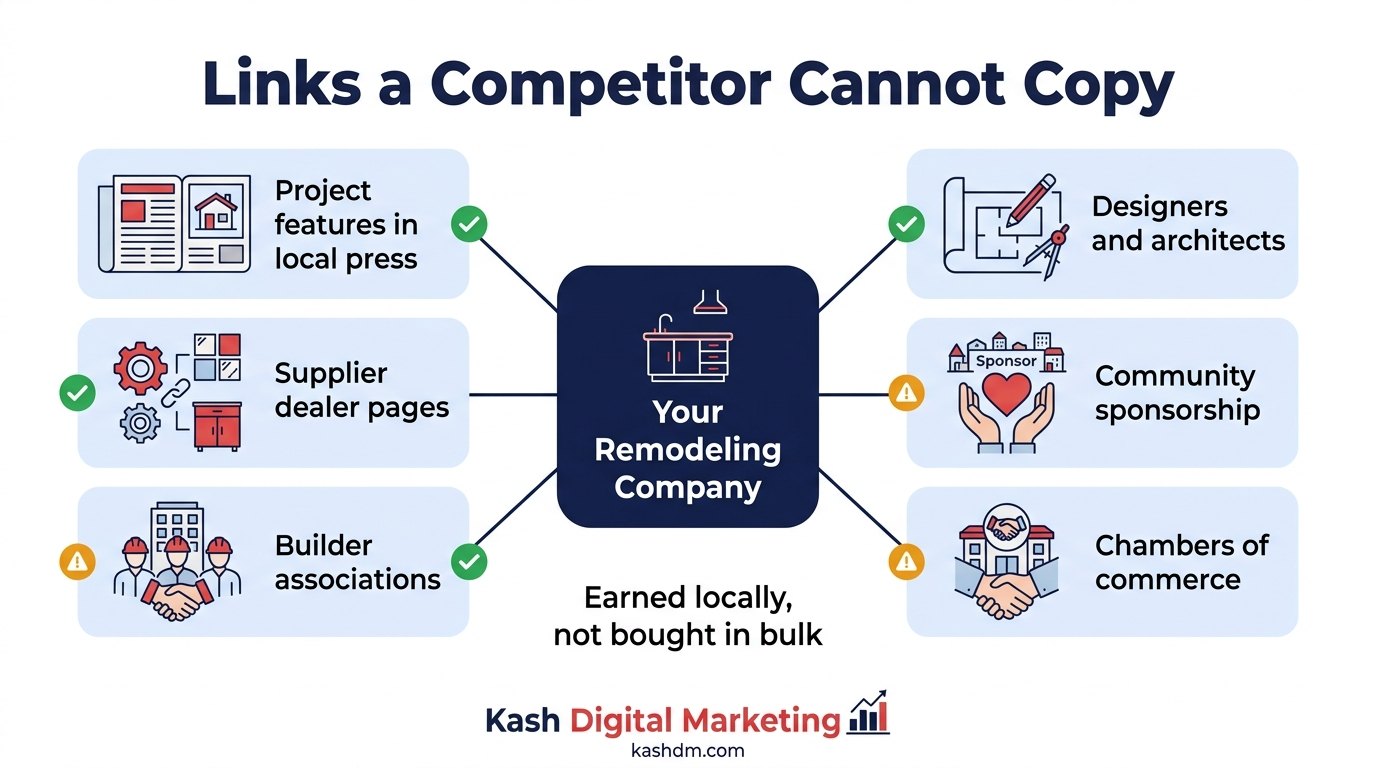
Project features in design and home publications
Local lifestyle magazines, regional home publications and design blogs publish completed projects. A well-photographed kitchen is the price of entry, and most remodelers already have several.
Supplier and manufacturer dealer pages
Cabinet, countertop, appliance and fixture manufacturers maintain dealer and certified installer directories. These are among the most relevant links a remodeler can hold, and many already qualify without realising it.
Local business associations and chambers
Chambers of commerce, builder associations, remodeling industry bodies and regional trade groups all provide legitimate, locally relevant listings. Unglamorous and effective.
Designers, architects and trade partners
Kitchen designers, interior designers, architects and real estate professionals all publish supplier and partner references. These relationships already exist offline for most remodelers and simply are not reflected online.
Community sponsorship and local events
Sponsoring a school event, a charity build or a local festival typically earns a mention on the organiser's site. Real community involvement that happens to produce exactly the signal local search rewards.
Local press and practical stories
Local reporters cover housing trends, permit changes, renovation costs and seasonal home topics. A remodeler is a natural source, and one local news mention often outweighs months of low-quality link acquisition.
What to refuse
Purchased link packages, private blog networks, irrelevant guest posting, automated links and excessive exact-match anchor text. The penalty risk is not worth a temporary gain for a licensed business with a real reputation.
AI SEO: Getting a Remodeler Cited in AI Answers
Search results are increasingly assembled into direct answers rather than listed as links, and remodeling questions about cost, process and materials are exactly the kind those answers address. Being the source they cite is now part of the job.
The techniques overlap heavily with good SEO, but the emphasis shifts toward clear, extractable, verifiable statements.
Answer the question in the first sentence
Content structured so each heading is followed immediately by a direct, complete answer is far more likely to be quoted. Burying the answer three paragraphs into context is the most common reason good content is passed over.
Experience, expertise, authority and trust
Named authors with real remodeling credentials, licensing details, service-area clarity and content reflecting actual project experience. Generic content assembled from other websites is what these systems are designed to filter out.
Consistent business facts everywhere
Your name, phone, service area, services and profiles should agree across every surface. A system assembling an answer about remodelers in your city is resolving an entity, and contradictions are a reason to omit you.
Original information cannot be summarised away
Local permit processes, what older homes in your area hide behind the walls, real project timelines and material behaviour in your climate are things no competitor can restate. Content that only repeats what is published elsewhere has nothing to be cited for.
Cost answers are the ones most often assembled
"How much does a kitchen remodel cost" is exactly the query an AI answer summarises. Publishing a clear, well-structured, locally specific answer is the most direct route into that surface.
Traditional rankings still underpin all of it
Being cited in a generated answer correlates strongly with ranking well conventionally. AI SEO is a layer on competent SEO, not a replacement, and anyone selling it as a shortcut is selling something else.

Kitchen Remodeling SEO Versus PPC and Other Channels
SEO builds an asset the remodeler owns, while ads and marketplaces rent attention that stops the moment payment does. Most successful remodelers use several channels, but they should understand precisely what each one is.
| Factor | SEO | PPC |
|---|---|---|
| Traffic source | Organic | Paid |
| Cost model | Investment in content and assets | Pay per click |
| Speed to results | Slower, months | Faster, days |
| Long-term value | Compounds | Stops when spending stops |
| Local visibility | Strong | Strong |
| Best use | Sustainable acquisition | Immediate lead generation |
What paid search does well
Immediate visibility, precise control of geography and timing, and the ability to test which messages and services convert before committing content to them. For a new company or a new market it buys presence while SEO matures.
What paid search does poorly
It stops instantly when the budget stops, and remodeling clicks are expensive because the job value is high. Dependence on it means marketing cost scales with every project forever.
Social advertising and the inspiration stage
Design-led platforms reach homeowners early and build brand familiarity, but they reach people who were not looking. They complement search rather than replacing the intent that search captures.
Marketplaces and shared leads
Covered earlier in detail. Useful for filling capacity, structurally unsuited to being the foundation of a remodeling business, and priced by a third party you do not control.
Referrals remain the best lead you get
Nothing converts like a personal recommendation. Referrals also do not scale on demand, which is precisely why they should be complemented rather than relied upon.
The sensible combination
Use paid to cover gaps and test messaging, use social for inspiration-stage reach, build SEO so the baseline calendar does not depend on either, and measure everything against signed projects rather than lead volume.
Measuring Kitchen Remodeling SEO
The only kitchen remodeling SEO metrics that matter are consultation requests, qualified leads, signed projects and revenue. Rankings and traffic are diagnostic; they are not the result.
If a report cannot connect the work to projects on the calendar, it is not a report on business performance, and a remodeler is entitled to insist on the difference.
| KPI | Why it matters |
|---|---|
| Organic clicks | Measures search traffic reaching the site |
| Map pack visibility | Measures local presence across the service area |
| Phone calls | Measures direct lead generation |
| Form submissions | Measures online conversion |
| Consultation requests | Measures genuine buying intent |
| Qualified leads | Measures traffic quality, not just volume |
| Signed projects | Measures the business outcome |
| Revenue by service line | Measures actual return |
Attribution has to survive a long cycle
A homeowner who reads a cost article in March and requests a consultation in June will often be recorded as direct traffic. Without attribution that spans the whole cycle, the content that started the relationship gets no credit and risks being cut.
Consultations booked, not forms started
Remodeling forms abandon heavily. Measuring started against completed submissions isolates whether the problem is visibility or the form itself, and those need very different fixes.
Qualified versus unqualified enquiries
A homeowner with a budget a fraction of your minimum is not a lead. Tracking qualification rate reveals whether content is attracting the right buyer or simply attracting volume.
Revenue by service line
Full remodels, refacing, countertops and bathrooms have very different values and margins. Reporting by line shows which SEO work is paying and which produces enquiries without profit.
Map pack visibility across the service area
Rankings vary by the searcher's location, so a single position number misleads. Grid-based local visibility shows where you genuinely appear and where the next city page is needed.
Metrics that mislead
Traffic without a baseline, rankings for terms nobody searches, impressions, and percentage improvements quoted without a starting number. Each can be technically accurate and completely uninformative.
How Long Kitchen Remodeling SEO Takes
Profile corrections can move within weeks, long-tail cost and design terms usually enter the top ten within two to four months, and competitive city terms take six months or longer. There is no fixed timeframe, and any provider quoting one before looking at your market is quoting a sales figure.
Remodeling adds a second delay on top of the ranking delay: the buying cycle itself. A homeowner reached in month three may not sign until month six.
What decides your timeline
Domain history and existing authority, how many established remodelers compete in your metro, city size, the strength of your profile, your review position, the condition of the website and your current rankings. These vary enormously.
Weeks: the profile and the obvious faults
Duplicate listings, a wrong primary category, missing services and unindexed pages are corrections rather than campaigns. They frequently produce the first movement, because most remodelers are held back by something broken rather than something absent.
Two to four months: cost, design and long-tail terms
These face thinner competition and move first. They are also the terms that start relationships, which is why they are built early even though they convert later.
Six months and beyond: commercial city terms
"Kitchen remodeling company [major metro]" is contested by established firms with years of accumulated authority and hundreds of reviews. Reaching them requires sustained content, links and reputation rather than a technical fix.
The buying cycle sits on top of the ranking timeline
Ranking movement and revenue movement are separated by the homeowner's own decision process. Honest reporting acknowledges that gap rather than pretending rankings are the outcome.
What happens if you stop
Rankings decay rather than collapse. Content keeps working, reviews age, competitors keep publishing, and position erodes over quarters. It is an asset that depreciates slowly, unlike advertising which stops the same day.
What Changes the Cost of Kitchen Remodeling SEO
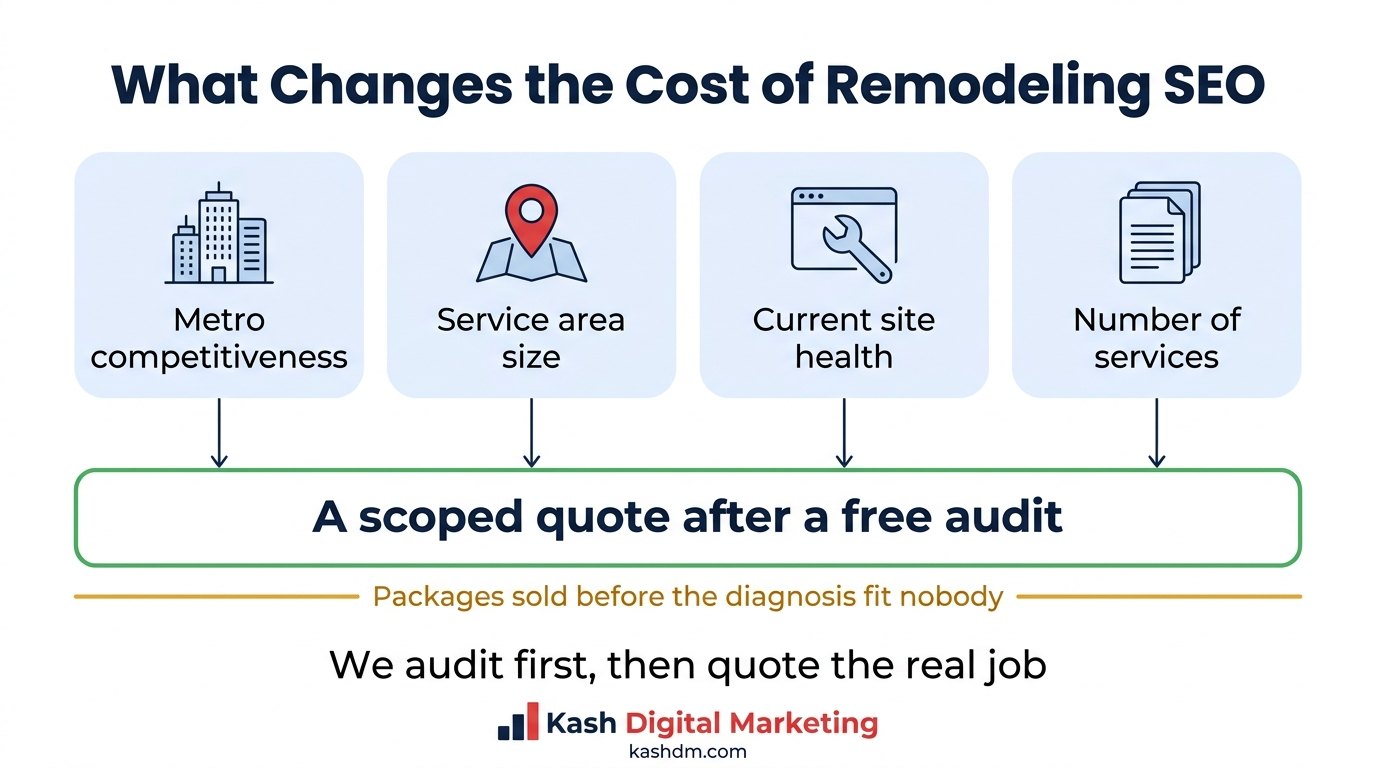
Kitchen remodeling SEO is priced by the size of the job, and the job is defined by your market's competitiveness, how many areas you serve, the condition of your website and how many services you sell. Anyone quoting before examining those is quoting a package rather than your business.
We do not publish a price list for this reason. A single-city remodeler with a healthy site and a multi-metro design-build firm with a suspended profile are different jobs, and pretending otherwise serves the agency rather than the client.
Metro competitiveness
Remodeling is fiercely contested in large metros where established firms hold hundreds of reviews and years of content. The same work costs more there because more of it is required to move.
Size of the service area
One city is a different scope from twelve suburbs. Every additional area needs its own page, its own local projects and its own review flow, and cost scales with genuine coverage rather than claimed coverage.
Condition of your current website
A fast, well-structured site needs growth work. A slow site with duplicate location pages, an uncrawlable gallery and indexation problems needs repair before growth work produces anything.
How many services you sell
Kitchens only is a different scope from kitchens, bathrooms, basements and additions. Each service line needs its own content track, and the scope should say so honestly.
Content and photography requirements
Cost pages, design content, comparison articles and project write-ups all take real effort. A company with a large photographed portfolio starts far ahead of one with a phone camera and no archive.
What a package should include
An audit, keyword research, competitor analysis, on-page and technical SEO, local SEO and profile work, content strategy and production, project and location page build-out, link acquisition, conversion work, and reporting that tracks leads. Anything missing from that list should be explained rather than omitted quietly.
Why we audit before we quote
The audit tells us which of the above actually apply to you. It is free, it is yours to keep, and it means the number we give describes your situation rather than an average.
Common Kitchen Remodeling SEO Mistakes
Most remodelers are not failing at SEO because of anything exotic. They are failing because of eight or nine predictable mistakes that appear on audit after audit. Every one of them is fixable.
We list them here because a remodeler who recognises three of these has just learned more about their situation than a sales call would have told them.
Targeting only "kitchen remodeling"
One head term, enormous competition, and a page trying to serve four different buying stages at once. The pipeline lives in cost, design, comparison and city terms.
Treating the portfolio as decoration
The strongest ranking and persuasion asset in the industry, reduced to an undifferentiated grid of photographs that ranks for nothing.
Refusing to publish cost content
The highest-value search in the category, abandoned to national calculators that know nothing about your market and have no reason to send anyone to you.
Mass-produced city pages
Dozens of pages identical but for a place name. Treated as duplicates, and capable of holding back the pages that were working.
One generic service page
Full remodels, refacing, countertops and design all crammed into a single page that ranks poorly for each of them.
Stock photography
Recognisable, used by competitors, and worthless as proof. It also cannot rank as your work, because it is not your work.
Ignoring image optimisation entirely
In the one local industry where image results genuinely drive enquiries, most sites upload camera filenames, skip alt text and serve full-resolution photographs to phones.
Publishing generic AI content
Content assembled from other websites, with no project detail, no local knowledge and no original observation. It is exactly what search systems are built to filter out.
Measuring traffic instead of consultations
Without attribution nobody can say whether the work is producing projects. Remodelers in this position usually cancel good campaigns and continue bad ones, because they cannot tell them apart.
How to Choose a Kitchen Remodeling SEO Company
Judge a remodeling SEO company on its diagnosis, not its pitch, and ask five questions that a competent provider answers without hesitation. Hesitation on any of them is the answer.
We publish this checklist knowing it will be used on us, which is the point. A provider unwilling to be judged by the standard it recommends is not worth hiring.
Which remodeling clients can I speak to directly
References you can actually call are the strongest evidence available. A provider with genuine results will connect you; one relying on an anonymous graph will find reasons not to.
How do you measure leads, not traffic
Ask specifically how consultations are tracked and attributed across a months-long buying cycle. A provider who only discusses rankings has not thought about your business.
What specifically is included, and what is not
Audit, keyword research, technical work, local SEO, content production, project pages, link acquisition, conversion work and reporting. Ask which of these are included and which cost extra.
How do you approach link building
The answer should describe earned local and industry relationships. If it describes a fixed number of links per month at a fixed price, that is a purchased-link programme regardless of what it is called.
Who owns the website, the domain and the profile
Get it in writing. Agencies that build on their own platform can hold the entire asset, and remodelers discover this at exactly the moment they want to leave.
Warning signs worth walking away from
Guaranteed rankings, long contracts, quotes given before any audit, a fixed link quota regardless of need, and reluctance to explain what will actually be done. Any one of these is enough.
How to judge a newer agency fairly
Judge the diagnosis. Request the free audit, see whether the findings are specific to your business or generic boilerplate, and check whether the recommended work matches the problems found. An agency that correctly diagnoses your site before being paid is demonstrating the exact skill you are hiring for.
What Our Kitchen Remodeling SEO Services Include
Our kitchen remodeling SEO services cover the five things that decide whether a remodeler ranks: the Google Business Profile, the website's technical health, service and city page coverage, the portfolio, and local prominence. Every engagement includes all five, because fixing four and ignoring the fifth is how remodelers end up paying for SEO that never moves.
Kitchen remodeling SEO audit
We assess the website, the Google Business Profile, competitors, current rankings, citations, reviews, backlinks, technical health, portfolio structure and local landing pages, then tell you in plain language what is holding you back and in what order to fix it.
Keyword research and mapping
Keyword families mapped to specific URLs so no two pages compete for the same term, covering commercial, cost, design, comparison, project-type and city searches.
Google Business Profile management
Categories, services, service areas, hours and attributes corrected, duplicate listings removed, and the profile kept active with new project photography and posts. This continues every month, because it is the asset producing the enquiries.
Technical repair before growth work
Mobile speed, Core Web Vitals, crawl and index errors, schema markup, redirect chains, duplicate location pages, uncrawlable galleries and broken internal structure. This comes first, always.
Service, city and project pages
Dedicated pages for each service you sell, each area that produces real work, and each completed kitchen worth publishing, written with genuine operational detail rather than a swapped place name.
Cost, design and comparison content
The content that reaches homeowners before they are ready to hire, built to rank for the questions they actually ask and to bring them back when they are ready.
Portfolio and image optimisation
Project pages structured to rank, galleries organised by style and scope, and images compressed, named and described properly so they compete in image results.
Reviews, citations and local links
A review system your crews will actually use, citation cleanup across the listings that matter, and local link building through suppliers, associations, designers, publications and community involvement.
Reporting that names booked consultations
Monthly reporting on calls, form submissions, consultations and revenue by service line, with next month's priorities set by what the numbers show. If a month underperforms, the report says so and explains what changes.
| Included every month | What it produces |
|---|---|
| Google Business Profile management | Map pack visibility and direct enquiries |
| Technical monitoring and fixes | Pages that load fast and stay indexed |
| Service, city and project pages | Rankings for the work you want to sell |
| Cost, design and comparison content | Reach at the research stage |
| Portfolio and image optimisation | Visibility in image results |
| Review, citation and link work | Prominence, the third ranking factor |
| Reporting on consultations | Evidence instead of impressions |
Your First 90 Days of Kitchen Remodeling SEO With Us
We tell you exactly what happens in the first ninety days before you sign anything, because that is the question we tell remodelers to ask every agency they consider. It would be a poor guide that refused to answer its own test.
Days 1 to 15, audit and diagnosis
We audit your profile, technical health, current rankings, portfolio structure, competitor positions and the gap between the areas you serve and the areas you rank in. You get the findings in plain language, and they are yours whether or not you continue.
Days 15 to 45, foundation repair
Duplicate listings removed, categories and services corrected, name, address and phone inconsistencies cleaned, mobile speed fixed, galleries made crawlable and indexation errors cleared.
Days 45 to 75, coverage and cost content
The highest-value service pages, the priority city pages and the first cost content get written and published, with the portfolio restructured into project pages that can rank.
Days 75 to 90, prominence and first reporting
Review generation starts, citations get built out, supplier and association links are pursued, and you receive the first full report showing enquiries attributed to organic search.
What we need from you
Access to the website and Google profile, a list of the areas that actually produce projects, photographs of completed kitchens with client permission, and a willingness to ask happy customers for a review at the reveal.
Our Kitchen Remodeling SEO Process
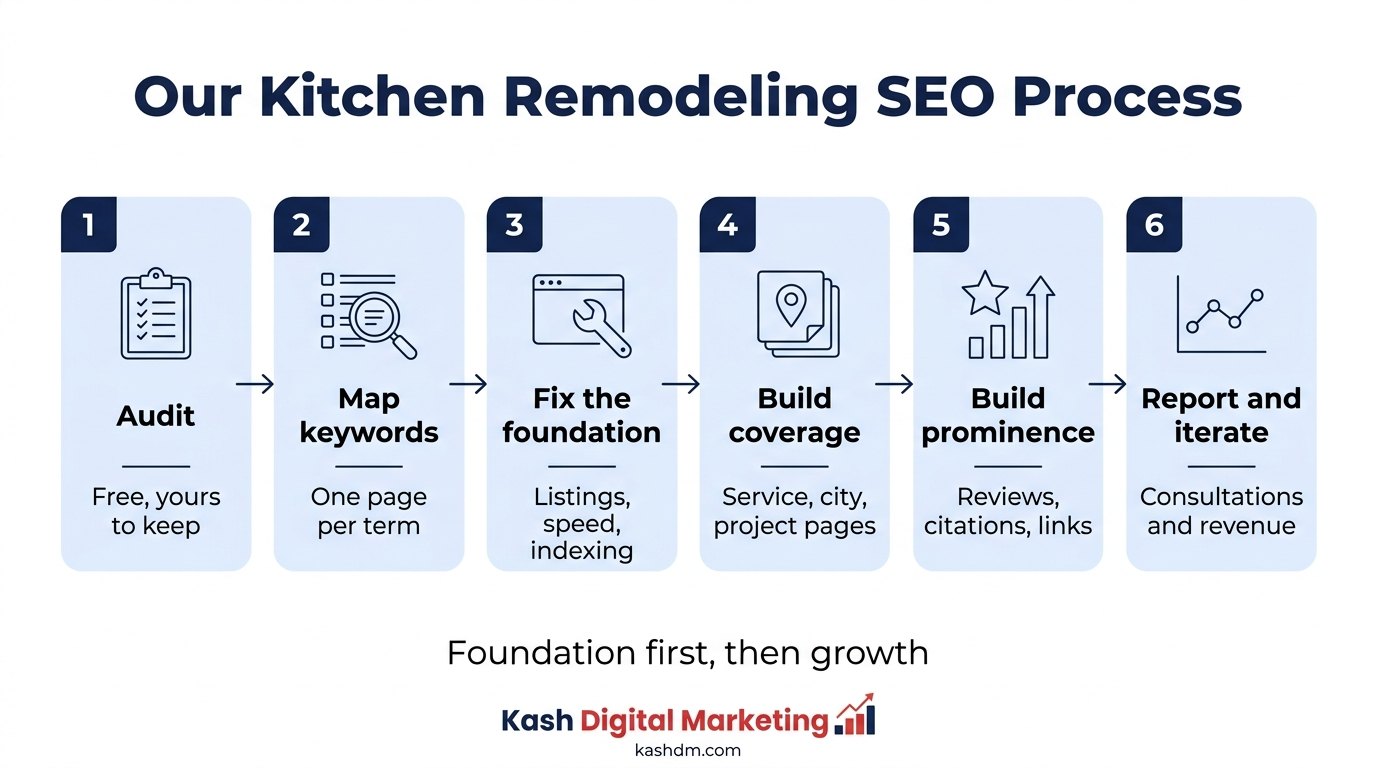
Our process runs in the same order every time, because the sequence is what makes it work: diagnose, repair, cover, prove, build prominence, then report and iterate. Skipping ahead to content is the most common way remodeling SEO fails.
Step one, audit and competitor analysis
A full assessment of profile, technical health, content coverage, portfolio, competitors and local visibility across your service area. Free, and yours to keep regardless of what you decide.
Step two, keyword research and mapping
Keyword families assigned to specific URLs so that commercial, cost, design and city terms each have one page responsible for them.
Step three, fix the foundation
Listings, speed, indexation, duplicates, galleries and structure. Unglamorous, frequently the source of the first ranking movement, and pointless to skip.
Step four, build coverage and proof
Service pages, city pages, cost content and project pages in priority order, linked into a structure Google can read as genuine expertise across a service area.
Step five, build prominence
Reviews, citations and local links accumulating month over month. The slowest signal and the one a competitor cannot buy past quickly.
Step six, report and iterate
Consultations, qualified leads and revenue by service line, with the next month's priorities set from the numbers rather than from a fixed deliverable list.
Why Kitchen Remodelers Choose Kash Digital Marketing
We work the way we would want an agency to work for us: diagnose before quoting, no long contracts, plain reporting on booked consultations, and no promises about rankings nobody can guarantee. That is the whole pitch, and it is deliberately easy to verify.
We audit before we quote, not after
Most remodeling marketing proposals arrive before anyone has looked at the Google profile or run a speed test. Ours arrives after. A five-city design-build firm with duplicate listings is a different job from a single-city remodeler with a healthy site.
No long contracts
We keep clients by producing results, not by holding them to a twelve-month term. If we stop earning the work you should be free to leave that month. Long contracts exist to protect the agency.
You own everything, during and after
Your website, your domain, your Google Business Profile, your content, your project pages and every citation and link we build. Some agencies build on their own platform, so leaving means starting from zero. If we part ways, you keep the asset.
White-hat only, because a penalty costs more than a ranking
No purchased links, no manufactured reviews, no keyword-stuffed business names, no fabricated addresses in cities you do not serve. Home services is a category Google scrutinises closely.
Reporting that names booked consultations
You get calls, form submissions, consultations and revenue by service line. Impressions and keyword counts appear nowhere, because a remodeler cannot install a kitchen for an impression.
We usually reply within an hour, and always within 8 hours
Audit requests get a reply usually within an hour, and always within 8 hours during business hours, which is a fair preview of what working together looks like.
We will tell you when SEO is not the answer
If your profile is suspended, your enquiries go unanswered for days, or your crew capacity cannot absorb more projects, we will say so rather than sell you a retainer. Sometimes the honest recommendation is to fix operations first.
| How remodeling marketing is often sold | How we work |
|---|---|
| Quoted from a package sheet | Free audit first, then a scoped quote |
| Twelve-month contract | No long contracts |
| Agency owns the site or the profile | You own every asset |
| Rankings guaranteed | No guarantees, documented method instead |
| Reporting on traffic and impressions | Reporting on consultations and revenue |
| Fixed number of links per month | Work chosen by what the audit found |
Remodeling Companies We Work With
We work with kitchen remodelers, design-build firms and general remodeling contractors across the United States, from single-crew specialists to multi-location companies. The strategy changes considerably between them.
Kitchen remodeling specialists
One trade, done properly, with a portfolio that supports it. Often the fastest to move because the content and the profile can be tightly focused on a single service line.
Design-build firms
Design and construction under one roof, which means competing for design searches as well as contractor searches. Two audiences, two vocabularies and a genuine advantage if the content reflects both.
Full-service remodeling contractors
Kitchens, bathrooms, basements and additions. Each service line needs its own content track, and the biggest risk is a site where everything competes with everything else.
Cabinet and countertop specialists
A narrower service with its own strong search demand, frequently overshadowed on sites that treat refacing and countertops as a footnote to full remodels.
Luxury and custom remodelers
A different buyer, a longer cycle and a different standard of photography. Content and design have to match the price point or the enquiries do not arrive.
Newer remodeling companies building from zero
No rankings, few reviews and a thin portfolio is a real disadvantage, and also the cleanest starting point because nothing has to be undone. Long-tail cost and design terms are usually winnable within the first few months.
What Realistic Kitchen Remodeling SEO Results Look Like
Realistic results follow a predictable shape: profile and long-tail movement within the first two months, cost and design terms from month three, and competitive commercial terms from month six onward. Anyone showing a faster curve is showing a smaller starting point than yours.
What moves first, and why
Google Business Profile corrections move fastest because the profile is re-crawled constantly and most remodelers have obvious errors sitting in theirs. Duplicate listings or a wrong primary category can suppress a profile for years and take days to fix.
What a normal curve looks like
Long-tail cost, design and project-type terms enter the top ten first because competition on them is thin. Commercial city terms follow much later. The curve is slow, then compounding, which is the opposite shape of paid advertising.
Why signed projects lag ranking movement
A homeowner reached during the research stage may not sign for months. Ranking movement and revenue movement are separated by the buying cycle, and honest reporting acknowledges the gap rather than pretending rankings are the outcome.
Results depend on your starting point
A remodeler with a suspended profile, a slow site and no recent reviews has more available upside than one already ranking fifth, and will show larger percentage gains for identical work. This is exactly why percentages quoted without a baseline are meaningless.
How to verify any provider's results claims
Ask what the starting position was, over what timeframe, in which metro, and what else changed during the period. Ask to speak to the remodeler named in the case study. A provider confident in genuine results answers all four without hedging.
| Claim you might be shown | What to ask before believing it |
|---|---|
| Traffic up 400% | Up from what number, over how long? |
| Ranked #1 in 30 days | For which term, in which city, at what volume? |
| 200 new leads | Enquiries, consultations, or signed projects? |
| Case study with no name | Can I speak to that remodeler directly? |
Our Position on Case Studies and Client Privacy
Kash Digital Marketing is a growing agency, and we publish no kitchen remodeling case studies yet because we will not invent them. This page argues that remodelers should demand verifiable proof, and it would be worthless if we broke that rule on our own page.
Why there are no remodeling case studies here
We would rather tell you plainly that our remodeling portfolio is still being built than publish a stock graph and an unnamed client. Every claim here is a claim about method, not about results we cannot evidence. When we have remodeling results worth publishing they will appear here with the starting baseline, the timeframe and the work performed.
Client privacy when we do publish
Client work is published only with written permission. Many remodelers would rather competitors in their own metro not know who handles their search visibility, which is reasonable in a market where a handful of firms compete for the same map pack slots. Where a client prefers anonymity we publish the metro size, the timeframe and the mechanism, and omit the name.
What you can verify about us today
Our method is documented in full on this page, including the ninety-day plan, what is included every month and what we report. You own every asset we build, there is no long contract, and the audit that starts the relationship is free and yours to keep.
Kitchen Remodeling SEO Across the United States
We provide kitchen remodeling SEO to companies in every US state and metro, and the strategy shifts with housing stock, competition and local design preference. A remodeling market is defined by the age and style of its homes.
Dense, competitive metros
Los Angeles, Chicago, Dallas, Atlanta, Phoenix and comparable markets carry many established firms with large review counts. Success depends on neighbourhood-level targeting and specialised service pages rather than city-level head terms.
Older housing stock markets
The Northeast and Midwest, where kitchens are small, closed off and full of surprises behind the walls. Content about layout changes, load-bearing walls and older-home renovation performs unusually well.
High-growth suburban markets
The Southeast and Southwest, where newer homes need updating rather than rebuilding and open-concept conversions dominate the search demand.
Luxury and second-home markets
Coastal and resort areas with a different buyer, a different budget and a much stronger emphasis on photography and design credentials than on price.
Secondary metros and smaller cities
Lower competition, lower volume and a much shorter path to visibility. Remodelers here frequently see the fastest results in the category, because the basics done properly are enough to lead.
Multi-market design-build firms
Companies covering several metros need a profile, a landing page and a review stream for each, and the coordination across them is where an outside team usually earns its cost several times over.
Get Your Free Kitchen Remodeling SEO Audit
Request Your Free SEO Audit
Prefer to talk it through? WhatsApp US +2135622433 or WhatsApp PK +92 348 3879366. We usually reply within an hour, and always within 8 hours.
Your free kitchen remodeling SEO audit shows where you rank now, what is holding you back, and what a competitor is doing that you are not, and it is yours to keep whether or not you work with us. There is no obligation and no catch.
What the audit covers
Your current rankings for commercial, cost and city terms, an assessment of your Google Business Profile, technical and mobile speed issues, how your portfolio is structured, competitor positions in your metro, your citation and review position, and the gap between the areas you serve and the areas you rank in.
What you receive
A plain-language document naming specific problems and the order in which they should be fixed. Not a template, and not a sales deck with your logo on it.
What happens next
If the findings suggest we can help, we scope the work and quote it. If they suggest something other than SEO is your bottleneck, we will tell you that instead. Either way the audit is yours.
How to request it
Send us your website and the areas you serve. We usually reply within an hour, and always within 8 hours during business hours, which is also a fair preview of how we communicate once we are working together.
Kitchen Remodeling SEO FAQs
These are the questions remodelers ask us most often, answered directly. If yours is not here, ask it and we will answer it plainly.
What is kitchen remodeling SEO?
It is the work that makes a remodeling company visible in Google and Google Maps while homeowners research a kitchen project. It covers your Google Business Profile, your website, your project portfolio, your reviews and citations, and the cost, design and city content that reaches homeowners before they are ready to hire.
How does SEO help kitchen remodeling companies?
By putting you in front of homeowners during the weeks they spend researching, rather than only at the moment they search for a contractor. That means ranking for cost questions, design ideas and comparison searches as well as for "kitchen remodeler near me", so your name is familiar by the time a shortlist is formed.
How do I get my kitchen remodeling company on Google?
Claim and verify your Google Business Profile, set "Kitchen Remodeler" as the primary category, list every service, upload real project photography, and keep reviews arriving. Then make sure your website has indexable service, city and project pages. Those two steps cover most of what visibility requires.
How long does kitchen remodeling SEO take?
Profile corrections can move within weeks. Long-tail cost and design terms usually enter the top ten within two to four months, and competitive city terms take six months or more. Remodeling adds a second delay because the homeowner's own buying cycle runs for weeks or months after they find you.
How much does kitchen remodeling SEO cost?
It depends on your metro's competitiveness, how many areas you serve, the condition of your website, how many services you sell and how much content and photography is needed. We do not publish a package price because those factors change the job substantially. We audit first, then quote the actual work.
Is SEO better than PPC for kitchen remodelers?
They do different jobs. PPC buys immediate visibility and is useful for a new company or a new market, but remodeling clicks are expensive and it stops producing the day the budget stops. SEO takes months and then compounds, and it builds an asset you own. Most established remodelers run both.
What keywords should kitchen remodelers target?
Four families rather than one head term: commercial terms like "kitchen remodeler near me", cost terms like "kitchen remodel cost [city]", design terms like "small kitchen remodel ideas", and comparison terms like "cabinet refacing vs replacement". Cost and design carry the volume; commercial terms carry the intent.
How can I get more kitchen remodeling leads?
Rank for the searches that happen before hiring, publish honest cost content, structure your portfolio into project pages that rank, keep reviews arriving, make the consultation request easy to find, and track which pages produce enquiries so you can build more of what works.
Does local SEO work for kitchen remodeling companies?
Yes, and it is the largest single lever. The map pack sits above organic results and produces a substantial share of enquiries. Correct categories, complete services, real project photography, steady reviews and genuine city pages are what move it.
How do I rank a kitchen remodeling company in Google Maps?
Through relevance, distance and prominence. Set the correct primary category, list every service, keep the profile gallery current with completed kitchens, earn recent reviews, keep your business details consistent across directories, and build real local pages. Distance is the one factor you cannot change.
Should kitchen remodelers create separate city pages?
For the areas that genuinely produce projects, yes. Each needs real local content: neighbourhoods covered, kitchens completed there with photographs, local housing stock notes and reviews from that area. Templated pages that only swap the city name get treated as duplicates.
Should I publish kitchen remodel prices on my website?
Publish what drives the price rather than a single figure: kitchen size, layout changes, whether plumbing or electrical moves, cabinet grade, countertop material and finish level. Homeowners will find a number somewhere regardless, and it is better that it comes from a local expert who can explain it.
Can SEO help a small remodeler compete with larger companies?
Yes, more than in most industries. Large firms rarely cover cost content, comparison content or specific project types well, and a smaller company with genuine local knowledge and a strong portfolio can own those searches. Competing on the single head term is where a small company loses.
How important are project photos for remodeling SEO?
They are central rather than decorative. Kitchen remodeling is one of the few local industries where image results drive real enquiries, and project pages built around before-and-after photography rank, earn links and persuade far better than service copy alone.
What makes Kash Digital Marketing different from other remodeling marketing agencies?
Three things you can verify before paying us anything. We audit before we quote instead of selling from a package sheet, we do not use long contracts, and you own your website, domain, Google Business Profile and every asset we build. Our reporting names consultations and revenue rather than impressions.
What do I get in the free kitchen remodeling SEO audit, and is there a catch?
You get your current rankings for commercial, cost and city terms, an assessment of your Google Business Profile, technical and mobile speed issues, an evaluation of how your portfolio is structured, competitor positions in your metro, and the gap between the areas you serve and the areas you rank in. No catch and no obligation.