Basement waterproofing SEO is the work that puts a waterproofing contractor in front of homeowners at the moment they discover water, mould or a crack they do not understand, so the inspection request comes to you instead of to a competitor. At Kash Digital Marketing, our basement waterproofing SEO services combine Google Business Profile optimization, problem-based content, city pages, honest cost and insurance answers, review generation and technical site work into one system aimed at booked inspections rather than traffic.
Basement waterproofing occupies a position no other trade shares. The homeowner is frightened, the problem is invisible behind a wall, the diagnosis is genuinely contested between honest professionals, quotes for the same basement can differ by a factor of several, and the category has a well-earned reputation for high-pressure selling. A homeowner who searches "water in basement after rain" at eleven at night is anxious about the water and almost equally anxious about being taken advantage of.
That second anxiety is the opportunity. In a market where homeowners arrive expecting to be pressured, the contractor who explains the problem plainly, publishes what actually drives cost, and refuses to use fear as a closing tool has an enormous and durable advantage. Search is where that reputation gets built, long before anyone walks down the basement stairs.
This page is a complete guide to basement waterproofing SEO across the United States, written so you can evaluate any provider, including us, against a real standard. It covers how homeowners search, why problem-based content outperforms service pages, how to own the interior-versus-exterior question, what the work costs and how long it takes.
What Basement Waterproofing SEO Actually Is
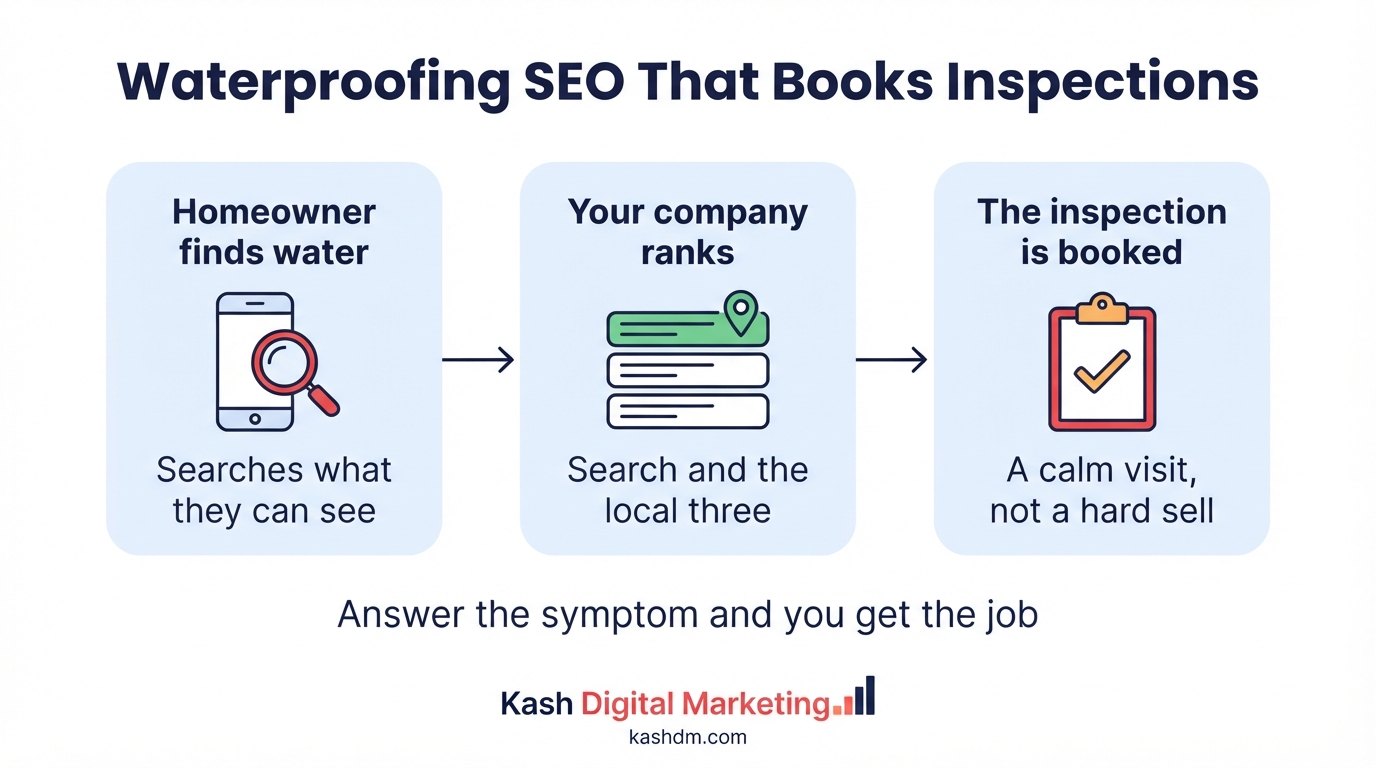
Basement waterproofing SEO is the process of optimizing a waterproofing contractor's website, Google Business Profile and local signals so the business appears when homeowners search about water, damp, mould, cracks and flooding in their basement or crawl space. It differs from generic SEO because most of the valuable searches describe a symptom rather than a service.
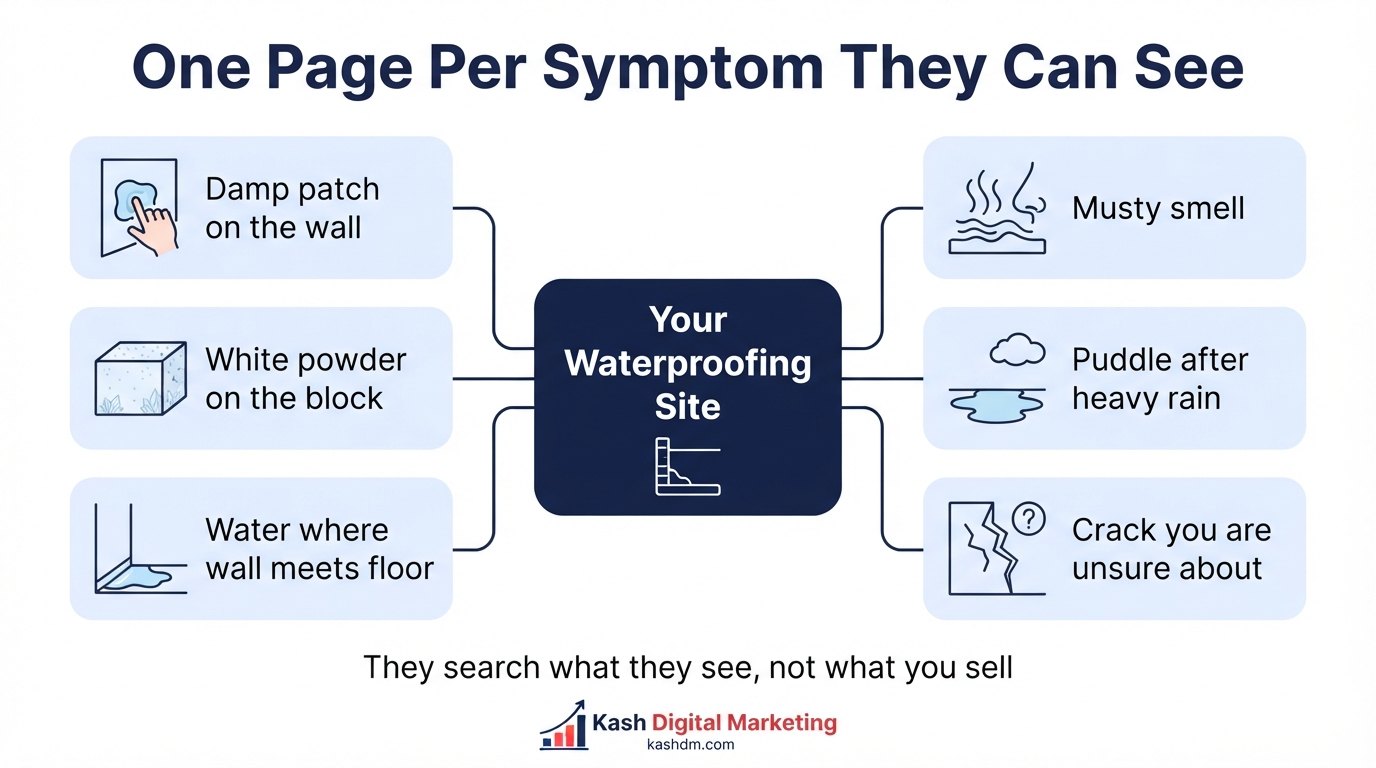
Homeowners rarely search for "basement waterproofing" first. They search for what they can see: a puddle by the wall, a white powdery residue, a musty smell, a crack that seems to have grown. The contractor whose content answers the symptom is the one who gets to explain the solution.
The three places a waterproofing contractor can appear
Paid ads sit at the top, the local map pack shows three businesses on a map beneath them, and organic results follow. Waterproofing SEO targets the second and third, and the organic side matters more here than in most trades because so much of the demand starts as a question.
Why symptom searches outrank service searches in value
"Basement waterproofing" is searched by people already convinced they need it. "Why is water coming through my basement wall" is searched by far more people, earlier, before anyone has been called. Owning the second group means you are the one who frames the problem.
The two halves of the work
The first half is your Google Business Profile and local signals, which decide the map pack. The second half is your website, which wins the question searches and converts the visitor into an inspection request. Doing one and skipping the other is the most common reason contractors conclude that SEO did not work.
What basement waterproofing SEO is not
It is not ranking for one head term. It is not stuffing city names into a footer, and it is not buying links. It is also not a project that finishes, because competitors keep publishing and Google keeps re-evaluating.
How a search becomes a booked inspection
A homeowner searches a symptom, finds your explanation, reads what it might cost, checks whether insurance covers it, looks at your reviews, and requests a free inspection. Every step in that chain is something SEO work can improve, which is why the discipline should be judged on booked inspections rather than rankings.

Why Waterproofing Contractors Depend on Search
Basement waterproofing is a large, unplanned, once-in-a-lifetime purchase that almost no homeowner has a trusted provider for, which makes search the first and often only place the decision gets made. There is no annual service visit, no maintenance relationship and usually no useful referral.
Most homeowners have never thought about their basement until the day they have to, and then they have to decide quickly, under stress, about a repair that can cost as much as a car.
The purchase is rare and the brand memory is nil
Very few people hire a waterproofing contractor twice. There is no habit to fall back on, so every job is competed for again in the open market, and search is where that competition happens.
The job value justifies serious competition
A full perimeter drainage system, a sump installation and wall treatment is a substantial contract. That value is why the category attracts aggressive marketing, and why a modest ranking improvement is worth a great deal.
Referrals are weak in this category specifically
Homeowners are often slightly embarrassed about basement water and do not volunteer the story the way they discuss a new kitchen. Word of mouth travels less freely here than in almost any other home service, which puts more weight on search.
Demand arrives in bursts, not steadily
Heavy rain, spring thaw and storm events produce sharp spikes in searching. Companies already ranked absorb that demand; companies that start reacting when the rain arrives are too late for that event.
Trust has to be established before the phone rings
A homeowner about to let a stranger diagnose an invisible problem and quote five figures is looking for reassurance. Reviews, plain explanations, real project photography and transparent process do that work before anyone picks up the phone.
How Homeowners Actually Search About a Wet Basement
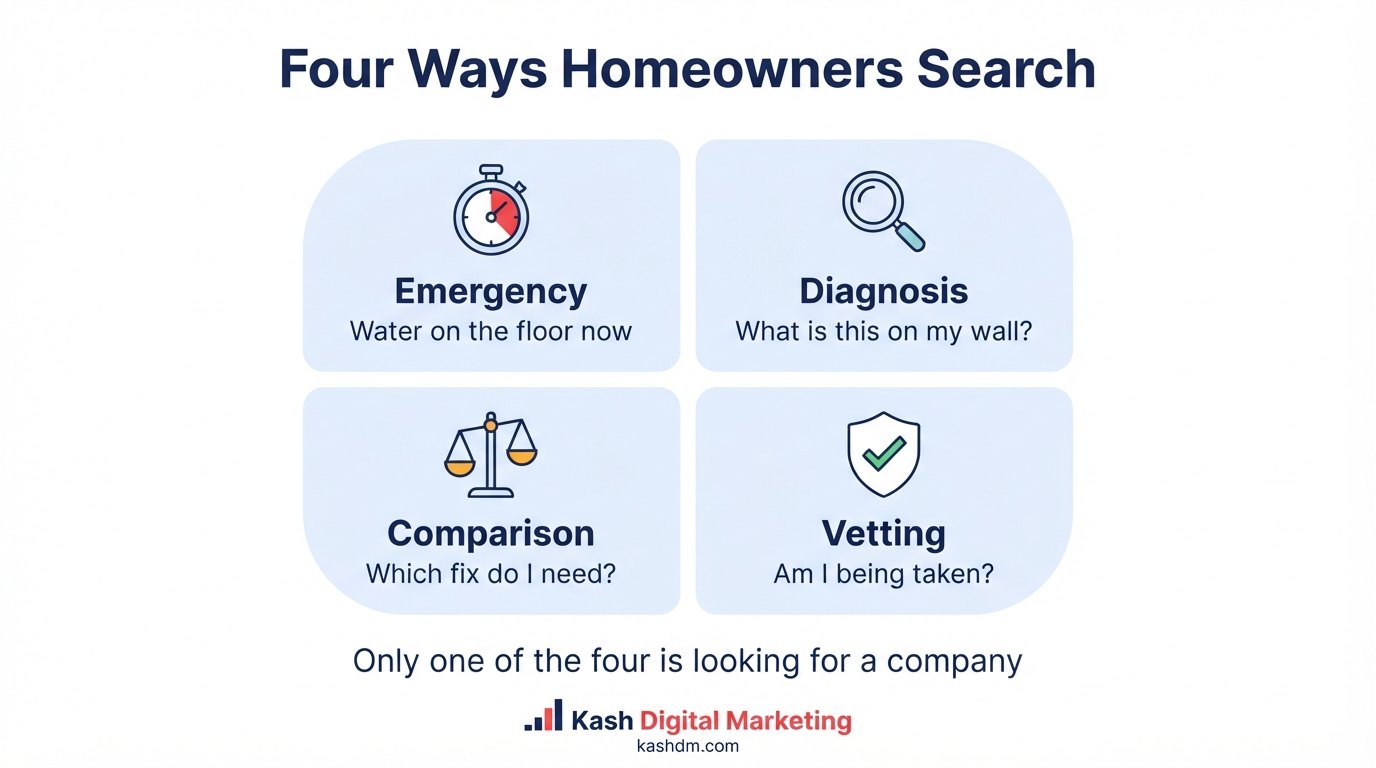
Homeowners searching about basement water fall into four groups, and only one of them is looking for a waterproofing company. Building only for that group, which is what most waterproofing sites do, forfeits the majority of the demand.
Understanding these groups is the difference between a site that ranks for terms nobody valuable types and one built around how frightened homeowners actually behave.
The emergency search
Water is on the floor right now. "Flooded basement," "water in basement after heavy rain," "basement flooding what to do." The searcher wants immediate help and will call within an hour. Speed, a visible phone number and honest availability decide this one.
The diagnosis search
Something is wrong but it is not an emergency. "White powder on basement wall," "musty smell in basement," "crack in basement wall when to worry," "damp basement floor." These are the largest and least contested searches in the entire category.
The solution-comparison search
Now they know they have a problem and want to understand the options. "Interior vs exterior waterproofing," "french drain vs sump pump," "waterproofing vs foundation repair," "is basement waterproofing worth it."
The vetting search
They have quotes in hand and are trying not to be taken. "Basement waterproofing scams," "how to choose a waterproofing contractor," "is my waterproofing quote reasonable," "do I need a second opinion." Uniquely important in this industry.
Why group determines page type
Emergencies need fast, phone-first pages. Diagnosis needs genuine explanation of causes. Comparison needs honest treatment of options you do not sell as well as those you do. Vetting needs the confidence to publish how to check a contractor, including you. One services page cannot serve four frightened readers.
The Trust Problem That Defines This Industry
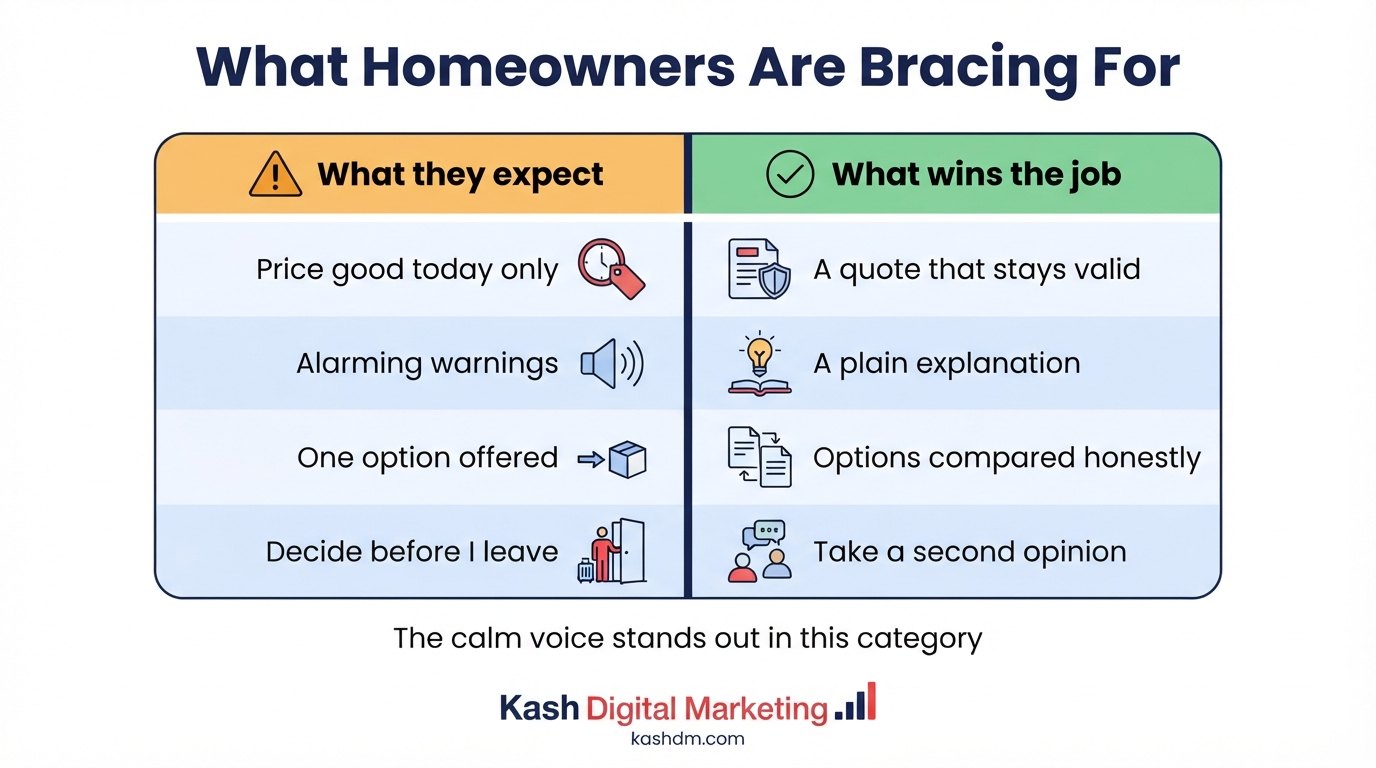
Basement waterproofing carries a reputation problem that most trades do not, and any contractor who ignores it in their marketing is competing with one hand tied. Homeowners arrive at the search already braced for high-pressure selling, and content that acknowledges this outperforms content that pretends otherwise.
This is the single largest strategic difference between waterproofing SEO and SEO for any other home service. The honest operator has an advantage available nowhere else, and almost nobody claims it.
What homeowners have heard before they search
Same-day pressure closes, prices that expire at the end of the visit, commissioned sales representatives rather than technicians, dire warnings about imminent structural failure, and quotes for the same basement that differ enormously. Whether or not it happened to them, they have read about it.
Why fear-based selling created an opening
An industry that leans on alarm trains its own customers to distrust it. That leaves the calm, explanatory voice standing out sharply, and search is the cheapest place to be that voice at scale.
Publish how to vet a waterproofing contractor, including you
A page explaining what a thorough inspection involves, what a fair quote itemises, why a second opinion is reasonable and which pressure tactics to walk away from will rank, will be shared, and will make you the company the homeowner already trusts on arrival.
Explain when waterproofing is not the answer
Sometimes the fix is a downspout extension, a regraded flowerbed or a gutter repair. Saying so publicly costs a few small jobs and earns the large ones, because a contractor who talks a homeowner out of work is the one they call when work is genuinely needed.
Transparency about diagnosis beats confidence about solutions
Homeowners do not expect a diagnosis over the internet. They expect honesty about what is possible to know before someone looks. Content that distinguishes the two is more persuasive than content that projects certainty.
Why this is a ranking strategy and not just an ethics one
Vetting and scam-related searches carry real volume and almost no competition from contractors, because most companies are unwilling to publish anything that invites scrutiny. That reluctance is the gap.
Local SEO and the Map Pack for Waterproofing Contractors
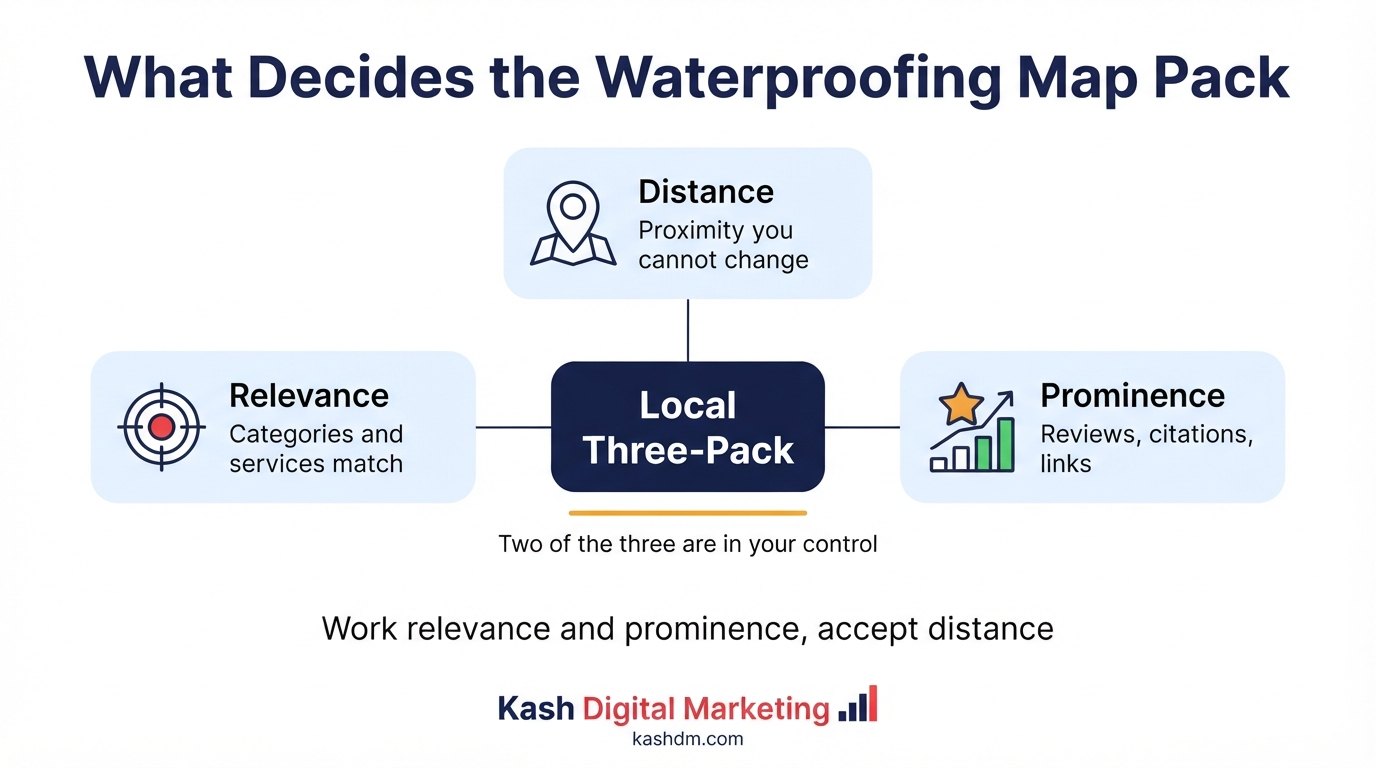
The three-result map pack sits above organic listings and produces a large share of the emergency calls waterproofing contractors receive, and Google ranks it on relevance, distance and prominence. Only two of the three are in your control.
Knowing which two is the fastest way to stop wasting effort on the one that is not.
Relevance: does Google understand what you do
Relevance comes from your profile categories, your listed services and your website content. A company listed under a general contractor category rather than a waterproofing category is telling Google something vague about a specific business, and it ranks accordingly.
Distance: the factor you cannot change
Google favours businesses near the searcher. You cannot relocate to every suburb you serve, and you must never fake an address, which is a suspension risk. What you can do is compete harder on the other two and build genuine local content for target areas.
Prominence: the factor most contractors neglect
Prominence is how established the business appears, built from reviews, citations, links and mentions. It is the slowest signal to build and the hardest for a competitor to copy quickly, which makes it the most durable advantage available.
Why the map pack matters most during rain events
When demand spikes, homeowners call from the map pack rather than reading three websites. Map visibility during a storm week is worth disproportionately more than the same visibility in a dry month.
Offices, yards and service-area businesses
Contractors working from a yard or home office should configure a service-area business with the address hidden and service areas defined. Handling this incorrectly is a common cause of profile suspension in the trades.
One profile cannot cover an entire metro
A single profile ranks strongly near its own location and weakens with distance. Covering a wide metro means building real local relevance through city pages, local links and reviews naming those areas, not expecting one pin to reach across a county.
Google Business Profile Optimization for Waterproofing Companies
Your Google Business Profile is the highest-return asset in basement waterproofing SEO, and most contractors have fixable errors sitting in theirs right now. It is also the fastest-moving part of the job, because Google re-crawls profiles constantly rather than on a slow content schedule.
This is where we start with almost every waterproofing client, because it is common to find years of lost calls traceable to a category setting or a duplicate listing nobody knew existed.
Primary category decides more than anything else
"Waterproofing Service" or "Waterproofing Company" is correct for most specialists. Foundation contractor, general contractor, drainage service and mould remediation belong in secondary categories where you genuinely offer them. Getting the primary wrong is the single most expensive setting error available.
List every service you actually sell
Interior drainage, exterior excavation and membrane, sump pump installation and replacement, battery backup systems, foundation crack injection, crawl space encapsulation, dehumidification and egress work. An empty services section tells Google almost nothing about a business that does a great deal.
Photographs that show the work, not stock basements
Excavation in progress, interior drainage being installed, sump systems, finished crawl spaces and your crews. Homeowners study these closely because the work is otherwise invisible to them, and stock imagery is transparent and adds nothing.
Duplicate listings quietly suppress everything
Duplicates are common in this trade, created by previous owners, franchise conversions, old marketing agencies or directory scrapers. They split reviews across two profiles and can suppress both. Finding and merging them is often the highest-value hour of an engagement.
Hours that tell the truth about emergencies
If you genuinely respond after hours during flooding, say so, and then answer. If you do not, do not claim it. Emergency searches convert on the phone being picked up, and an unanswered call listed as available produces a one-star review rather than a job.
The questions section is unusually valuable here
Homeowners ask the same anxious questions repeatedly. Seeding and answering them on the profile, honestly, puts your explanation in front of people who never reach your website.
Never manipulate the business name
Adding keywords to the business name field is a violation, it is reported by competitors routinely, and the penalty ranges from a filtered listing to suspension. An established contractor has far too much to lose.

Basement Waterproofing Keyword Research
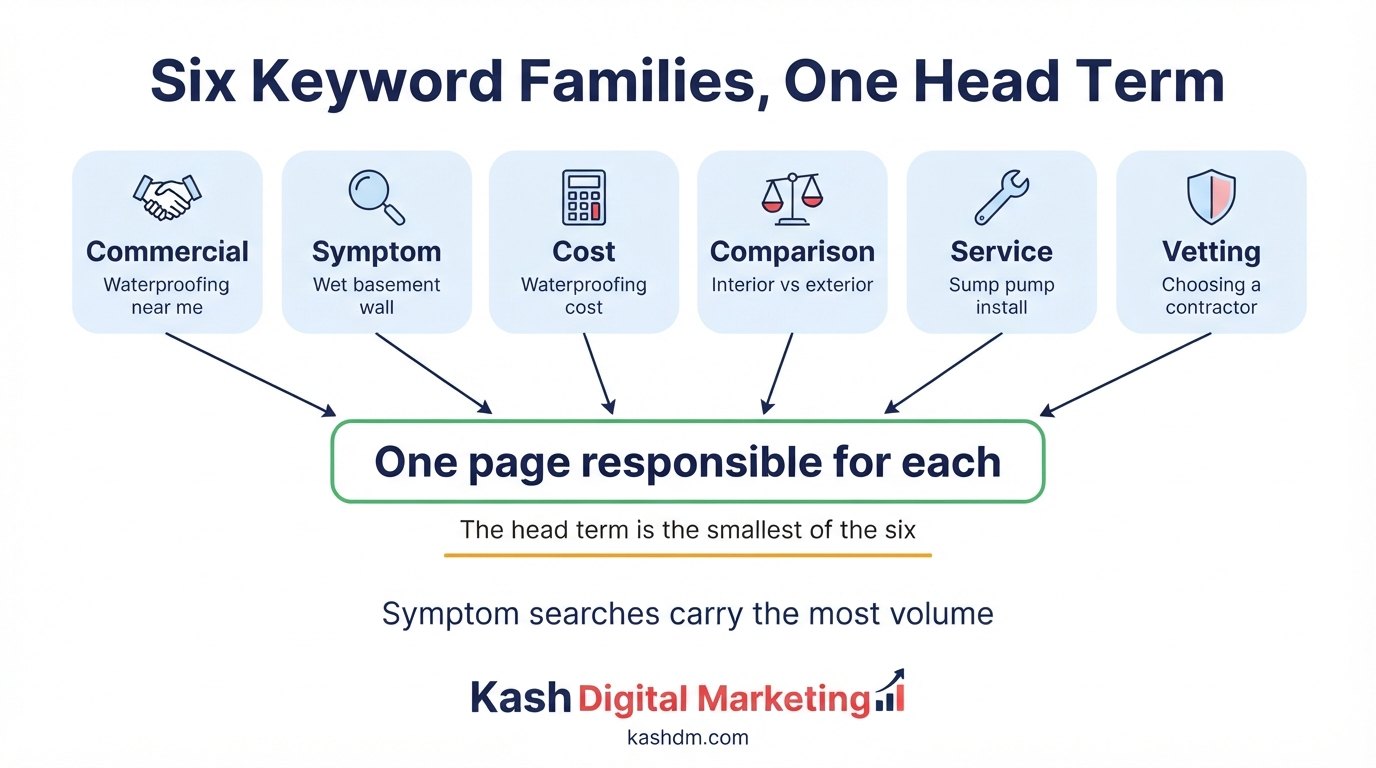
The waterproofing keywords worth ranking for split into four families, and the head term everybody asks about is the smallest of them. "Basement waterproofing" is searched by homeowners already sold on the idea. The symptoms, the costs and the comparisons are where the pipeline actually lives.
Chasing head-term volume rather than intent is the most common way waterproofing budgets are wasted, and it is easy to spot in a report full of impressive traffic and a quiet inspection calendar.
Commercial and hiring terms
"Basement waterproofing near me," "basement waterproofing company [city]," "waterproofing contractor [city]," "basement waterproofing estimate." Highest intent, most contested, heavily weighted to the map pack.
Problem and symptom terms
"Water leaking into basement," "wet basement walls," "white residue on basement wall," "musty smell in basement," "basement floor cracks," "water coming up through basement floor." Largest volume, earliest stage, least contested by other contractors.
Cost and value terms
"Basement waterproofing cost," "cost to waterproof a basement," "sump pump installation cost," "is basement waterproofing worth it." Genuine buying intent and the searches homeowners are most afraid of asking a salesperson.
Solution comparison terms
"Interior vs exterior basement waterproofing," "french drain vs sump pump," "waterproofing vs foundation repair," "crack injection vs excavation." Mid-funnel, low competition, and the easiest place to demonstrate genuine expertise.
Service-specific terms
"Sump pump installation," "crawl space encapsulation," "foundation crack repair," "interior drainage system," "exterior waterproofing membrane," "egress window installation." These match the specific job and convert far better than the generic term.
Vetting and trust terms
"Basement waterproofing scams," "how to choose a waterproofing contractor," "questions to ask a waterproofing company," "second opinion basement waterproofing." Almost entirely unclaimed by contractors, and enormously persuasive when claimed.
Keywords worth deliberately ignoring
DIY sealant queries from homeowners who will never hire anyone, products you do not install, cities you cannot serve, and national terms with no local intent. Ranking for these produces healthy-looking traffic and an empty schedule.
Problem-Based Content: The Largest Untapped Cluster
Symptom searches are the biggest and least contested opportunity in basement waterproofing, because homeowners describe what they see long before they know what to call it. The contractor who explains the symptom gets to define the problem, and whoever defines the problem usually sells the solution.
Most waterproofing websites are built entirely around services. That leaves the entire diagnostic stage of the customer journey unserved.
Write a page for each symptom, not each service
Efflorescence, damp patches, standing water after rain, water through the cove joint, hydrostatic seepage through the floor, musty odour, mould on stored belongings, bowing walls, stair-step cracks. Each is a distinct search and a distinct anxiety.
Explain the cause before the cure
A homeowner who understands why water is arriving is far more receptive to the solution than one who is simply told what to buy. Explaining grading, gutters, hydrostatic pressure and the water table plainly is what earns the inspection.
Say plainly when a symptom is not urgent
Some cracks are cosmetic and some efflorescence is historic. Contractors who say so build the credibility that makes their urgent warnings believable when it matters.
Use plain language, not industry vocabulary
Homeowners do not search for "cove joint seepage." They search for "water coming in where the wall meets the floor." Content should use their words and introduce yours, not the reverse.
Photographs of the actual symptom outperform diagrams
A homeowner comparing their wall to a photograph is engaged in a way a technical illustration cannot match. Your crews walk past these photographs on every job.
Link symptoms to solutions, not to the contact form
A symptom page should explain, then point to the relevant service page, then offer the inspection. Jumping straight from a frightening symptom to a sales request is the pattern homeowners have learned to distrust.
Cost Content in a Category Homeowners Distrust
"How much does basement waterproofing cost" is among the most searched and least honestly answered questions in this industry, which makes it the single largest content opportunity available to a transparent contractor. Homeowners ask it precisely because they expect the answer to be hidden from them.
The instinct to withhold pricing is stronger here than in most trades, because scope genuinely varies. But refusing to engage confirms the suspicion the homeowner already arrived with.
Why silence costs more than a range
A homeowner who finds no useful pricing anywhere assumes the number is bad. One who finds a clear explanation of what drives cost arrives at the inspection informed and calmer, which is a better conversation for everyone.
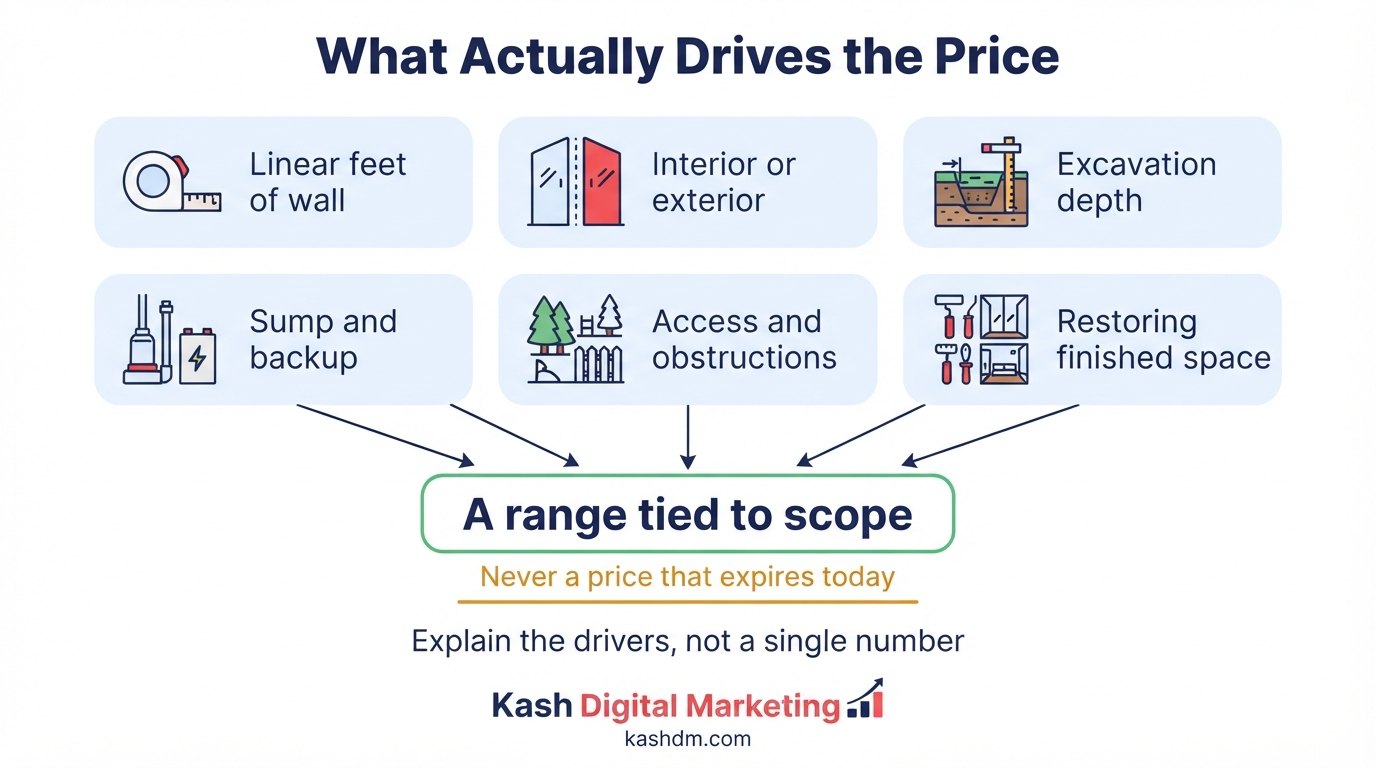
Publish the drivers, not a single figure
Linear feet of wall treated, interior versus exterior approach, depth of excavation, sump and backup requirements, access constraints, restoration of finished space, and whether the cause is drainage or structural. Ranges tied to scope are defensible in a way one number is not.
Cost by solution type
Interior drainage systems, exterior excavation and membrane, crack injection, sump installation, crawl space encapsulation and dehumidification each sit at very different price points. Homeowners searching for one should not land on a page about another.
Explain why quotes vary so widely
This is the question behind the question. Different diagnoses, different system designs, different warranty terms and different business models produce genuinely different numbers for the same basement. Explaining that plainly is more reassuring than any promise of a low price.
Financing as a legitimate topic
For an unplanned five-figure repair, financing availability is a real decision factor rather than a footnote. Stating plainly what exists removes a barrier that otherwise stops a homeowner enquiring at all.
Never publish a price that expires
Countdown offers and same-day discounts are exactly the pattern homeowners associate with pressure selling in this category. They convert poorly online and undermine the trust the rest of the site is building.
Insurance Content: The Question Nobody Answers Properly
Homeowners overwhelmingly assume their insurance covers basement water, and discovering otherwise is one of the most common searches in this category. Content that explains the distinction accurately is genuinely useful, highly searched and almost entirely absent from contractor websites.
This is where basement waterproofing differs sharply from roofing. In roofing, the insurance claim is often the path to the job. Here, the honest answer is usually that no claim is coming, and saying so early builds more trust than avoiding it.
The distinction homeowners get wrong
Standard homeowners policies generally respond to sudden, accidental water originating inside the home, such as a burst pipe. Groundwater, surface water and seepage entering from outside are typically excluded and fall under separate flood coverage where it exists at all.
Why this matters commercially
A homeowner who believes a claim will pay is not a buyer yet. One who has just learned it will not is a buyer today. Being the source that explained it puts you in the conversation at exactly the right moment.
Prevention is almost never covered
Waterproofing as an improvement is a homeowner expense in essentially all cases. Stating this plainly saves the homeowner a wasted call to their insurer and positions the work correctly as protection of the asset.
Where a claim genuinely might apply
Sump pump failure endorsements, sewer and drain backup riders, and sudden internal plumbing failures. Explaining the narrow cases where coverage may exist is more credible than a blanket answer in either direction.
Stay on the right side of the line
Explain the general landscape, note that policies and state regulation differ, and tell homeowners to read their own policy or call their agent. Never advise on how to characterise a claim, and never promise a coverage outcome.
Document damage regardless
Photographs, dates and rainfall context help the homeowner whether or not a claim is possible, and they help you scope the work accurately. It is useful advice that costs nothing to give.
Owning the Interior Versus Exterior Question
"Interior versus exterior basement waterproofing" is the defining comparison search in this industry, and it is where homeowners are most confused and most vulnerable to a one-sided answer. The contractor who explains both honestly wins the searcher who has already been given a single option by somebody else.
Most companies specialise in one approach and write about the other dismissively. That is transparent to a reader who has just been told the opposite by a different contractor, and it costs the sale.
Explain what each approach actually does
Interior systems manage water that has already reached the foundation and route it to a sump. Exterior systems aim to stop water reaching the wall at all. They solve related but different problems, and the honest answer is that the right one depends on the cause.
Be honest about cost and disruption
Exterior work involves excavation, landscaping disruption and higher cost. Interior work is less invasive and less expensive. Pretending otherwise about whichever one you sell is the fastest way to lose a well-researched homeowner.
Where each is genuinely the better answer
Explain the conditions plainly: the source of the water, the depth, the foundation type, the site grading, whether the wall is failing structurally. A page that helps a homeowner reason about their own basement will rank and will convert.
The cases where neither is the first step
Downspouts discharging at the foundation, negative grading, blocked gutters and window well drainage. Fixing these can resolve the problem entirely, and saying so is the single most trust-building statement a waterproofing company can publish.
Waterproofing versus foundation repair
A distinct and heavily searched confusion. Water intrusion and structural movement are different problems that sometimes share symptoms. Explaining the difference prevents the homeowner buying the wrong solution and positions you as the diagnostic authority.
Why balanced comparison content outranks partisan content
Search engines reward pages that satisfy the question rather than steer it, and homeowners cross-check. A genuinely balanced comparison earns links from outside the industry in a way a sales page never will.

Foundation Repair and Waterproofing: One Business, Two Search Markets
Most waterproofing contractors also do foundation work, and most of their websites treat it as a footnote. That is a mistake, because foundation repair is a separate search market with its own vocabulary, its own urgency and frequently a higher job value.
A homeowner with a wet basement searches about water. A homeowner with a cracked foundation searches about cracks, settling, bowing walls, sticking doors and uneven floors. Those searchers rarely type the word waterproofing at all, which means a site optimised entirely around waterproofing is invisible to them.
The overlap is real but it is not total, and the practical answer is not one page trying to be both. It is:
- A waterproofing section covering interior drainage, exterior excavation, sump systems, vapour barriers and crawl spaces
- A foundation section covering wall cracks, bowing and leaning walls, piering and underpinning, slab settling and carbon fibre reinforcement
- Symptom-led pages that catch people who do not know which category their problem falls into: sticking doors, cracks above windows, sloping floors, a musty smell that will not go away
- Clear internal linking between the two, because a genuine share of waterproofing enquiries turn out to be foundation jobs and the reverse
If you sell both and only market one, you are paying for the capability and capturing half the demand.
Seasonal SEO: Spring Thaw and Storm Events
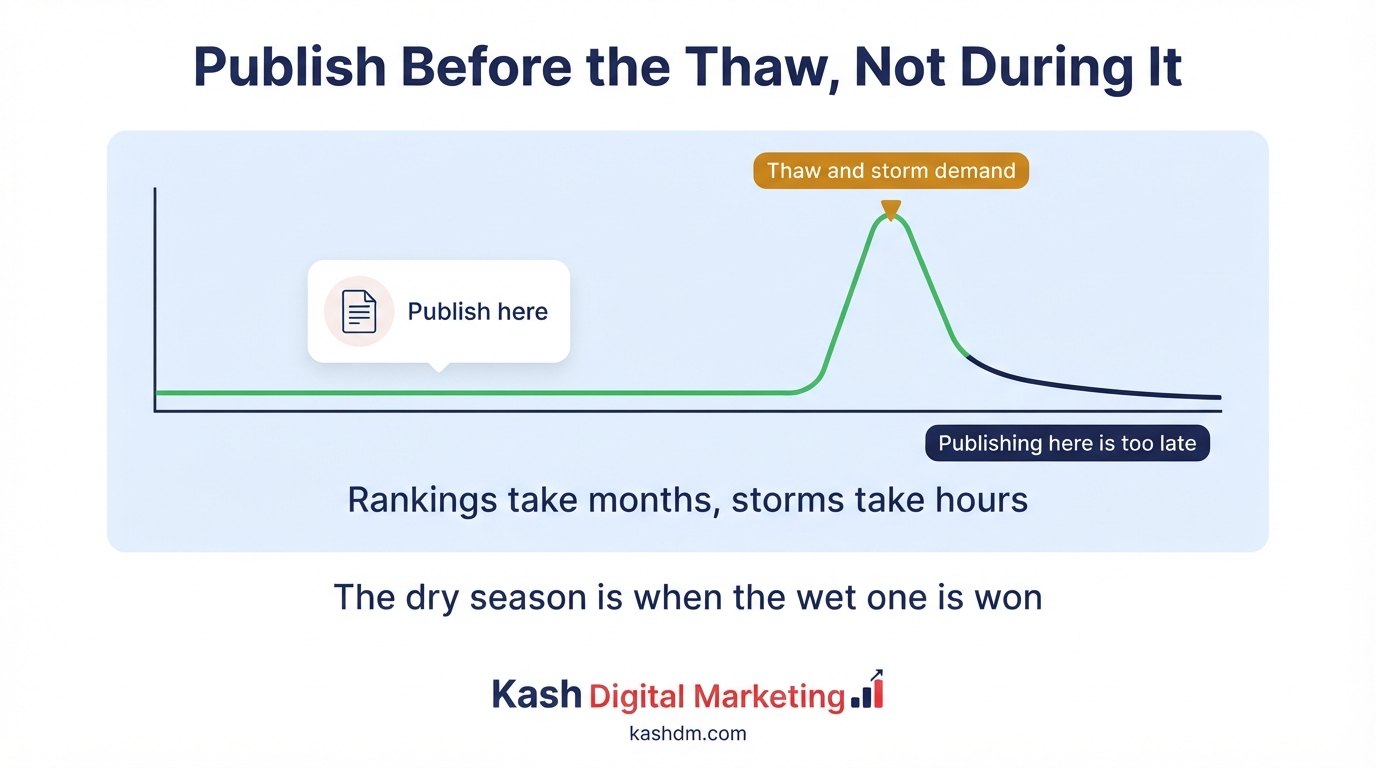
Basement water demand arrives in predictable annual spikes and unpredictable storm surges, and content published during the spike is too late to rank for it. The quiet months are when the busy months are won.
This mirrors storm work in roofing, with one advantage: the largest spike is seasonal and therefore plannable.
The spring thaw spike
Frozen ground, melting snow and saturated soil send water toward foundations faster than systems can manage. In northern markets this produces the year's heaviest concentration of searches, and it recurs on roughly the same schedule every year.
Heavy rainfall events
A single sustained storm produces a sharp surge within hours. Companies already ranked absorb it. Companies that begin reacting when the rain starts are competing for attention they cannot yet earn.
Publish ahead of the season, not into it
Thaw and flooding content should be written, published, indexed and matured in autumn and midwinter. The work feels premature at the time and pays entirely at the moment demand arrives.
The dry-season problem and how content solves it
Summer and early autumn are quiet, and that is exactly when prevention, inspection and maintenance content should be ranking. A homeowner who had water in March is receptive in September if somebody is there to prompt them.
Regional differences are real content
Frost depth, clay soils, high water tables, hurricane rainfall and monsoon patterns all shape the problem differently by market. This is knowledge a local contractor has and a national competitor cannot fake.
Emergency capacity and honest messaging
During a spike everyone is overwhelmed. Publishing realistic response expectations rather than implied immediacy protects your reviews at the exact moment they are most exposed.
Exterior Waterproofing: The Higher-Value Search Nobody Optimises For
Exterior waterproofing, excavating to the footing, sealing and membraning the foundation wall from outside, replacing drain tile, is usually the largest job a waterproofing company sells. It is also the one with the least content written about it, because it is harder to explain and homeowners rarely know to ask for it by name.
That combination is exactly what an SEO opportunity looks like: meaningful search demand, high job value and thin competing content.
What a page on this needs to cover, in the homeowner's terms:
- What exterior waterproofing actually involves, including the excavation, because the disruption is the objection
- When it is genuinely the right answer, and when interior drainage will solve the problem for less
- What the landscaping, driveway and access constraints mean in practice
- Why the price gap between interior and exterior exists, explained rather than defended
- How long the work takes and what the property looks like during it
A contractor who explains honestly when the cheaper option is sufficient wins more of the expensive jobs, not fewer. Homeowners can tell the difference between advice and a sales pitch, and this is a category where they are actively looking for it.
Service Pages for Every System You Install
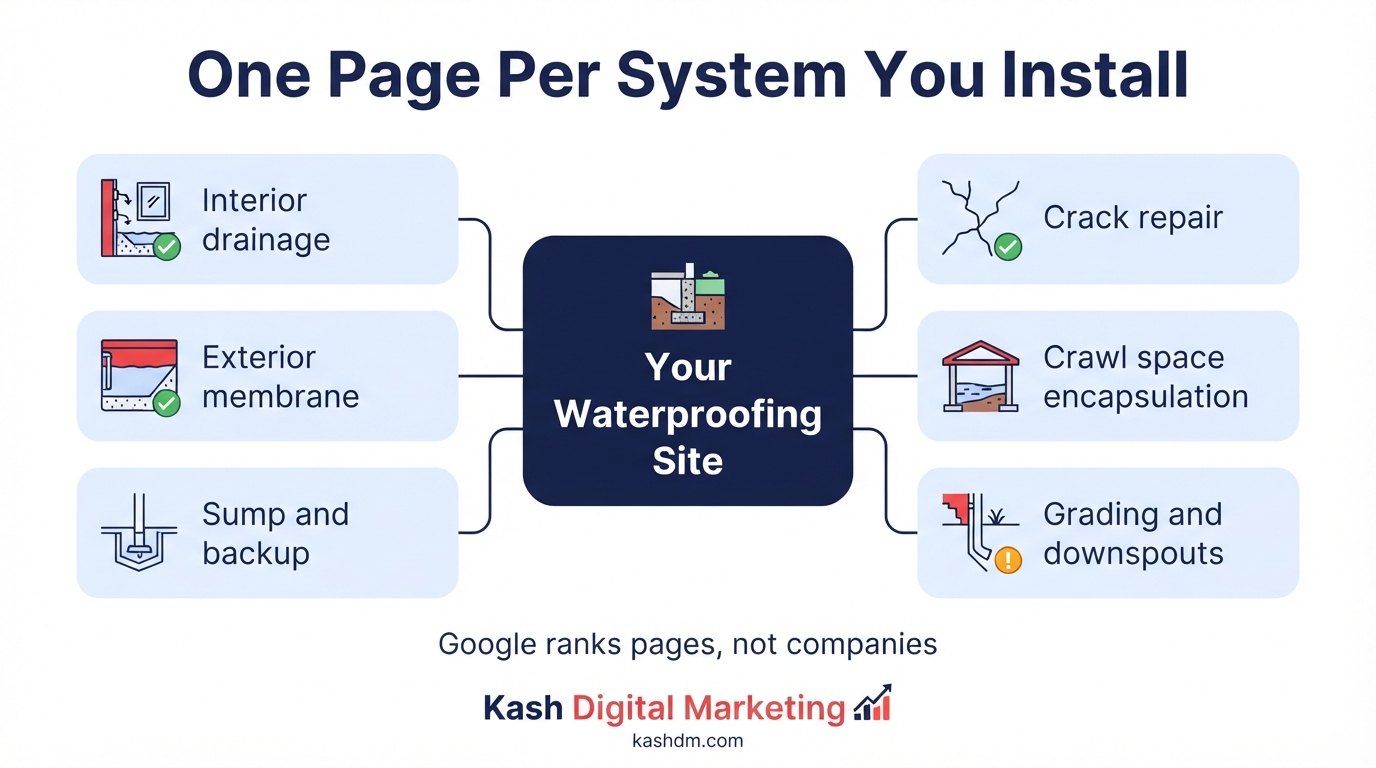
Every service you sell needs its own page, because Google ranks pages rather than companies and one page cannot rank for interior drainage, exterior membrane, sump systems and crawl space work at once. This is the most reliable structural upgrade available to a typical waterproofing website.
Most waterproofing sites we audit have two or three pages covering work that deserves ten. Each absent page is a service that simply cannot be found.
Interior drainage systems
The most commonly sold system and usually the flagship page. It should explain how the system captures and routes water, what the installation involves, and what the homeowner should expect during and after.
Exterior excavation and membrane
Higher cost, greater disruption, and a different buyer. Homeowners researching this are usually further along and more technically engaged, and the page should respect that.
Sump pumps, backups and alarms
Frequently searched independently, often as a first purchase before a larger system. Covers replacement, capacity, battery backup and what happens in a power cut, which is the question homeowners actually ask.
Foundation crack repair and injection
A smaller job that is frequently the entry point to a relationship. It also sits at the boundary with structural work, and the page should be clear about where that boundary is.
Crawl space encapsulation and dehumidification
A distinct service with its own vocabulary and its own search demand, frequently buried inside a general waterproofing page where it cannot rank.
Drainage, grading and exterior water management
Downspout extensions, french drains, window wells and regrading. Small-ticket work that builds enormous credibility because recommending it demonstrates you are not selling the biggest system by default.
Mould, air quality and finished basement restoration
Adjacent concerns homeowners raise constantly. Where you offer them, they deserve pages; where you do not, saying so and referring on is still worth publishing.
What separates a real service page from a thin one
The actual process, honest discussion of cost drivers and disruption, photographs of your own installations, the questions homeowners ask, warranty terms, and a specific next step. A page that could belong to any contractor in America will rank like one.
City and Location Pages for Waterproofing Contractors
A waterproofing contractor ranks in the areas where it has genuine local content, not in every city it claims to serve. One page per market you actually work in, carrying real local detail, outperforms fifty templated pages with the city name swapped.
This is where waterproofing SEO most often goes wrong, because bulk location pages are easy to generate and look like progress on a report while doing active harm.
What belongs on a real city page
The neighbourhoods you cover, jobs completed there with photographs, the soil and water table conditions in that area, the typical foundation types, local permit notes, and reviews from customers there. None of it can be copied.
Why templated location pages backfire
Pages identical except for a city name are treated as duplicates. At best they are ignored, at worst they dilute the authority of pages that were working. This trade is badly affected because the temptation to mass-produce is strong.
Local ground conditions are genuine content
Clay soils that expand and contract, high water tables, bedrock depth, historic fill, neighbourhoods built on former wetland, and areas where a specific decade of construction shares a specific foundation weakness. This is expert local knowledge no national competitor has.
Housing stock and foundation age
Stone foundations in older districts, block walls from a particular era, poured concrete in newer subdivisions. Homeowners recognise their own house in this writing, and recognition converts.
Choose areas by revenue, not by map coverage
Rank the markets producing real jobs and build those first. A page for a town you would rather not send a crew to competes for attention with one you would.
Internal linking between areas, symptoms and services
Each city page should link to the symptoms common there and the services that address them, and each service page should link back to the areas where you sell it. This structure tells Google you cover a service area properly rather than claiming to.
Proof, Warranties and Resale Value
Waterproofing is invisible once finished, which makes documented proof and warranty terms unusually important both to homeowners and to search visibility. A homeowner cannot admire a drainage system the way they admire a kitchen, so the evidence has to be constructed deliberately.
This is also where a serious contractor separates from a transient one, and where content can make that separation obvious.
Project documentation as content
Before, during and after photographs, the diagnosis, the system installed, the conditions encountered and the outcome after the next heavy rain. Excavation and installation photography is genuinely interesting and almost nobody publishes it well.
Warranty terms deserve a page, not a footnote
What is covered, for how long, what voids it, and what happens if the company changes hands. Homeowners in this category read warranty terms carefully because they have been warned to.
Transferable warranties and the resale conversation
A warranty that transfers with the property is a genuine asset at sale time, and homeowners search for this specifically. Where you offer it, explain what transfers and how.
Documented dryness supports the home's value
A basement with a documented system and an active warranty is easier to sell than one with a history of water and no paperwork. This is a legitimate, checkable argument that does not require inventing a percentage.
Follow-up after the next storm
Returning after the first heavy rainfall to confirm the system performed is both good practice and the natural moment to request a review that mentions the specific storm.
Never fabricate proof
No stock before-and-afters, no invented testimonials, no borrowed project photography. In a category defined by distrust, being caught once is terminal.
Website SEO and the Free Inspection Conversion
A waterproofing website has one job: turn a worried homeowner into a booked inspection, and the offer that converts is an inspection rather than a quote. Everything technical serves that.
We fix structural and technical problems before publishing anything new, because adding content to a broken foundation is the most common way waterproofing budgets get spent without result.
The free inspection is the conversion, not the sale
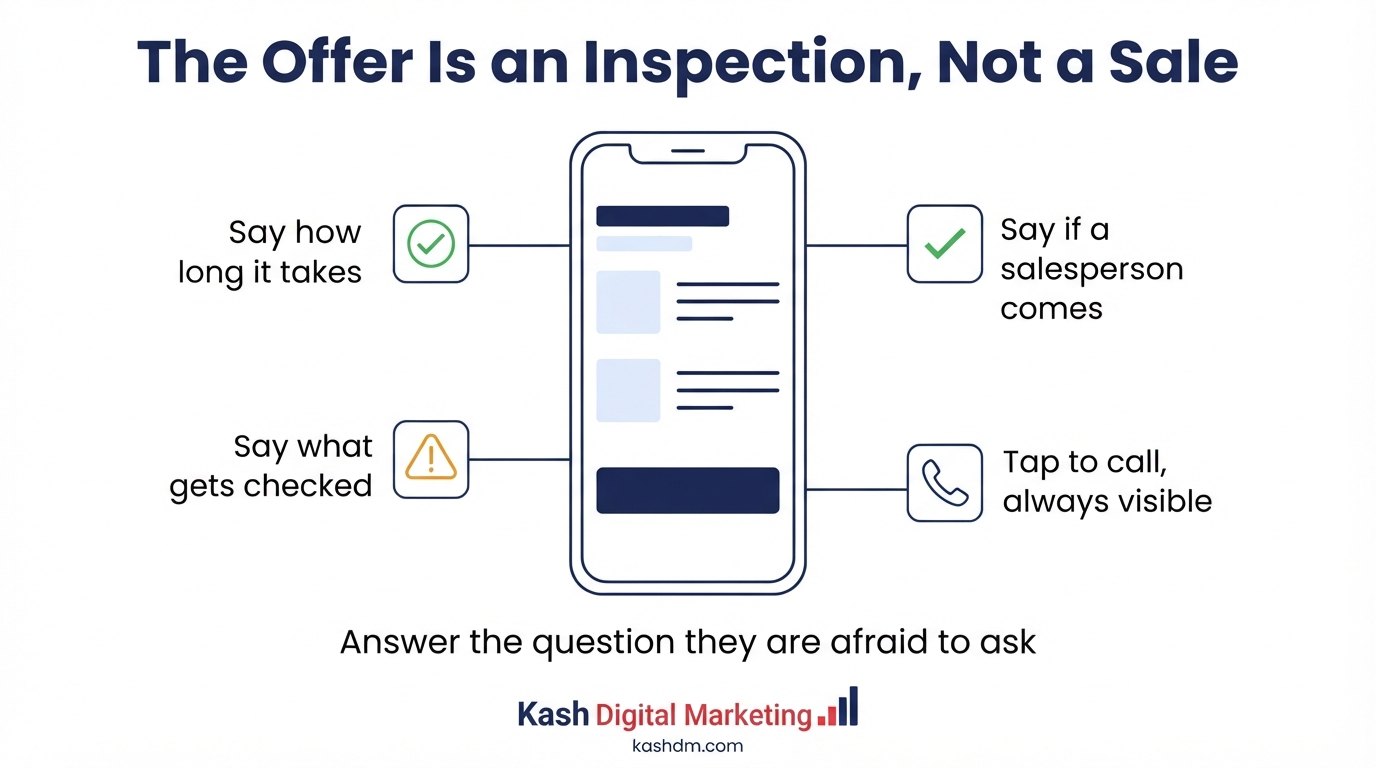
Homeowners are not ready to buy a system from a website. They are ready to have somebody look. Framing the call to action as an assessment rather than a sales visit removes the pressure they are bracing against.
Say what the inspection actually involves
How long it takes, what gets examined, whether a report is provided, and explicitly whether a salesperson will be present. Answering the last question honestly is a competitive act in this industry.
The phone number must be visible and tappable
Emergency searches convert on a call. A number hidden in a header image or buried on a contact page is the most expensive design decision available.
Trust signals that matter for an invisible repair
Licensing and insurance, years in business, named team members, warranty terms, association memberships, financing options and real reviews. Each removes a specific hesitation this particular buyer has.
Crawlability and indexation
If a page is not indexed it cannot rank. Waterproofing sites frequently have entire service or location sections excluded by an old directive, a stray noindex tag or a gallery plugin generating uncrawlable URLs.
Site architecture that mirrors the business
Symptoms, services, locations and resources should each sit in a clear section, with no important page more than a few clicks from the homepage. Flat, sprawling structures make it hard for Google to identify which pages matter.
Internal linking as a ranking instrument
Links from strong pages to weaker ones distribute authority and signal importance. On waterproofing sites this is usually the fastest technical improvement available, because symptom articles are typically linked from nowhere.
Technical SEO and Core Web Vitals
Technical SEO is the foundation under every ranking a waterproofing contractor earns, and it is invisible to customers right up until it costs a job. A site can have excellent content and still fail because Google cannot crawl it or a homeowner will not wait for it to load.
Most waterproofing searches happen on a phone, frequently in a basement with poor signal, which makes speed a practical constraint rather than a technical nicety.
Largest Contentful Paint
How quickly the main content appears. The usual culprit is an oversized hero image loading before anything else. Correct sizing and priority hints fix most of it.
Cumulative Layout Shift
Content jumping as images load, which makes a homeowner tap the wrong thing. Images without declared dimensions are the primary cause and it is entirely preventable.
Interaction to Next Paint
How quickly the page responds to a tap. Chat widgets, tracking scripts and form embeds stacked together are the usual cause, and these sites accumulate them from successive vendors.
Mobile-first means mobile-designed
Google evaluates the mobile version. Tap targets, readable text, a number that dials on tap and forms that work on a small screen are ranking factors and conversion factors simultaneously.
Duplicate content across location and service pages
The most common technical fault in this industry. Near-identical pages need genuine differentiation or consolidation, and canonical tags are a signal rather than a fix for pages that should not exist.
Redirect hygiene after a rebrand or franchise change
Waterproofing companies change names, leave franchises and merge more often than most trades. Each transition leaves redirect chains and orphaned pages that quietly bleed authority.
Third-party scripts and their real cost
Every widget should justify its place. These sites frequently carry scripts for review tools, chat systems and pixels from vendors nobody has worked with in years.
Schema Markup for Waterproofing Companies
Schema markup turns your business into machine-readable facts, which matters more every year as results are assembled rather than listed. It does not automatically produce rich results, and anyone promising that is overselling it. What it does is remove ambiguity about who you are and what you offer.
For a local service business the return is high relative to the effort, and it is almost always missing on waterproofing sites we audit.
LocalBusiness and the most specific accurate type
Use the most specific type that genuinely describes the business, with correct name, address or service area, phone, hours and coordinates. This states plainly what a search engine would otherwise have to infer.
Service schema for each system
Interior drainage, exterior waterproofing, sump installation, crack repair and crawl space encapsulation can each be described as a distinct service with its own area served. This supports page-level relevance that business-level markup cannot.
Service area rather than invented addresses
areaServed lets you state the cities and counties you cover without fabricating a presence in each one. For a service-area business this is the honest way to express coverage.
FAQ schema on pages that genuinely answer questions
Symptom and cost pages are natural candidates, and this content is used heavily by AI-generated answers. Mark up questions you actually answer, not questions invented to carry markup.
Review markup used honestly
Reviews may be marked up when they are genuine and displayed on the page. Fabricated review markup is a manual-action risk, and home services is a category Google watches closely.
Validate before deploying and keep it truthful
Markup must describe what a visitor actually sees. Hours in code that contradict the profile, or services listed only in markup, turn a helpful signal into a liability. Validate every template before it ships.
Reviews and Reputation for Waterproofing Contractors
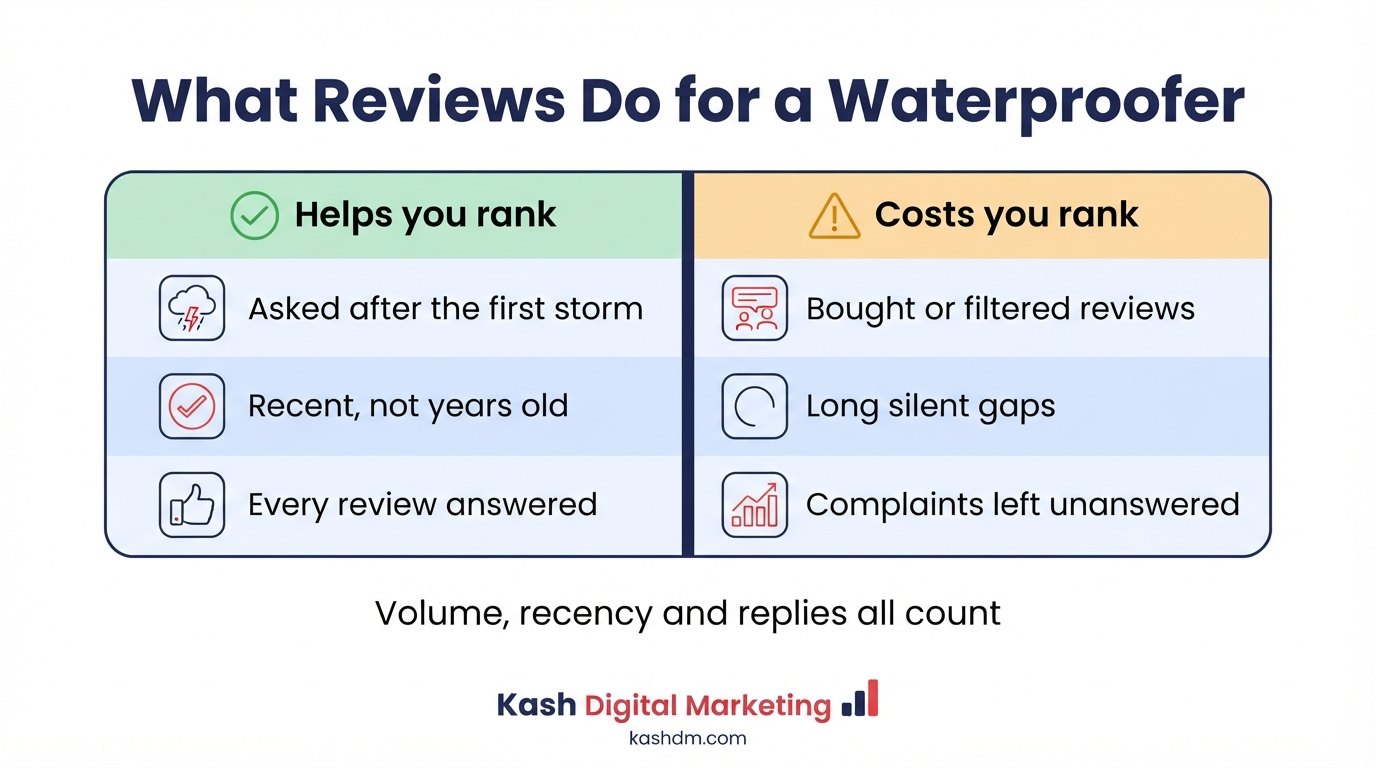
Reviews carry more weight in basement waterproofing than in almost any other trade, because the homeowner cannot inspect the finished work and is already primed to expect a bad experience. Volume, recency, rating and your replies all count.
Reputation is also the part of prominence a contractor controls most directly, which makes it the highest-leverage ongoing work available.
Recency matters as much as volume
A profile with many reviews and none this year reads as a business in decline. A steady arrival of recent reviews signals an operating company, and freshness is weighted as well as count.
Ask after the next heavy rain, not at the invoice
The moment a homeowner knows the system worked is the first storm after installation, not the day the crew leaves. A follow-up then produces reviews that describe the outcome rather than the politeness of the crew.
Reviews that describe the problem and the place
"Water through the wall every spring in our Beverly bungalow, dry through two storms since" carries relevance and persuasive weight that a bare five stars does not. Asking what the problem was produces these naturally.
Responding to every review, especially the difficult ones
This industry attracts strongly worded complaints. A calm, specific, non-defensive reply persuades far more readers than the complaint dissuades, and it is read as evidence you are not the company they were warned about.
Sales conduct is a marketing input
Many negative reviews in this category describe the sales visit rather than the workmanship. Reputation work that ignores how quotes are presented is cosmetic, and we will say so rather than paper over it.
Never buy reviews
Purchased and incentivised reviews are detectable, and in a category where homeowners are actively hunting for signs of dishonesty, being caught is far more damaging than the reviews were worth.
Citations and Local Link Building
Citations corroborate that your company is real and established, and local links are what separate a contractor that ranks from one that merely has a tidy website. Consistency matters more than quantity in the first, and genuine relationships matter more than volume in the second.
Waterproofing businesses accumulate inconsistent listings unusually fast, because franchise changes, name changes and supplier directories all create them.
Why name, address and phone consistency is the whole point
Two versions of your phone number across the web is a contradiction a search engine has to resolve, and it resolves it by trusting you slightly less. Cleaning this up is unglamorous work with a measurable effect.
Old listings from franchise and name changes
Contractors who left a franchise or rebranded almost always have stale listings carrying the former name. Each quietly contradicts the current record, and finding them is part of the audit.
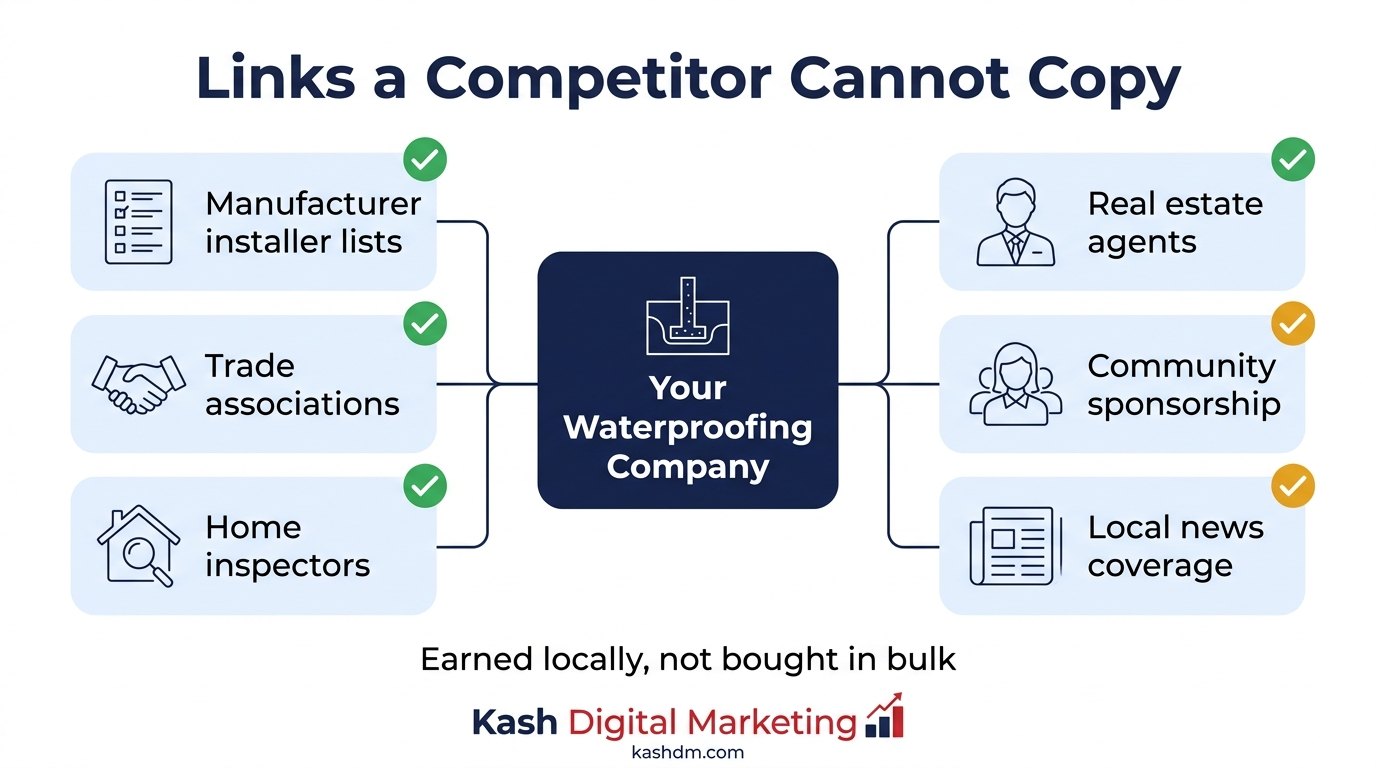
Manufacturer and supplier dealer directories
Drainage, membrane, sump and encapsulation manufacturers maintain certified installer directories. These are among the most relevant links available and many contractors already qualify without realising it.
Trade associations and licensing bodies
Foundation and waterproofing associations, contractor licensing registries and regional builder groups all provide legitimate, locally relevant listings.
Real estate agents, inspectors and adjacent trades
Home inspectors, realtors and structural engineers all field basement water questions constantly and publish resource pages. These relationships usually exist offline already and are simply not reflected online.
Local press and seasonal stories
Local reporters cover flooding, thaw damage and storm preparation every year. A waterproofing contractor is a natural source, and one local news mention often outweighs months of low-quality link acquisition.
What to refuse
Purchased link packages, private blog networks, irrelevant directory spam, automated links and excessive exact-match anchor text. The penalty risk is not worth a temporary gain for a licensed business with a real reputation.
Content Clusters and Topical Authority
Topical authority is what makes a waterproofing site rank for searches it never explicitly targeted, and it comes from covering basement water completely rather than publishing occasionally. Google is judging whether your site is a credible source on the subject.
The cluster model organises that coverage, and it is the difference between a neglected blog and a library that lifts the pages which actually sell work.
Four clusters worth building properly
Symptoms and causes, solutions and systems, cost and value, and vetting and trust. Each deserves a pillar and supporting pages, all linked to each other and back to the pillar.
Cover a cluster completely or leave it alone
Half a cluster performs worse than none because it signals shallow coverage. Choosing three subjects and covering them thoroughly beats touching ten.
The questions your inspectors answer every day
Your team already knows what homeowners ask on every visit: will this happen again, how long will it take, will you damage the garden, what happens if it fails, do I have mould. These make better content than any keyword tool suggestion.
Local ground and weather content only you can write
Soil types, water table behaviour, frost depth, historic flooding and the construction eras in your market. This is the content a national competitor structurally cannot produce.
Updating old content usually beats writing new content
Refreshing a symptom page already sitting on page two frequently produces faster gains than publishing something new. Most waterproofing sites have several of these sitting unexamined.
Publishing rhythm beats publishing volume
Consistent, useful publication over a year outperforms a burst followed by silence. A sustainable pace is far more valuable than an ambitious one that stops in month three.
AI SEO for Basement Waterproofing Companies
Search results are increasingly assembled into direct answers rather than listed as links, and basement water questions about causes, costs and insurance are exactly the kind those answers address. Being the source they cite is now part of the job.
There is also a second meaning of AI SEO in this industry, which is using AI tools in the production of the work. Both are worth addressing, and the second carries real risk.
Answer the question in the first sentence
Content structured so each heading is followed immediately by a direct, complete answer is far more likely to be quoted. Burying the answer three paragraphs into context is the most common reason good content is passed over.
Consistent business facts everywhere
Your name, phone, service area, services and profiles should agree across every surface. A system assembling an answer about waterproofing contractors in your city is resolving an entity, and contradictions are a reason to omit you.
Original field knowledge cannot be summarised away
Local soil behaviour, what a particular construction era hides behind the wall, what a specific symptom usually means in your market. Content that only repeats what is published elsewhere has nothing to be cited for.
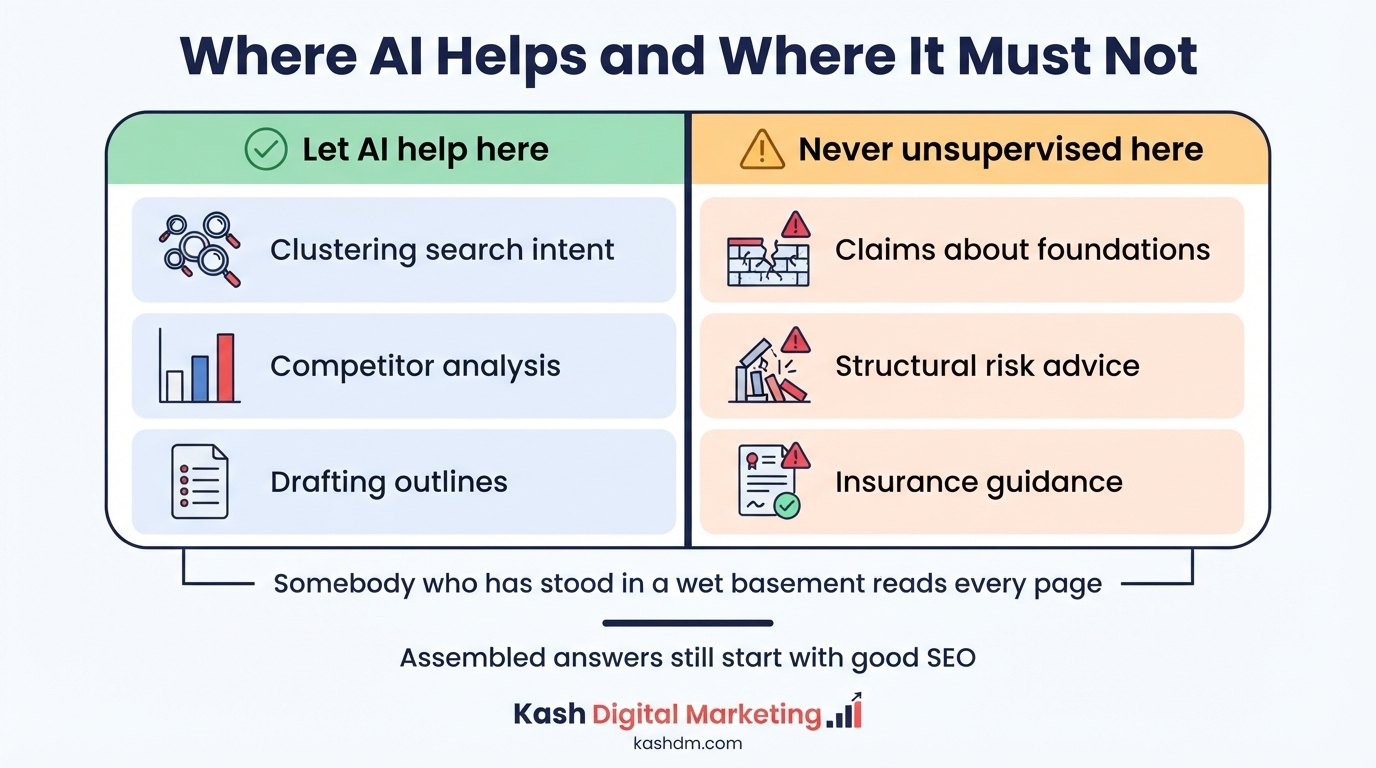
Where AI genuinely helps in producing SEO work
Clustering search intent, discovering topics, analysing competitor coverage, drafting outlines, generating candidate FAQ questions and spotting internal linking opportunities. These are research and structuring tasks and AI is good at them.
Where AI must not be trusted unsupervised
Anything factual about foundations, drainage, structural risk, insurance or local code. Generic AI-written contractor pages are exactly what search systems are built to filter out, and in this category a confident wrong statement is a liability rather than merely a ranking problem.
How to use AI without producing low-quality pages
Verify every claim, add the contractor's own field experience, use original photographs and real project examples, include local knowledge, and have somebody who has actually stood in a wet basement read every page before it publishes.
Traditional rankings still underpin all of it
Being cited in a generated answer correlates strongly with ranking well conventionally. AI SEO is a layer on competent SEO, not a replacement, and anyone selling it as a shortcut is selling something else.
E-E-A-T and Trust Signals
Experience, expertise, authority and trust matter more in this category than in most, because the advice concerns structural risk and the industry's reputation invites scepticism. Anonymous content performs poorly here regardless of how well written it is.
Demonstrating who is behind the advice is both a ranking consideration and the main persuasion mechanism on the page.
Show who wrote it and why they know
Named authors with real field credentials, years in the trade and the roles they hold. A page attributed to a person who has diagnosed a thousand basements is a different document from one attributed to nobody.
Publish credentials, licensing and insurance
Licence numbers where applicable, insurance coverage, manufacturer certifications and association memberships. Homeowners in this category have been explicitly told to check these.
Real project photography is expertise made visible
Excavation, installation and finished systems from your own jobs. It demonstrates capability in a way claims cannot and it cannot be replicated by a competitor writing from a desk.
Be explicit about limits and uncertainty
Saying that a diagnosis requires an in-person inspection, that a symptom has several possible causes, or that structural questions need an engineer, reads as competence rather than weakness.
Contact details and a real address presence
A findable physical presence, real phone numbers and named contacts. Anonymity is a warning sign to a homeowner who has been reading about contractors who disappear.
Warranty and process transparency
Publishing what the warranty covers and how the inspection works removes exactly the uncertainties that make this buyer hesitate.
Basement Waterproofing SEO Versus PPC
SEO builds an asset the contractor owns, while paid advertising rents attention that stops the moment payment does. Most successful waterproofing companies use both, and the storm-driven demand pattern makes the combination genuinely useful here.
| Factor | SEO | PPC |
|---|---|---|
| Traffic source | Organic | Paid |
| Cost model | Investment in content and assets | Pay per click |
| Speed to results | Slower, months | Faster, days |
| Long-term value | Compounds | Stops when spending stops |
| Storm surges | Already ranked, no extra cost | Costs rise exactly when demand peaks |
| Best use | Sustainable acquisition | Immediate lead generation and testing |
What paid search does well
Immediate visibility, precise control of geography and timing, and the ability to test which symptoms and services convert before committing content to them. For a new company it buys presence while SEO matures.
What paid search does poorly
It stops instantly when the budget stops, and waterproofing clicks are expensive. During a storm week costs rise exactly when everyone needs visibility most, which is the worst possible time to be bidding.
Shared lead platforms
Useful for filling capacity, structurally unsuited to being the foundation of the business, and priced by a third party you do not control. A lead sold to four contractors starts a price conversation rather than a trust conversation.
The compounding difference
Every symptom page, review and link keeps working after it is paid for. A page published this year still produces inspections in three years. Advertising produces nothing the day after it stops.
The sensible combination
Use paid to cover gaps and test messaging, build SEO so the baseline calendar does not depend on it, and measure both against booked inspections and signed contracts rather than clicks.
Measuring Waterproofing SEO
The only waterproofing SEO metrics that matter are calls, inspections booked, contracts signed and revenue by service line. Rankings and traffic are diagnostic; they are not the result.
If a report cannot connect the work to inspections on the calendar, it is not a report on business performance, and a contractor is entitled to insist on the difference.
| KPI | Why it matters |
|---|---|
| Organic clicks | Measures search traffic reaching the site |
| Map pack visibility | Measures local presence across the service area |
| Phone calls | Measures emergency and direct demand |
| Form submissions | Measures online conversion |
| Inspections booked | Measures genuine buying intent |
| Contracts signed | Measures the business outcome |
| Revenue by service line | Measures actual return |
| Cost per booked inspection | Measures efficiency honestly |
Inspections booked, not forms started
Waterproofing forms abandon heavily because the homeowner is nervous. Measuring started against completed submissions isolates whether the problem is visibility or the form itself, and those need very different fixes.
Call tracking is essential in an emergency trade
A large share of the value arrives by phone during rain events. Without call attribution separating organic, profile and paid, every subsequent number is guesswork.
Revenue by service line
Interior systems, exterior work, sump replacements and crack repairs have very different values. Reporting by line shows which SEO work is paying and which produces enquiries without margin.
Seasonality has to be handled honestly
Comparing a thaw month against a dry one proves nothing. Reporting should compare like periods year over year, or state plainly when weather rather than work explains the movement.
Map pack visibility across the service area
Rankings vary by the searcher's location, so a single position number misleads. Grid-based local visibility shows where you genuinely appear and where the next city page is needed.
Metrics that mislead
Traffic without a baseline, rankings for terms nobody searches, impressions, and percentage improvements quoted without a starting number. Each can be technically accurate and completely uninformative.
How Long Basement Waterproofing SEO Takes
Profile corrections can move within weeks, symptom and long-tail terms usually enter the top ten within two to four months, and competitive city terms take six months or longer. There is no fixed timeframe, and any provider quoting one before looking at your market is quoting a sales figure.
This trade adds a seasonal complication: rankings earned in a dry month prove themselves only when the rain returns.
What decides your timeline
Domain history and existing authority, how many established contractors compete in your metro, city size, the strength of your profile, your review position, the condition of the website and your current rankings.
Weeks: the profile and the obvious faults
Duplicate listings, a wrong primary category, missing services and unindexed pages are corrections rather than campaigns. They frequently produce the first movement, because most contractors are held back by something broken rather than something absent.
Two to four months: symptom and long-tail terms
These face thin competition and move first. They are also the terms that start relationships, which is why they are built early even though they convert later.
Six months and beyond: commercial city terms
"Basement waterproofing [major metro]" is contested by established firms with years of accumulated authority and hundreds of reviews. Reaching them requires sustained content, links and reputation rather than a technical fix.
The season decides when rankings become revenue
A thaw page that reaches position three in August proves nothing until March. Ranking movement and revenue movement are separated by the weather, and honest reporting acknowledges the gap.
What happens if you stop
Rankings decay rather than collapse. Content keeps working, reviews age, competitors keep publishing, and position erodes over quarters. It is an asset that depreciates slowly, unlike advertising which stops the same day.
What Changes the Cost of Waterproofing SEO
Basement waterproofing SEO is priced by the size of the job, and the job is defined by your market's competitiveness, how many areas you serve, the condition of your website and how many services you sell. Anyone quoting before examining those is quoting a package rather than your business.
We do not publish a price list for this reason. A single-city contractor with a healthy site and a multi-metro operation with a suspended profile are different jobs, and pretending otherwise serves the agency rather than the contractor.
Metro competitiveness
Waterproofing is fiercely contested in older, wetter metros where national franchises and long-established local firms both compete. The same work costs more there because more of it is required to move.
Size of the service area
One city is a different scope from twelve suburbs and three counties. Every additional area needs its own page, its own local signals and its own review flow.
Condition of your current website
A fast, well-structured site needs growth work. A slow site with duplicate location pages, an uncrawlable gallery and indexation problems needs repair before growth work produces anything.
How many services you sell
Interior only is a different scope from interior, exterior, crawl space, crack repair and foundation work. Each service line needs its own content track.
Content and photography requirements
Symptom pages, cost pages, comparison content and project documentation all take real effort. A company with a photographed archive of installations starts far ahead of one with nothing.
Monthly retainer versus project work
Technical repair and page build-out can be scoped as a project. Content, reviews, links and profile maintenance are ongoing by nature. An honest proposal separates the two rather than blending them.
Why we audit before we quote
The audit tells us which of the above actually apply to you. It is free, it is yours to keep, and it means the number we give describes your situation rather than an average.

Common Basement Waterproofing SEO Mistakes
Most waterproofing contractors are not failing at SEO because of anything exotic. They are failing because of eight or nine predictable mistakes that appear on audit after audit. Every one of them is fixable.
We list them here because a contractor who recognises three of these has just learned more about their situation than a sales call would have told them.
Targeting only "basement waterproofing"
One head term, heavy competition, and a page trying to serve four very different readers at once. The pipeline lives in symptom, cost, comparison and city terms.
No symptom content at all
The largest and least contested search category in the industry, and most waterproofing sites do not address a single symptom with a dedicated page.
Refusing to discuss cost
The question homeowners most want answered, abandoned to national estimate sites that know nothing about your market and have no reason to send anyone to you.
Mass-produced city pages
Dozens of pages identical but for a place name. Treated as duplicates, and capable of holding back the pages that were working.
Fear-based copy that mirrors the pressure tactics homeowners fear
Alarming language, countdown offers and imminent-collapse warnings convert poorly online and actively confirm the suspicion the visitor arrived with.
Neglecting the Google Business Profile
The asset producing the most emergency calls is frequently the least maintained. Wrong category, no services, stock photos, unanswered reviews and duplicate listings are all common and all consequential.
Publishing generic AI content about structural matters
Content assembled from other websites, with no field experience and no local knowledge, making confident claims about foundations. It is what search systems filter out and it is a liability besides.
No call tracking in a phone-driven trade
Without attribution nobody can say whether the work is producing inspections. Contractors in this position usually cancel good campaigns and continue bad ones, because they cannot tell them apart.
Stopping in the dry season
Cutting SEO in the quiet months guarantees weak rankings when the thaw arrives, because the work takes months to mature. The quiet season is when the busy one is won.
How to Choose a Basement Waterproofing SEO Company
Judge a waterproofing SEO company on its diagnosis, not its pitch, and ask five questions that a competent provider answers without hesitation. Hesitation on any of them is the answer.
We publish this checklist knowing it will be used on us, which is the point. A provider unwilling to be judged by the standard it recommends is not worth hiring.
Have you worked with contractors before
Home services SEO has specific mechanics: the map pack, emergency call patterns, seasonal demand and symptom-led search. An agency without that background will spend your budget learning it.
How do you measure leads, not traffic
Ask specifically how calls and inspections are tracked and attributed. A provider who only discusses rankings has not thought about your business.
What specifically is included, and what is not
Audit, keyword research, technical work, local SEO, content production, symptom pages, link acquisition, conversion work and reporting. Ask which are included and which cost extra.
How do you approach link building
The answer should describe earned local and industry relationships. If it describes a fixed number of links per month at a fixed price, that is a purchased-link programme regardless of what it is called.
Who owns the website, the domain and the profile
Get it in writing. Agencies that build on their own platform can hold the entire asset, and contractors discover this at exactly the moment they want to leave.
Warning signs worth walking away from
Guaranteed rankings, long contracts, quotes given before any audit, a fixed link quota regardless of need, and reluctance to explain what will actually be done.
How to judge a newer agency fairly
Judge the diagnosis. Request the free audit, see whether the findings are specific to your business or generic boilerplate, and check whether the recommended work matches the problems found. An agency that correctly diagnoses your site before being paid is demonstrating the exact skill you are hiring for.
What Our Basement Waterproofing SEO Services Include
Our basement waterproofing SEO services cover the five things that decide whether a contractor ranks: the Google Business Profile, the website's technical health, symptom and service coverage, city pages, and local prominence. Every engagement includes all five, because fixing four and ignoring the fifth is how contractors end up paying for SEO that never moves.
Waterproofing SEO audit
We assess the website, the Google Business Profile, competitors, current rankings, citations, reviews, backlinks, technical health and local landing pages, then tell you in plain language what is holding you back and in what order to fix it.
Keyword research and mapping
Keyword families mapped to specific URLs so no two pages compete for the same term, covering commercial, symptom, cost, comparison, service and vetting searches.
Google Business Profile management
Categories, services, service areas, hours and attributes corrected, duplicate listings removed, and the profile kept active with real installation photography and answered questions.
Technical repair before growth work
Mobile speed, Core Web Vitals, crawl and index errors, schema markup, redirect chains left by rebrands, duplicate location pages and broken internal structure. This comes first, always.
Symptom, service and city pages
Dedicated pages for each symptom homeowners search, each system you install and each area that produces real work, written with genuine field detail rather than a swapped place name.
Cost, insurance and comparison content
The content that reaches homeowners during the diagnosis stage and answers the questions they are most reluctant to ask a salesperson.
Reviews, citations and local links
A review system your crews will actually use, citation cleanup including old franchise and rebrand records, and local link building through manufacturers, associations, inspectors, realtors and local press.
Reporting that names booked inspections
Monthly reporting on calls, form submissions, inspections and revenue by service line, with next month's priorities set by what the numbers show. If a month underperforms, the report says so and explains what changes.
| Included every month | What it produces |
|---|---|
| Google Business Profile management | Map pack visibility and emergency calls |
| Technical monitoring and fixes | Pages that load fast and stay indexed |
| Symptom, service and city pages | Rankings across the whole customer journey |
| Cost, insurance and comparison content | Trust at the diagnosis stage |
| Review and citation work | Prominence, the third ranking factor |
| Local link building | Authority a competitor cannot copy quickly |
| Reporting on booked inspections | Evidence instead of impressions |
Your First 90 Days With Us
We tell you exactly what happens in the first ninety days before you sign anything, because that is the question we tell contractors to ask every agency they consider. It would be a poor guide that refused to answer its own test.
Days 1 to 15, audit and diagnosis
We audit your profile, technical health, current rankings, competitor positions and the gap between the areas you serve and the areas you rank in. You get the findings in plain language, and they are yours whether or not you continue.
Days 15 to 45, foundation repair
Duplicate and stale listings removed, categories and services corrected, name, address and phone inconsistencies cleaned, mobile speed fixed, click-to-call made prominent and indexation errors cleared.
Days 45 to 75, coverage build
The highest-value symptom pages, the core service pages and the priority city pages get written and published, internally linked so the structure reads as genuine expertise across a service area.
Days 75 to 90, prominence and first reporting
Review generation starts with your crews, citations get built out, manufacturer and association links are pursued, seasonal content goes into production ahead of the thaw, and you receive the first full report showing inspections attributed to organic search.
What we need from you
Access to the website and Google profile, a list of the areas that actually produce work, photographs of installations and excavations, and crews willing to ask satisfied customers for a review after the first heavy rain.
Our Waterproofing SEO Process
Our process runs in the same order every time, because the sequence is what makes it work: diagnose, repair, cover, prove, build prominence, then report and iterate. Skipping ahead to content is the most common way this fails.
Step one, audit and competitor analysis
A full assessment of profile, technical health, content coverage, competitors and local visibility across your service area. Free, and yours to keep regardless of what you decide.
Step two, keyword research and mapping
Keyword families assigned to specific URLs so that symptom, service, cost and city terms each have one page responsible for them.
Step three, fix the foundation
Listings, speed, indexation, duplicates and structure. Unglamorous, frequently the source of the first ranking movement, and pointless to skip.
Step four, build coverage and proof
Symptom pages, service pages, city pages and documented projects in priority order, linked into a structure Google can read as genuine expertise.
Step five, build prominence
Reviews, citations and local links accumulating month over month. The slowest signal and the one a competitor cannot buy past quickly.
Step six, report and iterate
Calls, inspections and revenue by service line, with the next month's priorities set from the numbers rather than from a fixed deliverable list.
Why Waterproofing Contractors Choose Kash Digital Marketing
We work the way we would want an agency to work for us: diagnose before quoting, no long contracts, plain reporting on booked inspections, and no promises about rankings nobody can guarantee. That is the whole pitch, and it is deliberately easy to verify.
We audit before we quote, not after
Most contractor marketing proposals arrive before anyone has looked at the Google profile or run a speed test. Ours arrives after. A three-county operation with duplicate listings is a different job from a single-city contractor with a healthy site.
No long contracts
We keep clients by producing results, not by holding them to a twelve-month term. If we stop earning the work you should be free to leave that month. Long contracts exist to protect the agency.
You own everything, during and after
Your website, your domain, your Google Business Profile, your content and every citation and link we build. Some agencies build on their own platform, so leaving means starting from zero. If we part ways, you keep the asset.
We will not write fear-based copy
In a category where homeowners are actively watching for pressure tactics, alarm-led marketing damages the brand it is meant to help. We write the calm, explanatory version, and it converts better.
White-hat only, because a penalty costs more than a ranking
No purchased links, no manufactured reviews, no keyword-stuffed business names, no fabricated addresses in cities you do not serve. Home services is a category Google scrutinises closely.
Reporting that names booked inspections
You get calls, form submissions, inspections and revenue by service line. Impressions and keyword counts appear nowhere, because a contractor cannot dig a trench for an impression.
We will tell you when SEO is not the answer
If your profile is suspended, your calls go unanswered during rain events, or your crews cannot absorb more work, we will say so rather than sell you a retainer.
| How contractor marketing is often sold | How we work |
|---|---|
| Quoted from a package sheet | Free audit first, then a scoped quote |
| Fear-led copy and urgency offers | Calm explanation that earns the inspection |
| Twelve-month contract | No long contracts |
| Agency owns the site or the profile | You own every asset |
| Rankings guaranteed | No guarantees, documented method instead |
| Reporting on traffic and impressions | Reporting on inspections and revenue |
Waterproofing Companies We Work With
We work with basement waterproofing and foundation contractors across the United States, from single-crew specialists to multi-metro operations. The strategy changes considerably between them.
Independent basement waterproofing specialists
One trade done properly, with a tight service area. Often the fastest to move, because the content and the profile can be focused entirely on basement water.
Combined waterproofing and foundation repair companies
Two related but distinct service lines that homeowners confuse constantly. Both need their own content tracks, and the biggest opportunity is content that explains the difference.
Former franchisees and rebranded companies
A specific and common situation: real history and real reviews scattered across an old brand name. Consolidating that identity is usually the single highest-value piece of work available.
Crawl space and encapsulation specialists
A narrower service with its own strong search demand, frequently overshadowed on sites that treat crawl spaces as a footnote to basement work.
Multi-metro and multi-location operations
Each base needs its own profile, landing page and review stream. Coordinating that across markets is a process problem before it is a marketing problem.
Newer waterproofing companies building from zero
No rankings, few reviews and no citation history is a real disadvantage, and also the cleanest starting point because nothing has to be undone. Symptom and long-tail terms are usually winnable within the first few months.
What Realistic Results Look Like, and Our Position on Case Studies
Realistic results follow a predictable shape: profile and long-tail movement within the first two months, symptom and cost terms from month three, and competitive city terms from month six onward. Anyone showing a faster curve is showing a smaller starting point than yours.
What moves first, and why
Google Business Profile corrections move fastest because the profile is re-crawled constantly and most contractors have obvious errors sitting in theirs. Duplicate listings or a wrong primary category can suppress a profile for years and take days to fix.
What a normal curve looks like
Long-tail symptom and cost terms enter the top ten first because competition on them is thin. Commercial city terms follow much later. The curve is slow, then compounding, which is the opposite shape of paid advertising.
Why the weather sits on top of the timeline
Rankings earned in a dry month prove themselves when the rain returns. Ranking movement and revenue movement are separated by the season, and honest reporting acknowledges that rather than pretending rankings are the outcome.
Results depend on your starting point
A contractor with a suspended profile, a slow site and no recent reviews has more available upside than one already ranking fifth, and will show larger percentage gains for identical work. This is exactly why percentages quoted without a baseline are meaningless.
We publish no waterproofing case studies yet
Kash Digital Marketing is a growing agency, and we will not invent them. This page argues that contractors should demand verifiable proof, and it would be worthless if we broke that rule on our own page. When we have waterproofing results worth publishing they will appear here with the starting baseline, the timeframe and the work performed.
Client privacy when we do publish
Client work is published only with written permission. Many contractors would rather competitors in their own metro not know who handles their search visibility. Where a client prefers anonymity we publish the metro size, the timeframe and the mechanism, and omit the name.
How to verify any provider's results claims
Ask what the starting position was, over what timeframe, in which metro, and what else changed during the period. Ask to speak to the contractor named in the case study. A provider confident in genuine results answers all four without hedging.
| Claim you might be shown | What to ask before believing it |
|---|---|
| Traffic up 400% | Up from what number, over how long? |
| Ranked #1 in 30 days | For which term, in which city, at what volume? |
| 200 new leads | Calls, booked inspections, or signed contracts? |
| Case study with no name | Can I speak to that contractor directly? |
Basement Waterproofing SEO Across the United States
We provide basement waterproofing SEO to contractors in every US state and metro, and the strategy shifts with soil, climate and the age of the housing stock. A waterproofing market is defined by its ground and its weather.
Freeze-thaw and snowmelt markets
The upper Midwest, New England and the mountain states, where spring thaw produces the year's heaviest demand and frost depth shapes both the problem and the solution.
Clay soil and expansive ground markets
Much of Texas, Colorado and the Plains, where soil movement drives cracking and the boundary between waterproofing and foundation repair is constantly in question.
High water table and coastal markets
The Gulf Coast, Florida and low-lying coastal areas, where crawl spaces and slab construction change the vocabulary and hydrostatic pressure is a year-round condition.
Older housing stock metros
The Northeast and industrial Midwest, where stone and block foundations, historic fill and century-old drainage create problems that newer markets never see.
Heavy rainfall and storm-driven markets
The Southeast and Ohio Valley, where single storm events produce sharp surges and content published ahead of the season captures demand that reactive competitors miss.
Secondary metros and rural service areas
Lower competition, lower volume and a much shorter path to visibility. Contractors here frequently see the fastest results in the category, because the basics done properly are enough to lead.
Get Your Free Waterproofing SEO Audit
Request Your Free SEO Audit
Prefer to talk it through? WhatsApp US +2135622433 or WhatsApp PK +92 348 3879366. We usually reply within an hour, and always within 8 hours.
Your free basement waterproofing SEO audit shows where you rank now, what is holding you back, and what a competitor is doing that you are not, and it is yours to keep whether or not you work with us. There is no obligation and no catch.
What the audit covers
Your current rankings for commercial, symptom and city terms, an assessment of your Google Business Profile, technical and mobile speed issues, competitor positions in your metro, your citation and review position including any old franchise records, and the gap between the areas you serve and the areas you actually rank in.
What you receive
A plain-language document naming specific problems and the order in which they should be fixed. Not a template, and not a sales deck with your logo on it.
What happens next
If the findings suggest we can help, we scope the work and quote it. If they suggest something other than SEO is your bottleneck, we will tell you that instead. Either way the audit is yours.
How to request it
Send us your website and the areas you serve. We usually reply within an hour, and always within 8 hours during business hours, which is also a fair preview of how we communicate once we are working together.
Basement Waterproofing SEO FAQs
These are the questions waterproofing contractors ask us most often, answered directly. If yours is not here, ask it and we will answer it plainly.
What is basement waterproofing SEO?
It is the work that makes a waterproofing contractor visible in Google and Google Maps when homeowners search about basement water, damp, mould, cracks and flooding. It covers your Google Business Profile, your website, your reviews and citations, and the symptom, cost and city content that reaches homeowners during the diagnosis stage.
Why does a basement waterproofing company need SEO?
Because this is a rare, unplanned, high-value purchase that almost nobody has a trusted provider for, and referrals travel poorly in this category. Most homeowners start with a search describing a symptom, so whoever answers that search gets to frame the problem and usually books the inspection.
How can SEO help a waterproofing company get more leads?
By reaching homeowners earlier than competitors do. Ranking for symptom searches like "water coming through basement wall" puts you in the conversation before anyone has been called, and ranking in the map pack captures the emergency calls that arrive during heavy rain.
What keywords should basement waterproofing companies target?
Four families rather than one head term: commercial terms like "basement waterproofing near me", symptom terms like "wet basement walls", cost terms like "basement waterproofing cost", and comparison terms like "interior vs exterior waterproofing". Symptom searches carry the most volume and the least competition.
What is local SEO for basement waterproofing companies?
The work that decides whether you appear in the three-result map pack: correct Google Business Profile categories and services, consistent business details across directories, genuine city pages, local links and a steady flow of recent reviews. It is the highest-return part of the job.
How do I rank a waterproofing company in Google Maps?
Through relevance, distance and prominence. Set the correct primary category, list every service, keep the profile active with real installation photos, earn recent reviews, keep your details consistent everywhere, and build real local pages. Distance is the one factor you cannot change.
How long does basement waterproofing SEO take?
Profile corrections can move within weeks. Symptom and long-tail terms usually enter the top ten within two to four months, and competitive city terms take six months or more. The season adds a second delay: rankings earned in a dry month prove themselves when the rain returns.
How much does SEO for basement waterproofing companies cost?
It depends on your metro's competitiveness, how many areas you serve, the condition of your website, how many services you sell and how much content is needed. We do not publish a package price because those factors change the job substantially. We audit first, then quote the actual work.
Is AI SEO useful for basement waterproofing companies?
Yes for research, clustering search intent, competitor analysis and drafting outlines. No for unsupervised factual writing about foundations, drainage, structural risk or insurance. Generic AI-written contractor pages are exactly what search systems filter out, and a confident wrong statement about a foundation is a liability rather than just a ranking problem.
Should waterproofing companies invest in SEO or PPC?
They do different jobs. PPC buys immediate visibility and is useful for a new company, but costs rise exactly during the storm weeks when everyone needs visibility. SEO takes months and then compounds, and it builds an asset you own. Most established contractors run both and reduce their dependence on paid over time.
Can SEO generate emergency basement waterproofing leads?
Yes, and the map pack is where most of them arrive. Emergency searches convert on a phone being answered, so honest hours, a tappable number and strong local visibility matter more than any amount of on-page copy. The ranking has to exist before the storm, not after it.
Should I publish basement waterproofing prices on my website?
Publish what drives the price rather than a single figure: linear feet, interior or exterior approach, excavation depth, sump requirements and restoration of finished space. Homeowners in this category expect pricing to be hidden from them, so explaining it plainly is unusually persuasive.
Does homeowners insurance cover basement waterproofing?
Generally no. Standard policies typically respond to sudden accidental water originating inside the home, while groundwater and surface seepage are usually excluded and fall under separate flood coverage. Waterproofing as prevention is almost always a homeowner expense. Policies and state rules differ, so homeowners should check their own policy.
Should waterproofing companies create separate city pages?
For the areas that genuinely produce work, yes. Each needs real local content: neighbourhoods covered, jobs completed there, local soil and water table conditions, typical foundation types and reviews from that area. Templated pages that only swap the city name get treated as duplicates.
What makes Kash Digital Marketing different from other contractor marketing agencies?
Three things you can verify before paying us anything. We audit before we quote instead of selling from a package sheet, we do not use long contracts, and you own your website, domain, Google Business Profile and every asset we build. We also will not write fear-based copy, because in this category it damages the brand it is meant to help.
What do I get in the free waterproofing SEO audit, and is there a catch?
You get your current rankings for commercial, symptom and city terms, an assessment of your Google Business Profile, technical and mobile speed issues, competitor positions in your metro, your citation and review position, and the gap between the areas you serve and the areas you rank in. No catch and no obligation.
Should I market foundation repair and waterproofing separately?
Yes, if you sell both. They are different searches with different language, and a site built entirely around waterproofing simply will not appear for someone searching about a cracked or bowing foundation wall. The two should sit as separate sections that link to each other, with symptom-based pages catching the homeowners who do not yet know which problem they have.
Waterproofing is seasonal. Does SEO still make sense?
It makes more sense, not less, but the timing has to be right. Search demand spikes with spring thaw and after heavy rain, and if you start SEO when the phones are already ringing you have missed the window, because the work takes months to compound. The contractors who do best start in the quiet season so the rankings are already in place when the weather creates the demand.