You have probably been pitched by an SEO agency before. Someone promised first-page rankings in 30 days, sent a report full of keyword positions you had never heard of, and stopped answering the phone once the invoice cleared. That experience is common enough in Pakistan that most business owners now treat SEO as a gamble rather than a channel.
We are Kash Digital Marketing, an SEO and digital marketing company based in Bahawalpur, Punjab. We also run kashdm.com, our own US-facing site, which we built and optimise ourselves as our working example of this method. This page opens the same work to two audiences: Pakistani businesses selling to Pakistani customers, and Pakistani companies selling into the US, UK, Gulf, Canada and Australia. Delivery is remote either way, because SEO ships over a wire and geography never touched the quality of the work.
What we will do on this page is explain the mechanism instead of the marketing. What each piece of SEO actually is, what it changes on your site, how long it realistically takes, what it costs to run, and where SEO is the wrong place to put your money. If you want a free SEO audit of your current site, message WhatsApp on +92 348 3879366 (Pakistan) or +2135622433 (US), or email [email protected]. We usually reply usually within an hour, and always within 8 hours.
Why Choose Kash Digital Marketing as Your SEO Company in Pakistan
Choose us because we explain exactly what we will do, price it against the scope of your situation rather than a fixed package, and tell you plainly what we cannot promise.
Almost every SEO company in Pakistan claims the same four things: customized strategy, transparent reporting, white-hat methods, and number one rankings. Those claims cancel each other out, because everyone makes them and nobody shows their working. The five sections below are what we actually do differently, stated in a way you can hold us to.
Customized SEO strategies, not a fixed package
Package tiers exist because they are easy to sell, not because businesses come in three sizes. A furniture retailer in Bahawalpur with a fifteen-page site and no technical debt needs almost nothing in common with a cotton exporter chasing B2B buyers in Europe. Selling both the same "Standard" tier means one is overpaying for articles nobody reads and the other is underserved on the technical work that would actually move things.
Scope in SEO turns on six independent dials, and we set each one against your situation before quoting anything:
- How competitive your vertical is. Finance, real estate and ecommerce are the expensive ones because you are outspending funded competitors, not because the tactics differ.
- How many locations or markets you target. One city is the cheapest configuration; national and multi-country targeting each add work.
- The starting technical condition of your site. An old WordPress build with broken redirects and a slow theme costs more before content even begins.
- How much content you need per month, which is the clearest linear cost driver in the whole discipline.
- The link acquisition method, not the link count. Directory submissions are nearly free; real outreach is labour.
- Platform complexity, meaning ecommerce SKU scale, faceted navigation, or multilingual pages.
Tell us which dials are turned up in your case and you can predict the shape of the engagement yourself, without us hiding behind a proposal.
SEO judged on business growth, not rankings alone
Keyword positions are the easiest metric to make look good and the least connected to your bank account. A report showing you at position two for a term nobody searches, or for your own brand name, is technically accurate and commercially worthless. Buyer guides list "we measure rankings" as a disqualifying answer for exactly this reason.
We define success at the level you actually feel it: qualified enquiries. For most Pakistani businesses that means tracked WhatsApp clicks, phone taps and form submissions, because the conversion happens in a conversation, not a checkout. Cash and cash-on-delivery culture means a lead that ends in a phone call is still a lead, and analytics that only count online purchases will understate your results badly. We set up the tracking for calls and WhatsApp before we start the SEO work, so there is a baseline to compare against.
Technical foundation before content
Publishing content onto a site Google struggles to crawl is spending money to fill a bucket with a hole in it. If your key pages are blocked in robots.txt, canonicalised to the wrong URL, or take eight seconds to render on a 4G connection, more articles will not fix it.
With mobile reported at roughly 78% of Pakistani web traffic (DataReportal, Digital 2025 Pakistan) and the great majority of connections on mobile broadband rather than fibre, mobile rendering speed is the binding constraint on most Pakistani SME sites, not desktop design. So the first phase of any engagement is crawl, index and speed. Content follows once the foundation holds.
Transparent reporting and plain-English updates
Every agency says transparent reporting. Very few say what is in the report. Ours contains the work log for the month with the specific pages touched, the change in impressions and clicks from Search Console, the movement in tracked enquiries, the positions we are watching and why, and what is queued for next month. Written in plain English, in a document you keep.
You own all of it. Your Google Analytics 4 property, your Search Console, your Google Business Profile, your website, your content, your backlink records. We are added as a user; we never hold sole custody. If you leave, you keep everything and we hand over a documentation pack. There is no lock-in clause whose purpose is to make leaving expensive.
What we will not promise you
Nobody can guarantee a Google ranking. Not us, not the agency that told you they could. No SEO provider has access to the algorithm, so a guaranteed number one position means one of three things: the target keyword has no search volume, the tactics are risky enough to earn a penalty, or both. Watch for the softer version of the same trick, where "first page guaranteed" quietly does not specify whether that means organic results, paid ads, the map pack, or some directory listing. Ask for the result type in writing.
The other thing we will not do is claim a history we do not have. Kash Digital Marketing is a new company for the Pakistani market. We have no published case studies, no named client list, no awards, no testimonials, and we are not going to invent any or borrow round numbers from a template. What we can offer is a free audit of your site where you see the quality of the thinking before any money changes hands, and a clear description of the method so you can judge it on substance.
We will also tell you when SEO is the wrong spend. It has a genuine lag of several months before compounding, so if your business needs cash flow this quarter to survive, paid ads or direct outreach are the honest recommendation and we will say so.
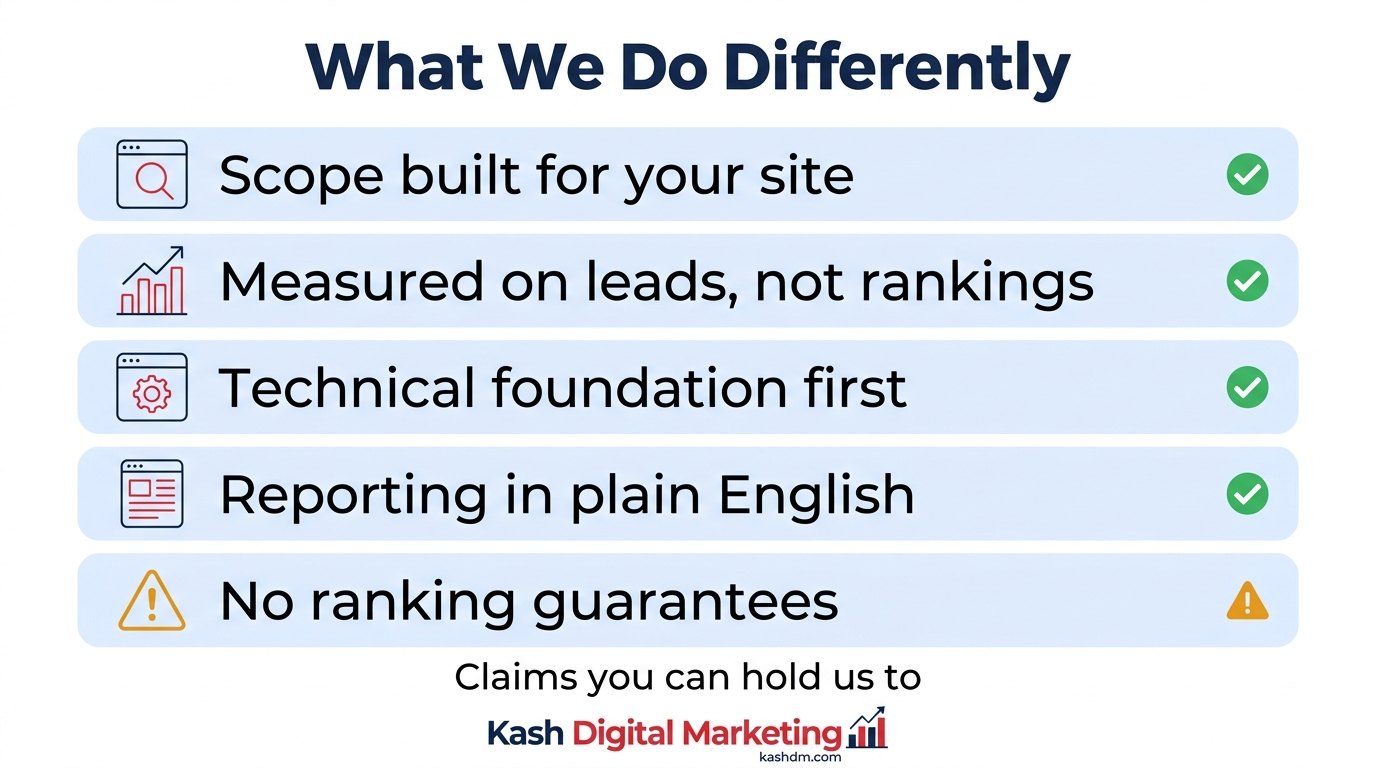
SEO Services We Provide Across Pakistan
We provide eight connected services — technical SEO, on-page SEO, keyword research, content SEO, link building, local SEO, ecommerce SEO and international SEO — and most engagements use only some of them, in a sequence that fits your site.
These are not eight products to buy separately. They are stages of one system, and the order matters more than the list. Below is what each one actually involves.
Technical SEO
Technical SEO is the work that decides whether Google can reach, render and understand your pages at all. It is unglamorous, it rarely produces a screenshot worth showing, and it is the single most common reason a site with decent content is invisible. We start here because every later investment depends on it.
- Crawl analysis: finding pages Google cannot reach, crawl traps, and wasted crawl budget
- Indexing review: which pages are indexed, which are excluded and why
- Site architecture and URL structure so important pages sit close to the homepage
- Core Web Vitals and page speed, measured on mobile over a realistic connection
- Mobile rendering and mobile-first indexing readiness
- Canonical tags, so duplicate versions of a page consolidate instead of competing
- Redirect audit: fixing chains, loops and broken 301s left behind by past redesigns
- XML sitemaps and robots.txt directives that match what you actually want indexed
- Structured data and schema markup for organisation, service, product, article, FAQ and local business
- JavaScript SEO, where content rendered client-side is not making it into the index
On-page SEO
On-page SEO is how each individual page tells Google and a reader what it is about and why it deserves the click. It is the highest-leverage work on most Pakistani SME sites, because the typical site was built by a developer with placeholder titles that were never revisited.
- Title tags written for the query and the click, not stuffed with city names
- Meta descriptions that describe the page honestly and improve click-through
- Heading structure with a single clear H1 and a logical H2 and H3 hierarchy
- Internal linking that passes relevance between related pages and rescues orphaned ones
- Image optimisation: compression, correct formats, dimensions, and descriptive alt text
- Entity optimisation, so your business, services and locations are described consistently enough for Google to connect them to known entities
Keyword research
Keyword research is deciding which searches are worth your money before anything gets written. Done properly it is a commercial exercise, not a spreadsheet of volume numbers, because a low-volume term where the searcher is ready to buy usually beats a high-volume term where they are browsing.
In Pakistan there is a specific wrinkle worth naming: commercial queries are typed in English or Roman Urdu because keyboards default to Latin script and service nouns are English, while the sales conversation that follows happens in Urdu or Saraiki. So the page is written in English, the Roman Urdu variants get worked into the Business Profile posts and supporting content, and your phone handling must be in the language your customer actually speaks.
- Commercial and transactional terms, grouped by what the searcher is trying to buy
- Informational terms that build topical authority and feed the funnel earlier
- Local terms with city, area and "near me" patterns
- Long-tail variants, usually the fastest wins for a newer site
- Competitor gap analysis showing what they rank for and you do not
- Mapping every group to a specific page, so nothing cannibalises anything else
Content SEO
Content SEO is the work of covering a topic thoroughly enough that Google treats your site as a legitimate source on it, rather than one more thin page. The structure that does this is the pillar page and topic cluster: one comprehensive page on the main subject, supported by focused pages on each sub-question, all interlinked.
E-E-A-T matters here, and for a new company it is mostly earned through demonstrated experience and clarity rather than borrowed authority. That means named authors, specific and checkable claims, real detail about how work is done, and no filler.
- Pillar page planning and topic cluster mapping
- Long-form service and location pages built around genuine search demand
- Supporting articles that answer the questions buyers ask before they buy
- Refreshing and consolidating existing pages instead of endlessly adding new ones
- FAQ sections targeting the questions that appear in the SERP itself
- Author attribution, sourcing and factual specificity to support E-E-A-T
Link building
Links still function as a vote of relevance, which is exactly why the market is full of people selling five hundred of them for a low flat fee. Those packages are cheap because directory and bookmark submissions are near-free to produce; real outreach costs money because it is human labour and the placement is not guaranteed. When a price looks impossible for the work described, the work described is not what you are getting.
Our rule is relevance first. A handful of links from sites genuinely connected to your industry or your city outperforms hundreds from a network built to sell links, and does not carry penalty risk.
- Relevance-led prospecting rather than volume targets
- Digital PR and outreach to publications in your industry or market
- Genuine local citations, chambers, trade bodies and supplier or partner listings
- Manual review of every placement site before it is approved
- No private blog networks, no bought link packages, no guaranteed-DA placements
- A running record of every link acquired, which stays yours
Local SEO
Local SEO is how you appear when someone nearby searches for what you sell and then calls, messages or walks in. In Pakistan this is the highest-return SEO work available to most businesses, for one blunt reason: the competitive floor is on the ground. Google Business Profiles here are widely claimed but shallow — no photos, no posts, no services listed, only stale reviews — so profile completeness is an unusually low bar to clear compared with Western markets. How quickly that translates into visibility varies and we cannot predict it.
- Google Business Profile claim, category selection, services, hours and full completion
- Consistent NAP details across your site, profile and every directory listing
- Local citation building on Pakistani and industry directories
- Review generation with a repeatable request process, including WhatsApp follow-up with a direct review link
- Photo and post cadence to keep the profile active
- Location landing pages with genuinely distinct content per area
- Map pack visibility tracking and call and message tracking
Ecommerce SEO
Ecommerce SEO differs from lead-generation SEO mainly in scale and structure. The money is in category and collection pages, not the homepage, and the technical risk is in navigation systems that generate thousands of near-identical URLs. Expect ecommerce work to carry a meaningful premium over an equivalent-size service site, because SKU-level templates and product description volume are genuine labour.
For Pakistani stores there is a conversion layer that sits alongside the SEO: cash-on-delivery expectations, JazzCash and Easypaisa checkout options, and the interplay with Daraz or other marketplaces where you may already be selling. Ranking a product page that then loses the sale at checkout is a wasted ranking.
- Category and collection page optimisation, treated as the primary landing pages
- Product page templates that scale without creating duplicate content
- Product, offer, review and breadcrumb schema
- Faceted navigation control so filter combinations do not flood the index
- Internal linking between categories, products and buying-guide content
- Out-of-stock and discontinued product handling
- Site search and pagination handling
International SEO
International SEO is what you need when the same site must rank in more than one country, whether you are a Pakistani exporter selling into the US and UK or a foreign business hiring a Pakistani team. Note one thing that changed in 2022: Google removed the country-targeting setting from Search Console, so there is no switch to flip. Geographic relevance now comes from your domain structure, hreflang, on-page localisation and links from the target country.
- Domain architecture decision, made before anything else is built
- hreflang implementation via head tags, HTTP headers or the XML sitemap
- Reciprocal and self-referencing hreflang tags, since a cluster where pages do not point back at each other is ignored entirely
- Correct ISO codes —
en-GBnoten-UK, and never a region code without a language x-defaultfor the fallback page- Regional landing pages with localised spelling, currency, units, dates and phone formats
- In-market link acquisition, because a
/uk/folder with only US links reads as American - No IP-based forced redirects, which stop Google crawling your other locale versions
The first decision — how to structure the domain — constrains everything after it:
| Structure | Geo signal | Authority | Cost and operations | Best when |
|---|---|---|---|---|
Subfolder (example.com/uk/) | Weaker; depends on hreflang and content | Consolidated on one domain | Lowest; fastest to launch | The default choice, and correct unless you can fund separate link building per market |
Subdomain (uk.example.com) | Weak | Often treated as a separate site; authority flows less freely | Medium | Infrastructure or platform must be separated per market |
ccTLD (example.co.uk) | Strongest; the country is unambiguous | Split — each domain starts from zero | Highest: separate hosting, legal, and link acquisition per country | Legal separation is required, or local trust materially lifts conversion |
The honest rule: if you cannot fund unique link acquisition in each market, choose subfolders. ccTLDs look impressive and quietly divide your authority into pieces too small to rank with.
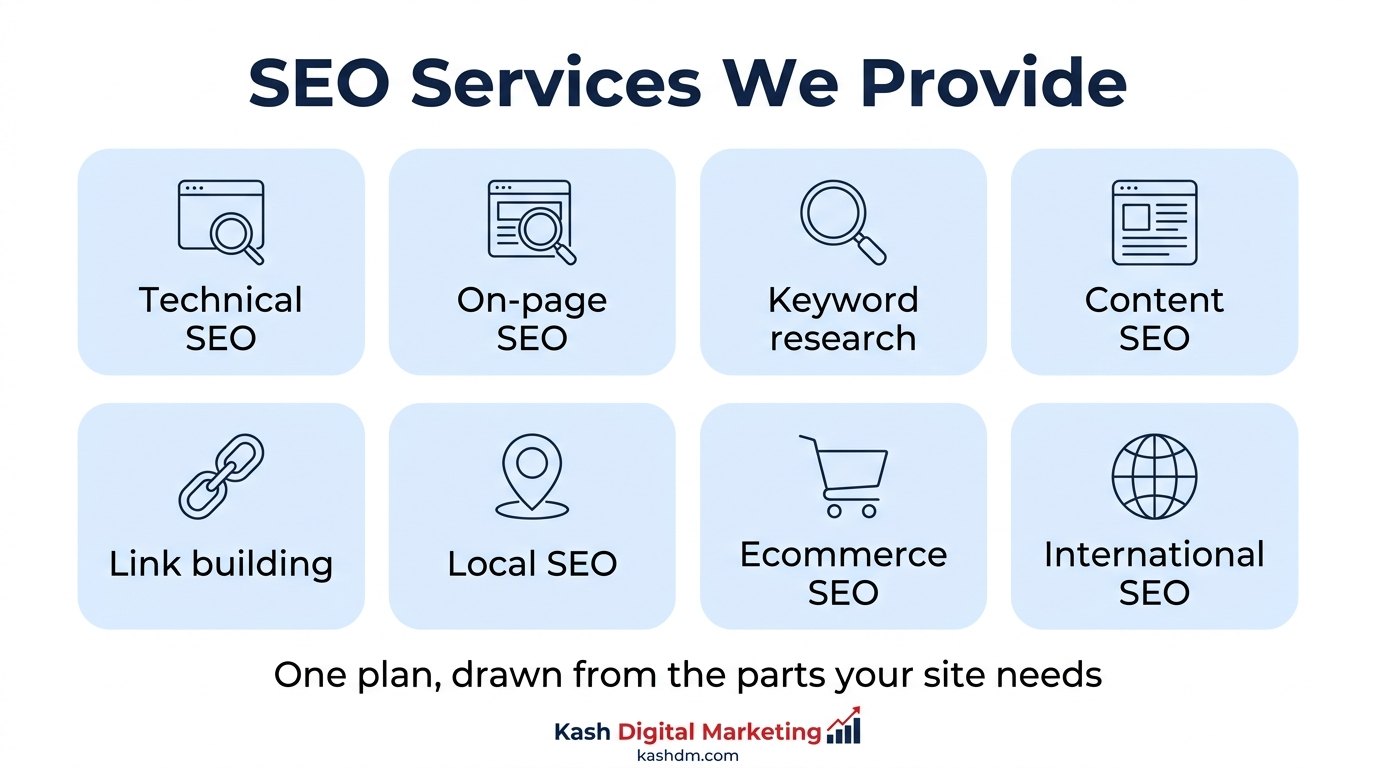
SEO Company in Bahawalpur, Punjab
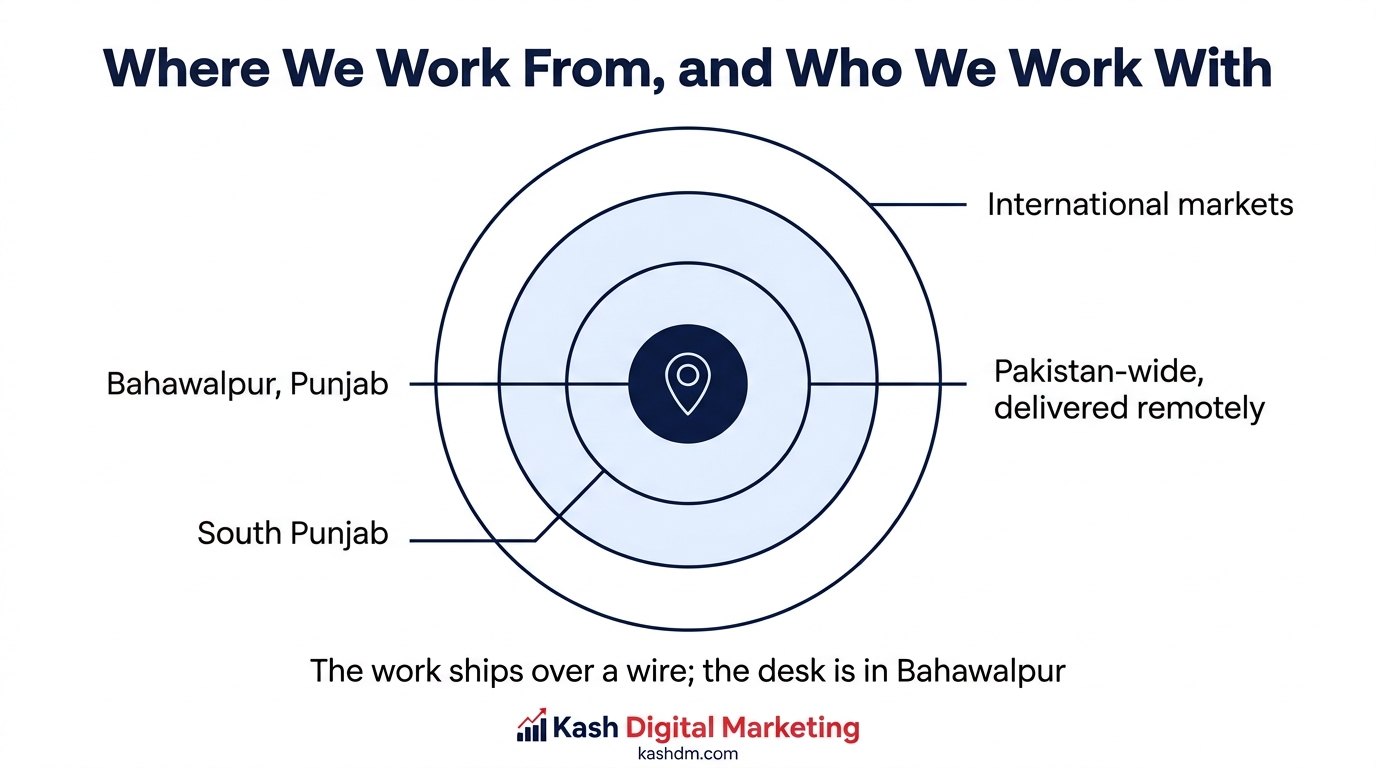
We are based in Bahawalpur, in south Punjab, and we work with businesses here, across Pakistan, and overseas — the desk is local, the delivery is remote, and the work is identical either way.
Bahawalpur city has a population of about 920,000 and sits at the head of a district of more than 4.2 million people (Pakistan Census 2023) across the largest district area in Punjab. It is the divisional headquarters for Bahawalpur, Bahawalnagar and Rahim Yar Khan. That is a real commercial catchment with very few agencies serving it properly.
Why being based in Bahawalpur matters for your project
Two things follow from a tier-2 base, and only one of them is about price.
The first is cost structure. Metro agencies carry costs a Bahawalpur desk does not: city-centre rent, metro salary bands and layers of sales commission. Compare any two published rate cards yourself and judge whether the gap reflects better work or a higher cost base. Office rent, metro salary bands and layers of sales commission are real costs, and they land in your invoice. We do not carry them. That is not a claim to be cheap — it is an explanation of where a metro premium actually comes from.
The second is that SEO is a remote-delivered service. Pakistan's IT and IT-enabled services are a substantial national export, delivered entirely over the wire (see the State Bank of Pakistan's published services-trade data for the current figures). None of that moved through a port. A page audit, a technical fix list, a content brief and a link outreach campaign are the same artefacts whether they leave a desk in Bahawalpur or one in Clifton. Where the agency sits changes the cost base, not the deliverable.
The honest caveat: local search volume in Bahawalpur is low, and local willingness to pay is lower than in the metros. If you are a Bahawalpur business, that is good news — competition for your terms is thin. If you are a Bahawalpur business hoping SEO will unlock a national customer base overnight, read Section 5 on timelines before you commit money.
Local SEO for Bahawalpur businesses
The local economy here is specific, and generic SEO advice ignores it. Agriculture engages the majority of the district population and Bahawalpur is among Punjab's largest cotton-producing districts (district profile, Punjab Bureau of Statistics) and a major market town for mangoes, dates, wheat, sugarcane and cotton. Cotton ginning and pressing is an officially recognised SMEDA industrial cluster. Around that sit the sectors that actually search: private clinics and labs feeding off the Quaid-e-Azam Medical College and Bahawal Victoria Hospital ecosystem, real estate and housing societies, hotels and Cholistan tour operators, furniture and handicraft workshops, and the enormous student economy around The Islamia University of Bahawalpur — hostels, academies, test prep, IT retail, print shops.
How search behaves here matters as much as what people search for:
- Mobile dominates. Mobile is reported at around 78% of Pakistani web traffic, and roughly 74% of mobile connections are mobile broadband (DataReportal 2025; PTA telecom indicators). Your site is judged on how it loads on a mid-range Android phone on 4G, not on your designer's laptop.
- The language split is real. Commercial queries are typed in English or Roman Urdu because keyboards default to Latin. The conversation that closes the sale happens in Urdu or Saraiki. So: English pages, Roman-Urdu variants in profile posts and reviews, and Urdu/Saraiki-capable handling on the phone.
- WhatsApp is the conversion channel. Not contact forms, not email. Which means the number needs to be tappable everywhere, and click tracking on call and WhatsApp buttons matters more than form-fill analytics.
- Google Business Profiles here are mostly empty shells. Many Pakistani profiles have no photos, no posts, no services listed and stale reviews. The competitive floor is so low that a properly filled profile with real photos, complete services, consistent NAP and an active review flow moves in the local pack far faster than the same effort would in a US city.
How we would work with a client elsewhere in Pakistan
If you are in Lahore, Karachi, Islamabad, Multan or Rahim Yar Khan, nothing about the engagement would change except your invoice. You get the same audit, the same keyword strategy, the same implementation support and the same reporting cadence. Meetings happen on WhatsApp video or Google Meet. Access to your Search Console, Analytics and Business Profile stays in your name with us added as a user.
We are also candid about what a national campaign involves. Competing for a head term in a mature vertical against Karachi and Lahore agencies with years of backlink accumulation is a long, expensive fight. For most businesses the faster route is service-plus-niche and service-plus-city long-tail terms, where intent is higher and the incumbents are thin. We will tell you which of those two your budget actually supports.
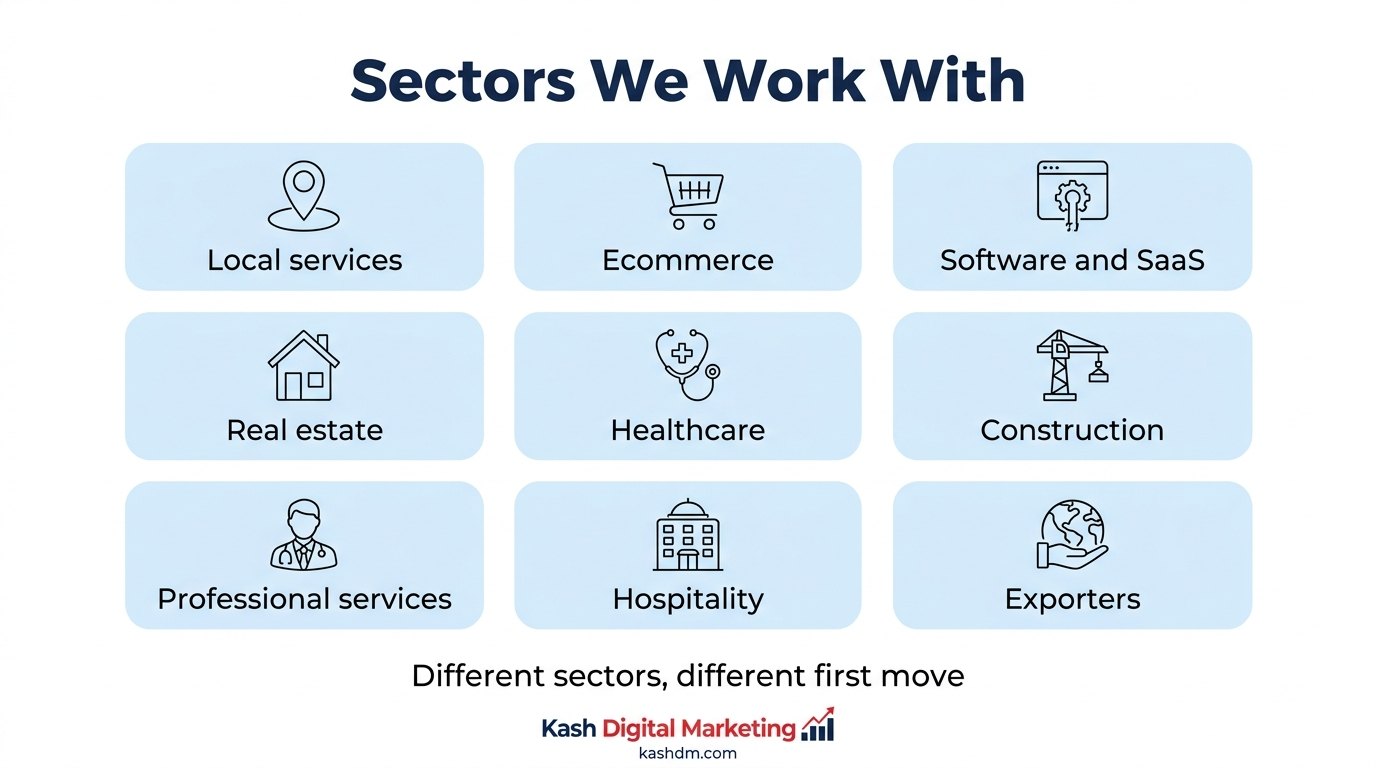
SEO for Different Types of Businesses in Pakistan
Different sectors get results from different levers first, so the sequence of work changes by business type even though the underlying method does not.
The sections below describe what the work is for each sector. They are explanations of mechanism, not accounts of past projects.
Local service businesses
Searches are short, geo-tagged and urgent: service plus city, often typed in Roman Urdu, almost always on mobile. The map pack takes most of the clicks. First lever: a complete Google Business Profile with real photos, full service list, correct categories and a steady review flow, backed by consistent NAP citations. The website matters second, mainly as a set of service pages that give the profile something to rank alongside.
Ecommerce
Pakistani shoppers compare across Daraz and independent stores, buy heavily cash-on-delivery, and often check a brand's own site after seeing it on a marketplace. First lever is almost never blog content — it is category and product page architecture, faceted navigation that does not generate thousands of crawlable junk URLs, product schema, and page speed on mobile. Checkout friction matters too: JazzCash and Easypaisa options and a visible COD promise change conversion on traffic you already have.
SaaS and software
Buyers search problems and comparisons, not brand names. Demand is usually thin domestically and much larger in export markets, so keyword research has to be done in the market you actually sell to. First lever: bottom-of-funnel comparison, alternative and use-case pages, then documentation and integration pages, which quietly rank for long-tail queries competitors ignore.
Real estate
Searches are society, sector, block and plot-size specific — a level of granularity national portals cover shallowly. First lever is a page-per-area architecture with genuinely different content on each, plus listing schema and fast image handling. Freshness matters more here than in most verticals; stale inventory pages lose rankings and trust simultaneously.
Healthcare
Patients search symptom, specialty and location, and they check reviews before booking. This is a high-stakes topic area, so authorship and credentials on the page carry weight. First lever: the Business Profile plus doctor and service pages that name qualifications, registration and clinic hours, with review generation built into the follow-up process.
Construction and contractors
Enquiries are project-shaped and expensive: a handful of leads a month can be the whole business case. Queries mix service, material and city. First lever: individual service pages by trade and material rather than one "our services" page, supported by project galleries with descriptive filenames and alt text, and a profile that shows real completed work.
Professional services and law firms
Searches are problem-first — a person describes their situation before they know what practice area it belongs to. First lever: practice-area pages that answer the problem in plain language, then an FAQ layer that captures the long tail of situation queries. Trust signals — bar registration, named lawyers, physical office — do the conversion work.
Restaurants and hospitality
Discovery happens on Maps and social, and the decision is made in minutes. First lever: profile completeness — photos, menu, hours including holiday hours, order and reservation links — plus review velocity. The website's job is menu, location and booking, loading fast on a phone with poor signal.
Pakistani businesses selling to international customers
Whether you export surgical instruments, textiles, rice, furniture, Himalayan salt or software, ranking well in Pakistan is worth nothing to you. You need pages targeted at the USA, UK, UAE, Canada or Europe, links from those countries, and content answering the questions buyers there actually type — certifications, MOQ, Incoterms, lead times, sample policy. Local-pack tactics do not transfer; a Bahawalpur or Karachi profile will not surface in Chicago. First lever is market-specific keyword research and a /us/ or /uk/ subfolder structure with correct hreflang, followed by trust engineering: verifiable entity details, named staff, and a payment path that works, since Stripe and PayPal do not serve Pakistani merchants.
Our SEO Process, Step by Step
We run six steps — discovery, audit, keyword strategy, implementation, authority growth, then measurement — and you receive a named deliverable at every one of them.
Nothing in this process is proprietary. Any agency refusing to explain its method is telling you something.
Discovery
We start by understanding what you sell, at what margin, to whom, and what a lead is worth to you. We ask what has already been tried and what went wrong. We look at your current traffic, your competitors, and whether search demand for what you sell actually exists at a useful volume. You receive a written summary of goals, target markets and success definition, plus an honest read on whether SEO is the right spend at all. Typically the first week.
SEO audit
A technical and content review of the site as it stands: crawlability, indexation, site speed on mobile, structure, internal linking, duplicate and thin content, schema, and the current backlink profile. You receive a prioritised fix list — not a 200-page automated tool export, but issues ranked by impact against effort, with the reasoning for each. This is the free audit if you have not yet engaged us; the paid version goes deeper. Usually delivered within one to two weeks.
Keyword research and strategy
We map the queries your buyers actually use, in the language they use them in, and group them by intent. Roman Urdu variants matter domestically; market-native research matters for exports. Each cluster gets assigned to a page that exists or a page that needs to be built. You receive a keyword map, a page-by-page plan and a content calendar. Weeks two to four.
Implementation
Technical fixes, on-page optimisation, page builds and structural changes. We can implement directly on your site or hand specifications to your developer — your choice, stated upfront. You receive a change log recording what was changed, when and why. This starts in month one and continues; on a mid-sized site we would plan four to eight weeks for the first pass, and we will confirm the estimate after the audit rather than before.
Authority and content growth
Ongoing publishing against the content plan, plus link acquisition through outreach, partnerships, relevant directories and digital PR. We tell you the method we are using, and you can review and reject any placement. We do not buy bulk links or use private networks, because the downside lands on your domain, not ours. You receive published content and a monthly record of every link acquired with its source. Month two onward, continuous.
Measurement and optimisation
Monthly reporting covering traffic, rankings, conversions and calls or WhatsApp clicks — not rankings alone, which are the easiest number to make look good. We review what moved, what did not, and what changes next month. You receive a monthly report and a call to walk through it. Across the industry the commonly reported range for first meaningful movement is three to six months; we have no Pakistani project history of our own to quote against that; competitive verticals take longer, and anyone telling you otherwise is selling something.
| Step | What we do | What you get | Roughly when |
|---|---|---|---|
| 1. Discovery | Understand the business, market and search demand | Written goals, target markets, honest fit assessment | Week 1 |
| 2. SEO audit | Technical, content and backlink review | Prioritised fix list with reasoning | Weeks 1–2 |
| 3. Keyword research and strategy | Map real queries to pages by intent | Keyword map, page plan, content calendar | Weeks 2–4 |
| 4. Implementation | Technical fixes, on-page work, page builds | Change log of every edit made | Month 1 onward |
| 5. Authority and content growth | Publishing plus vetted link acquisition | Published content, monthly link record | Month 2 onward |
| 6. Measurement and optimisation | Track traffic, conversions, calls and WhatsApp | Monthly report plus a review call | Monthly, ongoing |
What Makes Our SEO Strategy Different
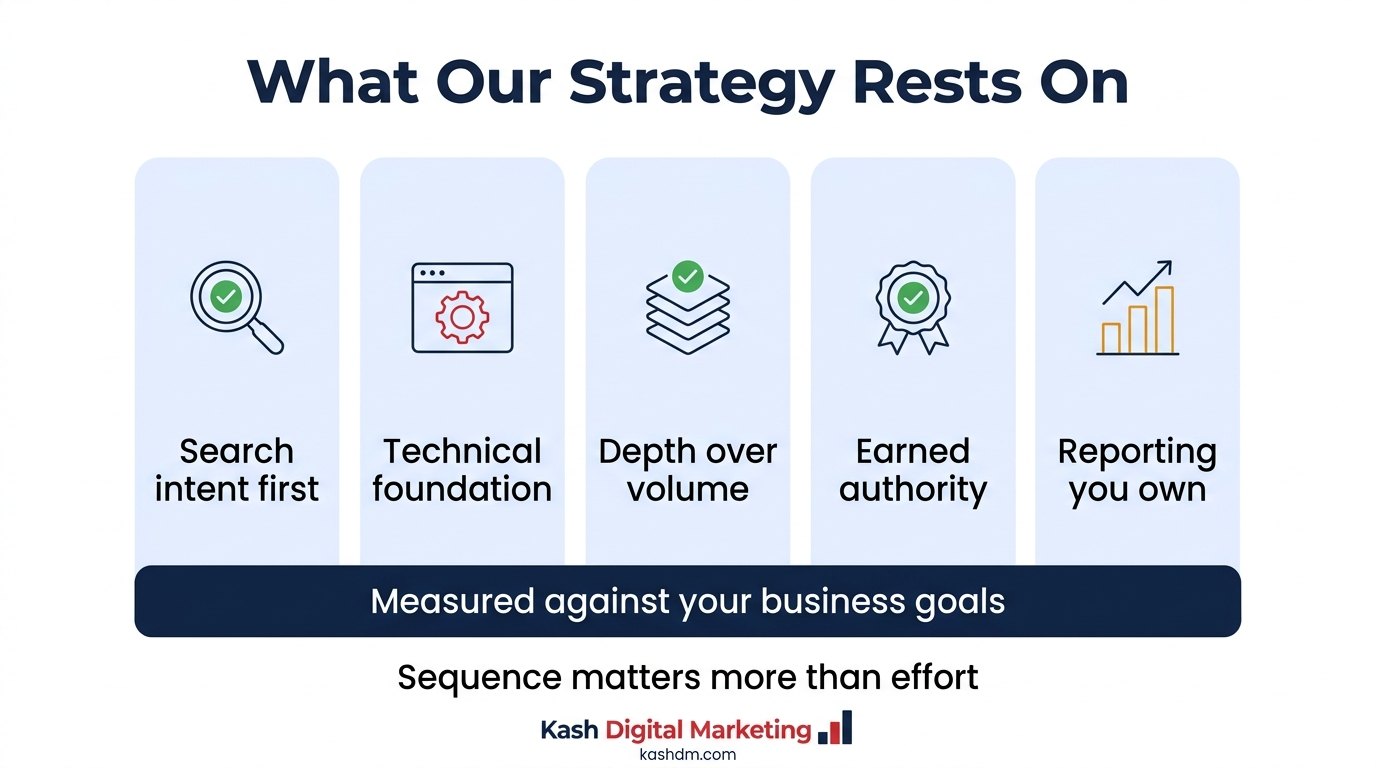
Our strategy is different in one way that matters: every decision we make is one you can check yourself, because we work on intent, technical health, depth and real authority rather than on claims you have to take on faith.
Almost every SEO page in Pakistan says "customized strategy", "data-driven" and "100% white-hat". Those words cost nothing to write. Below is what we actually do differently, stated concretely enough that you could hold any agency to it, including us.
Search intent before keyword volume
A keyword with high volume that brings people who are researching, not buying, is a bad target for most businesses. We start by sorting the terms your customers use into three buckets: people trying to understand a problem, people comparing options, and people ready to contact someone today. Ready-to-buy terms are usually low volume and get ignored by agencies who need a big number to put in a report. Those are the terms we build your money pages around first, because they convert at a rate the informational terms never will.
This matters more in Pakistan than most places. Commercial searches here are typed in English or Roman Urdu even when the conversation that follows happens in Urdu or Saraiki. If keyword research is done on English terms alone, whole pockets of demand stay invisible.
Technical foundation first
We do not publish content onto a broken site. Before writing anything, we check that Google can crawl and index your pages, that your site loads acceptably on a 4G phone connection, that there is one canonical version of each URL, that your sitemap and robots file are honest, and that nothing important is blocked. Around 78% of Pakistani web traffic is mobile (DataReportal 2025), the same figure cited in Section 1, so mobile page speed is not a refinement, it is the constraint the whole project sits on.
Technical work is unglamorous and it is where a lot of quiet damage lives: duplicate pages competing with each other, staging sites left indexed, pagination that buries products, category pages with no crawl path. Fixing these produces no headline, but content published onto a fixed foundation performs differently than content published onto a broken one.
Depth over volume in content
Publishing eight thin articles a month is easy to sell and easy to produce, and it usually does nothing. We would rather build one genuinely complete page on a topic your buyers care about than eight pages that each half-answer something. A complete page answers the primary question in the first paragraph, then handles the follow-up questions, the objections, the comparisons and the edge cases in a structure a reader can scan.
That depth also matters for AI answer engines. When a language model summarises a topic, it pulls from sources that state answers plainly and completely. Padding hurts you twice now.
Quality authority, not bulk links
We do not sell link counts. Anyone quoting you a number of backlinks per month is describing a production line, not a strategy, and the cheapest way to hit a link quota is directory submissions and private blog networks, which range from useless to actively dangerous.
What we do instead is slower and smaller in volume: earning mentions from sites that are real, relevant to your industry or your country, and that a human would recognise. You get to see and approve where links are placed. If an agency will not show you the placement list before or after, that is the whole answer to whether the links are safe.
Reporting you can actually check yourself
Here is the trust play, and it applies to us exactly as much as to anyone else you are considering.
Demand these accounts in your own name, with the agency added as a user:
- Google Search Console for your domain. This is the primary source. It shows impressions, clicks, average position, and which queries and pages produced them. It is free, it is Google's own data, and no agency can edit it.
- Google Analytics 4 on your site. Shows what visitors do after they arrive, which channel brought them, and which pages produce enquiries.
- Google Business Profile, if you have a physical location or serve a defined area. Ownership of this profile is ownership of your local visibility.
- Your domain registrar and hosting account. These should never sit only with an agency.
If any agency creates these under its own email, or refuses to give you admin access, walk away regardless of how good the pitch is. When the relationship ends you should keep the site, the content, the analytics history and the profile. We set every account up in your name from day one, and our reports point at numbers you can open in your own browser and verify line by line.
Why SEO Matters for Businesses in Pakistan
SEO matters in Pakistan because Google is where buying decisions now start, competition online is rising fast, and the businesses that own their search visibility stop paying a toll on every customer they acquire.
Pakistan has around 116 million internet users, roughly 45.7% penetration, on a telecom base of over 200 million subscribers (PTA telecom indicators, 2025; DataReportal Digital 2025 Pakistan). Survey work consistently finds a majority of consumers searching online before visiting a local shop or clinic, and SMEDA's SME reporting shows only a small minority of Pakistan's registered small enterprises have any online presence at all. We link the sources rather than ask you to take the numbers from us.
Read those two facts together and you get the actual opportunity. Demand has already moved online. Supply has not. In most Pakistani categories, the businesses competing for search visibility are a small fraction of the businesses competing for the customer.
What that means in practice:
- Local search is unusually winnable. Google Business Profiles across Pakistan are widely claimed but shallow: no photos, no posts, no services listed, only old reviews. A properly completed and maintained profile competes against profiles that are mostly empty. That is a favourable starting position, not a predicted outcome — we cannot tell you how fast Google will respond.
- Ecommerce is growing on rails that need different handling. Cash on delivery, JazzCash and Easypaisa checkout, and marketplace listings alongside your own store all change what a "conversion" looks like and how it must be tracked.
- Brand visibility compounds. Appearing repeatedly in search for the questions your buyers ask builds recognition before anyone contacts you. That shortens the sales conversation.
- You reduce dependence on paid ads. Not eliminate. Reduce. Every month you rank, you stop bidding for that traffic.
- The asset is yours. Rankings, content and reviews stay with you if you change agencies. Ad performance does not survive a stopped card.
Now the honest part. SEO is not free traffic. It is an ongoing investment of hours, and if the hours stop, the position decays as competitors keep publishing. There are also businesses for which SEO is the wrong first spend, and we will tell you if you are one of them:
- You need cash this month to stay open. SEO does not work on that horizon.
- Nobody is searching for what you sell yet, because the category is new in Pakistan and demand has to be created rather than captured.
- Your product or margin cannot absorb three to six months of spend before returns appear.
- Your website cannot take a booking, an order or an enquiry properly. Fix that first, or you are buying traffic into a leak.
- You are entirely dependent on one large contract or one relationship channel, where search plays no role.
If any of those describe you, paid ads, a fixed website problem, or simply doing nothing online for now is the better call. We would rather say that than take a retainer that cannot work.

SEO vs Google Ads in Pakistan
SEO and Google Ads solve different problems: Ads buy you visibility immediately for as long as you pay, SEO builds visibility slowly that keeps working after you stop, and most businesses in Pakistan should eventually run both.
Neither channel is a scam and neither is universally better. They differ on timing, on how cost behaves, and on what survives when the budget pauses.
| Factor | SEO | Google Ads |
|---|---|---|
| Time to visibility | Months. Meaningful movement typically begins in months three to six | Hours. Live as soon as the account is approved and funded |
| Cost behaviour over time | Front-loaded effort; cost per acquired customer tends to fall as rankings hold | Cost per click stays or rises with competition; you pay for every visit forever |
| What happens when you stop | Rankings decay gradually over months as competitors keep working | Traffic stops the same day |
| Testing speed | Slow. Weeks to learn whether a page and its angle work | Fast. Days to learn which offers, headlines and keywords convert |
| Trust and credibility | Organic results and map listings carry more perceived credibility with Pakistani buyers | Clearly labelled as sponsored; some buyers skip ads by habit |
| Best use | Steady demand you want to own long term, informational and comparison queries, local discovery | Launches, seasonal pushes, immediate lead flow, testing new services or markets before you invest in content |
The right answer for most businesses is both, in a specific order.
Start Ads first if you need enquiries now or if you do not yet know which of your services actually sells online. Two or three months of paid search will tell you which keywords convert, what people ask before buying, and what your realistic cost per lead is. That data is expensive to acquire and it makes the SEO plan far better, because you are no longer guessing which pages to build.
Then run SEO underneath the ads. As organic positions establish for a term, you can reduce paid bids on that term and move the budget to the next set. Over time the mix shifts: paid covers the terms you have not earned yet and the seasonal spikes, organic carries the steady base.
Start with SEO first only if your margins cannot support paid clicks in a competitive vertical, or if you have runway and are building a long-horizon asset rather than chasing this quarter.

How Much Does SEO Cost in Pakistan
SEO cost in Pakistan is a function of scope, not of geography, which is why published rates across the country differ by many multiples for work described with identical words.
We do not publish a price on this page, and you should be suspicious of any figure published without knowing your site. What we can do is tell you exactly which dials set the number, so that when you receive any proposal, ours included, you can tell whether it was scoped or guessed.
What drives the cost
- Competition in your vertical. This outweighs everything else. Finance, real estate and ecommerce are the most expensive categories to compete in because well-funded competitors are already working.
- Site size. Optimising ten pages and optimising a thousand-SKU catalogue are different jobs.
- Number of locations. Every location needs its own page, its own profile, its own citations and its own reviews. Multi-location is priced per location for that reason.
- Number of services. Each service you want found for needs its own page and its own keyword set.
- Content volume. The clearest linear driver anywhere in this market. Two articles a month and twenty articles a month differ by exactly the hours involved.
- Technical debt. A site that needs a migration, a rendering fix or a structural rebuild carries setup work that a clean site does not.
- Link acquisition method. Not the count, the method. Directory submissions are near-free and near-worthless. Genuine outreach and digital PR are labour, and labour is the price step.
- International targeting. Multiple markets mean hreflang implementation, localised content, market-specific keyword research and links from each target country. This is normally scoped separately from a domestic retainer.
- Ecommerce complexity. Faceted navigation, product template optimisation and description volume at scale add materially to an equivalent-sized lead generation site.
Four engagement shapes, described by scope only
Replace the table with prose: "Scope tends to cluster around four shapes — a single-location site testing whether search works at all; an established local business with several services or locations; a competitive vertical or large ecommerce catalogue; and export targeting across multiple countries. These are descriptions of situations, not tiers you buy. We scope against your six dials and quote from that."
| Starter | One location, one small site, a business testing whether search works for it | Technical audit and fixes, on-page optimisation of your core pages, Google Business Profile setup and optimisation, a small steady content cadence, monthly reporting from your own Search Console |
|---|---|---|
| Growth | Established local or regional businesses with several services or a second location | Full technical programme, on-page across the service and location set, competitor analysis, a higher content cadence, local citations and review process, earned links with placement approval, monthly call |
| Advanced | Competitive verticals, larger sites, or ecommerce catalogues | Ongoing technical engineering, category and product template work, substantial monthly content, structured internal linking at scale, outreach-based authority building, conversion tracking across calls, forms and WhatsApp |
| International | Pakistani exporters selling into the US, UK, Gulf, Canada or Australia, and overseas businesses buying delivery from Pakistan | Market and domain architecture decision, hreflang implementation and validation, locale-specific keyword research rather than translated keywords, localised content and currency/format handling, in-market link acquisition, overlap-hours account handling |
Ask any agency for a scope-based proposal. It should name the pages being worked on, the content quantity, the link method, who does the work, the reporting cadence, and what is excluded. If a proposal cannot survive the question "what exactly will you do in month two", it is a price with no plan behind it.
Red flags in a suspiciously cheap offer
- A guaranteed ranking, a guaranteed position, or a guaranteed timeframe. Nobody has access to the algorithm.
- "First page guaranteed" without defining organic, map pack, or paid in writing.
- A promised number of backlinks, especially a large one, with no right to see or reject the placements.
- "Proprietary" or "secret" methodology. Refusing to explain the work is a disqualifier, not a moat.
- Accounts created under the agency's own email rather than yours.
- Reports containing keyword positions only, with no traffic, enquiry or revenue line.
- A retainer smaller than the cost of the hours it claims to buy. If a package promises eight articles, technical fixes and outreach for less than a few days of one person's time, the arithmetic does not close, and the gap is being filled by automation or spun content.
How Long Does SEO Take in Pakistan
The commonly reported industry range for first meaningful organic movement is month three to month six, and nothing about Pakistan changes that materially. We have no client history of our own to quote here., with local search often moving faster and competitive national terms taking considerably longer.
Here is what actually happens, month by month, and what a healthy project looks like at each checkpoint.
Month 1 — foundation and diagnosis. Full technical audit, crawl and index review, Search Console and Analytics set up in your name, Google Business Profile claimed and completed, keyword and intent mapping, competitor analysis, and the first round of technical fixes. Almost nothing visible happens in rankings this month, and that is normal. A healthy month one ends with you holding a documented list of what is broken, what will be built, and in what order.
Months 2 to 3 — building and first signals. Core pages get rewritten or built, internal linking gets structured, content begins publishing on cadence, citations and reviews start accumulating. Local results are the ones most likely to appear first, because Google Business Profile improvements can surface within weeks when the local competition is as shallow as it typically is in Pakistan. Organically, you should see impressions rising in Search Console and long-tail terms entering the top fifty before you see traffic. A healthy month three shows impression growth and new ranking keywords, even if clicks are still modest.
Months 4 to 6 and beyond — traffic and enquiries. Pages that were published in months two and three begin maturing. Positions move from page three to page two to page one on the easier terms. Traffic becomes visible and enquiries follow. A healthy month six shows a clear upward trend in clicks, commercial terms climbing rather than flat, and at least anecdotal evidence of enquiries citing search. How far they climb depends on your vertical and we will not put a position or a date on it. If nothing has moved at all by month six on a project that started with a clean brief, something is wrong and you should be asking hard questions.
Beyond six months — compounding. Established pages earn links passively, topical authority makes each new page rank faster than the last, and the work shifts from building to defending and expanding. This is where the economics turn in your favour, and it is also the point at which most businesses that quit too early would have started seeing returns.
Variables that change the timeline
- Domain age and existing authority. A brand-new domain starts slower than an established one.
- Competition in your vertical. Real estate and finance take longer than a niche local service.
- Geographic scope. Local beats city beats national beats international, every time, on speed.
- Starting technical condition. A site needing a migration loses weeks before content can even help.
- Content velocity you can support. More published, faster, moves faster.
- Whether you implement. Recommendations that sit in a document do nothing.
- Algorithm updates, which arrive without warning and can reset a quarter's progress in either direction.
We do not give guaranteed timelines, and here is why. Nobody outside Google can see the ranking system, nobody controls what competitors publish next month, and nobody knows when the next core update lands. Anyone handing you a date is either guessing, or targeting keywords with no search volume so the guess is safe, or planning to do something to your site you would not approve of. What we will commit to is the work: the audit, the fixes, the content, the outreach, the reporting cadence, and a straight answer at every checkpoint about whether the project is tracking or not. That is the part we control, so that is the part we will put in writing.
Results, Proof and Why We Do Not Show Case Studies Yet
We do not publish case studies because we are a new company and have not earned any yet, and inventing them would make us exactly the kind of agency this page is warning you about.
Most competing pages you have opened today show traffic graphs, percentage lifts and client logos. Almost none of them can be checked. We would rather lose the sale than fake the proof.
Why we are not showing you numbers
Three reasons, in order of honesty. First, Kash Digital Marketing is new to the Pakistani market. We run kashdm.com and we do this work, but we do not have a shelf of finished Pakistani campaigns to point at, and we are not going to pretend otherwise. Second, real client work is confidential by default. A client who hires us to outrank a competitor does not want that competitor reading about it on our website, so any future case study will be published only with written permission. Third, screenshots are worthless as evidence. An analytics graph with no domain visible, no date range and no attribution is a picture, not a proof. In this market that picture is often borrowed, cropped or simply invented, and buyers have no way to test it. Treat unverifiable numbers as noise regardless of who is showing them to you, including us.
How to verify any SEO agency's claims before you hire them
Ask for the live URL of the site they are claiming the result for. If they cannot name it, the claim does not exist. Then put that domain and the claimed keyword into any rank tracker or an incognito search yourself and see where it actually sits today. Ask for read-only Google Search Console access on a current project, even for ten minutes on a screen share; an agency doing real work has nothing to hide in there. Ask what they actually did versus what the client already had, because an agency that inherited a ten-year-old domain with an established backlink profile did not build that authority. And check whether the growth predates the engagement by looking at the date the contract started against the date the curve turned up. A large share of published SEO results are seasonal recovery, a brand campaign, or a site that was already climbing.
Ask us the same questions. Ask any agency to explain their method in plain language, and walk away from "proprietary".

What we will report to you instead
You get accounts you own and a reporting rhythm you can audit. Google Analytics 4, Google Search Console and Google Business Profile are created under your email, with us added as users. If we part ways, you change one permission and keep everything.
- Monthly report covering organic sessions, impressions and clicks from Search Console, keyword position movement for your tracked terms, and conversions defined as calls, WhatsApp clicks and form submissions, not just rankings.
- Monthly work log listing what was changed, on which page, on which date, plus every link placement with the live URL so you can inspect it.
- Direct access to the source data — Search Console, Analytics and Business Profile are in your name, so you can look at exactly what we look at, any day, without waiting for a report.
- A call to walk the report, because a PDF you do not understand is not transparency.
What realistic progress looks like
SEO moves in stages, and the early stages are invisible in your revenue line. In the first weeks the work is technical and structural: crawl and indexing fixes, site speed, page structure, and a Google Business Profile filled out properly. The first signal you should see is more of your pages indexed and impressions rising for terms you never used to appear for at all, well before clicks follow. Next, long-tail and low-competition queries start converting, and local map pack visibility usually moves earlier than national organic. Then your core commercial terms begin climbing, which is slow and non-linear, with visible drops along the way. Only after that does organic become a channel you can forecast against. If your business cannot survive several months of building before the revenue arrives, SEO is the wrong spend right now and we will tell you so.
Industries We Work In
We will take on any business whose customers search before they buy. The table below is which lever we would pull first in each sector, not a list of accounts we hold.
| Industry | Primary SEO lever |
|---|---|
| Local businesses (retail, salons, repair, auto) | Google Business Profile depth, reviews, and city-level service pages |
| Ecommerce | Category and product page structure, faceted navigation control, and buying-intent content |
| SaaS | Problem-aware content clusters, comparison and alternative pages, and free-tool pages |
| Real estate and housing societies | Society, project and area landing pages with genuine local detail |
| Healthcare, clinics and labs | Condition and treatment pages, doctor entity pages, and map pack visibility |
| Construction and contracting | Service-plus-area pages, project galleries, and quote-request conversion paths |
| Legal and professional services | Practice-area depth, author credibility signals, and consultation intent pages |
| Home services | Emergency and same-day intent terms, call and WhatsApp tracking, and service-area coverage |
| Hospitality and tourism | Destination and stay content, review velocity, and booking-intent queries |
| Education, schools and academies | Course, admission and result pages, plus parent-question content |
| Manufacturing, agri-trade and exporters | Product and specification pages, certification and MOQ content, B2B buyer intent |
| International businesses | Correct domain structure, hreflang, localized keyword research, and in-market links |
If your sector is not listed, the question we will ask is simply whether people search for what you sell in enough volume to be worth the work.
Why You Might Choose Kash Digital Marketing
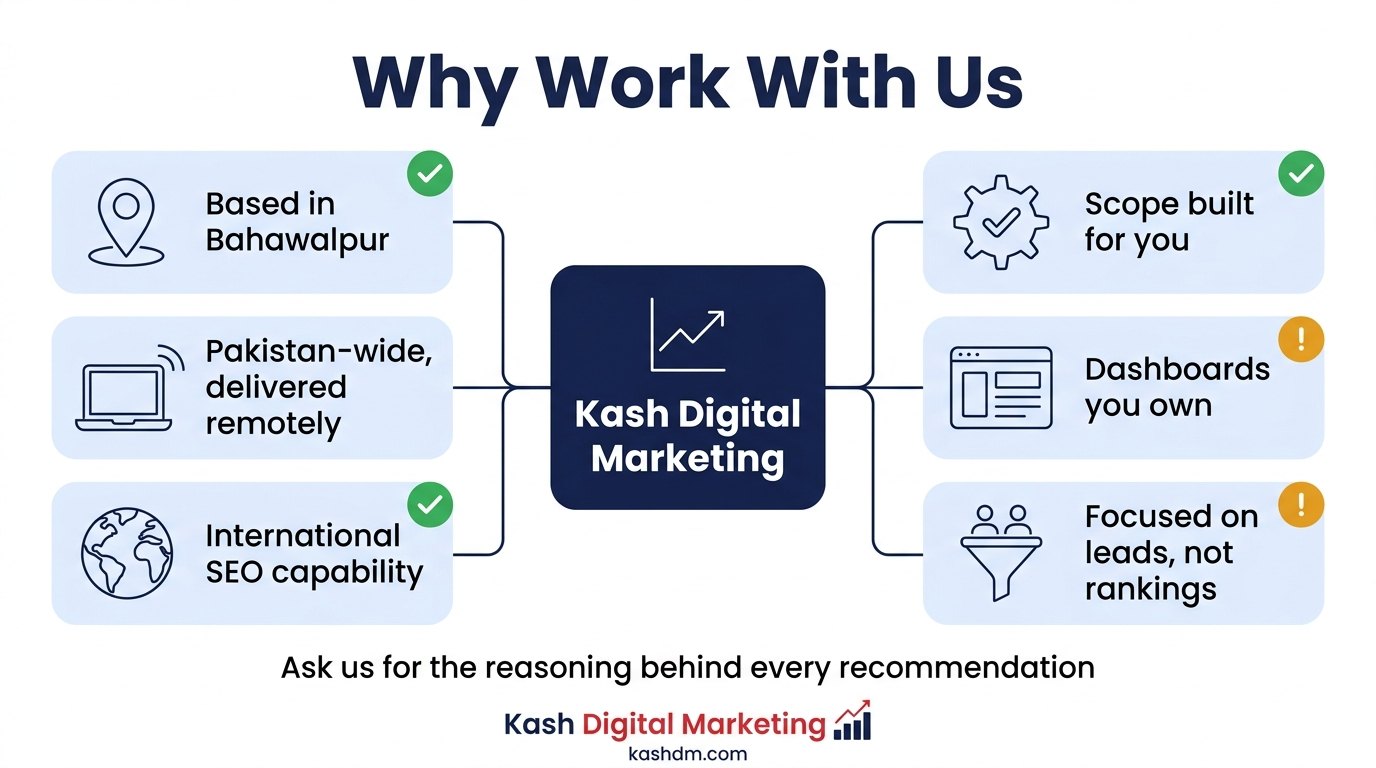
The case for us is narrow and checkable: we are local, we are open about being new, and we structure the engagement so you keep control of everything we build.
We are actually based in Bahawalpur, and you can verify it
Add the street address and a Google Business Profile link beneath this heading so the claim is checkable rather than asserted.
We sit in Bahawalpur, Punjab, Pakistan. Not a virtual office, not a city page templated by an agency in another country. We understand Saraiki and Urdu sales conversations, WhatsApp-first buyers, cash-on-delivery behaviour and the difference between how a Bahawalpur customer searches and how a Karachi customer searches.
Pakistan-wide reach
SEO delivery is remote by nature. We serve businesses in Lahore, Karachi, Islamabad, Multan, Faisalabad, Rahim Yar Khan and anywhere else in Pakistan on exactly the same terms, because the work happens in your Search Console, not in our office.
International capability
We run kashdm.com ourselves against the US local market, so hreflang, subfolder versus ccTLD decisions, locale spelling and currency handling and in-market link acquisition are things we have implemented on our own property. That is one site, ours, and you can inspect it. Overlap hours with UK, Gulf, US and Australian clients are agreed in writing before we start.
Custom scope, not a forced package
We do not sell a bronze, silver and gold ladder. Your price is a function of six things: how competitive your vertical is, how many locations or markets you target, the technical condition of your site, how much content you need each month, whether links come from submissions or real outreach, and how complex your platform is. We tell you which of those dials your situation turns, and you decide which ones to fund.
Transparent reporting
The accounts are yours, the work log is itemized, and every link we place is a URL you can open. You will never get a report that shows only keyword positions.
Business-focused SEO
Rankings are a means. What we optimize toward is calls, WhatsApp conversations, form submissions and orders. If a keyword ranks and produces nothing, we say so and move the effort somewhere else.
Frequently Asked Questions
These are the questions Pakistani business owners actually ask before hiring an SEO company, answered without sales language.
What is an SEO company in Pakistan?
An SEO company in Pakistan is a firm that improves how your website performs in Google's organic results, operating from Pakistan and billing in PKR or foreign currency. Most are concentrated in Karachi, Lahore and Islamabad, though delivery is entirely remote. The work is the same discipline practised worldwide; the difference is cost base, not method.
What does an SEO company do?
An SEO company fixes the technical foundation of your site, improves your pages for the terms your customers search, publishes content that earns rankings, builds links from other websites, and manages your local presence. It also measures the result and reports it. Anything described as secret or proprietary is a warning sign, not a service.
How much do SEO services cost in Pakistan?
There is no single Pakistani SEO price, because price is a function of scope. Published rates across the market differ by many multiples for the same label, which tells you the label means nothing. What actually sets your cost is your competition level, number of locations, technical starting condition, monthly content volume, link method and platform complexity. We quote after the audit, once we know which of those apply to you.
How long does SEO take to show results in Pakistan?
Expect months, not weeks, for commercial terms. Technical and indexing improvements can show within weeks, and local map pack visibility often moves earliest because most Pakistani Google Business Profiles are barely filled in. Competitive national keywords take considerably longer and progress unevenly. Anyone promising fast results on hard terms is either targeting keywords nobody searches or taking risks with your domain.
What are the best SEO services in Pakistan?
The best SEO service is the one matched to your bottleneck, not the one with the longest package list. A site with crawl and speed problems needs technical work first; a site with traffic but no enquiries needs conversion and intent work; a local business usually needs Google Business Profile and reviews before anything else. Be sceptical of every "best in Pakistan" claim, including on ranking pages, since every competitor makes it.
How do I choose an SEO company in Pakistan?
Choose on verifiability and clarity, not on badges. Ask for a live client URL you can check yourself, ask for read access to a real Search Console property, ask exactly who does the work and whether it is subcontracted, and ask for the deliverables list in writing. Disqualify any agency that guarantees a ranking, refuses to explain its method, or wants to own your analytics accounts.
Is SEO worth it for a Pakistani business?
SEO is worth it if your customers search online before buying and you can wait several months for compounding returns. It is not worth it if you need cash this month, sell something nobody searches for, or cannot fund consistent work for at least two quarters. In those cases paid ads or direct sales will serve you better, and we will say so rather than take the retainer.
Can an SEO company in Pakistan help me rank internationally?
Yes, and delivery location does not affect rankings in the target country. What matters is correct domain structure, valid hreflang, keyword research done natively for that market rather than translated, locale-correct currency and spelling, and links from websites in that country. Pakistani agencies as a sector already service UK, US, Gulf and Australian clients on exactly this basis. We are new and do not yet have overseas clients of our own to point to.
Do you provide local SEO?
Yes. Local SEO is generally the fastest-moving part of the discipline in Pakistan, which is why we would usually start there. It covers Google Business Profile optimization with real photos, services and posts, consistent name, address and phone details across directories, review generation, and city or area landing pages. The competitive floor for local search here is low because most profiles are effectively empty.
Do you provide SEO services in Bahawalpur?
Yes. Bahawalpur is where we are based, so if you are local you can have in-person meetings. We are set up to work with retail, clinics, real estate, education, hospitality and agri-trade businesses across Bahawalpur Division, including Bahawalnagar and Rahim Yar Khan. To be clear, we are new and do not yet have clients in those sectors to name. Local search competition here appears thin, which should mean less work is needed to compete than in a metro city. That is our reading of the market, not a measured result.
Do you work with businesses outside Pakistan?
Yes. kashdm.com is our own US-market site, which we build and rank ourselves; it is our demonstration of the method rather than a client roster. For an overseas client we would agree an overlap window in writing, keep all accounts in your ownership, and accept payment through Payoneer, Wise or direct bank transfer, since Stripe and PayPal do not support Pakistani merchants. Governing law can be your jurisdiction if that removes an objection.
Does SEO help ecommerce businesses in Pakistan?
Yes, though ecommerce SEO is more work than an equivalent lead-generation site because of product and category page volume and faceted navigation. The Pakistani specifics matter: cash-on-delivery expectations, JazzCash and Easypaisa at checkout, WhatsApp order handling, and how your own site competes with your Daraz listings. Those affect conversion as much as ranking does.
Do you guarantee Google rankings?
No legitimate SEO company can guarantee a specific Google ranking, because nobody outside Google controls the algorithm. Any agency guaranteeing a position is either targeting keywords with no search volume, using tactics that can get your site penalised, or quietly counting a paid ad or an obscure directory as "page one". What we commit to instead is the work itself: the audit, the fixes, the content and link volume, the reporting cadence, and the response times, all written down and all measurable against traffic, enquiries and sales.
How do I get started?
Send us your website URL and the terms you want to rank for, by WhatsApp or email. We acknowledge within one working day and send the completed audit within three working days. If the audit shows SEO is not your best next spend, we will tell you that instead of selling you a retainer.
Ready to Grow Your Business With SEO
Request Your Free SEO Audit
Prefer to talk it through? WhatsApp US +2135622433 or WhatsApp PK +92 348 3879366. We usually reply within an hour, and always within 8 hours.
Send us your website and we will send back a free SEO audit within three working days, with no obligation to hire us.
We are Kash Digital Marketing, based in Bahawalpur, Punjab, Pakistan, working with businesses across Pakistan and internationally.
The audit tells you where you currently rank for your main terms, the technical issues blocking your pages, how your Google Business Profile compares to the businesses beating you locally, what your visible competitors are doing that you are not, and the three things we would fix first and why. It is a document you can hand to any other agency and use. There is no call requirement, no contract, and no follow-up sequence.
- WhatsApp (Pakistan): +92 348 3879366
- WhatsApp (US): +2135622433
- Email: [email protected]
Tell us your website, your city, and what you sell. That is enough for us to start.